




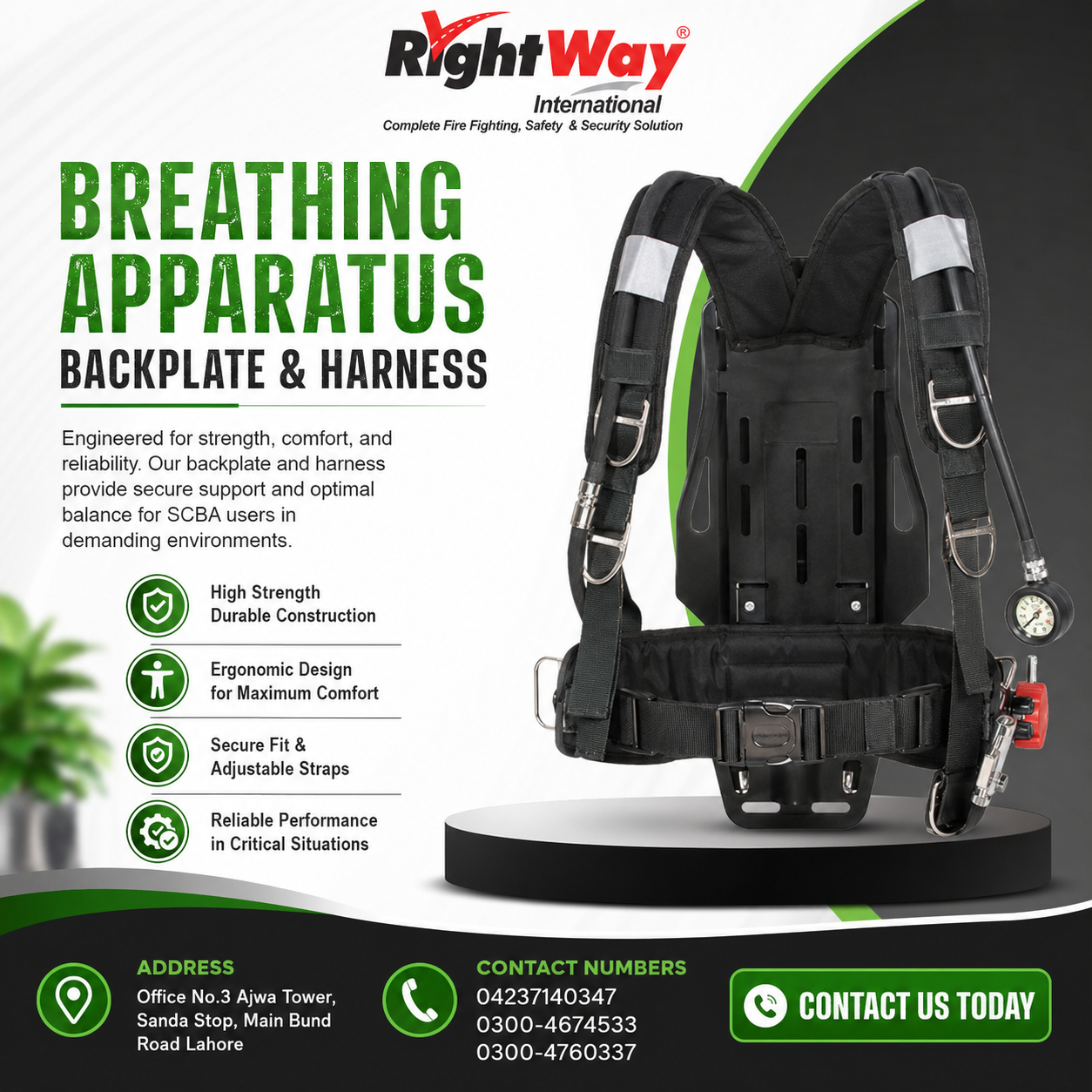
Breathing Apparatus Backplate and Harness is an essential component of a Self-Contained Breathing Apparatus (SCBA). It provides the structural support required to carry and secure the breathing-air cylinder on the user’s back. At the same time, it helps distribute the equipment’s weight during firefighting, rescue, and industrial emergency operations.
The backplate forms the main supporting structure of the SCBA carrying system. Meanwhile, the harness uses adjustable shoulder straps, waist straps, buckles, and other securing components to keep the equipment properly positioned. Together, these components help the wearer maintain stability and mobility during demanding operations.
Furthermore, a properly designed SCBA backplate and harness can improve equipment stability, wearer comfort, mobility, and operational efficiency. However, the backplate and harness remain components of an approved SCBA system. Therefore, users must always follow the manufacturer’s specifications and instructions.
What Is a Breathing Apparatus Backplate and Harness?
A Breathing Apparatus Backplate and Harness is the carrying and support assembly that secures an SCBA cylinder and associated components to the wearer.
The backplate provides the primary structural support for the breathing apparatus. Usually, it sits against the user’s back and connects to the cylinder mounting mechanism.
Meanwhile, the harness connects the backplate to the wearer through shoulder straps and, depending on the design, waist or hip straps.
During operation, the harness distributes the equipment load across the shoulders, back, and hips. As a result, it helps maintain the correct position of the SCBA while the wearer moves, bends, climbs, crawls, or performs emergency-response activities.
How Does an SCBA Backplate and Harness Work?
The SCBA backplate and harness work together as a carrying and support system.
First, the user securely mounts the breathing-air cylinder onto the backplate using the approved cylinder retention mechanism. Next, the wearer places the apparatus onto the back.
After that, the wearer adjusts the shoulder straps to position the backplate correctly. Where applicable, the wearer also adjusts the waist or hip strap to improve stability and distribute the equipment load.
Once the wearer correctly adjusts the harness, it helps minimize unnecessary movement of the SCBA assembly during operation.
Additionally, the breathing-air cylinder, pressure regulator, demand valve, face piece, pressure gauge, and other components connect according to the specific SCBA design.
Because manufacturers use different configurations, users must treat the backplate, harness, cylinder, regulator, face piece, and other components as one compatible SCBA system.
Main Components of an SCBA Backplate and Harness
A typical SCBA Backplate and Harness Assembly may include:
- SCBA backplate
- Cylinder mounting system
- Cylinder retention strap
- Cylinder locking mechanism
- Shoulder straps
- Waist strap
- Hip belt where applicable
- Chest strap where applicable
- Adjustable buckles
- Quick-release buckles
- Harness padding
- Shoulder padding
- Waist padding
- Carrying handle
- Regulator hose routing points
- Accessory attachment points
- Pressure-gauge support points
- Low-pressure hose routing
- Manufacturer-specific mounting components
However, the exact design varies according to the SCBA manufacturer, model, cylinder configuration, and intended application.
Therefore, buyers should select replacement backplates, harnesses, straps, buckles, and mounting components according to the exact SCBA specifications.
What Is an SCBA Backplate?
An SCBA Backplate is the rigid or semi-rigid supporting structure that carries the breathing-air cylinder and connects the cylinder assembly to the wearer.
The backplate provides stability and distributes the equipment load through the harness system. In addition, its design helps keep the cylinder positioned correctly against the wearer’s back.
Modern SCBA manufacturers may produce backplates from durable engineering polymers, composite materials, reinforced materials, or other approved materials.
Furthermore, a suitable backplate should provide sufficient strength for its intended environment while remaining practical for firefighters and emergency responders.
What Is an SCBA Harness?
An SCBA Harness is the adjustable strap system that secures the backplate and cylinder assembly to the wearer.
The harness commonly includes shoulder straps. Depending on the SCBA model, it may also include waist straps, hip belts, chest straps, or other adjustment components.
The wearer adjusts these straps to achieve a secure and comfortable fit.
Moreover, a properly adjusted harness can minimize unwanted SCBA movement during emergency operations and improve overall equipment stability.
However, users should avoid excessive strap tension. Instead, they should follow the manufacturer’s recommended adjustment procedure.
Types of SCBA Harness Systems
SCBA manufacturers use different harness configurations according to their equipment designs.
Common SCBA harness designs include:
- Standard shoulder harness
- Padded shoulder harness
- Adjustable shoulder harness
- Waist-support harness
- Hip-belt harness
- Five-point harness
- Six-point harness
- Quick-release harness
- Heavy-duty firefighter harness
- Ergonomic SCBA harness
- Textile harness
- Heat-resistant harness
- Chemical-resistant harness
- Modular SCBA harness
The appropriate configuration depends on the specific SCBA model and its certification.
Therefore, users should always verify compatibility before purchasing or replacing an SCBA harness.
SCBA Backplate Design
The SCBA backplate supports the breathing-air cylinder while allowing the wearer to move during emergency operations.
Manufacturers consider several factors when designing an SCBA backplate, including:
- Structural strength
- Weight
- Cylinder compatibility
- Harness attachment points
- Ergonomic design
- Load distribution
- Cylinder retention
- Durability
- Resistance to environmental conditions
- Ease of adjustment
- Manufacturer-specific connections
An ergonomic backplate can keep the cylinder close to the wearer’s body. Consequently, this design can reduce unnecessary equipment movement and help the wearer maintain better balance during demanding operations.
SCBA Cylinder Mounting System
One of the most important functions of the breathing apparatus backplate involves securing the breathing-air cylinder.
Manufacturers may use a retention strap, locking mechanism, clamp, or another approved cylinder mounting arrangement to secure the cylinder.
However, the mounting system must match the cylinder dimensions and the specific SCBA model.
Before operation, trained users should confirm that the cylinder sits securely and that the retention mechanism works correctly.
A loose or incorrectly mounted cylinder can create a serious safety and operational concern. Therefore, users should never ignore problems with the cylinder mounting system.
SCBA Shoulder Straps
SCBA Shoulder Straps connect the backplate to the wearer’s shoulders.
These straps normally include adjustable sections that allow the user to position the breathing apparatus correctly.
Additionally, padded shoulder straps can improve comfort when users wear SCBA equipment for extended periods.
Users should regularly inspect the shoulder straps for:
- Cuts
- Tears
- Fraying
- Damaged stitching
- Broken buckles
- Deformation
- Contamination
- Loose connections
If users find damaged harness components, they should follow the manufacturer’s approved replacement procedures.
SCBA Waist and Hip Harness
Some SCBA systems include a waist strap or hip belt to improve equipment stability and distribute part of the load away from the shoulders.
When properly adjusted, a waist or hip harness can help keep the backplate close to the wearer’s body.
As a result, this arrangement can provide additional stability during:
- Firefighting
- Stair climbing
- Rescue operations
- Crawling
- Confined-space entry
- Industrial emergency response
- Hazardous-material operations
However, harness configurations vary between SCBA models. Therefore, users should follow the specific manufacturer’s fitting instructions.
Benefits of an SCBA Backplate and Harness
A suitable Breathing Apparatus Backplate and Harness can provide several practical benefits.
These benefits may include:
- Secure cylinder support
- Improved SCBA stability
- Adjustable fitting
- Better load distribution
- Enhanced wearer mobility
- Ergonomic carrying design
- Reduced unnecessary equipment movement
- Secure harness attachment
- Support during emergency operations
- Comfortable positioning when correctly adjusted
- Durable construction
- Compatibility with approved SCBA components
- Easier equipment handling
- Support for professional firefighting applications
Furthermore, proper fitting, regular maintenance, appropriate training, and manufacturer-approved use all contribute to reliable SCBA performance.
SCBA Backplate and Harness for Firefighters
Firefighters commonly wear SCBA equipment while operating in smoke-filled buildings, industrial fire environments, rescue locations, and other hazardous atmospheres.
During these operations, the breathing apparatus must remain securely positioned while the firefighter climbs stairs, crawls through confined areas, carries equipment, operates fire hoses, or performs rescue activities.
The SCBA backplate and harness secure the cylinder and associated breathing-air equipment against the wearer.
Moreover, a correctly adjusted harness can improve equipment stability and help firefighters move more effectively.
For this reason, firefighters should receive appropriate SCBA training. They should also follow their organization’s inspection, fitting, maintenance, and operational procedures.
SCBA Backplate and Harness for Industrial Applications
SCBA Backplate and Harness Systems also support trained personnel in industrial emergency-response environments.
Common applications include:
- Chemical plants
- Oil and gas facilities
- Refineries
- Petrochemical facilities
- Manufacturing plants
- Power plants
- Industrial emergency-response teams
- Confined-space rescue
- Hazardous-material response
- Fire and rescue operations
- Industrial maintenance emergencies
- Emergency evacuation
- Rescue operations
- Storage facilities
- Process industries
However, the appropriate application depends on the hazards present and the approval of the complete SCBA system.
Therefore, organizations should select respiratory-protection equipment after evaluating workplace hazards and applicable requirements.
SCBA Backplate Materials
SCBA manufacturers use different materials for backplates depending on the design and intended application.
Common material categories include:
- High-strength engineering polymers
- Reinforced polymers
- Composite materials
- Lightweight structural materials
- Heat-resistant materials
- Chemical-resistant materials
- Manufacturer-specific reinforced materials
Material selection can affect the backplate’s weight, strength, durability, heat resistance, chemical resistance, and overall performance.
Therefore, buyers should review the manufacturer’s technical specifications instead of selecting a backplate based only on its material or appearance.
SCBA Backplate and Harness Maintenance
Regular inspection and maintenance play an important role in maintaining an SCBA Backplate and Harness.
Before use, trained personnel should inspect:
- Backplate
- Shoulder straps
- Waist straps
- Hip belt
- Buckles
- Quick-release mechanisms
- Cylinder retention strap
- Cylinder locking mechanism
- Harness stitching
- Padding
- Mounting points
- Hose routing
- Structural components
- Carrying handle
During inspection, users should look for cracks, cuts, deformation, broken components, excessive wear, contamination, loose fittings, damaged stitching, or other visible defects.
In addition, users should clean the equipment according to the manufacturer’s procedures.
They should avoid harsh chemicals, solvents, excessive heat, or unauthorized cleaning methods because these substances or methods may damage the backplate or harness materials.
SCBA Backplate and Harness Inspection
A proper SCBA Backplate Inspection should form part of the organization’s overall SCBA inspection program.
During inspection, trained personnel should verify that:
- The backplate remains structurally intact.
- The cylinder mounting system operates correctly.
- The retention strap remains secure.
- The harness straps remain undamaged.
- The buckles operate correctly.
- The quick-release mechanisms function correctly.
- The stitching remains intact.
- The padding remains in acceptable condition.
- The equipment contains no unauthorized modifications.
- All components remain compatible with the approved SCBA system.
If users find damage or a condition outside the manufacturer’s acceptance criteria, they should remove the equipment from service according to established procedures.
SCBA Harness Fit and Adjustment
Correct SCBA Harness Fit helps improve comfort, stability, and equipment positioning.
First, the wearer should position the backplate correctly against the back.
Next, the wearer should adjust the shoulder straps according to the manufacturer’s recommended procedure.
If the SCBA includes a waist or hip belt, the wearer should adjust it appropriately as well.
The harness should hold the equipment securely without unnecessarily restricting movement.
However, an incorrectly adjusted harness can cause discomfort, excessive equipment movement, or poor load distribution.
Therefore, organizations should train users to properly don, adjust, inspect, and remove SCBA equipment according to manufacturer instructions and workplace procedures.
SCBA Backplate and Harness Safety
Before using a Breathing Apparatus Backplate and Harness, trained users should:
- Inspect the complete assembly.
- Check the backplate for cracks or damage.
- Inspect all straps.
- Check buckles and quick-release mechanisms.
- Inspect the cylinder retention system.
- Verify cylinder compatibility.
- Check harness stitching.
- Confirm that all components remain correctly attached.
- Follow manufacturer instructions.
- Perform required pre-use checks.
- Never use visibly damaged equipment.
- Replace worn components with approved parts.
- Follow workplace SCBA procedures.
- Receive appropriate SCBA training.
Furthermore, users should never modify the backplate or harness without manufacturer approval.
SCBA Backplate and Harness vs Standard Backpack Harness
An SCBA backplate and harness differs significantly from an ordinary backpack carrying system.
An SCBA harness specifically supports breathing-air equipment and its associated components.
Therefore, manufacturers design the system around cylinder mounting, equipment stability, emergency movement, durability, and compatibility with the complete SCBA assembly.
A standard backpack harness does not carry the necessary design or approval for an SCBA cylinder. Consequently, users should never substitute an ordinary backpack harness for an approved SCBA carrying system.
How to Choose a Breathing Apparatus Backplate and Harness
When selecting a Breathing Apparatus Backplate and Harness, buyers should consider several important factors.
1. SCBA Compatibility
First, identify the exact SCBA manufacturer and model.
Then, confirm that the backplate and harness match the cylinder, regulator, mounting mechanism, and other system components.
2. Cylinder Compatibility
Next, check the approved cylinder size, diameter, mounting arrangement, and retention mechanism.
3. Harness Configuration
Consider the shoulder straps, waist belts, hip supports, padding, buckles, and adjustment mechanisms.
Additionally, confirm that the harness provides the adjustment range required by the intended users.
4. Material and Durability
Review the backplate and harness materials and confirm their suitability for the intended operating environment.
For demanding applications, buyers should consider factors such as durability, heat exposure, chemical exposure, and mechanical stress.
5. Ergonomic Design
Consider load distribution, wearer mobility, adjustment range, padding, and overall equipment balance.
An ergonomic design can make the equipment more comfortable and stable during extended operations.
6. Manufacturer Approval
Always verify that the backplate and harness have approval for use with the intended SCBA system.
Furthermore, avoid using components simply because they appear physically compatible.
7. Replacement Parts
Check the availability of replacement straps, buckles, cylinder retention components, padding, and other service parts.
Reliable replacement-part availability can simplify long-term equipment maintenance.
8. Application
Finally, consider the intended application.
The equipment may support firefighting, industrial emergency response, hazardous-material response, rescue operations, or another approved application.
Breathing Apparatus Backplate and Harness Price in Pakistan
The Breathing Apparatus Backplate and Harness Price in Pakistan varies according to the manufacturer, SCBA model, material, harness configuration, cylinder compatibility, certification, durability, accessories, and technical specifications.
Professional firefighter SCBA carrying systems may cost more than basic harness assemblies because manufacturers design them for demanding respiratory-protection applications.
Therefore, buyers should compare quality, compatibility, certification, manufacturer specifications, durability, ergonomic design, service support, and replacement-part availability instead of selecting equipment based only on price.
Breathing Apparatus Backplate and Harness in Pakistan
Breathing Apparatus Backplate and Harness in Pakistan serve as components of professional SCBA systems for firefighting, rescue operations, industrial emergency response, hazardous-material response, and other applications where approved breathing apparatus is required.
When purchasing an SCBA Backplate and Harness in Pakistan, buyers should provide the exact SCBA brand and model to the supplier.
This information allows the supplier to identify the correct backplate, cylinder mounting arrangement, shoulder harness, waist belt, buckles, and replacement components.
Moreover, buyers should prioritize genuine, compatible, and manufacturer-approved components for life-support respiratory equipment.
Common Applications of SCBA Backplate and Harness
Breathing Apparatus Backplate and Harness Systems can support approved SCBA equipment in applications such as:
- Firefighting
- Fire rescue
- Industrial emergency response
- Confined-space rescue
- Hazardous-material response
- Chemical emergency response
- Oil and gas facilities
- Refineries
- Petrochemical plants
- Manufacturing facilities
- Power plants
- Industrial rescue
- Emergency response teams
- Disaster response
- Smoke-filled environments
- Oxygen-deficient environments
- IDLH environments where an approved SCBA is required
However, users must always match the specific application with the certification and approval of the complete SCBA system.
Frequently Asked Questions
What is a Breathing Apparatus Backplate and Harness?
A Breathing Apparatus Backplate and Harness is the carrying and support assembly of an SCBA system. It helps secure the breathing-air cylinder and associated components to the wearer.
What does an SCBA backplate do?
The backplate provides structural support for the cylinder and connects the cylinder assembly to the harness and wearer.
What does an SCBA harness do?
The harness secures the backplate and cylinder assembly against the wearer. In addition, it helps distribute the equipment load across the body.
Is an SCBA backplate and harness a complete breathing apparatus?
No. The backplate and harness represent only components of a complete SCBA system. A complete system may also include a cylinder, cylinder valve, pressure regulator, demand valve, face piece, pressure indicators, hoses, and other components.
Can any SCBA cylinder be installed on any backplate?
No. Users must confirm cylinder and backplate compatibility according to the manufacturer’s specifications.
Can an SCBA harness be replaced?
Some SCBA harness components can be replaced. However, users should install only manufacturer-approved replacement parts that match the specific SCBA model.
Why is SCBA harness adjustment important?
Correct adjustment helps maintain the intended position of the breathing apparatus. Furthermore, it can improve stability, mobility, and wearer comfort.
How do I maintain an SCBA backplate and harness?
First, inspect the backplate, straps, buckles, cylinder retention mechanism, mounting points, stitching, and other components before use. Then, clean and maintain the equipment according to the manufacturer’s instructions.
Where are SCBA backplates and harnesses used?
SCBA backplates and harnesses commonly form part of approved SCBA systems used for firefighting, rescue, industrial emergency response, hazardous-material operations, confined-space rescue, and other hazardous-atmosphere applications.
What Is an SCBA Face Piece with Head Harness?
An SCBA Face Piece with Head Harness is a full-face respiratory-protection component designed to connect with an approved SCBA breathing system.
The face piece normally covers the user’s eyes, nose, and mouth while creating a controlled breathing environment inside the mask.
The head harness is attached to the face piece and allows the user to secure it comfortably around the head.
A properly fitted face piece can help maintain the seal required for the SCBA system to operate as intended.
Therefore, correct fitting, adjustment, inspection, and maintenance are essential when using an SCBA face piece. Read More