




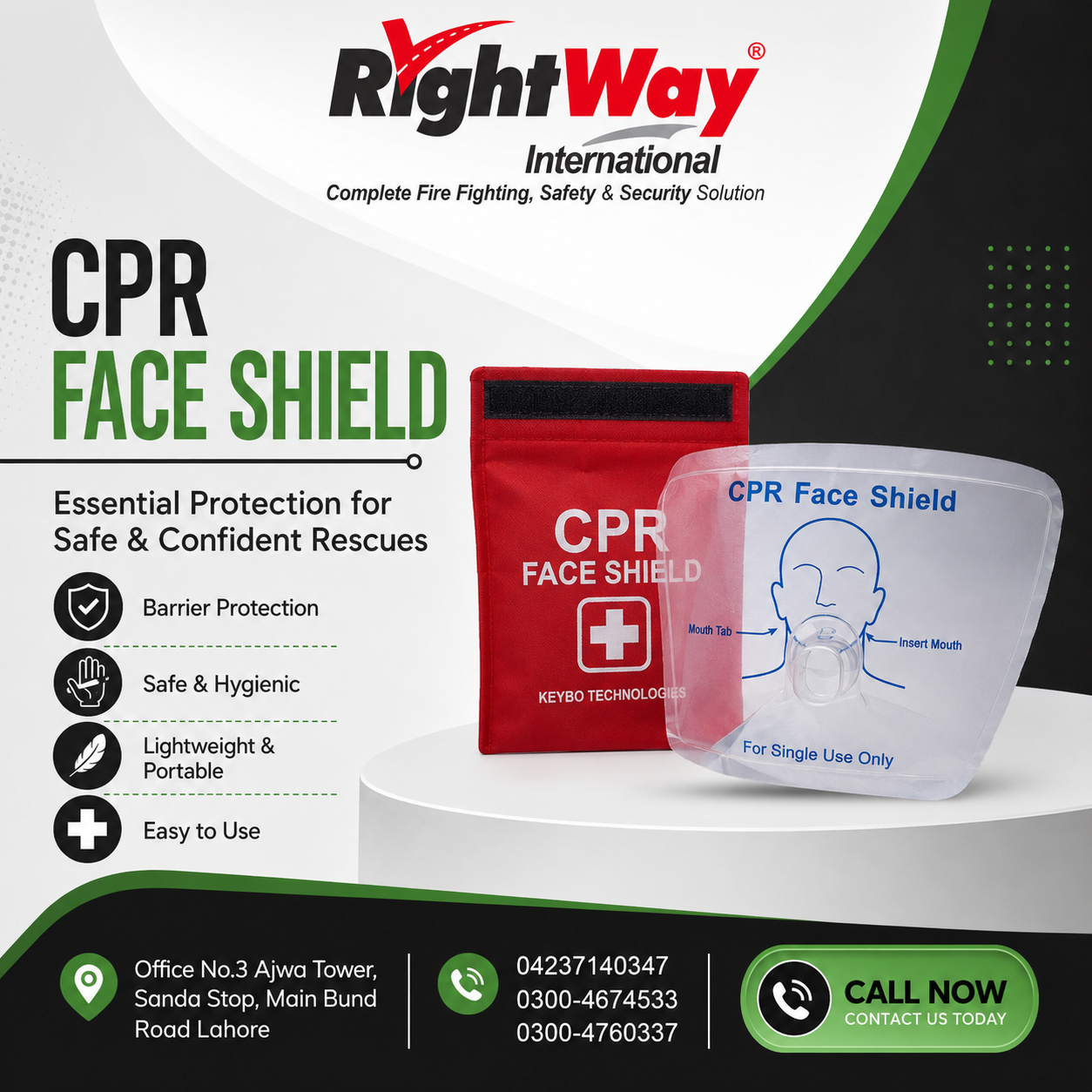
CPR Face Shield in Pakistan provides an important protective barrier during cardiopulmonary resuscitation (CPR) and emergency rescue situations. It helps reduce direct mouth-to-mouth contact between the rescuer and casualty during rescue breathing. Therefore, first responders, firefighters, rescue teams, paramedics, healthcare workers, and workplace safety personnel often keep CPR face shields in their emergency equipment.
Moreover, a CPR face shield offers a compact and convenient solution for emergency preparedness. Because of its lightweight construction, users can easily carry it inside first aid kits, rescue bags, emergency-response kits, vehicles, and workplace safety cabinets.
Furthermore, many CPR face shields include a one-way valve or filtration membrane. This feature helps create a controlled airflow pathway during rescue breathing while providing an additional barrier between the rescuer and casualty. However, users should always follow the manufacturer’s instructions and their CPR training when using the product.
What Is a CPR Face Shield?
A CPR Face Shield is a protective barrier that separates the rescuer from the casualty during CPR rescue breathing. The shield normally covers the mouth area and may include a mouthpiece, one-way valve, or filter.
In addition, many designs include a transparent sheet that allows the rescuer to maintain visibility while positioning the device. As a result, the rescuer can quickly identify the correct placement during an emergency.
Common CPR face shield components include:
- Transparent protective barrier
- One-way valve
- Filtration membrane
- Mouth opening
- Mouth tab
- Flexible plastic material
- Protective pouch
- Positioning instructions
However, manufacturers use different designs and materials. Therefore, buyers should always check the product specifications before purchasing a CPR face shield.
How Does a CPR Face Shield Work?
A CPR Face Shield creates a physical barrier between the rescuer and casualty during rescue breathing.
First, the rescuer prepares the casualty according to appropriate CPR procedures. Next, the rescuer places the face shield over the casualty’s mouth and nose. After that, the rescuer positions the mouthpiece or valve correctly.
When rescue breathing forms part of the applicable CPR procedure, the rescuer provides breaths through the designated opening. Meanwhile, the barrier helps reduce direct mouth-to-mouth contact.
Furthermore, a one-way valve can help control the intended direction of airflow. As a result, the CPR face shield provides an additional protective layer during emergency response.
Why Is a CPR Face Shield Important?
A CPR Face Shield plays an important role in emergency preparedness because it provides a physical barrier during rescue breathing.
For example, a CPR face shield can:
- Reduce direct mouth-to-mouth contact
- Provide a protective physical barrier
- Support hygienic emergency response
- Help reduce exposure to bodily fluids
- Provide convenient rescue-breathing access
- Fit easily inside first aid kits
- Support workplace emergency preparedness
- Provide compact emergency protection
Moreover, its lightweight design makes it practical for first responders and emergency teams. Therefore, organizations can keep CPR face shields in easily accessible emergency locations.
However, a CPR face shield does not eliminate every biological or emergency-response risk. For this reason, rescuers should combine appropriate protective equipment with recognized CPR and first-aid training.
CPR Face Shield with One-Way Valve
A CPR Face Shield with One-Way Valve provides a designated airflow pathway during rescue breathing. The valve helps direct airflow through the appropriate opening while creating a barrier between the rescuer and casualty.
Furthermore, some models incorporate a filtration membrane within the valve assembly. This additional feature can provide another layer of separation during emergency response.
Before using a CPR face shield, users should check the:
- Valve condition
- Packaging
- Product integrity
- Expiry information, where applicable
- Positioning instructions
- Manufacturer’s instructions
If the product shows damage or contamination, users should replace it according to the manufacturer’s recommendations.
CPR Face Shield for First Aid
A CPR Face Shield for First Aid can form an important part of a workplace or emergency first aid kit. For example, offices, factories, schools, warehouses, construction sites, hotels, and public facilities can keep CPR barrier devices alongside other first aid supplies.
A comprehensive first aid kit may include:
- CPR face shield
- Disposable gloves
- Sterile gauze
- Adhesive bandages
- Wound dressings
- Medical tape
- Antiseptic wipes
- Scissors
- Emergency dressings
In addition, organizations should select first aid equipment according to the risks, workplace environment, number of employees, and applicable safety requirements.
CPR Face Shield for Emergency Rescue
During an emergency, trained responders may need to provide immediate first aid and CPR. Therefore, a CPR Face Shield for Emergency Rescue gives responders convenient access to a protective barrier when rescue breathing becomes necessary.
Emergency teams may use CPR face shields in:
- Fire and rescue operations
- Workplace emergencies
- Industrial facilities
- Sports facilities
- Schools
- Public buildings
- Rescue vehicles
- Emergency-response kits
Furthermore, responders should keep the product in a clean, accessible location so they can reach it quickly during an emergency.
CPR Face Shield for Firefighters
Firefighters frequently carry specialized first aid and emergency-response equipment. Therefore, a CPR Face Shield for Firefighters can complement their rescue and first-aid equipment.
Fire and rescue teams may store CPR face shields inside:
- Firefighter first aid kits
- Rescue bags
- Emergency-response bags
- Ambulance equipment
- First responder kits
Moreover, the compact size allows responders to carry the device without adding significant weight to their equipment.
CPR Face Shield for Workplace Safety
A CPR Face Shield for Workplace Safety can support an organization’s emergency-response program. For instance, companies can place CPR barriers inside first aid cabinets, emergency response bags, medical rooms, and safety stations.
Industries that may maintain CPR equipment include:
- Manufacturing
- Construction
- Oil and gas
- Chemical processing
- Power generation
- Warehousing
- Transportation
- Hospitality
- Education
- Retail
- Industrial facilities
Furthermore, trained employees should know where emergency equipment is located. As a result, they can access essential supplies more quickly when an emergency occurs.
CPR Face Shield for Industrial Applications
Industrial facilities often maintain dedicated emergency-response teams. Therefore, an Industrial CPR Face Shield can support first aid and emergency preparedness programs.
Potential applications include:
- Factory emergency response
- Construction-site first aid
- Chemical facility response
- Oil and gas emergency response
- Warehouse safety
- Industrial rescue
- Occupational safety programs
- Emergency preparedness
However, organizations should use CPR face shields alongside proper training, emergency procedures, and other appropriate personal protective equipment.
CPR Face Shield and Infection-Control Considerations
A CPR Barrier Device provides a physical barrier during rescue breathing. Consequently, it can help reduce direct contact between the rescuer and casualty.
Some designs also include a one-way valve or filter. Therefore, buyers should review the product specifications carefully when selecting a CPR barrier.
However, users should not consider a CPR face shield a complete infection-control solution. Instead, rescuers should follow appropriate hygiene procedures and use gloves and other suitable PPE whenever available.
CPR Face Shield Types
Manufacturers offer several types of CPR face shields for different applications.
CPR Face Shield with One-Way Valve
This design incorporates a one-way valve to provide a designated airflow pathway during rescue breathing.
CPR Face Shield with Filter
Some products include a filtration membrane within the valve system. As a result, they provide an additional barrier during emergency use.
Disposable CPR Face Shield
Disposable face shields provide a convenient option for emergency kits. After use, the user should follow the manufacturer’s replacement instructions.
CPR Pocket Mask
A pocket mask provides a larger facial barrier and differs from a flat CPR face shield. Trained responders may use pocket masks according to their CPR training and the manufacturer’s instructions.
CPR Face Shield with Carrying Pouch
Many compact CPR face shields come with a protective pouch. Therefore, users can conveniently store them in first aid kits, emergency bags, or vehicles.
CPR Face Shield Materials
Manufacturers use lightweight materials to produce CPR face shields. Depending on the design, these materials can include:
- Transparent plastic film
- Flexible polymer materials
- Medical-grade or suitable plastic materials
- Filter membrane materials
- Elastomeric valve components
- Protective pouch materials
However, material specifications differ between manufacturers. Therefore, buyers should review the manufacturer’s technical documentation before selecting a product for professional use.
CPR Face Shield Storage
Proper CPR Face Shield Storage helps protect the product from contamination and physical damage.
Users should:
- Keep the product inside its original packaging
- Store it in a clean and dry location
- Protect it from excessive heat
- Avoid unnecessary crushing or folding
- Keep the valve protected
- Check packaging regularly
- Replace damaged products
Furthermore, organizations should keep emergency equipment in locations that trained personnel can access quickly.
CPR Face Shield Inspection
Regular CPR Face Shield Inspection helps organizations maintain emergency readiness.
During an inspection, responsible personnel should check:
- Packaging condition
- Product integrity
- Valve condition
- Expiry information, where applicable
- Visible contamination
- Storage conditions
- Product availability
- Protective pouch condition
If personnel find damage or contamination, they should replace the product according to the manufacturer’s recommendations.
CPR Face Shield Safety Guidelines
Users should follow several important CPR Face Shield Safety practices.
First, follow recognized CPR training and emergency-response procedures. Next, check the product before use. Then, position the face shield according to the manufacturer’s instructions.
In addition, users should:
- Use the product only for its intended purpose
- Avoid damaged products
- Follow single-use instructions
- Use gloves where appropriate
- Replace used disposable barriers
- Store replacement units properly
- Follow manufacturer instructions
Most importantly, a CPR face shield does not replace CPR training. Instead, it provides additional protective equipment for trained responders.
How to Choose the Right CPR Face Shield
When purchasing a CPR Face Shield, buyers should consider several factors.
1. Product Design
First, select a design that matches the intended application.
2. One-Way Valve
If the organization requires a valve system, confirm that the product includes the appropriate one-way valve.
3. Filter
Next, check whether the product includes a filtration membrane and review the manufacturer’s specifications.
4. Barrier Size
Make sure the face shield provides suitable coverage for its intended application.
5. Packaging
Individual packaging helps protect the product before use. Therefore, buyers should check packaging quality before purchasing.
6. Portability
A lightweight design allows responders to carry the CPR barrier easily inside emergency bags and first aid kits.
7. Manufacturer Information
Choose products with clear product information, instructions, and manufacturer details.
8. Intended Application
Consider whether you need the CPR face shield for workplace safety, first aid, emergency rescue, firefighting, vehicle kits, or professional response.
CPR Face Shield Price in Pakistan
The CPR Face Shield Price in Pakistan depends on several factors. For example, the manufacturer, product design, valve type, filtration system, material, packaging, and quantity can affect the overall price.
Furthermore, imported products may have additional costs related to shipping, availability, and supply conditions.
Therefore, buyers should compare:
- Product specifications
- Manufacturer
- Valve design
- Material
- Packaging
- Quantity
- Quality
- Supplier support
Rather than choosing the cheapest option, organizations should select a CPR face shield that meets their operational requirements.
CPR Face Shield in Pakistan
A CPR Face Shield in Pakistan can support emergency preparedness across many industries and organizations.
Potential users include:
- Fire departments
- Rescue teams
- Hospitals
- Ambulance services
- Industrial safety teams
- Security departments
- Schools
- Universities
- Offices
- Factories
- Construction companies
- Sports facilities
- Hotels
- Public facilities
Furthermore, buyers should provide suppliers with the intended application and required quantity. This information can help suppliers recommend an appropriate product.
CPR Face Shield Supplier in Pakistan
A reliable CPR Face Shield Supplier in Pakistan should provide clear product information and technical specifications. In addition, a professional supplier should help customers identify suitable products for their intended application.
When evaluating a supplier, consider:
- Product quality
- Manufacturer information
- Product specifications
- Packaging
- Availability
- Quantity requirements
- Technical documentation
- Customer support
- Delivery options
- After-sales support
Consequently, organizations can make better purchasing decisions when they evaluate both product quality and supplier reliability.
CPR Face Shield Applications
A CPR Face Shield can support many emergency-response applications, including:
- CPR response
- Rescue breathing
- First aid
- Emergency medical response
- Workplace first aid
- Industrial emergency response
- Fire and rescue operations
- Ambulance equipment
- Sports first aid
- School emergency kits
- Office first aid kits
- Vehicle emergency kits
- Construction-site first aid
- Public facility emergency response
- First responder equipment
- Emergency preparedness programs
However, responders should always use the equipment according to their training and the manufacturer’s instructions.
CPR Face Shield vs CPR Pocket Mask
A CPR Face Shield and CPR Pocket Mask both provide a barrier during rescue breathing. However, their designs differ.
A CPR face shield typically uses a compact barrier sheet with a mouth opening and, depending on the model, a one-way valve or filter.
In contrast, a pocket mask normally provides a larger mask that covers the casualty’s mouth and nose. Therefore, professional responders may choose between these products based on their training, equipment requirements, and intended application.
CPR Face Shield Replacement
A CPR Face Shield Replacement should remain available wherever organizations maintain CPR equipment.
Users should replace a CPR face shield when:
- Someone has used it
- Packaging becomes damaged
- The product becomes contaminated
- The valve becomes damaged
- The barrier tears
- The product reaches its expiry date, where applicable
- Storage conditions compromise the product
- The manufacturer recommends replacement
Therefore, emergency-response teams should maintain sufficient replacement stock.
CPR Face Shield First Aid Kit
A CPR Face Shield First Aid Kit can provide additional protection during emergency response.
Depending on the workplace or application, a first aid kit may contain:
- CPR face shield
- Disposable gloves
- Sterile gauze
- Adhesive bandages
- Wound dressings
- Medical tape
- Antiseptic wipes
- Scissors
- Emergency dressings
Furthermore, organizations should review their first aid kits regularly and replace used or expired supplies.
CPR Face Shield for Schools and Offices
Schools, colleges, universities, and offices can include CPR face shields in their emergency equipment.
For example, organizations can store them inside:
- First aid cabinets
- Reception areas
- Security rooms
- Medical rooms
- Emergency response bags
- Workplace first aid stations
In addition, organizations should train designated personnel so they know where emergency equipment is located and how to respond appropriately.
CPR Face Shield for Vehicles
A CPR Face Shield for Vehicles can form part of a vehicle emergency kit.
Because vehicles can experience high temperatures and other challenging storage conditions, users should follow the manufacturer’s recommended storage requirements.
Compact CPR barriers can fit conveniently inside:
- Cars
- Rescue vehicles
- Ambulances
- Company vehicles
- Buses
- Industrial transport vehicles
- Emergency response vehicles
CPR Face Shield for First Responders
First responders need equipment that they can access quickly during emergencies. Therefore, a CPR Face Shield for First Responders can provide a convenient barrier within emergency-response equipment.
Responders can carry the product inside:
- First responder bags
- Rescue kits
- First aid pouches
- Emergency medical bags
- Fire and rescue equipment
- Ambulance response kits
Moreover, responders should regularly inspect their emergency equipment to maintain readiness.
CPR Face Shield Safety
A CPR face shield provides useful protective equipment during rescue breathing. However, it forms only one part of a complete emergency-response system.
Therefore, organizations should combine CPR face shields with appropriate training, emergency communication, first aid equipment, gloves, and established response procedures.
Furthermore, users should inspect the product before use and replace any damaged, contaminated, or compromised equipment.
Frequently Asked Questions
What is a CPR Face Shield?
A CPR Face Shield is a protective barrier that helps reduce direct mouth-to-mouth contact during CPR rescue breathing.
What does a CPR face shield do?
It creates a physical barrier between the rescuer and casualty. Depending on the design, it may also include a one-way valve or filter.
Does a CPR face shield have a one-way valve?
Many CPR face shields include a one-way valve. However, designs vary, so buyers should check the manufacturer’s specifications.
Is a CPR face shield reusable?
Some products are designed for single use, while others may have different manufacturer instructions. Therefore, users should always follow the instructions supplied with the product.
Who should use a CPR face shield?
Trained first responders, firefighters, rescue personnel, healthcare workers, workplace emergency teams, and other appropriately trained individuals can use CPR barrier equipment according to their training.
Where should a CPR face shield be stored?
Users can store CPR face shields inside first aid kits, emergency response bags, workplace first aid stations, rescue bags, or vehicle emergency kits. However, they should follow the manufacturer’s storage recommendations.
How often should a CPR face shield be replaced?
Replacement depends on the product type and manufacturer. Disposable products generally require replacement after use, while other products require replacement according to their condition and manufacturer instructions.
What affects CPR Face Shield Price in Pakistan?
Price can vary according to the manufacturer, valve design, filter, material, packaging, quantity, product quality, specifications, and supplier availability.
Can a CPR face shield prevent infection?
A CPR face shield can provide a physical barrier and reduce direct contact during rescue breathing. However, it cannot guarantee infection prevention.
Can a CPR face shield replace CPR training?
No. A CPR face shield provides protective equipment, while proper CPR training teaches responders how to perform emergency procedures correctly.
Where can I buy a CPR Face Shield in Pakistan?
Buyers can contact a reputable first-aid, fire-safety, medical-safety, or emergency-response equipment supplier and provide the required specifications and quantity.
SCBA Pressure Reducer
Pressure Reducer is a mechanical pressure-regulating component installed between the high-pressure SCBA cylinder and the downstream breathing-air system.
SCBA cylinders store compressed breathing air at very high pressures. The pressure reducer reduces this cylinder pressure to a lower, controlled intermediate pressure suitable for the rest of the breathing apparatus.
Depending on the SCBA design, the pressure reducer may include:
- High-pressure inlet
- Intermediate-pressure outlet
- Pressure-reducing mechanism
- Internal valve assembly
- Springs
- Seals and O-rings
- Pressure gauges or gauge connections
- Safety relief mechanism
- High-pressure hose connection
- Low-pressure hose connection
- Manufacturer-specific fittings
However, the exact construction varies between SCBA manufacturers and models. Therefore, users should always confirm compatibility before replacing or servicing a pressure reducer. READ MORE