




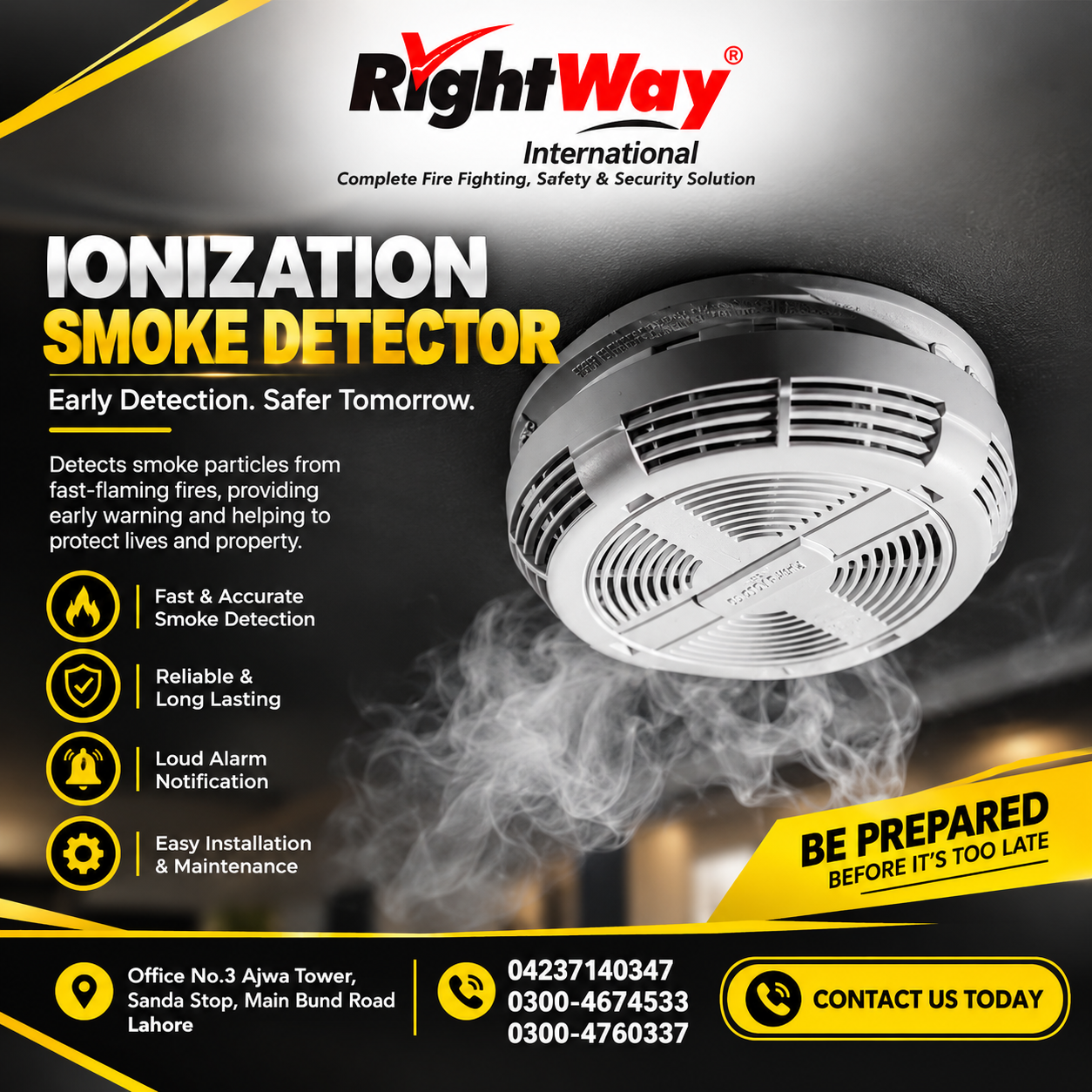
Importance of Ionization Smoke Detector lies in its ability to provide early warning when smoke particles from a developing fire enter its sensing chamber. Ionization smoke detectors are a type of smoke detection device designed to detect changes in an electrically charged environment caused by smoke particles.
Fire can spread rapidly, especially when combustible materials ignite and produce flames quickly. In such situations, early detection is essential because it can provide occupants with valuable time to respond, evacuate, and follow emergency procedures.
An ionization smoke detector can be an important part of a fire alarm and detection system in suitable applications. It can work alongside fire alarm control panels, sounders, manual call points, heat detectors, sprinkler systems, portable fire extinguishers, emergency lighting, and evacuation procedures.
However, ionization smoke detectors are not suitable for every environment. Cooking fumes, steam, dust, aerosols, and other airborne particles can cause unwanted alarms. Therefore, the correct detector technology should always be selected according to the expected fire risk, environmental conditions, building design, and applicable requirements.
What Is an Ionization Smoke Detector?
An Ionization Smoke Detector is a smoke detection device that uses an ionization chamber and a small radioactive source to detect smoke particles in the surrounding air.
Inside the detector, the radioactive source ionizes air within the sensing chamber. This creates electrically charged particles and allows a small electrical current to flow between two electrodes.
When smoke enters the chamber, the smoke particles interfere with the ionization process and reduce the electrical current.
The detector’s electronic circuitry recognizes this change. When the change reaches the detector’s alarm threshold, the device activates an alarm or sends a signal to the connected fire alarm system.
Ionization smoke detectors are particularly associated with detecting certain rapidly developing flaming fires, although actual detector performance depends on the fire characteristics, detector design, installation, and environmental conditions.
How Does an Ionization Smoke Detector Work?
An ionization smoke detector works by monitoring changes in electrical current inside its sensing chamber.
The detector contains two electrically charged plates and a small radioactive source. The source ionizes air molecules between the plates, allowing a small current to flow.
Under normal conditions, the detector maintains a relatively stable electrical condition.
When smoke enters the chamber, smoke particles attach to ions and interfere with the normal flow of electrical current.
As the current decreases, the detector’s electronic circuit identifies the change.
If the change reaches the programmed alarm threshold, the detector activates its alarm.
In a standalone unit, this may produce a loud audible warning.
When connected to a fire alarm system, the detector can send a signal to the fire alarm control panel, which can then activate connected notification appliances such as sounders, bells, strobes, or other devices according to the system design.
Why Is an Ionization Smoke Detector Important?
Fire detection is one of the most important parts of an effective fire safety strategy.
A fire can begin unexpectedly in a home, office, commercial building, storage area, or other facility.
Some fires can develop rapidly and produce flames soon after ignition. An appropriately selected ionization smoke detector can provide early warning when smoke enters its sensing chamber.
This warning can help occupants:
- Recognize a potential fire emergency
- Evacuate the building
- Alert other occupants
- Contact emergency services
- Follow established emergency procedures
- Move away from smoke and dangerous areas
Early warning can be especially important during sleeping hours when people may not immediately notice the signs of a developing fire.
Main Benefits of Ionization Smoke Detectors
1. Early Smoke Detection
An ionization smoke detector continuously monitors the surrounding air.
When smoke enters the sensing chamber and causes the electrical condition to change sufficiently, the detector can activate an alarm.
2. Suitable for Certain Flaming Fires
Ionization detectors are commonly associated with detecting certain rapidly developing flaming fires.
These fires can produce relatively small smoke particles, and ionization technology can be responsive to this type of combustion in suitable conditions.
3. Automatic Operation
Once installed and powered, an ionization smoke detector continuously monitors the protected area without requiring someone to manually operate it.
This provides continuous fire detection when the detector is properly installed and maintained.
4. Audible Fire Warning
Standalone ionization smoke detectors can produce a loud alarm when smoke is detected.
This warning can alert occupants and encourage them to begin their emergency response.
5. Integration With Fire Alarm Systems
System-connected ionization smoke detectors can send alarm signals to a fire alarm control panel.
The panel can then activate appropriate notification devices and other connected functions.
6. Useful for Residential Applications
Ionization smoke detectors have historically been used in residential environments because of their response characteristics to certain flaming fires.
However, detector selection should consider the entire environment and applicable fire safety requirements.
7. Continuous Monitoring
Unlike manual fire detection methods, an ionization smoke detector can continuously monitor the protected area.
This allows the device to provide automatic warning when its alarm threshold is reached.
How Is an Ionization Smoke Detector Different From a Photoelectric Smoke Detector?
Ionization and photoelectric smoke detectors use different sensing technologies.
An ionization smoke detector uses an ionization chamber to detect changes caused by smoke particles.
A photoelectric smoke detector uses a light source and sensing arrangement to detect smoke particles entering its sensing chamber.
Ionization detectors are generally associated with faster response to certain rapidly developing flaming fires.
Photoelectric detectors are generally more responsive to many slow-smoldering fires that produce larger smoke particles.
Neither technology should automatically be considered suitable for every application.
The correct detector depends on:
- Expected fire characteristics
- Building occupancy
- Environmental conditions
- Detector location
- Applicable requirements
- Manufacturer specifications
In some applications, using multiple detection technologies or combination detectors may provide appropriate coverage.
Types of Ionization Smoke Detector Applications
Ionization smoke detectors can be considered for applications where their detection characteristics are appropriate.
1. Residential Buildings
Homes and apartments can contain furniture, textiles, electrical appliances, plastics, and other combustible materials.
An appropriately selected smoke detector can provide early warning to occupants.
Because residential environments can also contain cooking fumes, steam, aerosols, and other sources of nuisance alarms, detector location and technology should be carefully considered.
2. Bedrooms and Sleeping Areas
Fire can develop while occupants are asleep.
A suitable smoke detector can provide an audible warning when smoke reaches its alarm threshold.
Detector placement should follow applicable requirements and manufacturer instructions.
3. Offices
Offices contain computers, electrical equipment, paper, furniture, cables, and other materials.
Ionization smoke detection may be suitable in selected areas where the expected fire characteristics and environmental conditions support its use.
4. Commercial Buildings
Commercial facilities may contain offices, shops, storage spaces, equipment rooms, and other areas with different fire hazards.
The detector type should be selected according to the specific application.
5. Corridors and Common Areas
Smoke detection in corridors and common areas can support early warning and evacuation.
Detector spacing and placement should be determined according to the applicable fire alarm design requirements.
6. Electrical and Equipment Areas
Electrical equipment can potentially develop fires because of overheating, electrical faults, damaged wiring, or component failures.
A suitable smoke detector may provide early warning.
However, environmental conditions such as dust, airflow, temperature, and contamination must be considered.
Where Should Ionization Smoke Detectors Be Used Carefully?
Ionization detectors may be unsuitable or require careful consideration in environments where airborne particles or normal activities can cause nuisance alarms.
Examples include areas with:
- Cooking fumes
- Heavy steam
- Excessive dust
- Aerosols
- Strong airflow
- Combustion products from normal activities
- Certain industrial contaminants
For these environments, another detection technology may be more appropriate.
The manufacturer’s instructions and applicable fire protection requirements should always be followed.
Ionization Smoke Detector vs Heat Detector
An ionization smoke detector detects smoke particles by monitoring changes in its ionization chamber.
A heat detector responds to temperature conditions or the rate of temperature increase, depending on its design.
Smoke detectors can generally provide earlier warning than heat detectors for fires that produce smoke before the surrounding temperature reaches a heat detector’s activation point.
Heat detectors can, however, be useful in locations where smoke detectors may experience frequent nuisance alarms.
Therefore, detector selection should be based on the environmental conditions and expected fire hazards.
Ionization Smoke Detector vs Fire Alarm System
An ionization smoke detector is one device within a fire detection system.
A complete fire alarm system may include:
- Ionization smoke detectors
- Photoelectric smoke detectors
- Heat detectors
- Manual call points
- Fire alarm control panels
- Sounders
- Bells
- Strobes
- Modules
- Power supplies
- Monitoring interfaces
The detector identifies a potential fire condition, while the fire alarm system processes the signal and provides appropriate notification.
Ionization Smoke Detector vs Fire Sprinkler
Ionization smoke detectors and fire sprinkler systems perform different functions.
An ionization smoke detector provides early warning when smoke is detected.
A sprinkler system is designed to control or suppress a fire by discharging water or another approved extinguishing medium, depending on the system.
Therefore, a smoke detector cannot replace a sprinkler system where sprinklers are required.
Smoke detection and fire suppression can work together as part of a comprehensive fire protection strategy.
What Type of Fire Can an Ionization Smoke Detector Detect?
Ionization smoke detectors are particularly associated with detecting smoke from certain rapidly developing flaming fires.
However, no smoke detector can guarantee detection of every fire condition.
Detector performance can depend on:
- Fire growth rate
- Fuel type
- Smoke particle characteristics
- Ventilation
- Air movement
- Detector location
- Detector sensitivity
- Environmental conditions
For this reason, detector selection should be based on the expected fire scenarios rather than relying on one detector type for every application.
How to Install an Ionization Smoke Detector
Ionization smoke detector installation should follow the manufacturer’s instructions and applicable fire safety requirements.
Step 1: Assess the Protected Area
Identify the rooms, corridors, sleeping areas, offices, equipment rooms, and other areas requiring smoke detection.
Step 2: Identify the Fire Risk
Determine the likely fire characteristics and combustible materials in the area.
Step 3: Select the Appropriate Detector
Select an ionization detector only where its technology is suitable for the environment and expected fire risk.
Step 4: Select the Mounting Location
Install the detector in an appropriate ceiling or high-level location according to the manufacturer’s recommended spacing.
Step 5: Avoid Obstructions
Make sure walls, beams, ducts, equipment, decorative structures, or other objects do not prevent smoke from reaching the detector.
Step 6: Connect the Detector
For system-connected detectors, connect the device to the fire alarm system according to the manufacturer’s wiring and system requirements.
Step 7: Test the Detector
After installation, test the detector to confirm that it responds correctly and communicates with the appropriate alarm equipment.
Step 8: Record the Installation
Maintain appropriate records of the detector location, model, installation date, testing, and maintenance.
Safety Precautions for Ionization Smoke Detectors
Proper installation and maintenance are essential for reliable smoke detection.
Follow these precautions:
- Select the detector according to the application.
- Follow manufacturer installation instructions.
- Install detectors at appropriate locations.
- Keep detectors unobstructed.
- Test detectors regularly.
- Keep sensing chambers clean.
- Do not paint over the detector.
- Do not cover the detector.
- Do not modify the detector.
- Do not remove or tamper with the radioactive source.
- Replace damaged detectors.
- Replace batteries when required.
- Investigate repeated nuisance alarms.
- Maintain fire alarm system records.
- Ensure occupants understand the alarm signal.
- Keep emergency exits clear.
- Maintain appropriate fire extinguishing equipment.
- Follow the building’s emergency evacuation procedure.
Radioactive Source in Ionization Smoke Detectors
Ionization smoke detectors use a very small radioactive source as part of their sensing technology.
The source is sealed inside the detector and is designed for safe operation when the detector is used correctly.
Users should never attempt to open, dismantle, modify, or remove the radioactive component.
When an ionization smoke detector reaches the end of its service life, disposal should follow the manufacturer’s instructions and applicable local requirements.
Maintenance of Ionization Smoke Detectors
Regular inspection and maintenance help ensure that ionization smoke detectors remain operational.
Dust, dirt, insects, paint, construction debris, and other contamination can affect detector performance.
A maintenance program may include:
- Visual inspection
- Functional testing
- Alarm testing
- Cleaning
- Battery inspection
- Battery replacement
- Wiring inspection
- Detector chamber inspection
- Fire alarm panel testing
- Fault monitoring
- Replacement of damaged detectors
- Replacement at the end of service life
- Maintenance documentation
Testing and maintenance frequency should follow applicable requirements, manufacturer recommendations, and the fire alarm system’s maintenance program.
Importance of Ionization Smoke Detector in Residential Buildings
Residential fires can develop rapidly, especially when combustible furniture, textiles, plastics, and other materials are involved.
An ionization smoke detector can provide an early warning when smoke enters its sensing chamber.
This warning can be particularly important during sleeping hours because occupants may not immediately notice a developing fire.
However, residential detector selection should consider the complete environment. Locations near kitchens, bathrooms, or other areas that produce steam or airborne particles require careful consideration to reduce nuisance alarms.
Importance of Ionization Smoke Detector in Offices
Offices contain electrical equipment, computers, paper, furniture, cables, and other combustible materials.
A suitable smoke detection system can provide early warning if a fire develops.
An ionization detector may be considered where its detection characteristics are appropriate and environmental conditions are suitable.
For larger office buildings, detectors can be connected to an addressable or conventional fire alarm system depending on the system design.
Importance of Ionization Smoke Detector in Commercial Buildings
Commercial buildings can contain many different fire hazards.
Retail areas, offices, storage rooms, electrical spaces, corridors, and equipment rooms may require different detection approaches.
An ionization smoke detector can provide an additional detection option in appropriate locations.
However, detector selection should be based on the specific fire risk and environmental conditions rather than using one detector type throughout an entire building.
Importance of Ionization Smoke Detector in Pakistan
Fire safety is important across homes, offices, shops, schools, hotels, commercial buildings, warehouses, factories, and industrial facilities throughout Pakistan.
Many buildings contain electrical equipment, combustible materials, storage areas, machinery, furniture, and other potential fire hazards.
An Ionization Smoke Detector in Pakistan can provide an early-warning fire detection solution in applications where ionization technology is appropriate.
For example, suitable applications may include selected residential areas, offices, commercial buildings, corridors, and other areas where the environmental conditions support the use of ionization detection.
However, local conditions should always be considered.
Areas with cooking fumes, heavy dust, steam, aerosols, or industrial contaminants may require a different detector technology.
Therefore, professional fire risk assessment and appropriate detector selection can help ensure that the installed smoke detection system matches the actual environment.
How to Choose the Right Ionization Smoke Detector
Before purchasing an ionization smoke detector, consider the following factors.
Detection Technology
Confirm that ionization technology is appropriate for the expected fire risk and environment.
Fire Risk
Consider whether the protected area is more likely to experience rapidly developing flaming fires, smoldering fires, or other fire scenarios.
Environmental Conditions
Check for dust, steam, cooking fumes, aerosols, humidity, temperature variations, and strong airflow.
Alarm Compatibility
For system-connected detectors, verify compatibility with the fire alarm control panel.
Sensitivity
Check the detector’s sensitivity and technical specifications.
Certification
Select products that meet applicable safety and certification requirements.
Power Supply
Determine whether the detector operates using batteries or a fire alarm system power supply.
Maintenance
Consider the manufacturer’s testing, cleaning, replacement, and service requirements.
Supplier Support
Choose a reliable supplier that can provide technical assistance, installation guidance, replacement products, and maintenance support.
Frequently Asked Questions About Ionization Smoke Detectors
What Is an Ionization Smoke Detector?
An ionization smoke detector is a fire detection device that uses an ionization chamber to detect changes caused by smoke particles entering the sensing chamber.
How Does an Ionization Smoke Detector Work?
A small radioactive source ionizes air inside the sensing chamber and creates a small electrical current. When smoke enters the chamber, it interferes with the ionization process and changes the current. The detector recognizes this change and can activate an alarm.
Why Is an Ionization Smoke Detector Important?
An ionization smoke detector is important because it can provide early warning for certain types of rapidly developing fires, allowing occupants more time to respond and evacuate.
What Is the Difference Between Ionization and Photoelectric Smoke Detectors?
Ionization detectors use an ionization chamber, while photoelectric detectors use light-based sensing technology. Ionization detectors are generally associated with certain rapidly developing flaming fires, while photoelectric detectors are generally more responsive to many slow-smoldering fires.
Are Ionization Smoke Detectors Suitable for Every Room?
No. Environmental conditions and expected fire characteristics should be considered. Areas with cooking fumes, steam, dust, aerosols, or other airborne contaminants may require another detector type.
Can an Ionization Smoke Detector Detect Heat?
No. An ionization smoke detector primarily detects smoke particles. A heat detector is designed specifically to respond to temperature conditions.
Can an Ionization Smoke Detector Put Out a Fire?
No. A smoke detector provides detection and warning. It does not extinguish a fire.
Does an Ionization Smoke Detector Contain Radioactive Material?
Yes. Ionization smoke detectors use a very small sealed radioactive source as part of their sensing technology. The detector should never be opened, modified, or dismantled.
Is an Ionization Smoke Detector Safe?
When properly manufactured, installed, used, and maintained according to applicable requirements and manufacturer instructions, the radioactive source is sealed within the detector. Users should not tamper with or dismantle the device.
Where Are Ionization Smoke Detectors Used?
They can be used in suitable residential, commercial, and other applications where their detection characteristics and environmental conditions make them appropriate.
Can an Ionization Smoke Detector Be Connected to a Fire Alarm Panel?
Yes, system-compatible ionization smoke detectors can be connected to suitable fire alarm systems. The exact compatibility depends on the detector and fire alarm control panel.
How Often Should an Ionization Smoke Detector Be Tested?
Testing should follow the manufacturer’s instructions, applicable fire safety requirements, and the maintenance program of the fire alarm system.
Can Ionization Smoke Detectors Cause False Alarms?
They can produce unwanted alarms when exposed to certain airborne particles or environmental conditions. Proper detector selection and installation can help reduce nuisance alarms.
Can Ionization Smoke Detectors Be Used in Kitchens?
They are generally not ideal for locations directly exposed to normal cooking fumes because cooking can produce airborne particles that may cause nuisance alarms. Detector selection and placement should follow applicable requirements.
What Happens When an Ionization Smoke Detector Detects Smoke?
The detector activates its alarm when the smoke reaches its alarm threshold. If connected to a fire alarm system, it can send a signal to the fire alarm control panel, which may activate connected notification devices.
The Importance of Ionization Smoke Detector comes from its ability to provide early warning when smoke enters its ionization sensing chamber.
Ionization smoke detectors are particularly associated with detecting certain rapidly developing flaming fires and can provide valuable warning time for occupants to respond to a fire emergency.
They can be used in suitable residential, commercial, office, and other applications. However, they should not be treated as a universal solution for every environment.
The correct detector depends on the expected fire characteristics, environmental conditions, building design, detector technology, applicable requirements, and manufacturer specifications.
Ionization smoke detectors should also complement—not replace—fire alarm systems, heat detectors, sprinkler systems, portable fire extinguishers, emergency exits, evacuation procedures, and other fire protection measures.
For businesses, property owners, facility managers, and households in Pakistan, selecting, installing, testing, and maintaining the appropriate smoke detection equipment can strengthen early fire detection and overall fire safety.