




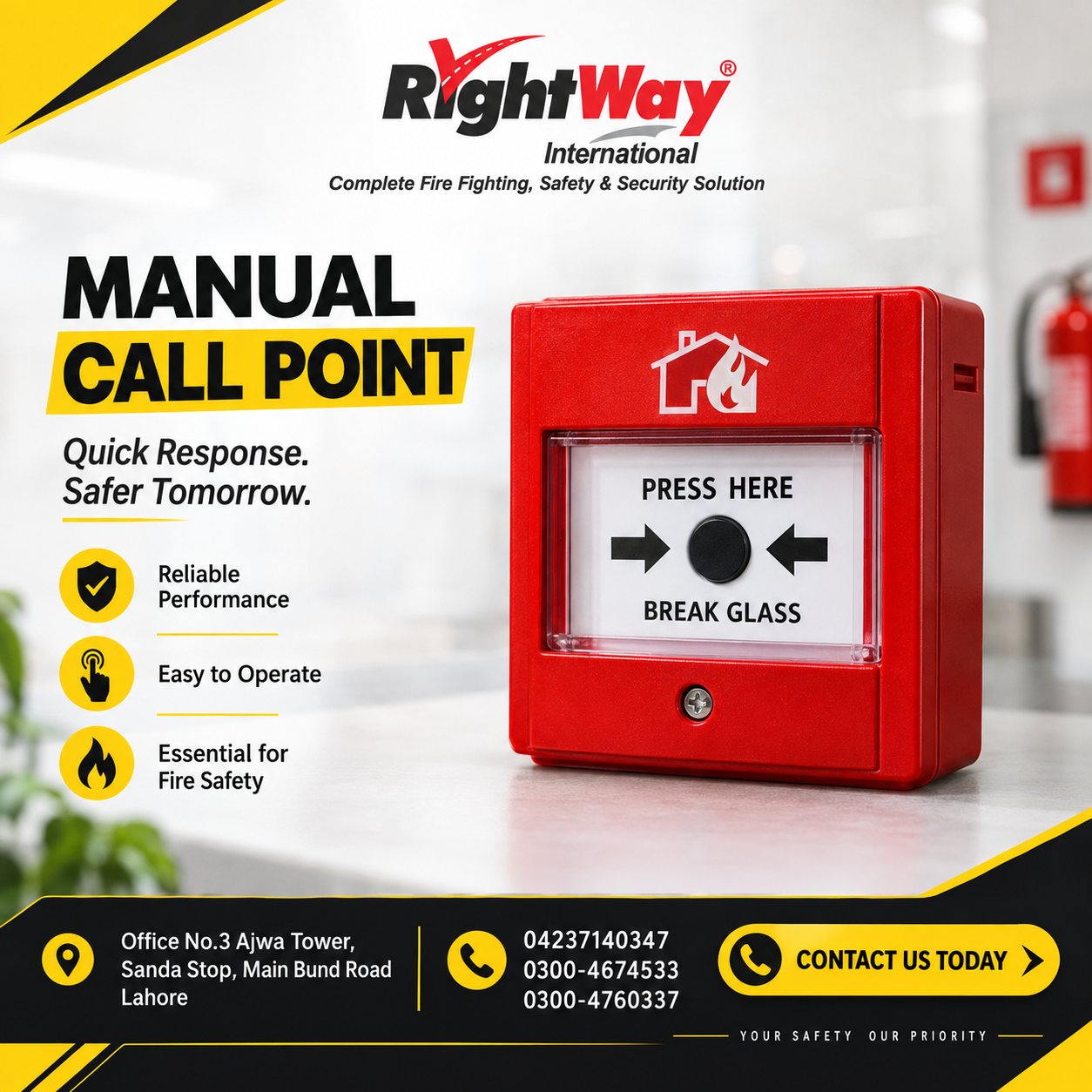
Importance of Manual Call Point (MCP) is an important part of a fire alarm system. It allows people to manually activate the fire alarm when they discover a fire or emergency condition. Unlike automatic detectors, a manual call point is operated by a person to send an alarm signal to the Fire Alarm Control Panel (FACP).
Manual call points are commonly installed near exits, stairways, corridors, entrances, and other easily accessible locations. They provide a simple and reliable way to raise an alarm and help occupants respond quickly during a fire emergency.
How Does a Manual Call Point Work?
When a person discovers smoke, flames, or another fire emergency, they can activate the manual call point by pressing the button or operating the break-glass mechanism, depending on the model.
The manual call point then sends a signal to the fire alarm control panel. The panel processes the signal and activates connected notification devices such as sounders, bells, strobes, or other programmed alarm equipment.
Therefore, a manual call point provides a direct method for people to alert others and initiate the building’s fire alarm system.
Types of Manual Call Points
The main types of manual call points include:
- Conventional Manual Call Point – Connected to conventional fire alarm zones.
- Addressable Manual Call Point – Provides an individual address so the fire alarm panel can identify the activated device.
- Resettable Manual Call Point – Uses a resettable element instead of requiring replacement after activation.
- Break Glass Manual Call Point – Activates the alarm when the glass element is operated.
- Weatherproof Manual Call Point – Designed for suitable outdoor or harsh environments.
- Waterproof Manual Call Point – Provides additional protection for areas where moisture may be present.
- Indoor Manual Call Point – Designed for standard indoor fire alarm applications.
The appropriate type depends on the fire alarm system, installation environment, manufacturer specifications, and project requirements.
Benefits of Manual Call Points
A manual call point provides several important benefits:
- Allows people to manually raise a fire alarm
- Provides quick alarm activation
- Supports early warning during a fire emergency
- Can be installed near exits and escape routes
- Connects with compatible fire alarm control panels
- Helps supplement automatic fire detection devices
- Provides a simple and easily accessible method of alarm activation
Where Are Manual Call Points Used?
Manual call points are widely used in offices, hotels, hospitals, schools, warehouses, factories, shopping malls, restaurants, residential buildings, commercial properties, and industrial facilities.
They are commonly positioned along escape routes and near exits so occupants can access them quickly when required.
The exact location and quantity should be determined according to the building design, fire risks, occupancy, applicable standards, and local requirements.
Manual Call Point and Automatic Fire Detectors
A manual call point and an automatic fire detector perform different functions within a fire alarm system.
Smoke detectors, heat detectors, and flame detectors automatically detect specific signs of fire and send signals to the fire alarm control panel.
A manual call point, however, allows a person to activate the alarm manually after discovering a fire or emergency condition.
Using both automatic detection devices and manual call points can provide multiple ways to initiate a fire alarm.
Installation of Manual Call Points
Manual call points should be installed in accessible locations where occupants can easily identify and operate them during an emergency.
Installation should follow the manufacturer’s instructions, applicable fire alarm standards, building requirements, and the design of the overall fire alarm system.
The manual call point should also be compatible with the connected fire alarm control panel and other system components.
Testing and Maintenance
Regular testing and maintenance are important for reliable manual call point operation.
Maintenance may include checking:
- Manual call point activation
- Reset mechanism
- Break-glass or resettable element
- Wiring and connections
- Alarm signal at the fire alarm control panel
- Sounders and visual alarm devices
- Fault indications
- Device condition and accessibility
Any damaged or faulty manual call point should be inspected and repaired or replaced by a qualified person according to the manufacturer’s requirements.
NFPA 72 provides requirements and guidance for fire alarm systems, including inspection, testing, and maintenance.
Manual Call Point in Pakistan
Manual call points are an important component of fire alarm systems used in commercial, industrial, residential, and public buildings across Pakistan.
They can be used as part of conventional or addressable fire alarm systems, depending on the project design. Before installation, the appropriate manual call point should be selected according to the fire alarm panel, building requirements, environmental conditions, and applicable local and international requirements.
Frequently Asked Questions
What is a Manual Call Point?
A manual call point is a fire alarm device that allows a person to manually activate the fire alarm after discovering a fire or emergency condition.
What is the purpose of a Manual Call Point?
Its main purpose is to provide a quick and accessible way for occupants to manually send an alarm signal to the fire alarm control panel.
Where should a Manual Call Point be installed?
Manual call points are generally installed in accessible locations such as escape routes, corridors, stairways, and near exits, according to the applicable requirements and fire alarm system design.
What is the difference between a Manual Call Point and a Smoke Detector?
A smoke detector automatically detects smoke, while a manual call point requires a person to activate it.
Are Manual Call Points connected to the Fire Alarm Control Panel?
Yes. Compatible manual call points are connected to the fire alarm control panel and send an alarm signal when activated.
What are the main types of Manual Call Points?
Common types include conventional, addressable, resettable, break-glass, weatherproof, and waterproof manual call points.
Why is testing a Manual Call Point important?
Regular testing helps confirm that the manual call point, wiring, control panel, and connected alarm devices operate correctly when an alarm is activated.
A Manual Call Point is a key component of a fire alarm system because it provides occupants with a direct method of activating the alarm during a fire emergency. When properly selected, installed, tested, and maintained, it can support early warning and help initiate an appropriate emergency response.
Manual call points should be used together with suitable fire detection and notification devices as part of a properly designed fire alarm system.