




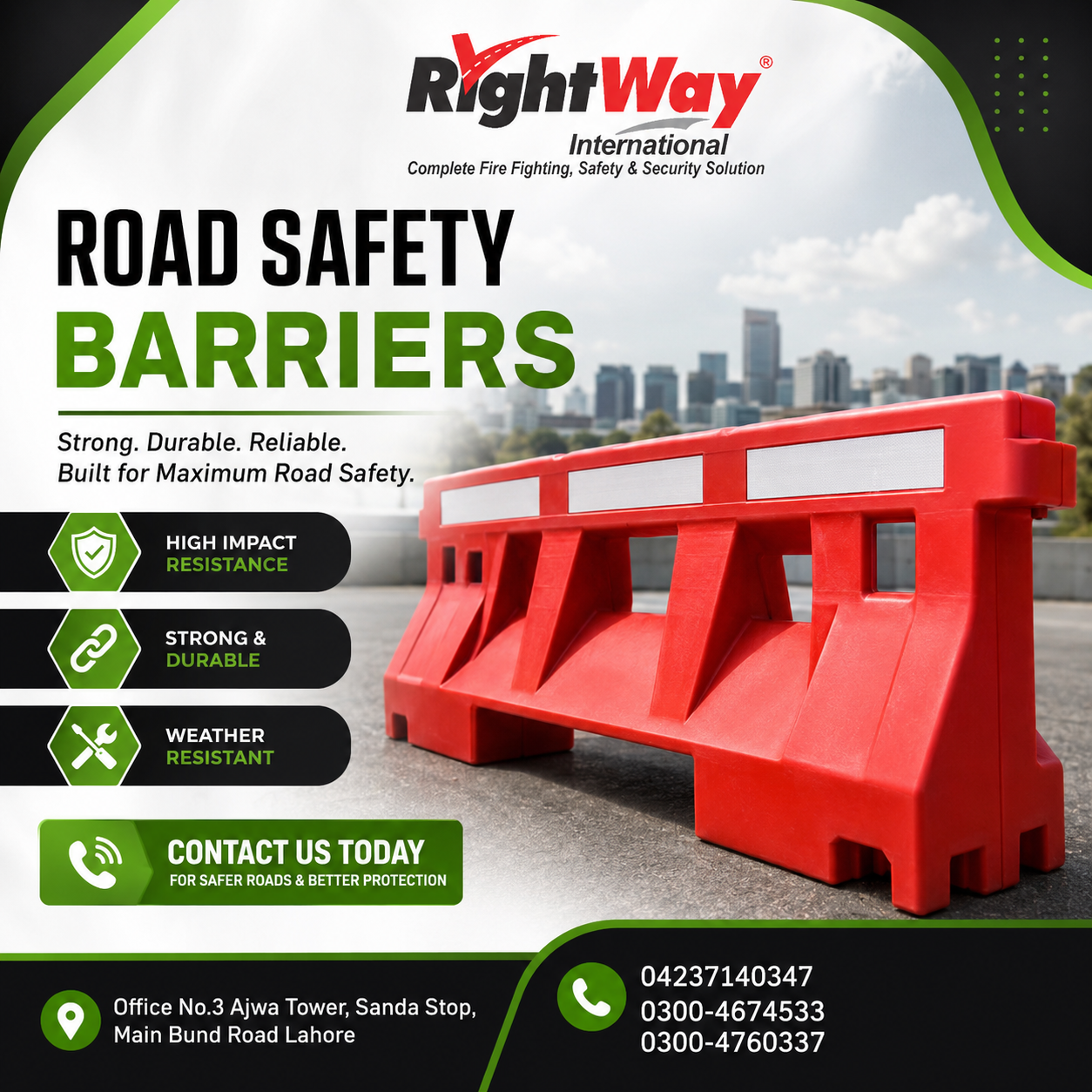
Road Safety Barriers play an important role in modern traffic management and workplace safety. These barriers create a clear physical separation between vehicles, pedestrians, work areas, restricted zones, and valuable infrastructure. As a result, they help organizations manage traffic movement while reducing the risk of unwanted vehicle access and collisions.
Furthermore, businesses, construction companies, factories, warehouses, parking facilities, and commercial properties use road safety barriers to create safer environments. Depending on the application, organizations can use barriers for traffic channelization, pedestrian protection, vehicle separation, property protection, and temporary traffic management.
Modern road safety barriers come in different materials, sizes, designs, colors, and installation configurations. Therefore, buyers can select a suitable barrier according to traffic conditions, vehicle types, location, visibility requirements, and the required level of protection.
What Are Road Safety Barriers?
Road Safety Barriers are physical safety devices that help control vehicle movement and separate vehicles from pedestrians, workers, structures, and restricted areas.
Manufacturers produce road safety barriers from durable materials such as steel, galvanized steel, concrete, plastic, HDPE, PVC, rubber, and other engineered materials. Moreover, manufacturers offer different designs for temporary and permanent applications.
Many barriers use high-visibility colors such as red, white, yellow, and black. In addition, reflective strips or panels can improve visibility when vehicle headlights illuminate the barrier at night.
Road safety barriers are commonly used for:
- Vehicle separation
- Traffic channelization
- Pedestrian protection
- Construction-site safety
- Roadwork traffic management
- Parking-area protection
- Industrial traffic control
- Warehouse safety
- Factory traffic management
- Highway safety
- Bridge protection
- Restricted-area control
- Work-zone protection
- Vehicle access control
- Property protection
- Temporary traffic management
Why Are Road Safety Barriers Important?
Uncontrolled vehicle movement can create serious risks for pedestrians, workers, vehicles, buildings, machinery, and other infrastructure. Therefore, organizations need effective systems to guide vehicles and separate them from vulnerable areas.
Road safety barriers provide a visible and physical boundary. Consequently, they help drivers recognize restricted areas and follow designated traffic routes.
For example, a construction company can install barriers around excavation zones, machinery, roadwork areas, and temporary work zones. Similarly, a warehouse can use barriers to separate forklifts from pedestrian walkways.
Moreover, factories and industrial facilities can install heavy-duty barriers around machinery, storage racks, loading areas, and important infrastructure. As a result, barriers can support a more organized and controlled working environment.
How Do Road Safety Barriers Work?
Road safety barriers work by creating a physical boundary between vehicle routes and protected areas. Depending on their design, they can guide traffic, prevent unauthorized access, protect structures, or separate pedestrians from moving vehicles.
Step 1: Identify the Risk Area
First, identify areas where vehicles could enter restricted zones or come too close to pedestrians, workers, machinery, or structures.
Step 2: Select the Appropriate Barrier
Next, select a barrier according to vehicle type, traffic volume, installation location, expected impact conditions, and required visibility.
Step 3: Prepare the Installation Area
Before installation, inspect the surface and make sure it can support the selected barrier and its fixing system.
Step 4: Install the Barrier
Install the barrier using suitable anchors, bolts, bases, connection systems, or other approved hardware. Always follow the manufacturer’s installation instructions.
Step 5: Improve Visibility
Where necessary, add reflective strips, high-visibility markings, warning signs, or suitable lighting. Consequently, drivers and pedestrians can identify the barrier more easily.
Step 6: Inspect the Installation
Finally, inspect the barrier regularly. Check its connections, mounting points, reflective markings, and overall condition to maintain reliable performance.
Types of Road Safety Barriers
Different environments require different traffic-control solutions. Therefore, manufacturers offer several types of road safety barriers.
1. Steel Road Safety Barriers
Steel road safety barriers provide a strong and durable solution for demanding environments. They work well in industrial facilities, parking areas, warehouses, factories, roads, and infrastructure-protection applications.
Furthermore, steel barriers can provide a long service life when manufacturers use suitable protective coatings and proper installation methods.
2. Galvanized Road Safety Barriers
Galvanized barriers feature a protective zinc coating that helps resist corrosion. Therefore, they can provide a practical solution for outdoor environments where barriers face rain, humidity, and changing weather conditions.
3. Concrete Road Barriers
Concrete barriers provide substantial physical separation. Consequently, they can suit highways, construction zones, road-diversion systems, and locations that require heavy-duty traffic separation.
4. Plastic Road Safety Barriers
Plastic barriers offer a lightweight option for traffic management. Because of their relatively low weight, workers can move and reposition them more easily than many heavy permanent barriers.
They can work well for construction zones, parking facilities, temporary roadwork, events, and other changing traffic environments.
5. Water-Filled Road Barriers
Water-filled barriers provide a convenient temporary traffic-control solution. Workers can transport the empty barriers more easily and then fill them with water after positioning them.
As a result, they can provide greater stability while maintaining practical handling and deployment characteristics.
6. Jersey Barriers
Jersey barriers use a specialized profile to separate traffic lanes and guide vehicles. Concrete and other suitable materials can form these barriers.
They can provide effective traffic separation on highways, construction projects, and temporary road-diversion routes.
7. Pedestrian Safety Barriers
Pedestrian safety barriers separate people from vehicle traffic. Therefore, they can help protect pedestrians around construction sites, sidewalks, crossings, parking areas, public spaces, and industrial facilities.
8. Traffic Barriers
Traffic barriers help guide and restrict vehicle movement. Organizations can use them in road construction, parking areas, industrial premises, warehouses, and commercial properties.
9. Crash Barriers
Crash barriers provide protection in areas where vehicles could leave their designated path. Depending on the design and application, organizations may use them alongside roads, bridges, highways, and other high-risk locations.
10. Temporary Road Safety Barriers
Temporary barriers help organizations manage changing traffic conditions. For example, construction companies can deploy them during road repairs, maintenance projects, temporary diversions, and work-zone operations.
11. Permanent Road Safety Barriers
Permanent barriers provide long-term traffic separation and protection. They can suit highways, industrial facilities, bridges, parking areas, factories, and property boundaries.
12. Reflective Road Safety Barriers
Reflective barriers feature reflective strips, panels, or markings. Therefore, they provide improved visibility during nighttime operations and low-light conditions.
Common Applications of Road Safety Barriers
Road safety barriers support traffic management across many industries and locations.
Construction Sites
Construction sites often contain workers, heavy machinery, trucks, excavations, building materials, and changing traffic routes. Therefore, contractors can use barriers to separate workers from moving vehicles and protect hazardous areas.
For example, barriers can surround:
- Excavation areas
- Heavy machinery
- Temporary traffic lanes
- Material storage zones
- Pedestrian routes
- Construction entrances
- Open trenches
Highways
Highways require effective traffic separation and roadside protection. Therefore, suitable road safety barriers can help guide vehicles and protect specific roadside areas.
Parking Areas
Parking facilities contain moving vehicles and pedestrians in a relatively limited space. Consequently, barriers can help protect:
- Pedestrian walkways
- Building entrances
- Parking structures
- Structural columns
- Walls
- Restricted areas
- Loading zones
Warehouses
Warehouses often contain forklifts, trucks, delivery vehicles, storage racks, and pedestrians. Therefore, warehouse managers can use safety barriers to separate vehicle routes from pedestrian areas.
In addition, barriers can protect storage racks, machinery, doors, columns, and other valuable infrastructure.
Factories
Factories can use barriers around production areas, machinery, loading zones, pedestrian walkways, storage areas, and internal vehicle routes.
As a result, barriers can help create clearly defined traffic paths within busy industrial environments.
Industrial Facilities
Industrial facilities often operate heavy vehicles and machinery. Therefore, they may require heavy-duty barriers around critical infrastructure.
These barriers can protect:
- Machinery
- Storage racks
- Pipelines
- Tanks
- Electrical equipment
- Loading docks
- Production areas
- Pedestrian walkways
- Vehicle checkpoints
Airports
Airports can use appropriate barriers for service roads, restricted zones, parking areas, vehicle-control points, and pedestrian separation.
Because airports manage different types of vehicles and people, organizations should select barrier systems according to the specific operating environment.
Bridges
Bridge barriers can help guide traffic and protect road users near bridge edges. However, organizations should select and install bridge protection systems according to applicable engineering and road-safety requirements.
Commercial Properties
Shopping centers, offices, commercial buildings, and private developments can use road safety barriers to organize traffic and protect pedestrians, buildings, entrances, and restricted areas.
Key Features of High-Quality Road Safety Barriers
When selecting a road safety barrier, buyers should evaluate several important features.
Durable Construction
Quality barriers use materials that can withstand regular traffic, outdoor exposure, physical contact, and demanding operating conditions.
High Visibility
Bright colors and contrasting patterns help drivers and pedestrians recognize barriers more easily. Therefore, high-visibility designs can improve awareness around restricted and protected areas.
Reflective Markings
Reflective strips and panels improve nighttime visibility when vehicle headlights illuminate them. Consequently, reflective barriers can provide additional visual guidance after dark.
Weather Resistance
Outdoor barriers should withstand rain, sunlight, humidity, temperature changes, and other environmental conditions.
UV Resistance
UV-resistant materials can help reduce fading, cracking, and material degradation caused by prolonged sunlight exposure.
Impact Resistance
Some applications require barriers that can withstand vehicle contact. Therefore, buyers should select an appropriate barrier according to the expected impact conditions and protection requirements.
Corrosion Resistance
Metal barriers need suitable corrosion protection, especially when they operate outdoors. Galvanization and other protective coatings can help extend service life.
Modular Design
Modular barriers allow organizations to connect multiple sections and create the required length. Therefore, they can provide greater flexibility for different road layouts.
Easy Installation
Many modern barriers use bolts, anchors, mounting plates, connection systems, or weighted bases. As a result, installers can deploy them efficiently when the site meets the manufacturer’s requirements.
Heavy-Duty Performance
Heavy-duty barriers can provide enhanced protection in areas with trucks, forklifts, industrial vehicles, and frequent traffic.
Benefits of Road Safety Barriers
Road safety barriers offer several practical benefits.
- Improve vehicle and pedestrian separation
- Help control traffic movement
- Protect construction workers
- Reduce unauthorized vehicle access
- Protect buildings and infrastructure
- Improve parking-area organization
- Support industrial workplace safety
- Protect machinery and equipment
- Improve work-zone traffic control
- Increase visibility around restricted areas
- Create physical separation
- Protect pedestrian walkways
- Support temporary traffic management
- Suit permanent traffic-control applications
- Provide a practical safety solution
Furthermore, road safety barriers can work alongside speed bumps, traffic cones, warning signs, road markings, pedestrian crossings, reflective devices, and other traffic-management equipment.
Road Safety Barriers for Daytime and Nighttime Visibility
Visibility plays an important role in effective traffic management.
During daylight, high-contrast colors help drivers identify barriers from a greater distance. At night, reflective strips and panels can make barriers more visible when vehicle headlights illuminate them.
Therefore, organizations that operate parking facilities, construction sites, industrial premises, warehouses, highways, and commercial properties after dark should consider reflective barrier designs.
However, organizations should not rely on visibility alone. Instead, they should combine barriers with suitable warning signs, lighting, road markings, and traffic-control procedures where required.
How to Choose the Right Road Safety Barrier
Selecting the right barrier requires careful consideration of the traffic environment and protection requirements.
1. Assess Vehicle Traffic
First, identify the vehicles that regularly operate in the area. Cars, vans, buses, trucks, forklifts, and heavy industrial vehicles can require different barrier solutions.
2. Determine the Required Protection Level
Next, determine what the barrier needs to protect. For example, pedestrian walkways may require a different solution than machinery, storage racks, or building structures.
3. Select the Appropriate Material
Choose steel, galvanized steel, concrete, plastic, HDPE, rubber, or another suitable material according to the application and expected operating conditions.
4. Consider the Installation Location
Evaluate the installation surface and surrounding environment. Asphalt, concrete, roadside areas, parking facilities, and temporary work zones may require different installation methods.
5. Evaluate Visibility
Choose high-visibility colors and reflective features when drivers need to recognize barriers during daytime and nighttime operations.
6. Consider Weather Conditions
For outdoor applications, select materials that can withstand sunlight, rain, humidity, temperature fluctuations, and local environmental conditions.
7. Check Installation Requirements
Always review the manufacturer’s installation instructions. In addition, use appropriate anchors, bolts, bases, or other approved fixing hardware.
8. Consider Barrier Dimensions
Barrier height, length, width, profile, spacing, and configuration should match the application, traffic conditions, and available installation area.
Best Practices for Installing Road Safety Barriers
Proper installation helps barriers perform their intended function.
- Select an appropriate installation location
- Identify vehicle and pedestrian routes
- Follow the manufacturer’s installation instructions
- Inspect the installation surface
- Use suitable fixing hardware
- Align barrier sections correctly
- Maintain clear visibility
- Use reflective markings where necessary
- Install warning signs where appropriate
- Inspect mounting points regularly
- Replace damaged sections promptly
- Keep reflective surfaces clean
- Maintain suitable pedestrian and vehicle clearance
- Follow applicable local traffic-management requirements
Moreover, organizations should review barrier placement whenever traffic patterns change. This approach helps ensure that the safety system continues to match the site’s current requirements.
Road Safety Barrier Maintenance
Quality barriers can provide long-term service; however, regular inspections remain important.
Inspect road safety barriers for:
- Cracks
- Broken sections
- Bent metal components
- Loose bolts
- Damaged anchors
- Corrosion
- Faded colors
- Damaged reflective strips
- Missing components
- Surface deterioration
- Excessive deformation
- Impact damage
- Loose connections
Furthermore, inspect mounting hardware regularly. If a barrier becomes damaged or a fixing point becomes loose, repair or replace the affected component promptly.
Road Safety Barriers for Parking Areas
Parking areas contain pedestrians, cars, delivery vehicles, service personnel, and other road users. Therefore, physical barriers can help organize vehicle movement and protect vulnerable areas.
Road safety barriers can protect:
- Parking entrances
- Parking exits
- Pedestrian crossings
- Building entrances
- Loading zones
- Payment areas
- Pedestrian walkways
- Structural columns
- Walls
- Restricted parking zones
- Service areas
In addition, high-visibility barriers can give drivers a clear visual indication of protected and restricted areas.
Road Safety Barriers for Industrial Facilities
Industrial environments can contain heavy vehicles, forklifts, trucks, machinery, workers, storage systems, and loading operations. Therefore, industrial facilities often need effective physical protection around critical areas.
Heavy-duty safety barriers can help protect:
- Factory entrances
- Warehouse entrances
- Loading docks
- Pedestrian walkways
- Employee areas
- Machinery
- Storage racks
- Production lines
- Electrical equipment
- Pipelines
- Tanks
- Vehicle checkpoints
- Internal traffic routes
However, facility managers should select barriers according to vehicle types, expected impact conditions, operating conditions, and the value or importance of the assets they need to protect.
Road Safety Barriers in Construction Sites
Construction sites frequently experience changing traffic conditions. Workers, excavators, cranes, trucks, materials, and pedestrians may operate within limited areas.
Therefore, temporary road safety barriers can help establish controlled boundaries around:
- Excavation areas
- Roadwork zones
- Construction machinery
- Material storage areas
- Pedestrian routes
- Temporary traffic lanes
- Construction entrances
- Open trenches
- Restricted work zones
Furthermore, contractors can combine barriers with traffic cones, warning signs, reflective devices, temporary fencing, and suitable lighting to create a more complete work-zone traffic-management system.
Road Safety Barriers for Pedestrian Protection
Pedestrian areas require effective separation when vehicles operate nearby. Consequently, pedestrian safety barriers can create clearly defined walking routes and reduce direct interaction between pedestrians and vehicles.
They can help protect people around:
- Sidewalks
- School entrances
- Shopping areas
- Construction sites
- Parking facilities
- Industrial walkways
- Factory premises
- Loading areas
- Public spaces
- Road crossings
As a result, barriers can help establish a more organized separation between vehicle routes and pedestrian pathways.
Road Safety Barriers vs Traffic Cones
Road safety barriers and traffic cones serve different purposes.
| Feature | Road Safety Barriers | Traffic Cones |
|---|---|---|
| Primary Purpose | Physical Separation and Protection | Traffic Guidance |
| Physical Protection | Higher, depending on design | Limited |
| Vehicle Channelization | Yes | Yes |
| Pedestrian Separation | Yes | Limited |
| Impact Resistance | Depends on Barrier Type | Generally Limited |
| Visibility | High with Proper Markings | High |
| Portability | Varies by Design | Highly Portable |
| Long-Term Use | Suitable for Many Applications | Usually Temporary |
| Common Applications | Roads, Construction, Industrial Sites | Temporary Traffic Control |
Therefore, traffic cones mainly provide visual guidance and temporary channelization, while suitable road safety barriers provide a stronger physical boundary.
Road Safety Barriers vs Speed Bumps
Speed bumps and road safety barriers perform different functions.
| Feature | Road Safety Barriers | Speed Bumps |
| Primary Purpose | Separation and Protection | Vehicle Speed Reduction |
| Installation | Along, Around, or Across Restricted Areas | Across Traffic Lanes |
| Main Function | Physical Protection | Traffic Calming |
| Pedestrian Protection | Direct | Indirect |
| Vehicle Speed Control | Limited | Primary Function |
| Traffic Separation | Yes | No |
| Infrastructure Protection | Yes | Limited |
| Common Applications | Roads, Worksites, Parking, Industrial Areas | Parking Areas, Private Roads, Schools |
Therefore, organizations should not use barriers as a direct replacement for speed bumps when the main objective involves reducing vehicle speed.
Importance of Reflective Road Safety Barriers
Reflective road safety barriers provide additional visual guidance during nighttime operations. When headlights illuminate reflective strips or panels, drivers can recognize the barrier more easily.
Consequently, reflective barriers can prove useful in:
- Construction sites
- Parking garages
- Highways
- Private roads
- Industrial facilities
- Warehouses
- Commercial parking areas
- Residential communities
- Factory premises
- Nighttime work zones
Road Safety Barriers in Pakistan
In Pakistan, organizations use road safety barriers in construction sites, highways, residential communities, schools, hospitals, parking areas, factories, warehouses, commercial properties, private roads, industrial facilities, and institutional premises.
When selecting road safety barriers in Pakistan, buyers should consider local traffic conditions, vehicle types, barrier material, impact requirements, road surface, weather exposure, visibility requirements, dimensions, installation method, and expected operating conditions.
Furthermore, professional buyers should review applicable local traffic-management, workplace-safety, construction, and infrastructure requirements before installation.
Technical Specifications
| Specification | Typical Details |
| Equipment Type | Road Safety Barrier |
| Primary Function | Traffic Separation and Physical Protection |
| Common Materials | Steel, Galvanized Steel, Concrete, Plastic, HDPE, Rubber |
| Common Colors | Red, White, Yellow, Black, High-Visibility Colors |
| Design | Modular, Fixed, Temporary, Permanent |
| Visibility | High-Visibility and Reflective Options |
| Surface | Smooth, Textured, Coated, or Reflective |
| Installation | Bolted, Anchored, Weighted, Connected, or Fixed |
| Applications | Roads, Construction Sites, Parking Areas, Factories, Warehouses |
| Weather Resistance | Available in Outdoor-Grade Designs |
| Impact Resistance | Available in Different Protection Levels |
| Main Benefit | Traffic Control, Separation, and Protection |
Frequently Asked Questions
What are Road Safety Barriers used for?
Road safety barriers help control vehicle movement, separate pedestrians from vehicles, protect infrastructure, restrict access, and create safer traffic environments. They are commonly used on roads, construction sites, parking areas, factories, warehouses, and industrial premises.
What materials are road safety barriers made from?
Manufacturers commonly use steel, galvanized steel, concrete, plastic, HDPE, PVC, rubber, and other engineered materials to produce road safety barriers.
Are road safety barriers suitable for construction sites?
Yes. Temporary and permanent barriers can help protect construction workers and separate excavation zones, machinery, materials, pedestrian routes, and temporary traffic lanes.
Why do road safety barriers use bright colors?
Bright colors improve visibility and help drivers and pedestrians recognize barriers and restricted areas more easily. In addition, reflective markings can improve visibility at night.
Are reflective road safety barriers suitable for nighttime use?
Yes. Reflective strips and panels can improve visibility when vehicle headlights illuminate them.
Where can road safety barriers be installed?
Organizations can use road safety barriers in highways, construction sites, parking areas, warehouses, factories, schools, hospitals, industrial facilities, commercial properties, private roads, bridges, and pedestrian areas.
Are road safety barriers suitable for heavy vehicles?
Some heavy-duty barriers can handle demanding vehicle environments. However, buyers should always verify the manufacturer’s specifications, intended application, impact performance, and installation requirements before selecting a barrier.
How are modular road safety barriers installed?
Depending on the design, modular barriers may use bolts, anchors, connection systems, weighted bases, or other mechanical fixing methods. Therefore, installers should follow the manufacturer’s installation instructions carefully.
How often should road safety barriers be inspected?
Organizations should inspect barriers regularly for impact damage, corrosion, loose bolts, damaged anchors, faded markings, broken sections, missing components, and other signs of deterioration. Moreover, high-traffic and high-risk areas may require more frequent inspections.