




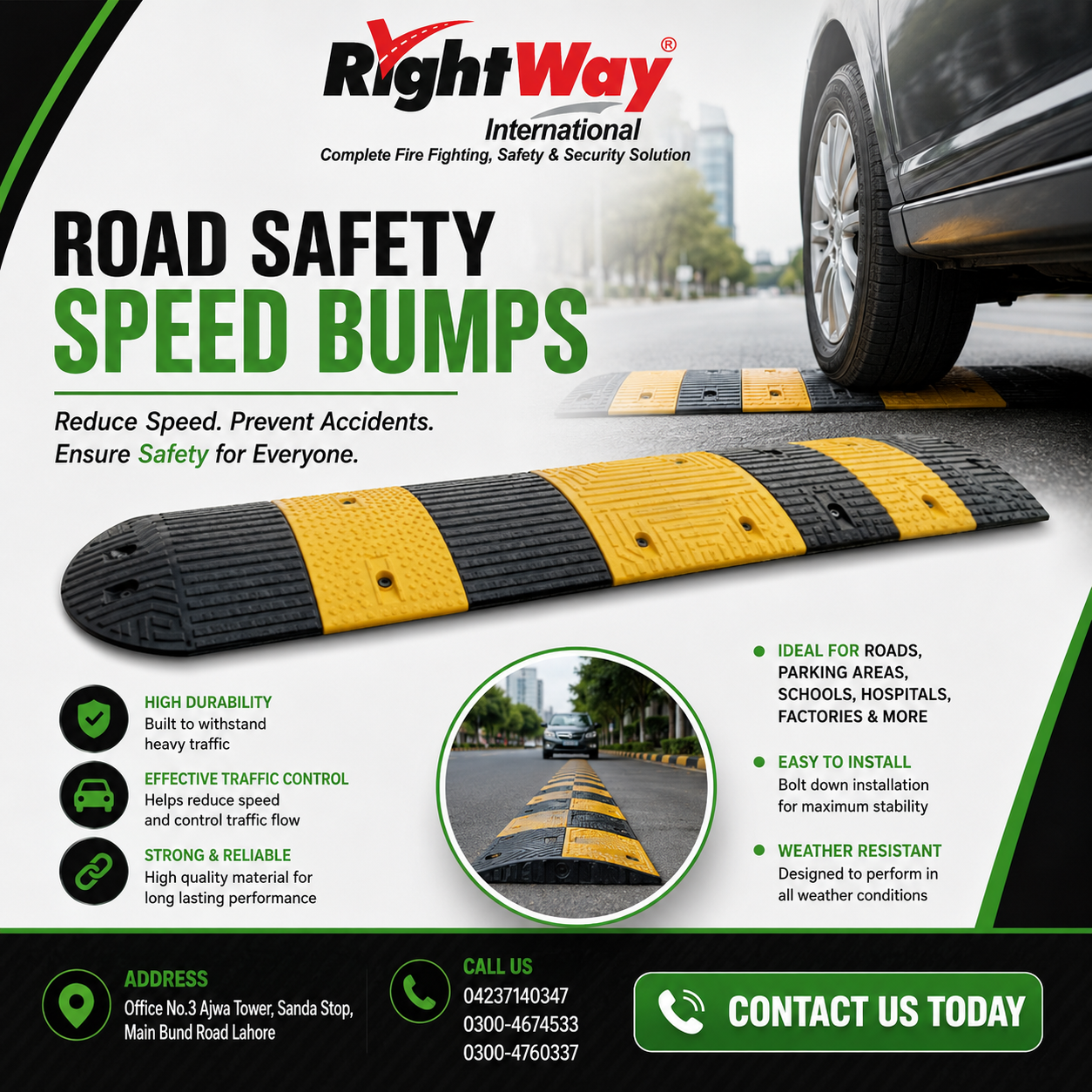
Road Safety Speed Bumps are important traffic-calming devices designed to reduce vehicle speed and improve safety in areas where motorists need to drive carefully. By creating a controlled elevation across the roadway, speed bumps encourage drivers to slow down before passing over the designated area.
Furthermore, road safety speed bumps help control vehicle movement in locations such as residential streets, parking areas, school zones, hospitals, factories, warehouses, private roads, commercial properties, industrial facilities, and pedestrian-heavy areas. As a result, they provide a practical solution for reducing excessive vehicle speed and improving traffic safety.
In addition, modern speed bumps are available in different materials, sizes, colors, profiles, and installation designs. Therefore, organizations can select a suitable speed bump according to road conditions, vehicle traffic, speed requirements, and the intended application.
What Are Road Safety Speed Bumps?
Road Safety Speed Bumps are raised traffic-calming devices installed across roads and driveways to encourage motorists to reduce speed. They create a noticeable change in the road surface, which naturally encourages drivers to approach the area at a controlled speed.
Manufacturers commonly produce speed bumps from durable materials such as rubber, recycled rubber, plastic, PVC, asphalt, concrete, or other engineered materials.
Moreover, many modern speed bumps feature high-visibility colors such as black and yellow. Reflective markings can also improve visibility during nighttime and low-light conditions.
Road safety speed bumps are commonly used for:
- Speed control
- Parking area safety
- School-zone traffic management
- Residential road safety
- Pedestrian protection
- Industrial traffic control
- Warehouse vehicle management
- Hospital traffic management
- Factory safety
- Private road traffic calming
- Commercial property safety
- Community road safety
- Vehicle entrance control
- Parking garage speed reduction
- Worksite traffic management
Why Are Road Safety Speed Bumps Important?
Excessive vehicle speed can increase the risk of collisions and reduce the amount of time available for drivers to react to pedestrians, vehicles, obstacles, and changing road conditions.
For this reason, speed bumps provide a simple physical reminder for drivers to reduce speed.
For example, property managers can install speed bumps near pedestrian crossings, entrances, exits, parking areas, and busy internal roads. Consequently, drivers receive a clear indication that they should approach these areas carefully.
In addition, speed bumps can help create safer environments around schools, hospitals, residential communities, warehouses, factories, and commercial facilities.
How Do Road Safety Speed Bumps Work?
Speed bumps use a raised road profile to encourage drivers to reduce vehicle speed.
Step 1: Identify the High-Risk Area
First, identify areas where vehicles regularly travel too quickly or where pedestrians and vehicles frequently interact.
Step 2: Select the Appropriate Speed Bump
Next, select a speed bump according to road width, vehicle type, traffic volume, installation surface, and required speed-control level.
Step 3: Install the Speed Bump
Install the speed bump securely across the designated traffic lane using the appropriate installation method and hardware.
Step 4: Add Visibility Features
Where appropriate, use reflective markings, warning signs, or high-visibility colors to make the speed bump easier to identify.
Step 5: Monitor Vehicle Speed
Finally, monitor traffic behavior after installation. If necessary, adjust the traffic-control arrangement to improve effectiveness and safety.
Types of Road Safety Speed Bumps
Different traffic environments require different speed-control solutions. Therefore, speed bumps are available in several types.
1. Rubber Speed Bumps
Rubber speed bumps are popular because they offer durability, flexibility, and relatively simple installation. They work well in parking areas, private roads, industrial sites, and commercial properties.
2. Heavy-Duty Speed Bumps
Heavy-duty speed bumps are designed for areas with frequent vehicle movement and demanding operating conditions. They can suit factories, warehouses, loading areas, industrial facilities, and commercial parking locations.
3. Modular Speed Bumps
Modular speed bumps consist of individual sections that can be connected to create the required length. Consequently, installers can adapt the system to different road widths.
4. Rubber Traffic Calming Humps
Rubber traffic calming humps provide a raised surface that encourages vehicles to slow down while allowing controlled traffic movement.
5. Plastic Speed Bumps
Plastic speed bumps can provide a lightweight and economical option for certain traffic-control applications.
6. Reflective Speed Bumps
Reflective speed bumps include reflective elements or high-visibility markings. As a result, they can provide better visibility during nighttime operations.
7. Black and Yellow Speed Bumps
Black and yellow speed bumps provide strong visual contrast. This color combination makes the raised surface easier for drivers to recognize.
8. Temporary Speed Bumps
Temporary speed-control systems can be installed where traffic conditions change periodically or where permanent construction is not practical.
9. Permanent Speed Bumps
Permanent speed bumps are generally installed in locations that require long-term traffic calming, such as private roads, residential areas, parking facilities, and industrial premises.
Common Applications of Road Safety Speed Bumps
Road safety speed bumps serve many different environments.
Residential Areas
Communities can use speed bumps to encourage drivers to reduce speed on internal roads and protect pedestrians, children, cyclists, and other road users.
School Zones
Schools can use appropriate traffic-calming measures near entrances, parking areas, and internal roads to encourage slower vehicle movement.
Hospitals
Hospitals and healthcare facilities often have pedestrians, ambulances, service vehicles, and visitors moving through the same areas. Therefore, suitable traffic-calming devices can help organize vehicle movement.
Parking Areas
Parking facilities can install speed bumps to control vehicle speed and improve pedestrian safety.
Warehouses
Warehouses often have forklifts, delivery vehicles, trucks, and pedestrians operating within the same facility. Speed-control measures can help organize vehicle movement in designated areas.
Factories
Industrial facilities can use speed bumps on internal roads, employee parking areas, loading zones, and vehicle routes.
Commercial Properties
Shopping centers, offices, commercial buildings, and private developments can use speed bumps to control vehicle speed in parking and access areas.
Private Roads
Private roads can use speed bumps to manage vehicle speed without requiring major road modifications.
Industrial Facilities
Factories, logistics centers, distribution facilities, and industrial compounds can use heavy-duty speed bumps where vehicle traffic requires additional speed control.
Key Features of High-Quality Road Safety Speed Bumps
When selecting a speed bump, buyers should consider several important features.
Durable Construction
Quality speed bumps use materials designed to withstand repeated vehicle loading, impacts, weather exposure, and regular traffic.
High Visibility
Bright colors and contrasting patterns help drivers identify the speed bump from a distance.
Reflective Markings
Reflective elements can improve nighttime visibility and help drivers recognize the raised surface.
Weather Resistance
Outdoor speed bumps should withstand sunlight, rain, temperature changes, and other environmental conditions.
UV Resistance
UV-resistant materials can help reduce fading and material degradation caused by prolonged exposure to sunlight.
Anti-Slip Surface
A textured surface can provide additional traction and help reduce unwanted vehicle movement over the speed-control device.
Modular Design
Modular sections allow installers to create different lengths according to the width of the road.
Easy Installation
Many modern speed bumps use bolts, anchors, or other mechanical fastening systems that allow relatively quick installation on suitable surfaces.
Heavy-Duty Performance
Heavy-duty models can provide greater durability for areas with frequent vehicle movement and heavier vehicles.
Benefits of Road Safety Speed Bumps
Road safety speed bumps provide several practical benefits.
- Encourage lower vehicle speeds
- Improve pedestrian safety
- Help manage traffic within private areas
- Reduce excessive vehicle speed
- Improve safety around schools
- Support parking-area traffic management
- Help protect workers in industrial facilities
- Improve vehicle movement control
- Provide a cost-effective traffic-calming solution
- Offer long-term traffic management
- Require relatively simple installation
- Provide high visibility when properly marked
- Work with other traffic-control measures
- Suit residential, commercial, and industrial applications
Furthermore, speed bumps can complement warning signs, road markings, traffic cones, barriers, pedestrian crossings, and other road-safety equipment.
Road Safety Speed Bumps for Daytime and Nighttime Visibility
Visibility plays an important role in the effectiveness of traffic-calming equipment.
During daylight, high-contrast colors help drivers identify the raised surface. At night, reflective markings can make the speed bump easier to recognize when vehicle headlights illuminate it.
Therefore, organizations that operate parking areas, industrial sites, private roads, or commercial facilities after dark should consider speed bumps with suitable reflective features.
However, visibility alone does not replace proper warning signs or traffic-control procedures. Instead, organizations should combine speed bumps with appropriate signs and markings where necessary.
How to Choose the Right Road Safety Speed Bump
Selecting the correct speed bump requires consideration of the traffic environment.
1. Assess Vehicle Traffic
First, determine the types of vehicles that regularly use the road. Cars, vans, trucks, buses, and industrial vehicles may require different speed-control solutions.
2. Determine the Required Speed Control
Consider the desired vehicle speed and the location of the installation. Areas with pedestrians may require stronger traffic-calming measures than low-traffic private roads.
3. Select the Appropriate Material
Choose rubber, recycled rubber, plastic, asphalt, concrete, or another suitable material according to the application and expected traffic load.
4. Consider Road Surface
Check whether the speed bump will be installed on asphalt, concrete, or another suitable surface.
5. Evaluate Visibility
Choose high-visibility colors and reflective features when the installation requires strong daytime or nighttime visibility.
6. Consider Weather Conditions
For outdoor applications, select materials that can withstand sunlight, rain, temperature changes, and local environmental conditions.
7. Check Installation Requirements
Review the manufacturer’s installation instructions and use appropriate anchors, bolts, or other approved hardware.
Best Practices for Installing Road Safety Speed Bumps
Proper installation helps ensure that speed bumps perform effectively.
- Select a suitable installation location
- Follow the manufacturer’s installation instructions
- Check the road surface before installation
- Use appropriate fixing hardware
- Ensure the speed bump remains securely attached
- Maintain proper visibility
- Use warning signs where appropriate
- Inspect fixing points regularly
- Replace damaged sections when necessary
- Keep surrounding markings visible
- Monitor traffic behavior after installation
- Follow applicable local traffic-management requirements
Speed Bump Maintenance
Although high-quality speed bumps require relatively little maintenance, regular inspection helps maintain their performance.
Inspect speed bumps for:
- Cracks
- Broken sections
- Loose bolts
- Damaged anchors
- Faded colors
- Worn reflective markings
- Surface deterioration
- Missing components
- Excessive deformation
- Damage caused by heavy vehicles
Furthermore, inspect the installation hardware regularly. If bolts become loose or sections become damaged, repair or replace them promptly.
Road Safety Speed Bumps for Parking Areas
Parking areas often contain pedestrians, vehicles, shopping carts, delivery vehicles, and service personnel. Therefore, controlling vehicle speed can improve safety and traffic organization.
Speed bumps can help control vehicle movement near:
- Parking entrances
- Parking exits
- Pedestrian crossings
- Building entrances
- Loading zones
- Payment areas
- Pedestrian walkways
- Internal parking roads
Moreover, high-visibility black and yellow speed bumps can provide a clear visual indication to drivers.
Road Safety Speed Bumps for Industrial Facilities
Industrial environments can contain heavy vehicles, forklifts, trucks, workers, machinery, and loading operations.
For this reason, industrial facilities may use heavy-duty speed bumps on internal roads and vehicle routes.
They can help manage speed near:
- Factory entrances
- Loading docks
- Warehouse entrances
- Pedestrian crossings
- Employee parking areas
- Vehicle checkpoints
- Production areas
- Logistics routes
- Internal intersections
However, facility managers should select speed-control devices according to the vehicle types and operating conditions within the facility.
Road Safety Speed Bumps in Schools and Pedestrian Areas
Schools and pedestrian-heavy locations require careful traffic management because vehicles and pedestrians often share the same space.
Speed bumps can encourage drivers to approach entrances, crossings, parking areas, and internal roads at a controlled speed.
In addition, organizations can combine speed bumps with:
- Pedestrian crossings
- Warning signs
- Road markings
- Traffic cones
- Safety barriers
- School-zone signs
- Pedestrian walkways
As a result, multiple safety measures can work together to create a more organized traffic environment.
Difference Between Speed Bumps and Speed Humps
Although people often use the terms interchangeably, speed bumps and speed humps can differ in their design and intended traffic-calming effect.
| Feature | Speed Bumps | Speed Humps |
|---|---|---|
| Profile | Generally more pronounced | Generally broader and more gradual |
| Speed Reduction | Stronger | More gradual |
| Typical Use | Parking Areas and Private Roads | Public or Internal Roads |
| Vehicle Response | More noticeable | Smoother |
| Traffic Flow | Suitable for controlled areas | Suitable for continuous road traffic |
| Design | Shorter raised section | Longer raised section |
The correct traffic-calming device depends on the road design, vehicle speed, traffic volume, and applicable local requirements.
Road Safety Speed Bumps vs Traffic Barriers
Speed bumps and traffic barriers serve different purposes.
| Feature | Road Safety Speed Bumps | Traffic Barriers |
| Primary Purpose | Reduce Vehicle Speed | Provide Physical Separation |
| Installation | Across Traffic Lane | Along or Around Restricted Areas |
| Main Function | Traffic Calming | Vehicle and Pedestrian Protection |
| Visibility | High with Proper Markings | High |
| Portability | Some Modular Models Are Portable | Generally Less Portable |
| Application | Roads, Parking, Industrial Sites | Work Zones, Restricted Areas |
| Traffic Control | Speed Reduction | Channelization and Separation |
Therefore, speed bumps are primarily designed to influence vehicle speed, while barriers provide a more physical form of separation.
Importance of Reflective Road Safety Speed Bumps
Reflective speed bumps provide additional visual information during nighttime operations. When headlights illuminate reflective sections, drivers can identify the raised road feature more easily.
Consequently, reflective speed bumps can be particularly useful in:
- Parking garages
- Private roads
- Industrial facilities
- Warehouses
- Commercial parking areas
- Residential communities
- Factory premises
- Nighttime work areas
Road Safety Speed Bumps in Pakistan
In Pakistan, organizations use road safety speed bumps in residential communities, schools, hospitals, parking areas, factories, warehouses, commercial properties, private roads, industrial facilities, and institutional premises.
When selecting road safety speed bumps in Pakistan, buyers should consider local traffic conditions, vehicle types, road surface, weather exposure, required visibility, product material, dimensions, installation method, and expected traffic load.
For professional applications, organizations should also consider applicable local traffic-management requirements before installation.
Technical Specifications
| Specification | Typical Details |
| Equipment Type | Road Safety Speed Bump |
| Primary Function | Vehicle Speed Control |
| Common Materials | Rubber, Recycled Rubber, Plastic, PVC, Asphalt, Concrete |
| Common Colors | Black, Yellow, High-Visibility Colors |
| Design | Modular or Continuous |
| Visibility | High-Visibility and Reflective Options |
| Surface | Textured / Anti-Slip Options |
| Installation | Bolted, Anchored, or Fixed Installation |
| Applications | Roads, Parking Areas, Schools, Factories, Warehouses |
| Weather Resistance | Available in Outdoor-Grade Designs |
| Main Benefit | Speed Reduction and Traffic Calming |
Frequently Asked Questions
What are Road Safety Speed Bumps used for?
Road safety speed bumps help control vehicle speed and encourage drivers to approach specific areas more carefully. They are commonly used in parking areas, schools, residential communities, factories, warehouses, private roads, and commercial properties.
What materials are speed bumps made from?
Manufacturers commonly produce speed bumps from rubber, recycled rubber, plastic, PVC, asphalt, concrete, and other durable materials.
Are rubber speed bumps durable?
Yes. Quality rubber speed bumps can provide durable performance under regular vehicle traffic. However, product quality, installation, vehicle load, and environmental conditions can affect service life.
Why are speed bumps usually black and yellow?
Black and yellow provide strong visual contrast, which helps drivers recognize the speed-control device more easily.
Are reflective speed bumps suitable for nighttime use?
Yes. Reflective markings can improve visibility when vehicle headlights illuminate the speed bump.
Where can speed bumps be installed?
Speed bumps can be used in suitable locations such as parking areas, private roads, residential communities, industrial facilities, warehouses, schools, hospitals, factories, and commercial properties.
Are speed bumps suitable for heavy vehicles?
Some heavy-duty speed bumps can handle frequent vehicle traffic and heavier vehicles. However, buyers should always verify the product’s load capacity and intended application before installation.
How are modular speed bumps installed?
Many modular speed bumps use mechanical fasteners such as bolts and anchors. Installers should follow the manufacturer’s installation instructions and use suitable hardware for the road surface.
How often should speed bumps be inspected?
Inspect speed bumps regularly for cracks, loose bolts, damaged sections, faded markings, worn reflective surfaces, and other signs of deterioration.