




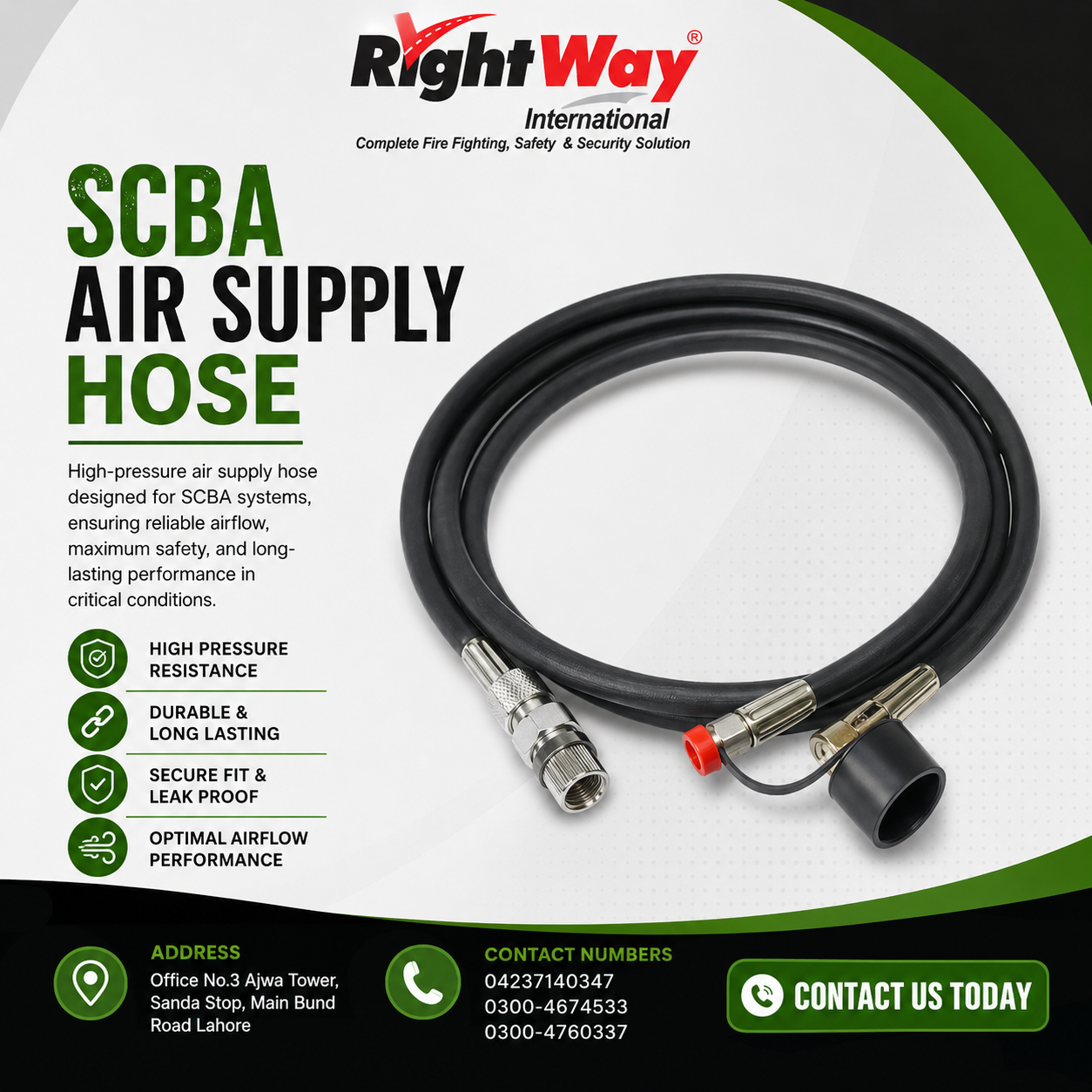
SCBA Air Supply Hose is an essential component used in Self-Contained Breathing Apparatus (SCBA) systems and related respiratory-protection equipment. It provides a flexible connection for transferring breathing air between approved SCBA components, depending on the specific equipment configuration.
In firefighting, rescue operations, industrial emergency response, hazardous-material operations, and other environments involving dangerous atmospheres, reliable breathing-air equipment is critical. An SCBA air supply hose must therefore be compatible with the complete respiratory-protection system and suitable for the pressure, environment, and application specified by the manufacturer.
The hose may connect different components of an SCBA system, such as the cylinder, pressure regulator, demand valve, or other approved breathing-air equipment. Its exact function depends on the SCBA design.
Furthermore, a properly selected SCBA Air Supply Hose can support reliable airflow, equipment flexibility, and user mobility. However, users should never treat an air supply hose as a universal component. The hose, fittings, connectors, pressure rating, and other components must match the approved SCBA system.
What Is an SCBA Air Supply Hose?
An SCBA Air Supply Hose is a flexible hose designed to carry breathing air within an approved respiratory-protection system.
The hose is manufactured to withstand the operating pressure and environmental conditions specified for its intended application. Depending on the system, it may incorporate specialized connectors, fittings, protective coverings, and routing arrangements.
In an SCBA system, the hose helps establish the airflow connection between compatible components. For example, a low-pressure hose may connect a pressure-reducing regulator to a demand valve, while other hose arrangements may be used in specialized breathing-air systems.
Because SCBA configurations differ between manufacturers and models, users should always identify the exact equipment before selecting a replacement hose.
How Does an SCBA Air Supply Hose Work?
The SCBA Air Supply Hose transports breathing air between compatible components of the respiratory-protection system.
First, compressed breathing air is stored in an approved cylinder. The cylinder supplies air through the cylinder valve and pressure-regulation components.
The pressure regulator reduces the cylinder pressure to the appropriate pressure required by the downstream components.
The air then travels through the appropriate hose toward the demand valve or other approved component. The demand valve supplies breathing air to the facepiece according to the specific SCBA design and the user’s breathing demand.
The hose must maintain its structural integrity while the wearer moves, bends, climbs, crawls, or performs emergency-response activities.
Therefore, hose routing is important. Users should ensure that the hose does not become excessively twisted, sharply bent, crushed, trapped, or exposed to conditions outside its approved operating limits.
Main Components of an SCBA Air Supply Hose
A typical SCBA Air Supply Hose Assembly may include:
- Air supply hose
- Hose tube
- Reinforcement layer
- Outer protective layer
- Hose connectors
- Couplings
- End fittings
- Sealing components
- O-rings where applicable
- Connection adapters
- Protective sleeves
- Strain-relief components
- Manufacturer-specific fittings
- Identification markings
- Pressure-rated connection components
The exact construction depends on the manufacturer, hose type, pressure rating, SCBA model, and intended application.
Consequently, replacement components should always correspond to the manufacturer’s approved specifications.
What Is an SCBA Breathing Air Hose?
An SCBA Breathing Air Hose is a hose specifically intended to transport breathing air within an approved breathing apparatus or respiratory-protection system.
Unlike ordinary industrial hoses, breathing-air hoses must be selected according to their intended application and compatibility requirements.
The hose material must be appropriate for breathing-air service, while the fittings must provide a secure connection with the corresponding SCBA components.
Furthermore, the hose must have an appropriate pressure rating and environmental suitability for the system in which it is installed.
Users should never substitute an ordinary air hose simply because its diameter or connector appears similar.
Types of SCBA Air Supply Hoses
SCBA manufacturers use different hose configurations depending on their equipment designs.
Common categories may include:
- SCBA low-pressure air hose
- SCBA medium-pressure air hose
- SCBA breathing-air hose
- SCBA regulator hose
- SCBA demand-valve hose
- SCBA connection hose
- SCBA supply hose
- High-pressure breathing-air hose
- Flexible breathing-air hose
- Reinforced SCBA hose
- Heat-resistant breathing-air hose
- Chemical-resistant breathing-air hose
- Firefighter SCBA hose
- Industrial SCBA hose
- Replacement SCBA hose
- Manufacturer-specific SCBA hose assembly
However, these terms should not be used interchangeably without checking the equipment specifications.
The correct hose depends on pressure, connection type, airflow requirements, temperature range, environmental exposure, and the manufacturer’s approved SCBA configuration.
SCBA Air Supply Hose Design
The design of an SCBA Air Supply Hose must balance flexibility, strength, pressure resistance, durability, and compatibility.
Manufacturers may consider several factors, including:
- Working pressure
- Burst pressure
- Internal diameter
- External diameter
- Hose length
- Flexibility
- Minimum bend radius
- Reinforcement
- Temperature resistance
- Chemical resistance
- Abrasion resistance
- Connector design
- Weight
- Routing requirements
- Compatibility with breathing-air components
A properly designed hose should allow the wearer or equipment to move without placing excessive mechanical stress on the hose or its connections.
SCBA Hose Pressure Rating
One of the most important specifications when selecting an SCBA Air Supply Hose is pressure rating.
SCBA cylinders store compressed breathing air at high pressure. However, the air pressure changes as it passes through different pressure-reduction stages.
Therefore, different hoses within respiratory systems may operate at different pressures.
Users should identify whether the required hose is intended for:
- High-pressure service
- Intermediate-pressure service
- Low-pressure service
- Specific regulator connection
- Demand-valve connection
- Manufacturer-specific breathing-air circuit
Never select a hose solely according to its physical appearance.
The hose must have an appropriate pressure rating for its exact location within the breathing-air system.
SCBA Hose Connectors and Fittings
SCBA Air Supply Hose Connectors provide the connection between the hose and other breathing-apparatus components.
Depending on the manufacturer and system, connectors may include specialized fittings, threaded connections, quick-connect couplings, or other approved designs.
The connector must provide a secure and reliable connection without leakage.
During inspection, trained personnel should check connectors for:
- Damage
- Cracks
- Deformation
- Corrosion
- Contamination
- Worn sealing surfaces
- Damaged threads
- Loose connections
- Damaged O-rings
- Improper fitting
Users should never force incompatible connectors together or modify fittings without manufacturer authorization.
SCBA Air Supply Hose Material
Manufacturers may construct breathing-air hoses using specialized rubber compounds, thermoplastic materials, reinforced polymers, or other approved materials.
The selected material can affect:
- Flexibility
- Pressure resistance
- Abrasion resistance
- Temperature resistance
- Chemical resistance
- Service life
- Weight
- Durability
For firefighting applications, environmental resistance is particularly important because equipment may encounter heat, smoke, water, chemicals, rough surfaces, and mechanical stress.
The correct material should therefore be selected according to the manufacturer’s specifications rather than appearance alone.
SCBA Air Supply Hose Length
SCBA Air Supply Hose Length varies according to the equipment configuration.
A hose that is too short may restrict movement or place unnecessary tension on the connections. Conversely, an unnecessarily long hose may create routing problems or increase the possibility of snagging.
The appropriate length depends on:
- SCBA model
- Component location
- Hose routing
- User mobility requirements
- Equipment configuration
- Manufacturer specifications
Replacement hoses should therefore match the approved length and configuration of the original equipment.
SCBA Air Supply Hose for Firefighters
Firefighters rely on SCBA systems when entering environments where the atmosphere may contain smoke, toxic gases, oxygen deficiency, or other respiratory hazards.
During firefighting operations, the air supply hose may be exposed to demanding conditions such as:
- High temperatures
- Smoke
- Water
- Abrasion
- Sharp surfaces
- Chemical contamination
- Repeated bending
- Equipment movement
- Confined spaces
A properly selected hose helps maintain the intended connection between SCBA components.
Firefighters should inspect the complete SCBA system before use and follow their organization’s established inspection, maintenance, fitting, and operational procedures.
SCBA Air Supply Hose for Industrial Applications
SCBA Air Supply Hoses may form part of approved respiratory-protection systems used in industrial environments.
Potential applications include:
- Chemical plants
- Oil and gas facilities
- Refineries
- Petrochemical plants
- Manufacturing facilities
- Power plants
- Industrial emergency-response teams
- Confined-space rescue
- Hazardous-material response
- Industrial fire response
- Storage facilities
- Process industries
- Emergency rescue operations
- Maintenance emergencies
The appropriate respiratory equipment depends on the workplace hazard assessment and the approval of the complete respiratory-protection system.
SCBA Air Supply Hose for Confined-Space Rescue
Confined-space operations can present serious atmospheric hazards, including oxygen deficiency and toxic or contaminated atmospheres.
SCBA equipment may be used by trained personnel where an approved SCBA is appropriate for the identified hazard.
In these environments, hose routing becomes particularly important because the wearer may need to crawl, climb, turn, or move through restricted spaces.
The hose should remain properly routed and protected from crushing, sharp edges, excessive bending, and snagging.
Users must follow the complete SCBA manufacturer’s instructions and their organization’s confined-space procedures.
Benefits of an SCBA Air Supply Hose
A suitable SCBA Air Supply Hose can provide several important benefits within an approved SCBA system.
These benefits may include:
- Reliable breathing-air connection
- Flexible equipment routing
- Improved wearer mobility
- Secure component connection
- Pressure-rated construction
- Resistance to mechanical stress
- Improved equipment organization
- Compatibility with approved SCBA components
- Support for firefighting operations
- Support for rescue operations
- Suitability for industrial applications
- Reduced unnecessary equipment movement
- Durable construction
- Easier equipment maintenance
- Professional respiratory-protection support
However, these benefits depend on correct selection, installation, inspection, maintenance, and use.
SCBA Air Supply Hose Inspection
Regular SCBA Air Supply Hose Inspection is an important part of maintaining respiratory-protection equipment.
Before use, trained personnel should inspect the hose for visible defects and verify that the connections remain secure.
Inspection may include checking for:
- Cuts
- Cracks
- Abrasion
- Fraying
- Bulges
- Flattening
- Kinks
- Deformation
- Chemical damage
- Heat damage
- Contamination
- Damaged fittings
- Loose connectors
- Damaged O-rings
- Leakage
- Improper routing
- Excessive wear
If a hose shows damage or fails the manufacturer’s acceptance criteria, it should be removed from service according to established procedures.
SCBA Air Supply Hose Maintenance
Proper SCBA Air Supply Hose Maintenance can help preserve the condition of the equipment.
Users should clean and maintain the hose according to the manufacturer’s instructions.
Maintenance procedures may include:
- Inspecting the hose before and after use.
- Checking the connectors and fittings.
- Cleaning contamination according to approved procedures.
- Checking the hose for cuts, cracks, and abrasion.
- Inspecting sealing components.
- Verifying that connections remain secure.
- Checking for signs of chemical or heat exposure.
- Storing the hose correctly.
- Avoiding unauthorized repairs.
- Replacing damaged components with approved parts.
Users should avoid solvents, harsh chemicals, excessive heat, sharp tools, or unauthorized cleaning methods that may damage the hose material.
SCBA Air Supply Hose Safety
Before using an SCBA Air Supply Hose, trained personnel should:
- Inspect the complete hose assembly.
- Check the hose for visible damage.
- Inspect all fittings and connectors.
- Confirm the correct hose pressure rating.
- Verify compatibility with the SCBA model.
- Check the cylinder and regulator connections.
- Ensure the hose is correctly routed.
- Check for leaks according to approved procedures.
- Follow manufacturer instructions.
- Perform required pre-use checks.
- Remove damaged equipment from service.
- Use only approved replacement parts.
- Never modify the hose or fittings without authorization.
Because SCBA equipment supports respiratory protection in hazardous atmospheres, users should treat hose inspection and compatibility as important safety requirements.
SCBA Air Supply Hose vs Standard Air Hose
An SCBA Air Supply Hose should not be confused with an ordinary compressed-air hose.
An SCBA breathing-air hose is selected for use within a specific respiratory-protection system and must meet the applicable requirements of that system.
A standard industrial air hose may have a completely different pressure rating, material construction, internal lining, connector design, or intended application.
Therefore, an ordinary air hose should never be substituted for an SCBA hose merely because the dimensions appear similar.
SCBA Air Supply Hose vs Supplied-Air Respirator Hose
An SCBA system and a supplied-air respirator system have different operating configurations.
An SCBA carries its breathing-air supply with the wearer, normally through a compressed-air cylinder.
A supplied-air respirator receives breathing air from an external source through a supply hose.
Although both systems use breathing-air hoses or connections, their operating requirements and configurations can differ significantly.
Therefore, users should select hoses according to the exact respiratory-protection system and manufacturer specifications.
How to Choose an SCBA Air Supply Hose
When selecting an SCBA Air Supply Hose, buyers should consider several factors.
1. SCBA Compatibility
Identify the exact SCBA manufacturer, model, and equipment configuration.
The replacement hose should be approved for use with the intended system.
2. Pressure Rating
Confirm the required working pressure and ensure that the hose is rated appropriately for that application.
3. Connector Type
Check the exact connector, coupling, thread, fitting, and sealing arrangement.
4. Hose Length
Select the manufacturer-approved length required for correct routing and equipment movement.
5. Material
Consider flexibility, abrasion resistance, temperature resistance, chemical resistance, and other environmental requirements.
6. Operating Environment
Determine whether the hose will be used in firefighting, industrial rescue, confined spaces, chemical environments, or other demanding applications.
7. Manufacturer Approval
Always verify that the hose is approved or specified for the intended SCBA system.
8. Replacement-Part Availability
Consider whether compatible connectors, seals, and other replacement components are available from an authorized supplier.
9. Condition and Quality
Inspect new and replacement hoses for damage, contamination, incorrect fittings, or other defects before installation.
SCBA Air Supply Hose Replacement
An SCBA Air Supply Hose Replacement should be performed according to the manufacturer’s approved maintenance procedures.
A hose may require replacement when it has:
- Visible cuts
- Cracks
- Severe abrasion
- Heat damage
- Chemical damage
- Deformation
- Leakage
- Damaged fittings
- Worn sealing components
- Failed inspection
- Exceeded the manufacturer’s service criteria
Users should not repair a damaged hose with tape, glue, unauthorized fittings, or other temporary methods unless the manufacturer specifically permits such a repair.
For life-support respiratory equipment, replacement should use the correct approved component.
SCBA Air Supply Hose Storage
Proper storage can help protect an SCBA Air Supply Hose from unnecessary damage.
When not in use, users should follow the manufacturer’s storage recommendations.
Generally, equipment should be protected from:
- Excessive heat
- Direct sunlight
- Chemicals
- Oils and solvents
- Sharp objects
- Excessive moisture
- Mechanical compression
- Extreme temperatures
- Contaminated environments
Hoses should not be stored in a way that creates permanent kinks, sharp bends, or unnecessary mechanical stress.
SCBA Air Supply Hose for Fire Safety Equipment
SCBA air supply hoses are an important part of professional respiratory-protection equipment used in fire and rescue operations.
They support the connection of approved SCBA components and help maintain the intended breathing-air pathway.
However, the hose is only one part of the complete system.
A complete SCBA may include:
- Breathing-air cylinder
- Cylinder valve
- Backplate
- Harness
- Pressure regulator
- Demand valve
- Facepiece
- Pressure gauge
- Hoses
- Low-pressure warning device
- Other manufacturer-specific components
All components should be maintained and operated as part of the approved system.
SCBA Air Supply Hose Standards and Certification
The applicable standards and certification requirements for an SCBA Air Supply Hose depend on the country, manufacturer, equipment type, and intended application.
Organizations should identify the applicable regulatory and certification requirements before purchasing respiratory-protection equipment.
Buyers should review:
- Manufacturer specifications
- Product certification
- Pressure ratings
- Material specifications
- Compatibility information
- Inspection requirements
- Maintenance requirements
- Applicable workplace regulations
- Applicable respiratory-protection standards
Certification of one component does not automatically mean that the component is compatible with every SCBA system.
Therefore, complete-system compatibility remains essential.
SCBA Air Supply Hose Price in Pakistan
The SCBA Air Supply Hose Price in Pakistan varies according to the manufacturer, SCBA model, hose length, pressure rating, connector type, material, certification, construction quality, and technical specifications.
Specialized firefighter SCBA hoses may cost more than general-purpose hoses because they are designed for specific respiratory-protection applications.
Therefore, buyers should compare:
- Quality
- Compatibility
- Pressure rating
- Certification
- Manufacturer specifications
- Material
- Durability
- Hose length
- Connector type
- Service support
- Replacement availability
Selecting the lowest-priced hose may not be appropriate when the component forms part of professional respiratory-protection equipment.
SCBA Air Supply Hose in Pakistan
SCBA Air Supply Hose in Pakistan is used as part of professional SCBA and breathing-apparatus equipment for firefighting, rescue, industrial emergency response, hazardous-material operations, and other approved applications.
When purchasing an SCBA Air Supply Hose in Pakistan, buyers should provide the supplier with the exact SCBA brand and model.
This information helps identify the correct hose length, pressure rating, connector configuration, and compatibility requirements.
Furthermore, buyers should prioritize genuine, compatible, and manufacturer-approved components for professional respiratory-protection systems.
Common Applications of SCBA Air Supply Hose
SCBA Air Supply Hose Systems may support approved respiratory-protection equipment in applications such as:
- Firefighting
- Fire rescue
- Industrial emergency response
- Confined-space rescue
- Hazardous-material response
- Chemical emergency response
- Oil and gas facilities
- Refineries
- Petrochemical plants
- Manufacturing facilities
- Power plants
- Industrial rescue
- Emergency-response teams
- Disaster response
- Smoke-filled environments
- Oxygen-deficient environments
- Hazardous-atmosphere operations
- Emergency evacuation
- Rescue operations
The exact application must always correspond to the certification, design, and approval of the complete respiratory-protection system.
Frequently Asked Questions
What is an SCBA Air Supply Hose?
An SCBA Air Supply Hose is a flexible, pressure-rated hose used to transfer breathing air between compatible components of an approved SCBA or breathing-apparatus system.
What does an SCBA air supply hose do?
It provides an airflow connection between specified SCBA components, such as a regulator and demand valve, according to the particular equipment configuration.
Can any air hose be used for SCBA?
No. Ordinary compressed-air hoses should not be substituted for an SCBA hose. The hose must have the correct pressure rating, material, fittings, and system compatibility.
What pressure does an SCBA air supply hose handle?
The required pressure depends on the exact location of the hose within the SCBA system. Users should check the manufacturer’s specifications for the applicable working pressure.
How often should an SCBA air supply hose be inspected?
The hose should be inspected according to the manufacturer’s instructions and the organization’s SCBA inspection procedures, including required pre-use inspections.
When should an SCBA air supply hose be replaced?
A hose should be removed from service and replaced when it shows unacceptable cuts, cracks, severe abrasion, heat or chemical damage, leakage, fitting damage, or any other condition outside the manufacturer’s acceptance criteria.
Can an SCBA air supply hose be repaired?
Users should not perform unauthorized repairs. Damaged hoses should be handled according to the manufacturer’s approved repair or replacement procedures.
Can SCBA hoses from different manufacturers be mixed?
Not necessarily. Physical compatibility does not guarantee safe or approved compatibility. Users should verify compatibility with the complete SCBA manufacturer’s specifications.
Where are SCBA air supply hoses used?
They may be used as components of approved SCBA systems for firefighting, rescue operations, industrial emergency response, hazardous-material response, confined-space rescue, and other hazardous-atmosphere applications.
Where can I buy an SCBA Air Supply Hose in Pakistan?
Buyers should contact a reputable respiratory-protection or fire-safety equipment supplier and provide the exact SCBA manufacturer and model. This allows the supplier to identify the correct compatible hose assembly.
Breathing Apparatus Backplate and Harness
What Is a Breathing Apparatus Backplate and Harness?
A Breathing Apparatus Backplate and Harness is the carrying and support assembly that secures an SCBA cylinder and associated components to the wearer.
The backplate provides the primary structural support for the breathing apparatus. Usually, it sits against the user’s back and connects to the cylinder mounting mechanism.
Meanwhile, the harness connects the backplate to the wearer through shoulder straps and, depending on the design, waist or hip straps.
During operation, the harness distributes the equipment load across the shoulders, back, and hips. As a result, it helps maintain the correct position of the SCBA while the wearer moves, bends, climbs, crawls, or performs emergency-response activities.