



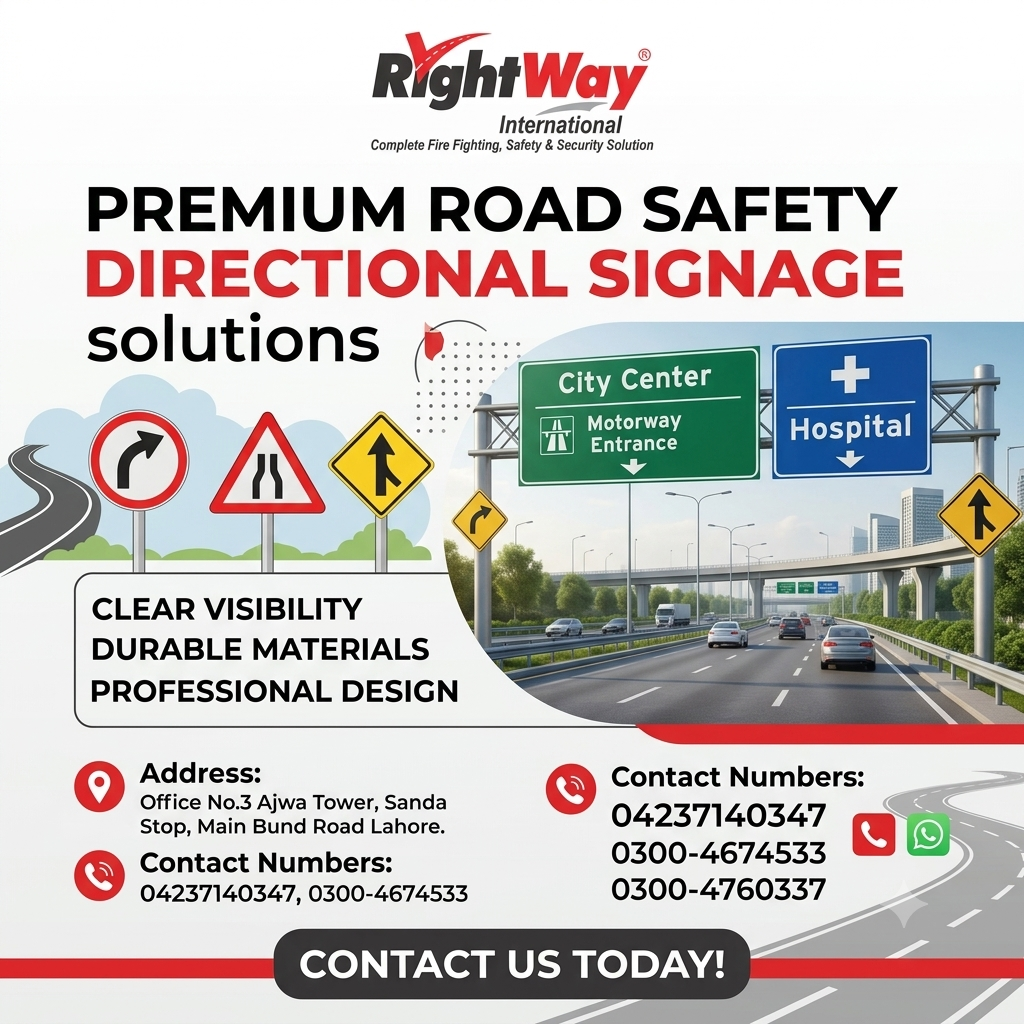
Road Safety Directional Signage in Pakistan plays a vital role in guiding drivers, pedestrians, cyclists, and other road users safely and efficiently across highways, motorways, urban roads, rural streets, commercial zones, industrial areas, and residential communities. These signs provide clear directions, route information, destination guidance, lane instructions, and traffic management support, helping reduce confusion, improve road safety, and enhance transportation efficiency.
Unlike regulatory or warning signs, road safety directional signage is specifically designed to provide navigation and route guidance using internationally recognized symbols, standardized colors, arrows, and clear text. These signs help motorists locate destinations, identify road routes, find emergency facilities, and travel safely with minimal delays.
Furthermore, road safety directional signage significantly contributes to reducing traffic congestion, preventing wrong turns, minimizing accidents, and improving overall road user experience. These signs are widely installed on motorways, national highways, expressways, city roads, airports, railway stations, bus terminals, hospitals, industrial zones, educational institutions, shopping malls, tourist attractions, government buildings, and commercial centers throughout Pakistan.
According to international road traffic standards and local transportation regulations, directional road signs should be properly designed, installed, maintained, and regularly inspected to ensure maximum visibility, readability, and effectiveness under all weather and lighting conditions.
Benefits of Road Safety Directional Signage
1. Improved Road Navigation
First, road safety directional signage provides clear route guidance for drivers and pedestrians. Consequently, travelers reach their destinations safely and efficiently.
2. Reduced Traffic Confusion
Moreover, well-placed directional signs minimize driver uncertainty at intersections, roundabouts, highways, and complex road networks. As a result, traffic flow becomes smoother.
3. Enhanced Road Safety
Additionally, directional signs reduce sudden lane changes, wrong turns, and dangerous driving behaviors. Therefore, road accidents are significantly minimized.
4. Faster Emergency Access
Furthermore, directional signage helps emergency responders quickly locate hospitals, fire stations, police stations, and emergency facilities, reducing response times.
5. Supports Tourism
Road directional signs assist domestic and international tourists by guiding them toward historical landmarks, hotels, airports, museums, parks, and recreational destinations.
6. Compliance with Traffic Regulations
Proper directional signage helps road authorities comply with national highway standards, municipal regulations, and international road safety guidelines.
7. Cost-Effective Traffic Management
Most importantly, road safety directional signage provides continuous navigation assistance without requiring electronic systems, making it an economical long-term traffic management solution.
Types of Road Safety Directional Signage
1. Highway Direction Signs
Guide drivers toward cities, towns, districts, and motorway exits.
2. Route Confirmation Signs
Confirm that motorists are traveling on the correct road or highway.
3. Advance Direction Signs
Provide advance notice of upcoming intersections, exits, or route changes.
4. Exit Direction Signs
Indicate motorway and highway exit locations.
5. Lane Direction Signs
Show which lanes should be used for specific destinations or turning movements.
6. Destination Signs
Identify nearby cities, commercial areas, industrial zones, airports, and tourist attractions.
7. Parking Direction Signs
Guide drivers toward public parking facilities and parking zones.
8. Hospital Direction Signs
Direct road users to nearby hospitals and emergency medical centers.
9. Airport Direction Signs
Provide navigation toward airports, terminals, and aviation facilities.
10. Tourist Information Signs
Guide visitors toward museums, historical monuments, parks, beaches, and recreational areas.
Common Road Safety Directional Signs
Modern road directional signage includes:
- Straight Ahead
- Left Turn
- Right Turn
- U-Turn
- One Way
- Roundabout Direction
- Motorway Entrance
- Motorway Exit
- Airport
- Railway Station
- Bus Terminal
- Hospital
- Police Station
- Parking
- Fuel Station
- Rest Area
- Tourist Attraction
- City Centre
- Industrial Area
- Emergency Route
These signs help improve navigation, reduce travel delays, and enhance road safety.
Common Uses of Road Safety Directional Signage in Pakistan
Road safety directional signage is installed across Pakistan wherever efficient traffic guidance and road safety are essential.
For example, motorways use directional signage to guide motorists toward exits, interchanges, service areas, and toll plazas.
Similarly, airports install directional signs to help passengers locate terminals, parking areas, and arrival or departure facilities.
Moreover, hospitals rely on directional signage to direct emergency vehicles and visitors toward emergency departments and specialized medical services.
In addition, universities, shopping malls, industrial estates, business parks, ports, railway stations, bus terminals, hotels, and tourist destinations use directional signs to improve accessibility and visitor convenience.
Meanwhile, government offices, military installations, residential communities, logistics centers, warehouses, manufacturing facilities, and commercial buildings install road directional signage to improve traffic organization and reduce congestion.
Therefore, road safety directional signage remains an essential component of modern transportation infrastructure throughout Pakistan.
Benefits Compared to Verbal Directions
1. Instant Visual Guidance
Directional signs provide immediate navigation without relying on verbal assistance.
2. Universal Understanding
Standardized symbols and arrows are recognized regardless of language barriers.
3. Continuous Navigation Support
Road signs remain visible day and night, offering uninterrupted travel guidance.
4. Faster Route Decisions
Drivers can make safe and timely decisions before reaching intersections or exits.
5. Improved Traffic Efficiency
Proper directional signage supports smoother traffic movement and reduces congestion.
Fire Safety Warning Signs
Fire safety warning signs are installed across Pakistan wherever fire protection and emergency preparedness are essential.
For example, airports use fire safety signage to guide passengers toward emergency exits and firefighting equipment.
Similarly, hospitals install fire signs to support the safe evacuation of patients, staff, and visitors.
Moreover, schools, universities, shopping malls, hotels, factories, warehouses, and office buildings rely on standardized fire safety signs to improve emergency response.
In addition, oil and gas facilities, power plants, construction sites, and manufacturing industries use fire warning signs to identify hazardous materials and restricted areas.
Meanwhile, government buildings, military facilities, banks, transportation terminals, and commercial complexes install fire safety signage to protect people and critical infrastructure.
Therefore, fire safety warning signs remain an essential component of modern fire protection systems throughout Pakistan.
How Road Safety Directional Signage Works
First, directional signs are strategically installed before intersections, exits, junctions, roundabouts, and important destinations.
Next, drivers identify standardized colors, arrows, route numbers, symbols, and destination names.
Then, motorists follow the displayed guidance while maintaining safe driving practices.
During unfamiliar journeys, travelers use directional signs to navigate efficiently.
Consequently, travel becomes safer, faster, and more organized.
Finally, emergency services, delivery vehicles, public transport operators, and tourists benefit from improved route identification and navigation.
Components of Road Safety Directional Signage
A typical directional road sign may include:
- Directional Arrow
- Destination Name
- Route Number
- Distance Information
- Highway Symbol
- International Traffic Symbols
- Reflective Sheeting
- High-Visibility Colors
- Aluminum Sign Panel
- Galvanized Steel Pole
- Weather-Resistant Coating
- Retroreflective Material
- UV Protection Layer
- Mounting Brackets
- Standardized Fonts
Together, these components ensure excellent visibility, durability, and readability.
Maintenance Requirements
Regular maintenance ensures that road safety directional signage remains accurate and effective.
Maintenance activities typically include:
- Inspecting sign visibility
- Cleaning reflective surfaces
- Replacing damaged signs
- Tightening mounting hardware
- Checking retroreflective performance
- Repairing faded graphics
- Trimming vegetation around signs
- Updating destination information
- Verifying alignment
- Ensuring regulatory compliance
Routine maintenance improves road safety and long-term traffic management.
Advantages of Road Safety Directional Signage
These signs offer numerous advantages:
- Improve road navigation
- Reduce driver confusion
- Support safe driving
- Enhance traffic flow
- Minimize wrong turns
- Reduce accident risks
- Improve emergency response
- Increase transportation efficiency
- Support tourism
- Improve accessibility
- Enhance public safety
- Strengthen traffic management
- Reduce travel time
- Improve route planning
- Support smart transportation systems
Applications of Road Safety Directional Signage
Common applications include:
- Motorways
- National Highways
- Expressways
- Urban Roads
- Rural Roads
- Airports
- Railway Stations
- Bus Terminals
- Hospitals
- Universities
- Schools
- Shopping Malls
- Hotels
- Industrial Areas
- Logistics Centers
- Government Buildings
- Tourist Attractions
- Residential Communities
- Commercial Complexes
- Ports and Harbors
In conclusion, Road Safety Directional Signage in Pakistan is an essential traffic management solution that improves road navigation, enhances transportation efficiency, supports emergency response, and protects road users. Its standardized design, reflective materials, clear symbols, and durable construction make it indispensable on highways, urban roads, industrial facilities, commercial areas, and public infrastructure.
Ultimately, properly designed, installed, inspected, and maintained road safety directional signage enhances traffic safety, improves driver confidence, supports regulatory compliance, reduces road accidents, and contributes to a safer and more organized transportation system throughout Pakistan.