




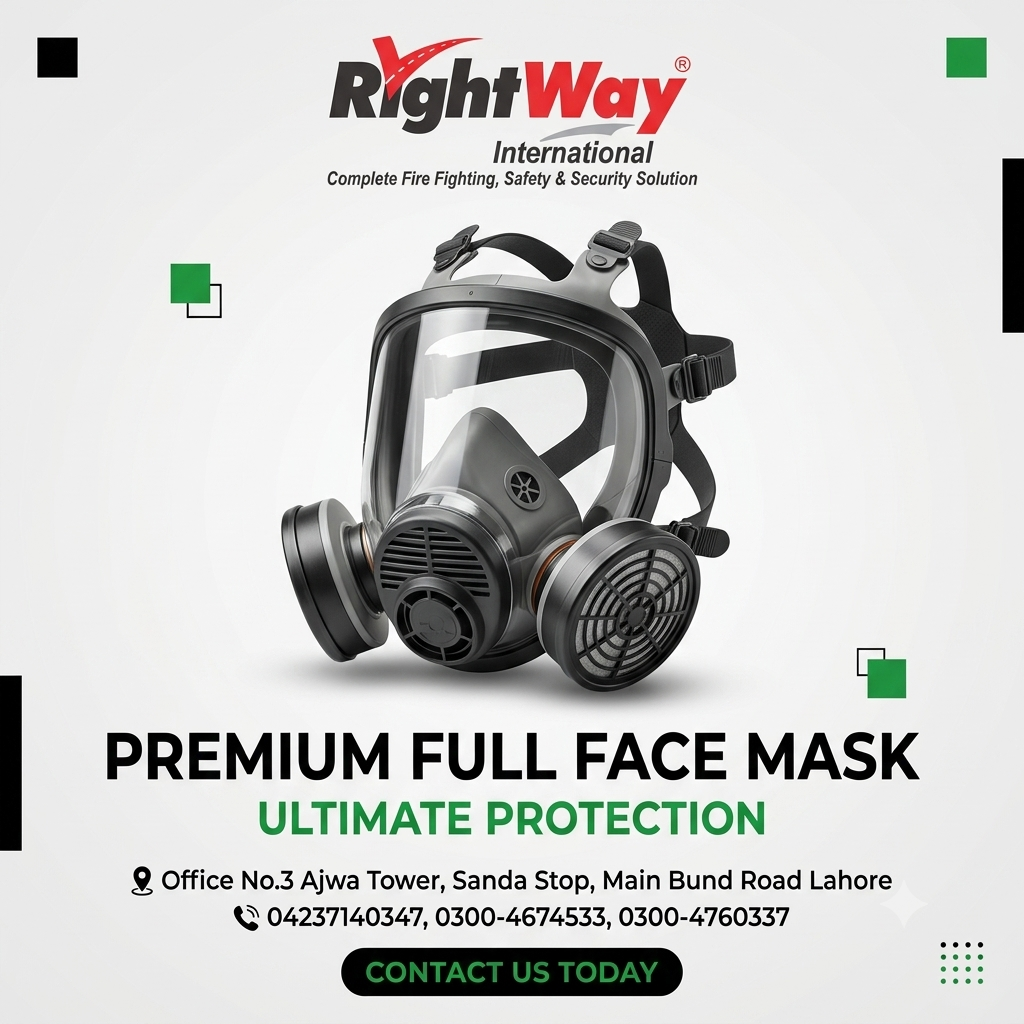
Full Face Mask in Pakistan is an important type of respiratory and eye protection equipment designed to protect the wearer from hazardous airborne substances, gases, vapors, dust, fumes, mists, and other workplace contaminants. Unlike half-face respirators, a full face mask covers the eyes, nose, and mouth, providing respiratory protection together with eye and facial coverage.
Full face masks are commonly used in chemical plants, pharmaceutical factories, manufacturing facilities, laboratories, paint industries, oil and gas facilities, industrial workshops, emergency-response operations, and other workplaces where workers may encounter respiratory and eye hazards.
Depending on the design and filter or cartridge configuration, a full face respirator can be used for protection against specific contaminants. However, the correct respirator must always be selected according to the identified hazard, contaminant concentration, oxygen level, workplace conditions, applicable certification, and manufacturer’s instructions.
A typical full face mask respirator may include a facepiece, visor or lens, inhalation and exhalation valves, head harness, nose cup, filter or cartridge connections, breathing-air channels, and sealing components. Exact features vary according to the manufacturer and model.
For workplaces in Pakistan, employers should establish an appropriate respiratory protection program before deploying full face respirators. The program should address respirator selection, medical evaluation, fit testing, training, cleaning, inspection, maintenance, storage, and replacement requirements.
The Occupational Safety and Health Administration (OSHA) provides respiratory protection requirements for covered workplaces through 29 CFR 1910.134. The standard addresses important areas such as respirator selection, medical evaluation, fit testing, proper use, maintenance, training, and respiratory protection program administration.
OSHA Respiratory Protection Standard: 29 CFR 1910.134
Benefits of Full Face Mask
Provides Respiratory Protection
A full face mask respirator can provide respiratory protection when fitted with the appropriate filters, cartridges, or other approved components.
The selected filter or cartridge must be suitable for the specific contaminant and workplace conditions.
Workers should never assume that one filter protects against every type of gas, vapor, dust, or chemical.
Protects the Eyes
One major advantage of a full face respirator is that it also covers the eyes.
The large visor protects the wearer from airborne particles, splashes, and other hazards when the respirator is approved for the intended application.
This makes a full face mask useful in workplaces where respiratory and eye hazards exist together.
Covers the Face
A full face mask creates a sealing surface around the face.
When correctly fitted and used according to the manufacturer’s instructions, the facepiece helps direct inhaled air through the respirator’s filtration or cartridge system.
Suitable for Chemical Applications
Full face masks are commonly used in certain chemical-handling applications where workers may encounter hazardous gases, vapors, or particles.
The correct cartridge or filter must be selected according to the chemical hazard.
Chemical compatibility should also be considered when selecting the facepiece and other components.
Useful in Industrial Environments
Manufacturing plants, workshops, laboratories, pharmaceutical facilities, paint operations, and chemical industries may use full face respirators where airborne contaminants create a respiratory or eye hazard.
The exact application depends on the respirator’s approval and limitations.
Provides a Wider Field of Protection
A properly designed full facepiece can provide a broader protective area than a half-mask respirator.
The large visor can also provide a useful field of view for workers performing industrial tasks.
Main Components of Full Face Mask
A full face mask breathing respirator contains several components that work together to provide respiratory and eye protection.
Full Facepiece
The full facepiece covers the wearer’s eyes, nose, mouth, and surrounding facial area.
The facepiece creates the primary seal between the respirator and the wearer’s face.
Visor or Lens
The visor provides eye protection and allows the wearer to see while working.
Different manufacturers use different lens materials, coatings, shapes, and designs.
Workers should check the manufacturer’s specifications for impact resistance, chemical resistance, optical properties, and other relevant characteristics.
Head Harness
The head harness secures the facepiece to the wearer’s head.
Adjustable straps allow trained users to achieve the correct fit according to the manufacturer’s instructions.
Inhalation Valve
The inhalation valve controls the direction of airflow into the facepiece.
Air passes through the approved filter or cartridge system before reaching the wearer.
Exhalation Valve
The exhalation valve allows exhaled air to leave the facepiece.
The valve should remain clean and free from contamination or damage.
Nose Cup
Some full face respirators include an internal nose cup.
The nose cup helps manage airflow and can reduce fogging of the visor by directing exhaled air toward the exhalation system.
Filter or Cartridge Connection
Depending on the respirator design, filters or cartridges may connect directly to the facepiece.
The correct filter or cartridge must be selected for the identified workplace hazard.
Sealing Surface
The sealing surface is the area where the facepiece contacts the wearer’s face.
A proper seal is essential for the respirator to provide its intended protection.
Types of Full Face Mask
Full Face Respirator with Filters
A full face respirator with filters is designed to protect against specific particulate hazards when used with approved particulate filters.
These systems may be suitable for environments containing dust, mist, fumes, or other particles, depending on the filter approval.
Full Face Respirator with Gas Cartridges
Gas cartridges can be used with compatible full face respirators for specific gases or vapors.
The cartridge must be selected according to the contaminant and concentration.
Full Face Respirator with Combination Filters
Some respirators use combination filters that provide protection against both particulate matter and specific gases or vapors.
The exact protection depends on the approval and cartridge configuration.
Reusable Full Face Mask
Reusable full face respirators are designed to be cleaned, inspected, maintained, and reused according to the manufacturer’s instructions.
They are commonly used in industrial environments where respiratory protection is required repeatedly.
Powered Air-Purifying Full Face Respirator
Some powered respirator systems use a powered blower to move air through filters before supplying it to the facepiece.
These systems have different operating principles and requirements from conventional negative-pressure respirators.
Supplied-Air Full Face Respirator
A supplied-air respirator receives breathing air from an external source rather than relying solely on filters or cartridges.
These systems are used for specific applications where supplied breathing air is required.
Key Features of Full Face Mask
Common features of full face respirators include:
- Full-face coverage
- Large protective visor
- Adjustable head harness
- Inhalation valves
- Exhalation valve
- Replaceable filters
- Replaceable cartridges
- Comfortable face seal
- Nose cup
- Wide field of view
- Lightweight construction
- Chemical-resistant materials
- Adjustable straps
- Anti-fogging features
- Secure filter connections
- Replaceable components
However, features vary between manufacturers and models.
Organizations should always review the manufacturer’s technical specifications before purchasing or deploying a full face mask.
Common Applications in Pakistan
| Industry | Application | Full Face Mask Use |
|---|---|---|
| Chemical Plants | Chemical handling | Full face respirator |
| Pharmaceutical | Powder and chemical handling | Full face mask |
| Paint Industry | Paint and solvent applications | Full face respirator |
| Oil & Gas | Gas and vapor hazards | Approved full face respirator |
| Refineries | Chemical and vapor exposure | Full face respiratory protection |
| Manufacturing | Dust and fumes | Full face mask |
| Laboratories | Chemical handling | Full face respirator |
| Textile Industry | Dust and chemical processes | Respiratory protection |
| Steel Mills | Dust and fumes | Full face respirator |
| Food Processing | Cleaning chemicals | Full face protection |
| Waste Treatment | Hazardous airborne contaminants | Full face respirator |
| Industrial Workshops | Dust, fumes, and chemicals | Full face mask |
| Emergency Response | Hazardous-material incidents | Suitable full face respirator |
| Agricultural Operations | Certain chemical applications | Approved respiratory protection |
How Full Face Mask Works
First, a trained worker identifies the respiratory and eye hazards present in the workplace.
Next, the organization selects a respirator approved for the specific hazard.
The worker then inspects the full face mask, including the facepiece, visor, straps, valves, seals, filters, cartridges, and other components.
After that, the worker puts on the respirator according to the manufacturer’s instructions.
When the user inhales, contaminated workplace air passes through the appropriate filter or cartridge system.
The filter or cartridge removes or reduces specific contaminants according to its design and approval.
The cleaned air then enters the facepiece.
When the user exhales, exhaled air leaves through the exhalation valve.
The process continues while the respirator is being used correctly and remains within its approved operating conditions.
A full face mask does not automatically make every hazardous atmosphere safe. It must be appropriate for the contaminant, concentration, oxygen level, and workplace conditions.
Full Face Mask for Chemical Protection
Chemical workplaces may expose workers to gases, vapors, mists, or particulate contaminants.
A full face respirator can provide both respiratory and eye protection when the correct respirator and cartridge combination is selected.
Before selecting a respirator, organizations should identify:
- Chemical name
- Physical form
- Concentration
- Exposure level
- Workplace temperature
- Oxygen concentration
- Potential for splashes
- Required operating duration
- Cartridge compatibility
- Manufacturer limitations
Workers should never use an unknown cartridge for an unidentified chemical hazard.
When the atmosphere is unknown, oxygen-deficient, immediately dangerous to life or health, or outside the respirator’s approved limitations, an air-purifying full face respirator may not be appropriate.
Full Face Mask and Oxygen-Deficient Atmospheres
An important limitation of air-purifying respirators is that they generally do not provide oxygen.
Therefore, a conventional filter or cartridge full face respirator should not be treated as an independent breathing-air source.
Oxygen-deficient atmospheres can present an immediate and serious hazard.
Before entering a potentially hazardous atmosphere, employers should conduct appropriate atmospheric assessment and determine the correct respiratory protection.
Where conditions require supplied breathing air or self-contained breathing apparatus, organizations should use equipment specifically approved for that application.
Full Face Mask Selection Guide
When selecting a full face mask in Pakistan, organizations should consider several important factors.
Hazard Identification
First, identify the contaminants that workers may encounter.
Consider:
- Dust
- Fumes
- Mists
- Gases
- Vapors
- Chemical aerosols
- Biological particles
- Toxic substances
- Unknown contaminants
Contaminant Concentration
Determine the expected concentration of the contaminant.
Respirator selection depends not only on the type of contaminant but also on its concentration.
Oxygen Level
Determine whether the workplace has sufficient oxygen.
Air-purifying respirators should not be used as a substitute for supplied-air or SCBA equipment in oxygen-deficient environments.
Filter Selection
Select the correct filter according to the identified particulate hazard.
Do not use a filter beyond its approved application.
Cartridge Selection
For gases and vapors, select the appropriate cartridge based on the specific contaminant.
Different cartridges provide protection against different substances.
Face Fit
A full face respirator must achieve an appropriate seal.
Facial hair, scars, facial shape, and other conditions can interfere with the sealing surface.
Organizations should follow applicable fit-testing requirements.
Comfort
Workers may need to wear respiratory protection for extended periods.
Therefore, weight, strap design, visor design, breathing resistance, and overall comfort should be considered.
Certification
Before purchasing a full face mask, verify the relevant certification and approval for the intended application.
Full Face Mask Safety Practices
A full face respirator should be part of a complete respiratory protection program.
Organizations should:
- Identify workplace hazards.
- Conduct a suitable risk assessment.
- Select the appropriate respirator.
- Select compatible filters or cartridges.
- Complete required medical evaluations.
- Perform fit testing where applicable.
- Train workers before use.
- Inspect the respirator before use.
- Check the face seal.
- Inspect the visor.
- Check inhalation and exhalation valves.
- Inspect filters and cartridges.
- Follow cartridge replacement procedures.
- Clean the respirator correctly.
- Store equipment properly.
- Replace damaged components.
- Follow manufacturer instructions.
Most importantly, workers should never use a respirator outside its approved limitations.
Full Face Mask Inspection and Maintenance
Regular inspection can help identify damaged components before the respirator is used.
Inspect the following:
- Facepiece
- Visor
- Head harness
- Straps
- Inhalation valves
- Exhalation valve
- Valve covers
- Nose cup
- Filter connections
- Cartridges
- Seals
- Gaskets
- Buckles
- Other manufacturer-specified components
Look for:
- Cracks
- Cuts
- Tears
- Chemical damage
- Discoloration
- Deformation
- Loose components
- Damaged straps
- Contamination
- Damaged valves
- Poor seals
- Scratched or damaged visor
Damaged equipment should be removed from service and repaired or replaced according to the manufacturer’s requirements.
Cleaning a Full Face Mask
Proper cleaning is important when reusable respirators are used.
Cleaning procedures should follow the manufacturer’s instructions.
In general, organizations should:
- Remove filters or cartridges where applicable.
- Separate removable components according to the manufacturer’s instructions.
- Clean the facepiece using an approved cleaning method.
- Rinse components where required.
- Allow components to dry completely.
- Inspect the respirator.
- Reassemble the components correctly.
- Store the respirator in a clean and protected location.
Do not use cleaning chemicals that can damage the facepiece, visor, valves, seals, or other components.
Full Face Mask Storage
Correct storage helps protect the respirator from contamination and damage.
Store full face masks:
- In a clean location
- Away from direct sunlight
- Away from excessive heat
- Away from chemicals
- Away from dust
- Away from moisture when required
- In a suitable protective container or bag
- Without crushing or deforming the face seal
The visor should also be protected from scratches and unnecessary contact with contaminated surfaces.
Full Face Mask Training
Workers need proper training before using a full face respirator.
Training should cover:
- Respirator components
- Correct donning procedure
- Correct removal procedure
- Face seal
- Fit testing
- Filter selection
- Cartridge selection
- Cartridge limitations
- Respirator limitations
- Cleaning
- Inspection
- Storage
- Maintenance
- Emergency procedures
- Workplace-specific hazards
Workers should also understand when they must leave a hazardous area.
Training should be refreshed according to the organization’s respiratory protection program and applicable requirements.
Full Face Mask Fit Testing
Fit testing is an important part of respiratory protection for tight-fitting respirators.
A full face mask must achieve an appropriate seal around the wearer’s face.
Several factors can affect the seal, including:
- Facial hair
- Face shape
- Facial scars
- Incorrect strap adjustment
- Incorrect respirator size
- Damaged sealing surfaces
- Improper donning
Employers should follow applicable respiratory protection requirements for fit testing and ensure workers use a properly fitted respirator.
Full Face Mask Limitations
Although full face respirators provide important protection, they have limitations.
A full face mask may not be appropriate when:
- The atmosphere is oxygen-deficient.
- The contaminant is unknown.
- The concentration exceeds the respirator’s approved limits.
- The contaminant is outside the filter or cartridge capability.
- The respirator is damaged.
- The facepiece cannot achieve a proper seal.
- The wearer has facial hair that interferes with the seal.
- The environment requires supplied breathing air.
- The workplace conditions exceed the manufacturer’s specifications.
In these situations, a different respiratory protection system may be required.
Full Face Mask vs Half Face Mask
A full face mask and a half face mask provide different levels of coverage.
| Feature | Full Face Mask | Half Face Mask |
| Nose Protection | Yes | Yes |
| Mouth Protection | Yes | Yes |
| Eye Protection | Yes | No |
| Face Coverage | Higher | Lower |
| Field of View | Designed for broad coverage | Not applicable to eye protection |
| Filter/Cartridge Options | Depends on model | Depends on model |
| Suitable Applications | Respiratory + eye hazards | Respiratory hazards |
| Fit Testing | Required where applicable | Required where applicable |
The correct choice depends on the workplace hazard assessment.
Full Face Mask vs SCBA
A full face air-purifying respirator and Self Contained Breathing Apparatus (SCBA) are not interchangeable.
A conventional full face air-purifying respirator depends on filters or cartridges to reduce specific contaminants.
An SCBA provides breathing air from a compressed-air cylinder.
SCBA may be required for environments involving oxygen deficiency, unknown atmospheres, or conditions where air-purifying respirators cannot provide adequate protection.
The selection should always be based on the workplace hazard assessment and applicable requirements.
OSHA and Full Face Respirators
The Occupational Safety and Health Administration (OSHA) respiratory protection standard, 29 CFR 1910.134, establishes requirements for respiratory protection programs in covered workplaces.
The standard includes requirements related to:
- Respirator selection
- Medical evaluation
- Fit testing
- Proper use
- Respirator cleaning
- Maintenance
- Storage
- Training
- Program evaluation
- Workplace-specific procedures
Organizations should review the applicable requirements and establish a respiratory protection program suitable for their operations.
Why Full Face Mask Matters
Workers can encounter airborne contaminants in many industrial environments.
Dust, fumes, chemical vapors, gases, mists, and other airborne substances can create serious respiratory hazards.
A properly selected full face mask can provide respiratory protection while also covering the eyes.
This combination makes full face respirators useful in many industrial applications.
For organizations in Pakistan, full face respirators can support safety programs in:
- Chemical plants
- Pharmaceutical factories
- Oil and gas facilities
- Refineries
- Manufacturing plants
- Paint industries
- Laboratories
- Power plants
- Steel mills
- Industrial workshops
- Waste-treatment facilities
- Emergency-response operations
- Confined-space support operations
However, the respirator must always match the identified hazard and must be used within its approved limitations.
Self Contained Breathing Apparatus
Hazardous atmospheres can expose workers and emergency responders to serious respiratory risks.
Smoke, toxic gases, chemical vapors, and oxygen-deficient environments can make normal breathing unsafe.
A properly selected Self Contained Breathing Apparatus provides an independent breathing-air supply and can support trained personnel during firefighting, rescue, hazardous-material response, and other specialized operations.
Full Face Mask for Industrial Safety Programs
Full Face Mask provides an important combination of respiratory and eye protection for trained workers exposed to specific airborne hazards.
Its facepiece, visor, filters or cartridges, valves, head harness, seals, and other components work together to provide protection within the equipment’s approved operating conditions.
Organizations in Pakistan should select full face respirators according to hazard type, contaminant concentration, oxygen level, filter requirements, cartridge compatibility, face fit, certification, workplace conditions, operating duration, training requirements, maintenance procedures, and manufacturer instructions.
Whether used in chemical plants, pharmaceutical facilities, oil and gas operations, refineries, manufacturing facilities, laboratories, paint industries, industrial workshops, emergency-response teams, or other hazardous workplaces, a properly selected and maintained full face respirator can play an important role in workplace respiratory and eye protection.