




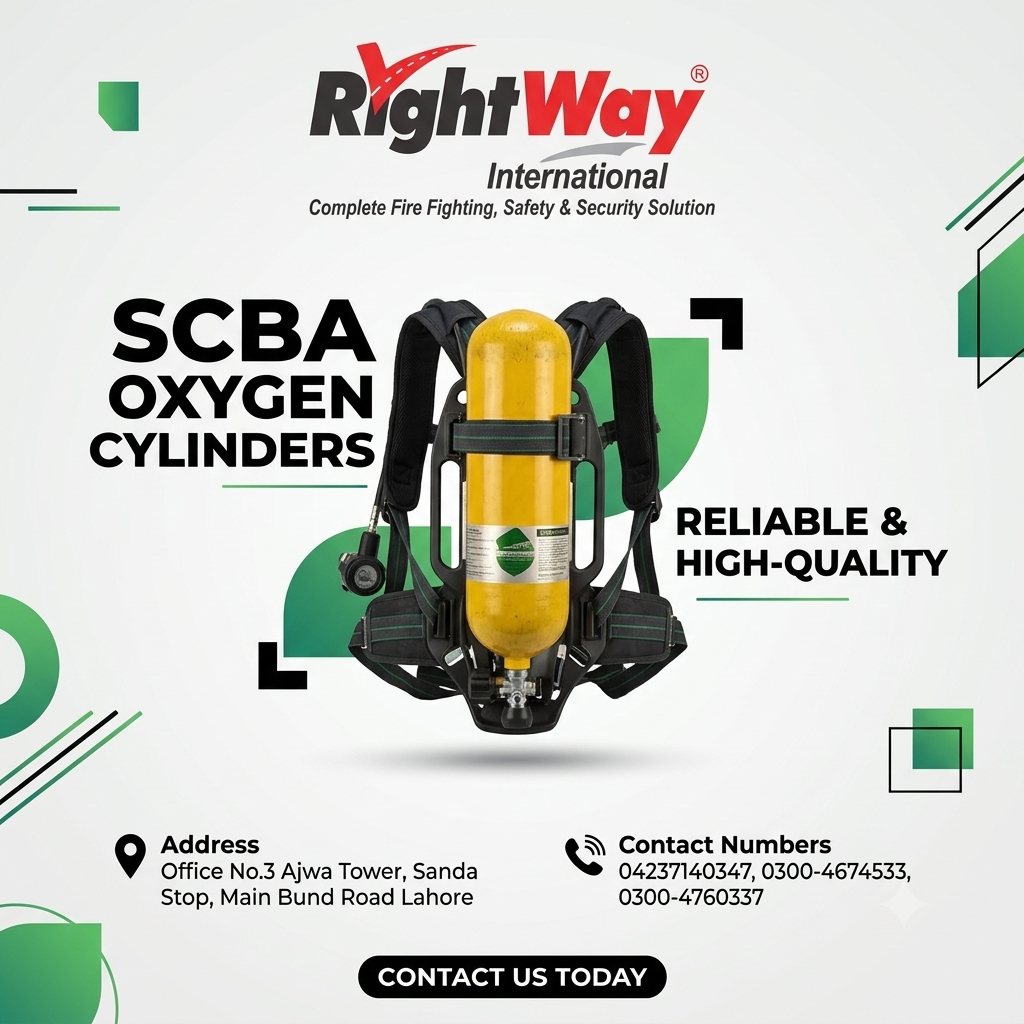
SCBA Oxygen Cylinders in Pakistan is a commonly searched term for breathing-air cylinders used with Self Contained Breathing Apparatus (SCBA). However, conventional SCBA systems normally use compressed breathing air cylinders, rather than cylinders filled with pure oxygen.
An SCBA air cylinder stores compressed breathing air and supplies it to the wearer through the SCBA regulator and facepiece. As a result, trained users can operate in certain hazardous atmospheres without depending on the surrounding air for breathing.
Fire departments, chemical plants, oil and gas facilities, refineries, pharmaceutical factories, power plants, manufacturing facilities, and industrial rescue teams commonly use SCBA systems. Furthermore, emergency-response teams may rely on SCBA equipment during fires, chemical releases, confined-space rescues, and other hazardous operations.
A typical SCBA cylinder includes a cylinder body, cylinder valve, pressure indication system, identification markings, and protective components. In addition, the cylinder must remain compatible with the SCBA regulator, backplate, harness, and other components.
When organizations select SCBA cylinders in Pakistan, they should consider the hazard, required operating duration, cylinder capacity, working pressure, certification, inspection requirements, SCBA compatibility, storage conditions, and manufacturer instructions. as per Occupational Safety and Health Administration (OSHA) standers.
It is also important to distinguish between breathing air and pure oxygen. Although people often search for “SCBA oxygen cylinders,” conventional SCBA equipment generally uses compressed breathing air. Therefore, users should never assume that an oxygen cylinder and an SCBA air cylinder serve the same purpose.
What Is an SCBA Air Cylinder?
An SCBA air cylinder is a high-pressure cylinder that stores compressed breathing air for a Self Contained Breathing Apparatus system.
When a trained user activates the SCBA, compressed air moves from the cylinder through the cylinder valve and regulator. The regulator then reduces the pressure and supplies breathing air to the facepiece.
As a result, the wearer receives breathing air without depending on the surrounding atmosphere.
However, the SCBA cylinder does not make every hazardous environment safe. Users must select the complete SCBA system according to the identified hazard, atmospheric conditions, and manufacturer requirements.
SCBA Air Cylinder vs Oxygen Cylinder
The difference between an SCBA air cylinder and an oxygen cylinder is important.
| Feature | SCBA Air Cylinder | Oxygen Cylinder |
|---|---|---|
| Contents | Compressed breathing air | Oxygen |
| Main Application | Respiratory protection | Specific oxygen-supply applications |
| Typical SCBA Use | Firefighting and emergency response | Not normally used with conventional SCBA |
| Gas Composition | Breathing air | Oxygen |
| Equipment Compatibility | Designed for compatible SCBA systems | Requires oxygen-compatible equipment |
| Primary Users | Firefighters and trained responders | Medical, industrial, or specialized users |
Therefore, organizations should verify the cylinder contents and specifications before purchase or use.
They should also use only the gas and equipment approved for the specific application.
Benefits of SCBA Air Cylinders
Provides an Independent Breathing-Air Supply
An SCBA breathing-air cylinder gives the wearer access to a stored supply of compressed breathing air.
Therefore, the user does not need to rely on the surrounding atmosphere while operating within the SCBA’s approved conditions.
This feature makes SCBA systems particularly useful during firefighting, rescue, and hazardous-material operations.
Supports Hazardous-Atmosphere Operations
Hazardous workplaces may contain smoke, toxic gases, chemical vapors, or insufficient oxygen.
In such situations, a properly selected SCBA can provide an independent breathing-air supply.
Furthermore, trained emergency responders can use SCBA systems during specific operations where air-purifying respirators cannot provide adequate protection.
Supports Firefighting
Firefighters commonly use SCBA systems when they enter smoke-filled buildings or other contaminated environments.
The cylinder supplies breathing air through the regulator and facepiece. Meanwhile, the pressure-monitoring system allows the firefighter to track the remaining air supply.
As a result, firefighters can follow their established entry, exit, and emergency procedures more effectively.
Supports Industrial Emergency Response
Industrial facilities can experience fires, chemical releases, gas leaks, and other emergencies.
Therefore, emergency-response teams may use SCBA systems when atmospheric conditions create a respiratory hazard.
Chemical plants, refineries, oil and gas facilities, and manufacturing plants can include SCBA equipment in their emergency-response programs.
Supports Confined-Space Rescue
Some confined spaces may contain toxic gases or oxygen-deficient atmospheres.
Consequently, rescue teams may require an independent breathing-air supply during certain confined-space operations.
However, organizations must complete an appropriate hazard assessment before selecting respiratory protection.
Helps Users Monitor Air Supply
Most SCBA systems provide pressure information through a gauge or electronic display.
In addition, many systems include a low-air warning alarm.
When the warning activates, the user should follow the established exit or emergency procedure rather than continue working until the cylinder becomes empty.
Main Components of an SCBA Air Cylinder
An SCBA cylinder works as part of a complete breathing apparatus.
The following components play important roles in the system.
Cylinder Body
The cylinder body stores compressed breathing air.
Manufacturers produce cylinders from different materials, including steel, aluminum, and composite materials.
Therefore, weight, capacity, pressure rating, and construction can vary between models.
Cylinder Valve
The cylinder valve controls the release of compressed breathing air.
The valve connects the cylinder to the SCBA regulator and breathing-air system.
Before use, trained personnel should inspect the valve for visible damage, contamination, and other problems.
Pressure Rating
Every cylinder has a specified pressure rating.
For example, manufacturers may design different SCBA cylinders for different operating pressures.
Therefore, users should always follow the cylinder’s marked pressure rating and manufacturer specifications.
Never exceed the approved pressure.
Cylinder Capacity
Cylinder capacity determines how much compressed breathing air the cylinder can store.
However, capacity alone does not determine actual operating time.
User activity, breathing rate, workload, temperature, and other conditions can affect the duration.
Pressure Indicator
SCBA systems normally include a pressure gauge or another pressure-monitoring method.
The user can check this information to determine the remaining cylinder pressure.
Consequently, trained users can monitor their air supply during an operation.
Protective Components
Some SCBA cylinders include protective boots or other protective components.
These parts help protect the cylinder from impacts and workplace damage.
Users should still handle the cylinder carefully because protective components cannot eliminate all risks.
Identification Markings
SCBA cylinders contain important identification information.
Depending on the cylinder, markings may identify the manufacturer, serial number, pressure rating, certification, manufacturing information, and inspection or testing details.
Therefore, users should check the markings before putting a cylinder into service.
Types of SCBA Air Cylinders
Steel SCBA Cylinders
Steel cylinders offer strong and durable construction.
However, they generally weigh more than many modern composite cylinders.
Therefore, organizations should consider cylinder weight when selecting equipment for firefighters and rescue teams.
Aluminum SCBA Cylinders
Aluminum cylinders provide another option for compressed breathing-air applications.
They can offer lower weight than some steel cylinders.
However, organizations should always select a cylinder that matches the SCBA system and applicable approval requirements.
Composite SCBA Cylinders
Composite cylinders combine different materials to reduce overall weight while maintaining the required pressure performance.
As a result, many modern SCBA systems use composite cylinder designs.
Carbon-Fiber Composite Cylinders
Carbon-fiber composite cylinders can provide a high strength-to-weight ratio.
Therefore, they can help reduce the overall weight carried by firefighters and emergency responders.
This advantage can improve mobility during demanding operations.
High-Pressure SCBA Cylinders
Some SCBA systems use high-pressure cylinders to store a substantial amount of breathing air in a relatively compact cylinder.
However, users must always follow the pressure rating marked on the cylinder.
They should also ensure compatibility with the SCBA regulator and other components.
Key Features of SCBA Air Cylinders
Common SCBA cylinder features include:
- Compressed breathing-air storage
- High-pressure construction
- Cylinder valve
- Pressure rating
- Cylinder capacity
- Identification markings
- Manufacturer information
- Serial number
- Protective components
- Compatible SCBA connection
- Inspection requirements
- Testing requirements
- Composite construction options
- Pressure monitoring through the SCBA system
However, manufacturers can provide different features and configurations.
Therefore, organizations should review the technical documentation before purchasing an SCBA cylinder.
Common Applications in Pakistan
| Industry | Application | SCBA Cylinder Use |
| Fire Services | Structural firefighting | SCBA breathing air |
| Chemical Plants | Chemical emergencies | Hazardous-atmosphere response |
| Oil & Gas | Emergency response | SCBA systems |
| Refineries | Fire and gas incidents | SCBA breathing air |
| Pharmaceutical | Chemical emergencies | SCBA systems |
| Power Plants | Emergency operations | SCBA equipment |
| Steel Mills | Smoke and hazardous atmospheres | SCBA systems |
| Manufacturing | Industrial emergency response | SCBA breathing air |
| Confined Spaces | Rescue operations | SCBA cylinders |
| Waste Treatment | Hazardous atmospheres | SCBA equipment |
| Industrial Workshops | Emergency response | SCBA systems |
| Emergency Services | Rescue operations | SCBA breathing air |
How SCBA Air Cylinders Work
First, trained personnel inspect the SCBA cylinder and confirm that it remains suitable for service.
Next, they check the cylinder pressure, markings, inspection status, valve, and physical condition.
After that, the user secures the cylinder to the SCBA backplate.
When the user activates the SCBA, compressed breathing air flows from the cylinder through the cylinder valve.
The air then reaches the pressure regulator.
The regulator reduces the high cylinder pressure to the levels required by the breathing system.
Next, the regulator supplies breathing air to the facepiece.
Meanwhile, the user monitors the remaining cylinder pressure through the pressure gauge or electronic monitoring system.
If the pressure reaches the specified warning level, the low-air alarm activates.
At that point, the user should follow the organization’s exit or emergency procedure.
SCBA Cylinder Operating Duration
The operating duration of an SCBA cylinder depends on several factors.
These factors include:
- Cylinder capacity
- Cylinder pressure
- User breathing rate
- Physical workload
- Temperature
- Stress
- Movement
- Work intensity
- SCBA design
- Manufacturer specifications
For example, a user performing heavy physical work may consume breathing air faster than someone performing light activity.
Therefore, organizations should never assume that every cylinder provides the same operating duration.
Instead, users should follow the manufacturer’s rated duration and workplace procedures.
Most importantly, users should maintain enough air for a safe exit.
SCBA Cylinder Selection Guide
When selecting an SCBA cylinder in Pakistan, organizations should consider several factors.
Hazard Identification
First, identify the atmospheric hazards.
For example, the workplace may contain:
- Toxic gases
- Smoke
- Chemical vapors
- Oxygen deficiency
- Unknown atmospheres
- Fire-related contaminants
- Hazardous-material releases
Once the organization identifies the hazards, it can select appropriate respiratory protection.
Required Operating Duration
Next, determine how long trained responders may need to work inside the hazardous environment.
Then, select a cylinder capacity and SCBA configuration that support the operational requirements.
However, users should always consider emergency exit time when planning air consumption.
Cylinder Pressure
Check the required working pressure before purchasing a cylinder.
The cylinder, valve, regulator, and other components must work together at the approved pressure.
Therefore, never mix incompatible components.
Cylinder Material
Organizations can consider steel, aluminum, composite, or carbon-fiber construction.
For example, firefighters may prefer lightweight composite cylinders because they can reduce the weight carried during emergency operations.
Certification
Before purchasing, verify the cylinder’s applicable certification and approval.
Furthermore, check whether the approval covers the intended application.
SCBA Compatibility
The cylinder must match the SCBA system.
Check compatibility with:
- Cylinder valve
- Regulator
- Backplate
- Mounting system
- Pressure monitoring system
- Manufacturer specifications
Inspection Requirements
Finally, review the inspection and periodic testing requirements.
Organizations should maintain records that demonstrate the cylinder’s inspection and testing status.
SCBA Cylinder Safety Practices
Compressed-air cylinders contain air at very high pressure.
Therefore, workers must handle them carefully.
Organizations should:
- Inspect cylinders before use.
- Check cylinder pressure.
- Verify inspection status.
- Check cylinder markings.
- Inspect the cylinder valve.
- Protect cylinders from impacts.
- Keep cylinders away from excessive heat.
- Protect cylinders from damaging chemicals.
- Use compatible SCBA components.
- Secure cylinders during transportation.
- Store cylinders correctly.
- Follow manufacturer instructions.
- Remove damaged cylinders from service.
- Follow applicable testing requirements.
In addition, workers should never drop, throw, drag, or deliberately strike a cylinder.
If a cylinder shows serious damage, remove it from service and arrange an appropriate inspection.
SCBA Cylinder Inspection
Regular inspection helps organizations identify problems before users enter hazardous environments.
Trained personnel should inspect:
- Cylinder body
- Cylinder valve
- Valve connection
- Pressure gauge or pressure indication
- Protective boot
- Cylinder markings
- Composite surface
- Mounting area
- Connections
- Signs of contamination
They should look for:
- Cracks
- Cuts
- Abrasion
- Corrosion
- Dents
- Bulges
- Chemical damage
- Heat damage
- Missing markings
- Leakage
- Valve damage
- Damaged protective components
If personnel discover a problem, they should remove the cylinder from service.
Furthermore, qualified personnel should evaluate the cylinder according to the applicable requirements.
SCBA Cylinder Maintenance
Proper maintenance keeps SCBA cylinders ready for service.
Maintenance activities may include:
- Visual inspection
- Periodic testing
- Valve inspection
- Cleaning
- Pressure checks
- Component replacement
- Certification checks
- Record keeping
However, maintenance requirements depend on the cylinder type, manufacturer, applicable standards, and local requirements.
Therefore, organizations should follow the manufacturer’s maintenance instructions.
Workers should never attempt unauthorized repairs on high-pressure cylinders.
SCBA Cylinder Hydrostatic Testing
Many compressed-gas cylinders require periodic inspection and testing.
Hydrostatic testing can evaluate the structural integrity of certain pressure cylinders.
However, testing requirements vary according to cylinder construction, approval, jurisdiction, and applicable standards.
Therefore, organizations should check the cylinder markings and manufacturer documentation.
They should also use an appropriately qualified testing facility.
If a cylinder fails the required inspection or testing, organizations should not return it to service.
SCBA Cylinder Storage
Proper storage protects cylinders from unnecessary damage.
Organizations should store cylinders:
- In a clean area
- Away from excessive heat
- Away from direct flames
- Away from corrosive chemicals
- Away from unnecessary impacts
- In a secure position
- According to manufacturer requirements
Furthermore, workers should protect cylinders from falling and rolling.
Storage areas should also allow personnel to inspect and access cylinders safely.
SCBA Cylinder Transportation
Workers should transport SCBA cylinders carefully.
During transportation, they should:
- Secure cylinders properly.
- Prevent rolling.
- Protect valves from impact.
- Avoid dropping cylinders.
- Keep cylinders away from sharp objects.
- Protect cylinders from excessive heat.
- Follow applicable transport requirements.
- Use suitable handling equipment.
Never drag or throw a high-pressure cylinder.
Instead, use appropriate cylinder-handling methods.
SCBA Cylinder Filling
Organizations should fill SCBA cylinders only with approved breathing air.
Furthermore, trained and authorized personnel should use suitable filling equipment.
Before filling, personnel should inspect the cylinder and verify its testing status.
They should not fill cylinders that show damage or fail the applicable inspection requirements.
The breathing air should also meet the applicable quality requirements for the SCBA system.
Therefore, organizations should use a qualified breathing-air filling facility and follow the manufacturer’s instructions.
Breathing Air vs Oxygen
The difference between breathing air and oxygen deserves special attention.
Conventional SCBA systems normally use compressed breathing air.
Breathing air contains oxygen together with other gases in a composition suitable for respiration when supplied through an approved breathing apparatus.
In contrast, an oxygen cylinder contains oxygen intended for applications specifically designed for oxygen service.
Therefore, users should never treat an SCBA air cylinder as a pure oxygen cylinder.
Likewise, they should never connect oxygen equipment to an SCBA system unless the manufacturer specifically approves that configuration.
SCBA Cylinders and Oxygen-Deficient Atmospheres
An oxygen-deficient atmosphere can create an immediate respiratory hazard.
Industrial processes can reduce oxygen levels through combustion, chemical reactions, gas displacement, or other processes.
Therefore, organizations should assess atmospheric conditions before workers enter potentially hazardous areas.
A properly selected SCBA can provide an independent breathing-air supply for trained users when the equipment matches the identified hazard.
However, an SCBA cylinder alone does not create a complete safety system.
Organizations should also use:
- Atmospheric monitoring
- Hazard assessment
- Trained personnel
- Appropriate respiratory protection
- Communication systems
- Emergency procedures
- Rescue planning
- Suitable PPE
SCBA Cylinder Training
Proper training helps users operate SCBA equipment safely.
Training should cover:
- SCBA components
- Cylinder identification
- Cylinder pressure
- Donning procedures
- Cylinder installation
- Pressure monitoring
- Low-air warning
- Emergency procedures
- Cylinder inspection
- Cylinder handling
- Cylinder storage
- Equipment limitations
- Maintenance
- Workplace hazards
In addition, firefighters and industrial emergency-response personnel may need specialized practical training.
Regular refresher training can also help users maintain familiarity with equipment and emergency procedures.
SCBA Cylinder Emergency Procedures
SCBA users should understand what to do when the air supply becomes low.
When the low-air warning activates, the user should follow the established exit procedure.
Similarly, if the SCBA develops a regulator problem, facepiece issue, air leak, or another malfunction, the user should follow the organization’s emergency plan.
Therefore, organizations should establish emergency procedures before workers enter hazardous environments.
Workers should never depend on improvisation during an emergency.
SCBA Cylinder Limitations
SCBA cylinders have specific operating limitations.
Users should never:
- Exceed the approved cylinder pressure.
- Use a cylinder that fails required testing.
- Fill a cylinder with an unauthorized gas.
- Modify the cylinder without approval.
- Expose the cylinder unnecessarily to excessive heat.
- Connect incompatible components.
- Use a cylinder with a damaged valve.
- Return seriously damaged cylinders to service without proper evaluation.
- Store cylinders incorrectly.
- Attempt unauthorized repairs.
Consequently, organizations should follow the complete SCBA manufacturer’s instructions.
SCBA Cylinder Standards and Certification
Before purchasing SCBA cylinders, organizations should verify the relevant standards and approvals.
Depending on the cylinder and intended application, requirements may cover:
- Cylinder construction
- Pressure rating
- Breathing-air quality
- Inspection
- Periodic testing
- Valve design
- Material compatibility
- SCBA approval
- Firefighting applications
- Storage
- Transportation
Furthermore, organizations should obtain current technical documentation from the manufacturer or an authorized supplier.
OSHA and SCBA Respiratory Protection
The Occupational Safety and Health Administration (OSHA) provides respiratory protection requirements through 29 CFR 1910.134 for covered workplaces.
The standard addresses several important areas, including:
- Respirator selection
- Medical evaluation
- Fit testing
- Proper use
- Cleaning
- Maintenance
- Storage
- Training
- Respiratory protection program evaluation
Therefore, organizations should establish a respiratory protection program that matches their workplace hazards.
Organizations operating in Pakistan should also consider applicable Pakistani laws, regulations, standards, and authority requirements.
Why SCBA Air Cylinders Matter
Hazardous atmospheres can expose firefighters and industrial workers to smoke, toxic gases, chemical vapors, and oxygen-deficient conditions.
An SCBA air cylinder supplies the compressed breathing air required by a compatible SCBA system.
The cylinder works together with the valve, regulator, pressure-monitoring system, facepiece, harness, and warning system.
As a result, trained personnel can receive an independent breathing-air supply during specific hazardous-atmosphere operations.
For industrial facilities in Pakistan, SCBA cylinders can support:
- Firefighting
- Industrial emergency response
- Hazardous-material response
- Chemical emergencies
- Oil and gas operations
- Refinery emergencies
- Confined-space rescue
- Industrial rescue
- Smoke-filled environments
- Oxygen-deficient atmospheres
- Emergency maintenance operations
However, organizations must select, inspect, test, fill, store, and maintain cylinders correctly.
SCBA Air Cylinders for Industrial Safety Programs
SCBA Air Cylinders play an important role in Self Contained Breathing Apparatus systems used by trained personnel during hazardous-atmosphere operations.
The cylinder stores compressed breathing air and supplies it through the SCBA regulator to the facepiece. Meanwhile, the pressure-monitoring system helps users track the remaining air supply.
Organizations in Pakistan should select SCBA cylinders according to hazard type, required operating duration, cylinder capacity, working pressure, cylinder material, certification, inspection requirements, SCBA compatibility, storage conditions, maintenance requirements, and manufacturer instructions.
Whether fire departments, chemical plants, oil and gas facilities, refineries, pharmaceutical factories, power plants, manufacturing facilities, emergency-response teams, or industrial rescue units use the equipment, proper cylinder management remains essential.
Most importantly, organizations should distinguish between compressed breathing-air cylinders and pure oxygen cylinders.
Using the correct cylinder, approved breathing air, compatible SCBA components, proper inspection, and suitable training can help organizations build a stronger respiratory protection program.
Full Face Mask
Full Face Mask provides an important combination of respiratory and eye protection for trained workers exposed to specific airborne hazards.
Its facepiece, visor, filters or cartridges, valves, head harness, seals, and other components work together to provide protection within the equipment’s approved operating conditions.
Organizations in Pakistan should select full face respirators according to hazard type, contaminant concentration, oxygen level, filter requirements, cartridge compatibility, face fit, certification, workplace conditions, operating duration, training requirements, maintenance procedures, and manufacturer instructions.
Frequently Asked Questions About SCBA Air Cylinders
Is an SCBA cylinder filled with oxygen?
Most conventional SCBA cylinders contain compressed breathing air, rather than pure oxygen.
Therefore, users should check the cylinder markings and manufacturer’s documentation before use.
What is an SCBA air cylinder?
An SCBA air cylinder stores compressed breathing air for a compatible Self Contained Breathing Apparatus system.
The cylinder supplies air to the regulator, which then delivers breathing air to the facepiece.
How long does an SCBA cylinder last?
The duration depends on cylinder capacity, pressure, user breathing rate, workload, temperature, and SCBA design.
Therefore, users should follow the manufacturer’s rated specifications instead of assuming a fixed duration.
Can an oxygen cylinder be used with SCBA?
No one should assume that an oxygen cylinder can replace an SCBA air cylinder.
Instead, users should follow the SCBA manufacturer’s approved cylinder and breathing-air specifications.
What are SCBA cylinders made from?
Manufacturers produce SCBA cylinders from materials such as steel, aluminum, composite materials, and carbon-fiber composite constructions.
The available materials depend on the cylinder design and certification.
Where are SCBA cylinders used?
Fire departments, chemical plants, oil and gas facilities, refineries, manufacturing plants, emergency-response teams, and rescue organizations commonly use SCBA cylinders.
Do SCBA cylinders require testing?
Yes. Applicable pressure-cylinder requirements may require periodic inspection and testing.
Therefore, organizations should check the cylinder markings, manufacturer documentation, and applicable requirements.
Can workers use a damaged SCBA cylinder?
Workers should not use a cylinder that shows serious damage, corrosion, leakage, heat damage, or another condition that could affect safety.
Instead, they should remove the cylinder from service and arrange an appropriate evaluation.