




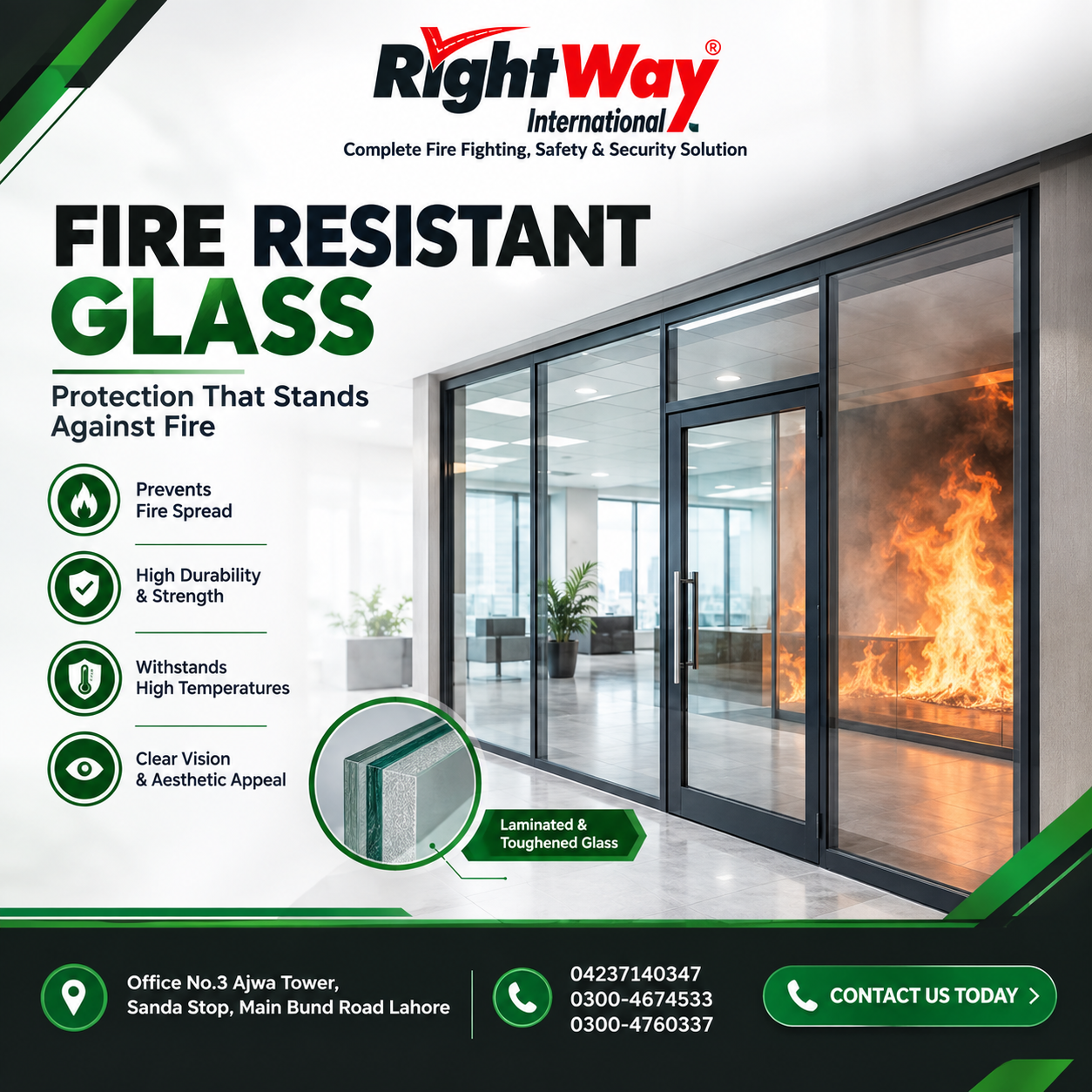
Fire Resistant Glass: Types Uses Benefits & Buying Guide. This is an important passive fire protection product that helps control the spread of fire, flames, smoke, and heat through glazed openings. Unlike ordinary glass, fire resistant glass uses specially engineered construction and tested glazing systems to provide fire protection for a specified period.
Moreover, fire resistant glass allows architects and building owners to maintain visibility and natural light while protecting important areas of a building. As a result, it provides a practical combination of fire safety, transparency, design flexibility, and compartmentation.
Fire resistant glass can form part of fire rated doors, fire rated windows, fire rated partitions, fire screens, curtain walls, and other approved glazing systems. Therefore, commercial buildings, hospitals, hotels, offices, shopping malls, schools, airports, industrial facilities, stairwells, and public buildings commonly use fire-rated glazing.
However, buyers should remember that the glass alone does not determine the complete fire performance. The glass, frame, seals, glazing materials, and fixing system must work together as a tested assembly.
What Is Fire Resistant Glass?
Fire Resistant Glass is specially manufactured or engineered glazing that helps resist fire exposure for a specified period.
During a fire, ordinary glass can break because of extreme heat and thermal stress. In contrast, fire-rated glazing uses specially engineered materials and construction methods to provide a higher level of fire performance.
Depending on its classification, fire resistant glass can:
- Help prevent flame passage
- Help restrict hot gases
- Help control smoke movement
- Reduce radiant heat transmission
- Limit heat transfer to the protected side
- Maintain a protected opening for a specified period
Therefore, architects and fire safety professionals select the glass according to the required fire performance and application.
Fire resistant glazing commonly uses classifications such as E, EW, and EI, which describe different levels of fire performance.
How Does Fire Resistant Glass Work?
Fire resistant glass works by using specially engineered glass, interlayers, coatings, multiple glass layers, or other fire-resistant construction methods.
When a fire exposes the glazing to extreme heat, the glass system works to maintain its required performance for the tested period.
For example, some laminated fire-resistant glass systems contain special interlayers. When the temperature rises, these interlayers can react and help maintain the protective properties of the glazing.
Furthermore, some fire-rated glazing systems use specially manufactured glass ceramics or other heat-resistant constructions.
As a result, the glazing can continue to provide the required level of protection during the fire test.
However, fire resistant glass does not mean that the glass can withstand every fire indefinitely. Instead, manufacturers test the complete glazing system for a specific period and classification.
Therefore, buyers should always select a tested fire-rated glazing system according to the project’s requirements.
Fire Resistant Glass Classifications
Fire resistant glass can provide different levels of protection. Therefore, understanding the rating is essential before purchasing or specifying the product.
E Rated Fire Resistant Glass
E rated glass provides integrity protection.
In simple terms, it helps prevent flames and hot gases from passing through the glazing for the specified test period.
However, E-rated glazing does not necessarily provide the same level of insulation against heat transfer as EI-rated glazing.
For example, projects may specify E30 or E60 systems where integrity protection meets the application requirements.
Therefore, designers should select E-rated glass only where the applicable fire safety design allows integrity-only protection.
EW Rated Fire Resistant Glass
EW rated glass provides integrity protection while also limiting radiant heat transmission.
Consequently, EW glazing provides more heat-radiation control than integrity-only E glazing.
This type of fire-rated glass can suit applications where the building design requires protection from flames and hot gases while also controlling radiant heat.
However, EW glazing does not provide the same insulation performance as EI glazing.
Therefore, the project specification should determine whether an E, EW, or EI classification provides the appropriate level of protection.
EI Rated Fire Resistant Glass
EI rated glass provides both integrity and insulation.
In addition to restricting flames and hot gases, EI glazing limits heat transfer through the glazing to the protected side.
As a result, EI-rated systems can provide a higher level of protection where occupants, escape routes, or adjacent spaces require additional thermal protection.
Common classifications can include:
- EI30
- EI60
- EI90
- EI120
- EI180
However, the available rating depends on the tested product and complete glazing system.
Therefore, buyers should check the manufacturer’s certification and test documentation before selecting EI-rated glass.
Types of Fire Resistant Glass
Wired Fire Resistant Glass
Wired fire resistant glass contains a wire mesh within the glass.
The wire helps the glass maintain its integrity during fire exposure and thermal shock.
Historically, wired glass has been widely used for fire protection. However, modern projects may choose other glazing technologies when they require improved appearance, impact performance, or design flexibility.
Tempered Fire Rated Glass
Tempered fire-rated glass uses specially processed glass that provides improved strength compared with ordinary glass.
Specially manufactured tempered glazing can provide fire protection for approved applications.
However, not every tempered glass product qualifies as fire-rated glass. Therefore, buyers must check the specific fire test rating and certification rather than assuming that all tempered glass provides fire protection.
Laminated Fire Resistant Glass
Laminated fire resistant glass combines multiple layers of glass with specially engineered interlayers.
During a fire, the interlayer can help maintain the protective properties of the glazing.
Furthermore, laminated constructions can provide additional benefits such as improved safety and acoustic performance, depending on the product design.
Therefore, laminated fire-rated glass can provide an attractive option for modern architectural applications.
Ceramic Fire Resistant Glass
Glass ceramic fire-resistant glazing uses specially manufactured glass ceramic materials that can withstand high temperatures and thermal shock.
Moreover, these products can provide clear visibility while maintaining fire protection.
As a result, glass ceramic systems can work well in modern buildings where designers want both fire safety and a clean architectural appearance.
Intumescent Fire Resistant Glass
Some advanced fire-rated glazing systems use intumescent interlayers.
When exposed to high temperatures, these materials react and expand. Consequently, they can create an insulating barrier that helps reduce heat transfer through the glazing.
Therefore, intumescent fire-rated glass can provide both transparency and thermal protection in suitable tested assemblies.
Fire Resistant Glass Ratings
Fire resistant glass manufacturers use different rating classifications according to the applicable fire-testing system.
Common ratings may include:
- 30 minutes
- 60 minutes
- 90 minutes
- 120 minutes
- 180 minutes
For example:
- E30 = integrity for 30 minutes
- E60 = integrity for 60 minutes
- EI60 = integrity and insulation for 60 minutes
- EI120 = integrity and insulation for 120 minutes
However, the exact classification and test standard depend on the project and applicable regulations.
Therefore, buyers should not select glass based only on the number of minutes. Instead, they should identify whether the project requires integrity, radiation control, insulation, or a combination of these performances.
Fire Resistant Glass vs Ordinary Glass
The main difference between fire resistant glass and ordinary glass is their tested performance under fire conditions.
| Feature | Fire Resistant Glass | Ordinary Glass |
|---|---|---|
| Fire performance | Specifically tested for fire performance | Not normally tested for fire resistance |
| Flame protection | Can restrict flame passage for its rated period | Can break rapidly during a fire |
| Smoke protection | Some approved systems help restrict smoke | No dedicated fire protection |
| Heat protection | Some systems provide insulation or radiation control | Provides no equivalent protection |
| Fire rating | Available with specific classifications | No fire rating |
| Application | Fire doors, windows, partitions and screens | General glazing |
| Certification | Uses applicable test documentation | Normally no fire-rated certification |
Therefore, ordinary glass should never replace specified fire resistant glass in a fire-rated assembly.
Where Is Fire Resistant Glass Used?
Fire resistant glass can protect many different areas of a building.
Common applications include:
- Fire rated doors
- Fire rated windows
- Fire rated partitions
- Fire screens
- Stairwell glazing
- Corridor glazing
- Fire barriers
- Commercial buildings
- Hospitals
- Hotels
- Offices
- Shopping malls
- Schools
- Universities
- Airports
- Industrial buildings
- Factories
- Warehouses
- Public buildings
- Residential buildings
Furthermore, designers can use fire-rated glazing where they want to maintain visibility between protected areas without compromising the required fire protection strategy.
Fire Resistant Glass for Fire Rated Doors
Fire resistant glass for fire rated doors allows occupants to see through a protected door while maintaining the required fire performance of the approved assembly.
For example, a fire door can include a fire-rated vision panel that allows people to see activity on the other side.
However, installers must use the correct glass, glazing materials, frame, seals, and fixing system.
Therefore, simply inserting fire-rated glass into an ordinary door does not automatically create a certified fire door.
The complete door and glazing assembly must meet the required test performance.
Fire Resistant Glass for Windows
Fire rated glass windows can protect openings in fire-rated walls and other designated areas.
These windows can provide visibility and natural light while helping maintain fire compartmentation.
Moreover, fire-rated windows can support architectural designs that require transparent separation between different areas.
However, the frame and glazing system must match the required fire performance.
Fire Resistant Glass Partitions
Fire resistant glass partitions provide transparent separation between different building areas.
They can help architects create open and modern spaces while maintaining designated fire compartments.
Common applications include:
- Offices
- Hospitals
- Hotels
- Shopping malls
- Airports
- Commercial buildings
- Educational buildings
- Public buildings
Consequently, fire-rated glass partitions can combine safety, visibility, and modern architectural design.
Fire Resistant Glass for Stairwells
Stairwells provide important escape routes during emergencies. Therefore, building designers often need to protect stairwell boundaries from fire and smoke.
Fire resistant glass for stairwells can provide visibility while supporting the required fire separation.
Furthermore, suitable EI-rated glazing can provide insulation where the design requires additional heat protection.
However, the correct rating depends on the complete fire safety design and applicable requirements.
Benefits of Fire Resistant Glass
Fire resistant glass provides several important benefits.
1. Helps Control Fire Spread
First, fire-rated glazing can help restrict flames and hot gases through protected openings for its tested period.
2. Provides Heat Protection
Furthermore, EI-rated glazing can limit heat transfer through the glass.
3. Supports Smoke Control
Suitable tested glazing systems can help restrict smoke movement through protected openings.
4. Maintains Visibility
Unlike solid fire barriers, glass allows people to see through protected areas.
5. Allows Natural Light
Additionally, fire-rated glass allows architects to introduce natural light while maintaining the required fire protection.
6. Supports Modern Architecture
Because fire-rated glass provides transparency, designers can create modern and open spaces without removing essential fire protection.
7. Supports Fire Compartmentation
Fire-rated glazing can form part of fire-rated walls, partitions, doors, windows, and screens.
8. Improves Design Flexibility
Moreover, manufacturers offer different fire-rated glazing constructions for different applications.
9. Supports Life Safety
By helping control fire and heat movement, suitable fire-rated glazing can support safer evacuation routes and protected areas.
10. Provides Long-Term Fire Protection
Finally, properly selected, installed, and maintained fire-rated glazing can provide reliable passive fire protection throughout its intended service life.
Fire Resistant Glass Installation
Correct installation plays a major role in fire-rated glazing performance.
Before installation, professionals should check:
- Glass fire rating
- Glass classification
- Frame rating
- Glazing system
- Fire-rated seals
- Setting blocks
- Fixings
- Glass thickness
- Opening dimensions
- Surrounding wall construction
- Door or window rating
- Manufacturer installation instructions
- Required test documentation
Furthermore, installers should use the exact glazing materials and frame systems specified for the tested assembly.
For example, replacing an approved fire-rated seal with an ordinary seal can affect the performance of the complete system.
Therefore, qualified installers should handle fire-rated glass installation according to the manufacturer’s instructions and project requirements.
Fire Resistant Glass Maintenance
Regular fire resistant glass inspection and maintenance help keep the glazing system in suitable condition.
During inspection, professionals should check:
- Glass condition
- Cracks
- Chips
- Frame condition
- Glazing beads
- Fire-rated seals
- Intumescent materials
- Fixings
- Gaps
- Damage
- Corrosion
- Door hardware where applicable
- Surrounding construction
In addition, building owners should make sure that occupants do not modify, drill, cut, or replace fire-rated glazing without approval.
If the glass becomes damaged, the building owner should use a compatible replacement that matches the approved system.
Common Fire Resistant Glass Problems
Building owners should avoid the following problems:
- Installing ordinary glass in a fire-rated opening
- Using incorrect fire-rated glass
- Installing incompatible frames
- Using ordinary glazing seals
- Damaging fire-rated seals
- Incorrect installation
- Excessive gaps around glazing
- Unauthorized glass modification
- Drilling or cutting approved glazing
- Using incompatible replacement glass
- Poor maintenance
- Ignoring cracks or damage
- Installing an untested glazing combination
- Failing to maintain documentation
Therefore, building owners should inspect fire-rated glazing regularly and correct defects promptly.
How to Choose the Best Fire Resistant Glass
Before purchasing fire resistant glass, consider the following factors.
1. Required Fire Rating
First, determine whether the project requires 30, 60, 90, 120, or another fire-resistance period.
2. Required Classification
Next, determine whether the project requires E, EW, or EI performance.
3. Application
Consider whether you need the glass for a:
- Fire door
- Window
- Partition
- Stairwell
- Fire screen
- Fire barrier
4. Glass Type
Choose the appropriate construction, such as laminated, tempered, wired, ceramic, or intumescent glazing, according to the tested application.
5. Frame Compatibility
Make sure the frame has the required fire performance and works with the selected glass.
6. Glazing System
Furthermore, check the approved glazing materials, seals, beads, and fixing system.
7. Certification
Always request relevant test reports, certificates, technical data, and product documentation.
8. Opening Size
Check the maximum approved glass dimensions for the selected system.
9. Installation
Use qualified installers who understand fire-rated glazing requirements.
10. Maintenance
Consider future inspection, repair, and replacement requirements.
11. Supplier Support
Finally, choose a supplier that can provide technical support, documentation, installation guidance, and replacement components.
As a result, careful product selection can improve both safety and long-term performance.
Fire Resistant Glass in Pakistan
Fire Resistant Glass in Pakistan provides an important solution for modern buildings that require both fire protection and transparent architectural design.
It can be used in:
- Offices
- Hospitals
- Hotels
- Shopping malls
- Schools
- Universities
- Factories
- Warehouses
- Airports
- Apartment buildings
- High-rise buildings
- Stairwells
- Fire exits
- Commercial buildings
- Industrial facilities
- Public buildings
When purchasing fire resistant glass in Pakistan, buyers should consider the required fire rating, classification, glass type, frame, glazing system, certification, installation, maintenance, warranty, and technical support.
Moreover, project teams should verify the applicable building requirements and use a tested glazing assembly suitable for the intended application.
Fire Resistant Glass Standards and Certification
Fire-rated glazing requires appropriate testing and documentation. Different projects may reference standards such as BS EN 1634-1, BS EN 1364-1, ASTM, UL, or other applicable fire-testing standards.
For example, BS EN 1634-1 covers fire-resistance testing for door and shutter assemblies, while BS EN 1364-1 covers fire-resistance testing for certain non-loadbearing elements such as fixed partitions.
However, the correct standard depends on the project’s location, building code, application, and specification.
Therefore, buyers should ask suppliers for:
- Fire test reports
- Product certification
- Classification reports
- Technical data sheets
- Installation instructions
- Approved glazing details
- Frame specifications
Most importantly, buyers should verify the complete tested assembly, not just the glass itself.
Fire Resistant Glass Accessories
A complete fire-rated glazing system can require several compatible components.
These may include:
- Fire rated frames
- Fire rated glazing beads
- Intumescent seals
- Fire rated sealants
- Setting blocks
- Glazing gaskets
- Fire rated fixing systems
- Fire rated door hardware
- Fire rated hinges
- Fire rated door closers
- Fire rated locks
- Fire rated vision panels
Therefore, installers should use accessories that the manufacturer approves for the specific fire-rated system.
Fire Resistant Glass for Commercial Buildings
Commercial buildings often need both safety and attractive architectural design.
Therefore, fire resistant glass for commercial buildings can provide a practical solution for areas that require transparency and fire protection.
It can help protect:
- Offices
- Shopping malls
- Hotels
- Hospitals
- Retail stores
- Business centers
- Public buildings
- Reception areas
- Corridors
- Stairwells
Furthermore, transparent fire-rated glazing can help maintain an open visual environment while supporting fire compartmentation.
Frequently Asked Questions
What is fire resistant glass?
Fire resistant glass is specially engineered and tested glazing that provides a defined level of fire protection for a specified period.
Is fire resistant glass completely fireproof?
No. The term fireproof can be misleading. Fire-rated glazing provides a tested level of fire performance for a specified period and application. Therefore, buyers should focus on the actual fire classification and test documentation.
What is the difference between E and EI glass?
E-rated glass primarily provides integrity by restricting flames and hot gases. In contrast, EI-rated glass provides integrity plus insulation, so it also limits heat transfer through the glazing.
What is EW fire rated glass?
EW glass provides integrity and limits radiant heat transmission. Therefore, it sits between E and EI classifications in terms of the type of protection it provides.
Can fire resistant glass be used in fire doors?
Yes. Fire-rated glazing can form part of a fire door assembly when the glass, frame, seals, and other components meet the required tested performance.
Can ordinary glass replace fire rated glass?
No. Ordinary glass does not automatically provide the fire performance required for a fire-rated opening.
What are common fire rated glass ratings?
Common ratings can include E30, E60, E90, EI30, EI60, EI90, EI120, and EI180, depending on the available tested system and applicable requirements.
Where is fire resistant glass used?
It is commonly used in fire doors, fire windows, fire partitions, stairwells, corridors, fire screens, commercial buildings, hospitals, hotels, schools, shopping malls, and industrial facilities.
Does fire resistant glass block heat?
It depends on the classification. EI-rated glass provides insulation and limits heat transfer, while E-rated glass focuses primarily on integrity.
Can fire resistant glass provide natural light?
Yes. One major advantage of fire-rated glazing is that it can provide transparency and natural light while supporting fire protection requirements.
How long does fire rated glass last during a fire?
The answer depends on the tested rating. For example, a 60-minute rated system provides its specified fire performance for the tested 60-minute period under the applicable test conditions.
Does the frame matter for fire resistant glass?
Yes. The frame and glazing system form an important part of the complete fire-rated assembly. Therefore, installers should use compatible tested components.
How should fire resistant glass be maintained?
Building owners should regularly inspect the glass, frame, seals, fixings, and surrounding construction. They should also repair damage and replace components with compatible approved products.
Fire Resistant Glass provides an effective way to combine transparency, architectural design, and passive fire protection. It can help control flames, smoke, radiant heat, and heat transfer depending on its classification and tested performance.
Moreover, fire-rated glazing can protect doors, windows, partitions, stairwells, corridors, fire barriers, and other critical areas.
However, the glass itself represents only one part of the system. The frame, seals, glazing materials, fixings, surrounding wall, installation method, and complete tested assembly all contribute to fire performance.
Therefore, buyers should carefully consider the required fire rating, E/EW/EI classification, application, glass construction, frame compatibility, certification, installation, inspection, and maintenance before purchasing fire resistant glass.
Finally, fire-rated glazing should work together with fire rated doors, fire barriers, fire alarm systems, smoke detectors, sprinkler systems, fire extinguishers, emergency lighting, fire stopping systems, evacuation procedures, and trained personnel to create a comprehensive building fire safety strategy.
Fire Rated Door
What Is a Fire Rated Door?
A Fire Rated Door is a specially designed door assembly that helps resist the spread of fire and, where required, smoke between designated areas of a building.
A fire rated door does more than simply use fire-resistant material. Instead, the complete door assembly must work together to provide the required fire performance.
A typical fire rated door system can include:
- Fire rated door leaf
- Fire rated door frame
- Intumescent seals
- Smoke seals
- Fire rated hinges
- Door closer
- Fire rated locks
- Latching mechanism
- Panic hardware
- Fire rated glass
- Vision panel
- Door coordinator
- Automatic release mechanism
- Electromagnetic hold-open device
- Fire rated threshold
- Compatible fixing hardware
Furthermore, every component can affect the performance of the complete assembly. Therefore, installers should use compatible components according to the manufacturer’s approved system and installation instructions.