




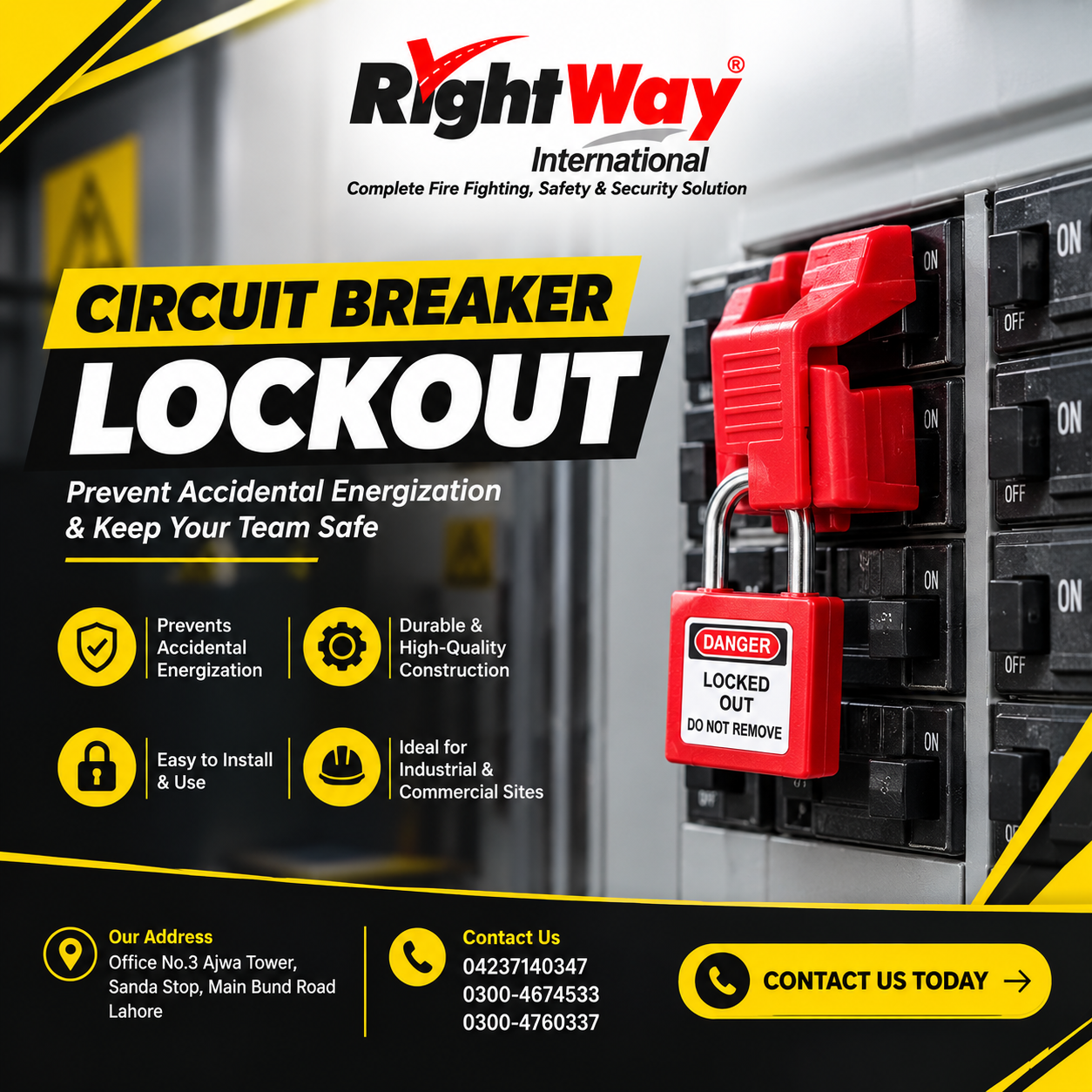
Importance of Circuit Breaker Lockout is an important safety device used in electrical Lockout/Tagout (LOTO) procedures. It helps workers secure circuit breakers in the OFF or safe position during maintenance, repair, inspection, and servicing activities.
Electrical equipment can create serious hazards when it becomes energized unexpectedly. A properly selected and applied circuit breaker lockout helps prevent unauthorized or accidental operation of the breaker while authorized workers are performing their tasks.
Under OSHA’s hazardous-energy requirements, a manually operated electrical circuit breaker can serve as an energy-isolating device. When the device is capable of being locked out, OSHA generally requires lockout to be used unless an equivalent level of protection is demonstrated through tagout.
What Is a Circuit Breaker Lockout?
A Circuit Breaker Lockout is a specialized Lockout/Tagout device designed to prevent a circuit breaker from being switched from its safe or OFF position.
It is installed directly onto a compatible circuit breaker and then secured with a Safety Padlock. A safety tag can also be applied to identify the authorized worker and provide a visible warning.
For example, an electrician may need to repair electrical equipment connected to a distribution panel. The electrician first shuts down the equipment and identifies the correct circuit breaker. After isolating the electrical supply, the worker applies the appropriate circuit breaker lockout and attaches a personal safety padlock.
This physical barrier helps prevent another person from accidentally switching the breaker back ON while maintenance is underway.
How Does a Circuit Breaker Lockout Work?
A circuit breaker lockout works by physically restricting the movement of a compatible circuit breaker.
A typical process begins with identifying the equipment and electrical energy source. The authorized worker then shuts down the equipment using the established procedure.
Next, the worker identifies and operates the correct circuit breaker to isolate the electrical supply. The compatible circuit breaker lockout is then installed and secured with a safety padlock.
After applying the lockout, the worker must control any remaining or stored energy and verify that the equipment has been properly isolated before starting maintenance.
OSHA’s LOTO procedure includes preparation, shutdown, isolation, application of lockout devices, control of stored energy, and verification of isolation before work begins.
Importance of Circuit Breaker Lockout
The importance of a Circuit Breaker Lockout becomes clear when workers need to perform maintenance on electrical equipment.
Its main benefits include:
- Helps prevent accidental breaker operation
- Helps prevent unexpected electrical energization
- Supports Lockout/Tagout procedures
- Provides physical control of the circuit breaker
- Helps protect authorized maintenance workers
- Supports personal worker accountability
- Provides a visible lockout point
- Works with safety padlocks and tags
- Helps improve electrical maintenance safety
- Supports hazardous energy control procedures
A circuit breaker lockout is particularly valuable in workplaces where multiple people may have access to electrical panels or machinery.
Circuit Breaker Lockout and Lockout/Tagout
A Circuit Breaker Lockout is commonly used as part of a complete Lockout/Tagout (LOTO) system.
LOTO procedures help control hazardous energy before employees perform servicing or maintenance. OSHA identifies electrical energy as one type of hazardous energy and requires an energy-control program that includes procedures, employee training, and periodic inspections for covered general-industry activities.
A typical electrical LOTO system may include:
- Circuit breaker lockout
- Safety padlock
- Safety tag
- Lockout hasp
- Lockout station
- Electrical disconnect lockout
- Group lockout equipment
Together, these devices can provide a structured method for isolating electrical energy.
Types of Circuit Breaker Lockouts
Different electrical panels and breakers require different lockout designs. Therefore, selecting the correct type is important.
Universal Circuit Breaker Lockout
A Universal Circuit Breaker Lockout is designed to fit a range of compatible breaker configurations.
It can be useful for workplaces where several types of circuit breakers are installed. However, workers should always verify compatibility before use.
Single Pole Circuit Breaker Lockout
A Single Pole Circuit Breaker Lockout is designed for compatible single-pole breakers.
It provides a compact solution for isolating individual electrical circuits where the breaker configuration supports the lockout device.
Double Pole Circuit Breaker Lockout
A Double Pole Circuit Breaker Lockout is designed for suitable double-pole circuit breakers.
It can help secure the breaker in the required position during electrical maintenance.
Multi-Pole Circuit Breaker Lockout
A Multi-Pole Circuit Breaker Lockout is designed for compatible multi-pole breaker arrangements.
The correct device depends on the breaker design and manufacturer specifications.
Miniature Circuit Breaker Lockout
A Miniature Circuit Breaker Lockout, often called an MCB Lockout, is designed for compatible miniature circuit breakers.
These devices are commonly used in electrical distribution systems where MCBs are installed.
MCCB Lockout
An MCCB Lockout is designed for suitable Molded Case Circuit Breakers (MCCBs).
Because MCCB designs can vary significantly, the lockout must match the specific breaker configuration.
Tie-Bar Circuit Breaker Lockout
A Tie-Bar Circuit Breaker Lockout is used for compatible breaker configurations where the breaker handles are mechanically linked.
Clamp-On Circuit Breaker Lockout
A Clamp-On Circuit Breaker Lockout uses a clamping mechanism to secure a compatible breaker handle.
These devices can provide a convenient solution for certain breaker designs without requiring permanent modification to the electrical equipment.
Benefits of Circuit Breaker Lockout
A Circuit Breaker Lockout provides several benefits when incorporated into a properly designed electrical energy-control procedure.
Helps Prevent Accidental Energization
The physical lockout helps prevent the breaker from being switched back to the energized position while maintenance is underway.
Supports Worker Safety
A properly applied lockout helps protect authorized workers from unexpected electrical energization.
Provides Physical Control
Unlike a warning label alone, a lockout device physically restricts operation of a compatible breaker.
Supports Personal Accountability
When combined with an individual safety padlock, the lockout can identify the worker responsible for the applied lock.
Supports Group Lockout
A compatible lockout hasp can be used when multiple workers need individual control over the same isolated circuit.
Easy Identification
Safety colors, tags, labels, and identification markings can make locked-out equipment easier to recognize.
Reusable Safety Equipment
Many circuit breaker lockout devices are designed for repeated use when properly inspected and maintained.
Circuit Breaker Lockout vs. Ordinary Lock
A Circuit Breaker Lockout is specifically designed to secure a compatible electrical energy-isolating device.
An ordinary padlock alone may not physically prevent a circuit breaker from being operated.
A proper circuit breaker lockout may provide:
- Breaker-specific compatibility
- Physical restriction of breaker movement
- Safety padlock attachment
- LOTO compatibility
- High-visibility identification
- Group lockout compatibility
- Industrial workplace durability
Therefore, organizations should select purpose-designed lockout equipment rather than assuming that an ordinary padlock can provide the same protection.
Where Are Circuit Breaker Lockouts Used?
Circuit breaker lockouts can be used in many workplaces where electrical energy must be isolated during maintenance.
Common applications include:
- Factories
- Manufacturing plants
- Construction sites
- Warehouses
- Workshops
- Power facilities
- Commercial buildings
- Electrical rooms
- Data centers
- Industrial plants
- Maintenance departments
- Processing facilities
- Machinery areas
- Oil and gas facilities
- Chemical plants
For example, an electrician working on a production machine may isolate the machine’s electrical circuit at the appropriate breaker and apply a compatible circuit breaker lockout.
How to Use a Circuit Breaker Lockout
Workers should always follow the site’s approved energy-control procedure and the manufacturer’s instructions.
A typical process includes:
- Identify the equipment and electrical energy source.
- Notify affected employees about the planned shutdown.
- Shut down the equipment using the established procedure.
- Locate the correct circuit breaker.
- Switch the breaker to the safe or OFF position.
- Apply the compatible circuit breaker lockout.
- Attach the authorized worker’s safety padlock.
- Apply the required safety tag.
- Control any stored or residual energy.
- Verify that the equipment is de-energized and isolated.
- Perform the maintenance or repair work.
- Remove the personal lock according to the approved procedure.
- Inspect the work area before restoring energy.
- Restore the equipment only after the required safety checks are complete.
OSHA requires verification of isolation before work begins and includes specific procedures for releasing equipment from lockout before energy is restored.
Circuit Breaker Lockout and Safety Padlock
A Circuit Breaker Lockout and Safety Padlock work together to secure an electrical isolation point.
The circuit breaker lockout physically restricts the compatible breaker, while the safety padlock prevents unauthorized removal or operation of the lockout.
For example, an electrician can apply a circuit breaker lockout and attach a personal safety padlock. The worker then keeps control of the key according to the organization’s procedure.
If several authorized workers are working on the same equipment, a compatible group lockout arrangement can allow each worker to apply a personal lock. OSHA’s group lockout provisions require each authorized employee to affix their personal lockout device to the group lockout mechanism when beginning work and remove it when they stop working.
Circuit Breaker Lockout and Lockout Hasps
A Circuit Breaker Lockout can also be used with a Lockout Hasp during group maintenance.
For example, several electricians may need to work on the same machine. After the correct breaker has been isolated and the breaker lockout installed, a suitable group lockout arrangement can allow each authorized worker to apply their personal safety padlock.
This provides individual control while maintaining the isolation of the electrical energy source.
Circuit Breaker Lockout and Safety Tags
A safety tag provides important visual information about the lockout condition.
A tag can identify:
- Authorized worker
- Department
- Equipment
- Warning message
- Lockout date
- Identification number
- Contact information, where appropriate
However, a tag should be used as part of the organization’s complete energy-control procedure. OSHA distinguishes tags from locks because tags provide a warning but do not provide the same physical restraint as a lock.
Circuit Breaker Lockout Installation and Maintenance
Circuit breaker lockouts generally do not require permanent modification of the breaker. Instead, the appropriate device is fitted to the compatible breaker according to its design.
Before installation, workers should confirm:
- Breaker type
- Breaker manufacturer
- Breaker handle design
- Pole configuration
- Lockout compatibility
- Available locking space
- Required safety padlock size
- Environmental conditions
During regular inspections, workers should check:
- Lockout body
- Clamping mechanism
- Screws or adjustment components
- Locking holes
- Cracks
- Deformation
- Corrosion
- Physical damage
- Identification markings
- Compatibility with the breaker
A damaged or defective lockout device should be removed from service and replaced according to the workplace procedure.
Safety Considerations When Using Circuit Breaker Lockouts
A circuit breaker lockout is only one component of an overall electrical safety procedure.
Workers should:
- Identify every relevant energy source
- Use the correct breaker
- Follow the approved LOTO procedure
- Use compatible lockout equipment
- Apply personal safety locks
- Control stored or residual energy
- Verify isolation before starting work
- Never bypass an applied lockout
- Never operate a locked-out breaker
- Never remove another worker’s personal lock unless an authorized procedure specifically permits it
- Inspect lockout equipment regularly
- Receive appropriate training
OSHA requires employers covered by its LOTO standard to establish energy-control procedures and provide appropriate training and periodic inspections.
Circuit Breaker Lockout and Electrical Safety
Electrical energy can remain hazardous even after equipment has been switched off if the correct energy-isolation procedure has not been completed.
Simply turning a machine OFF does not necessarily isolate its energy source. A proper energy-control procedure identifies the relevant energy-isolating device, applies the appropriate lockout device, controls stored energy, and verifies isolation.
For this reason, a circuit breaker lockout can be an important component of electrical maintenance safety.
Workers should also follow applicable electrical safety requirements, equipment-specific instructions, and site procedures.
Circuit Breaker Lockout and OSHA Lockout/Tagout
OSHA’s Control of Hazardous Energy (Lockout/Tagout) standard, 29 CFR 1910.147, covers servicing and maintenance where unexpected energization, startup, or release of stored energy could cause injury. OSHA specifically identifies manually operated electrical circuit breakers as examples of energy-isolating devices.
The OSHA energy-control program includes three core elements:
- Energy-control procedures
- Employee training
- Periodic inspections
The standard also requires lockout and tagout devices to be durable, standardized, substantial, and identifiable.
Therefore, organizations should select circuit breaker lockouts that are appropriate for their equipment and integrate them into a complete energy-control program.
Circuit Breaker Lockout in Pakistan
Circuit Breaker Lockout in Pakistan provides an important safety solution for factories, workshops, construction projects, manufacturing facilities, commercial buildings, and industrial plants.
Electrical maintenance teams can use suitable circuit breaker lockouts as part of a properly designed Lockout/Tagout system.
For example, a manufacturing plant may need to isolate a production machine before electrical maintenance. The authorized worker can identify the correct circuit breaker, shut down and isolate the circuit, apply the appropriate breaker lockout, and secure it with a safety padlock.
Before purchasing a circuit breaker lockout in Pakistan, consider:
- Circuit breaker type
- Manufacturer
- Single-pole or multi-pole configuration
- Breaker handle design
- Lockout compatibility
- Safety padlock compatibility
- Material
- Workplace environment
- Number of workers
- Group lockout requirements
- Applicable safety procedures
Selecting the correct device is essential because circuit breaker designs are not all the same.
Frequently Asked Questions
What is a Circuit Breaker Lockout?
A Circuit Breaker Lockout is a specialized LOTO device that helps secure a compatible circuit breaker in the OFF or safe position during maintenance and servicing.
What is the purpose of a Circuit Breaker Lockout?
Its purpose is to help prevent accidental or unauthorized operation of a circuit breaker while authorized workers perform maintenance.
Why is Circuit Breaker Lockout important?
Circuit breaker lockouts help control electrical hazardous energy and support Lockout/Tagout procedures during servicing and maintenance.
Can a Circuit Breaker Lockout prevent electrical shock?
A circuit breaker lockout is an energy-control device, but it does not by itself guarantee that a circuit is safe to touch. Workers must follow the complete electrical safety and energy-control procedure, including proper verification of de-energization.
Can I use an ordinary padlock instead of a Circuit Breaker Lockout?
An ordinary padlock alone may not physically secure the breaker. A compatible circuit breaker lockout should be selected for the specific breaker and used according to the workplace LOTO procedure.
Can a Circuit Breaker Lockout be used with a Safety Padlock?
Yes. Compatible circuit breaker lockouts are commonly secured using safety padlocks as part of a LOTO system.
Can several workers use one Circuit Breaker Lockout?
For group maintenance, a suitable group lockout arrangement can allow multiple authorized workers to maintain individual control through their personal locks.
What types of breakers can be locked out?
Circuit breaker lockouts are available for different breaker designs, including suitable single-pole, double-pole, multi-pole, MCB, MCCB, and other configurations. Compatibility must be verified before use.
What is an MCB Lockout?
An MCB Lockout is a circuit breaker lockout designed for compatible miniature circuit breakers.
What is an MCCB Lockout?
An MCCB Lockout is designed to secure compatible Molded Case Circuit Breakers during Lockout/Tagout procedures.
Can Circuit Breaker Lockouts be reused?
Many circuit breaker lockouts are designed for repeated use. However, workers should inspect them regularly and replace any damaged or defective device.
Where are Circuit Breaker Lockouts used?
They are used in factories, manufacturing plants, construction sites, workshops, warehouses, electrical rooms, commercial facilities, power facilities, and other workplaces where electrical energy must be controlled.
Are Circuit Breaker Lockouts required for every electrical job?
Not every electrical task uses the same procedure. The appropriate energy-control method depends on the equipment, task, hazards, applicable requirements, and workplace procedure.
What should I check before buying a Circuit Breaker Lockout?
Check the breaker manufacturer, model, pole configuration, handle design, dimensions, lockout compatibility, safety padlock compatibility, and workplace environment.
A Circuit Breaker Lockout provides an important physical method for securing compatible electrical energy-isolating devices during maintenance and servicing.
It helps prevent accidental breaker operation and supports Lockout/Tagout procedures, particularly when combined with safety padlocks, tags, lockout hasps, and other energy-control equipment.
Moreover, proper circuit breaker lockout procedures can help organizations maintain better control over hazardous electrical energy during maintenance activities.
Finally, always select the correct circuit breaker lockout for the specific breaker and follow the manufacturer’s instructions, workplace energy-control procedures, applicable electrical safety requirements, and relevant regulations. Proper training, isolation, verification, identification, and inspection are essential parts of an effective electrical lockout system.