

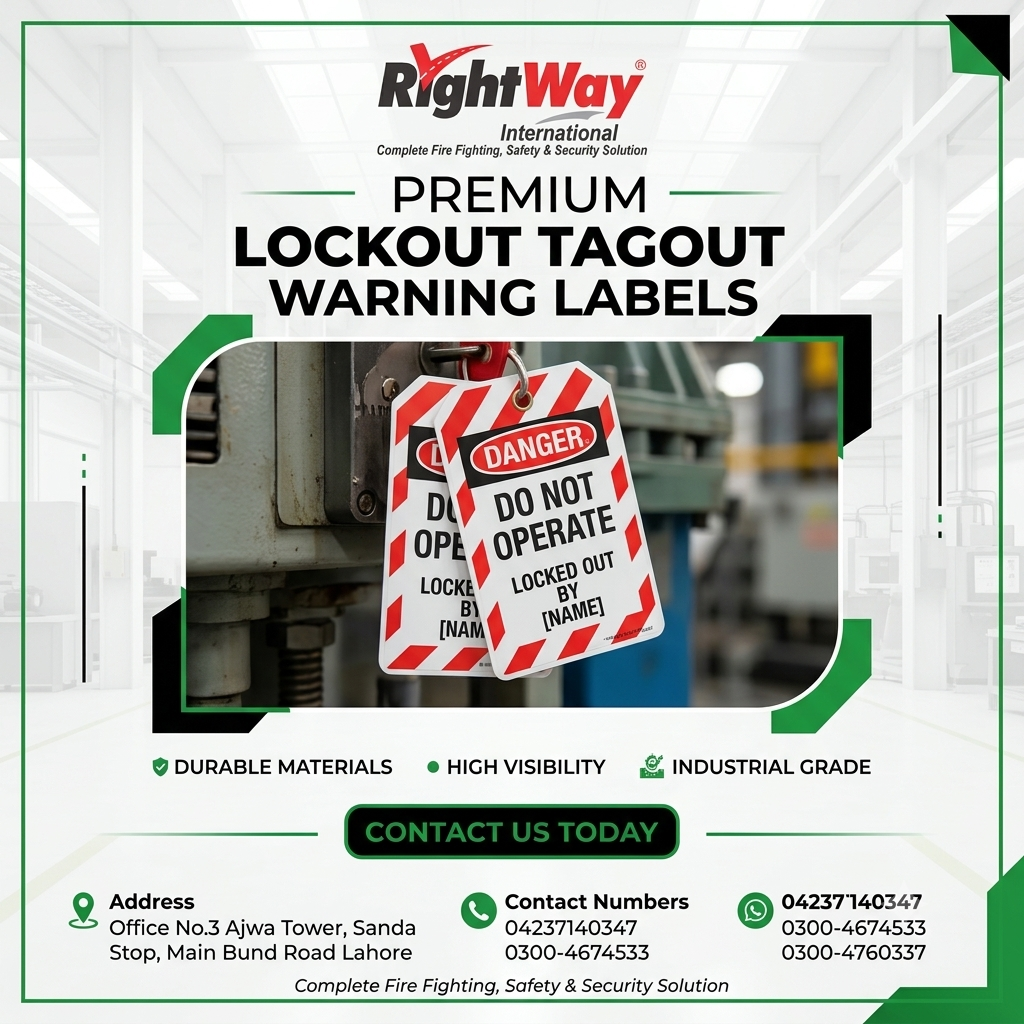
Lockout Tagout Warning Labels in Pakistan play an important role in industrial Lockout/Tagout (LOTO) programs and hazardous-energy control procedures. These labels give workers a clear visual warning when machinery, equipment, electrical systems, pneumatic systems, hydraulic systems, or other energy sources require isolation.
During maintenance, inspection, repair, installation, cleaning, and servicing, workers can face serious hazards from unexpected energy release. Therefore, a properly selected lockout tagout warning label helps workers identify equipment that should not operate during maintenance.
Companies commonly use LOTO warning labels with safety padlocks, lockout devices, lockout hasps, valve lockouts, electrical lockouts, pneumatic lockouts, hydraulic lockouts, and other LOTO equipment.
In addition, organizations should create clear energy-control procedures that match their equipment and workplace conditions. The U.S. Occupational Safety and Health Administration (OSHA) provides requirements and guidance for controlling hazardous energy under its Lockout/Tagout standard.
OSHA Website: Occupational Safety and Health Administration (OSHA)
Across Pakistan, companies use lockout tagout warning labels in manufacturing plants, textile mills, packaging facilities, food-processing plants, pharmaceutical factories, automotive facilities, chemical plants, warehouses, workshops, power facilities, oil and gas operations, construction sites, and production lines.
Benefits of Lockout Tagout Warning Labels
Clear Hazard Identification
A LOTO warning label gives workers an immediate visual warning about equipment under maintenance or energy isolation.
As a result, workers can quickly recognize equipment that requires special attention before they attempt to operate it.
Supports LOTO Procedures
Lockout tagout labels support an organization’s hazardous energy control program by communicating the equipment’s lockout status.
However, workers should always use these labels with suitable physical lockout devices and safety locks.
Helps Prevent Unauthorized Operation
A clear Do Not Operate label tells workers not to start, energize, or operate equipment during maintenance.
Furthermore, the warning helps maintenance teams communicate equipment status across different shifts.
Improves Worker Identification
Many LOTO warning labels provide space for important information such as:
- Employee name
- Department
- Date
- Equipment identification
- Reason for lockout
- Contact information
This information helps workers understand who applied the lockout and why the equipment remains unavailable.
Provides High Visibility
Manufacturers often use bright colors and bold text on industrial lockout labels. Consequently, workers can identify lockout points more easily in busy industrial environments.
Offers Durable Identification
Manufacturers produce LOTO warning labels from materials such as plastic, vinyl, polyester, laminated materials, and other industrial-grade substrates.
Therefore, companies should select label materials according to their working environment.
Types of Lockout Tagout Warning Labels
Danger Lockout Tags
Danger lockout tags provide a strong warning that workers must not operate equipment during a lockout.
Maintenance teams commonly attach these tags to safety padlocks or compatible lockout devices.
Do Not Operate Labels
Do Not Operate labels provide a direct instruction against starting or operating machinery.
For example, maintenance workers can use these labels when they isolate production equipment for repair.
Equipment Lockout Labels
Equipment lockout labels identify machines that workers have taken out of service for maintenance, inspection, repair, cleaning, or servicing.
Electrical Lockout Warning Labels
Electrical lockout warning labels identify electrical equipment and isolation points that require attention during an electrical energy-control procedure.
Workers can use these labels alongside appropriate circuit breaker lockouts, disconnect lockouts, and safety padlocks.
Pneumatic Lockout Labels
Pneumatic lockout labels identify compressed-air systems that maintenance teams isolate during servicing.
They work well with pneumatic lockout devices and other compressed-air isolation equipment.
Hydraulic Lockout Labels
Hydraulic lockout warning labels identify hydraulic machinery that remains under an energy-control procedure.
Workers can use them with suitable hydraulic isolation and lockout equipment.
Maintenance Warning Labels
Maintenance warning labels clearly communicate that workers should not operate machinery while maintenance work continues.
Custom LOTO Labels
Custom lockout tagout labels allow companies to add information such as:
- Company name
- Department
- Equipment number
- Asset number
- Employee information
- Specific safety instructions
As a result, custom labels can improve identification across large industrial facilities.
Key Features of Lockout Tagout Warning Labels
Industrial LOTO warning labels commonly include:
- High-visibility colors
- Bold warning messages
- Durable construction
- Easy-to-read text
- Employee identification fields
- Date and time fields
- Equipment identification
- Lockout reason
- Safety instructions
- Lockout status information
- Attachment holes
- Reinforced attachment areas
- Industrial-grade materials
Most importantly, the label should remain clear, visible, readable, and suitable for the application throughout the required period.
Common Applications in Pakistan
| Industry | Application | Common LOTO Labels |
|---|---|---|
| Manufacturing | Machinery maintenance | Danger lockout labels |
| Textile Mills | Production equipment servicing | Do Not Operate tags |
| Packaging | Automated machinery maintenance | Equipment lockout labels |
| Food Processing | Production-line servicing | Maintenance warning labels |
| Pharmaceutical | Equipment isolation | Custom LOTO labels |
| Automotive | Assembly equipment maintenance | Danger tags |
| Chemical Plants | Process equipment maintenance | Hazard warning labels |
| Workshops | Machine and tool servicing | Do Not Operate labels |
| Warehouses | Equipment maintenance | Lockout warning tags |
| Power Facilities | Electrical equipment servicing | Electrical lockout labels |
| Oil & Gas | Equipment isolation | High-visibility LOTO tags |
| Construction | Equipment servicing | Warning lockout labels |
How Lockout Tagout Warning Labels Work
First, the authorized employee identifies the machine and all related hazardous-energy sources.
Next, the employee shuts down the equipment according to the company’s approved energy-control procedure.
Then, the employee isolates every applicable energy source with the correct lockout devices.
After that, the employee controls stored or residual energy according to the equipment-specific procedure.
Next, the employee attaches the appropriate lockout tagout warning label or tag to the lockout point.
The label should clearly tell workers not to operate the equipment. Where applicable, the label should also identify the authorized employee responsible for the lockout.
Finally, authorized employees verify that the energy sources remain isolated before they begin maintenance.
Lockout Tagout Labels and Hazardous Energy
Industrial equipment can contain several forms of hazardous energy, including:
- Electrical energy
- Mechanical energy
- Hydraulic energy
- Pneumatic energy
- Chemical energy
- Thermal energy
- Gravitational energy
- Stored pressure
- Stored mechanical energy
- Potential energy
A lockout tagout warning label communicates the equipment’s status after the employee starts the energy-isolation procedure.
However, a warning label cannot physically stop energy from reaching equipment. Therefore, workers must use labels together with appropriate lockout devices, safety padlocks, energy-isolation procedures, and verification steps.
Information Commonly Included on LOTO Warning Labels
Warning Message
A label may display messages such as:
DANGER, DO NOT OPERATE, DO NOT START, LOCKED OUT, or EQUIPMENT UNDER MAINTENANCE.
These messages give workers a quick and direct warning.
Employee Identification
Some labels provide space for the authorized employee’s name or identification number.
This information helps other workers determine who controls the lockout.
Date and Time
Date and time fields help maintenance teams identify when the employee applied the lockout.
Equipment Identification
Companies can include the machine number, asset number, equipment name, or location.
This information helps workers match the label to the correct equipment.
Reason for Lockout
A reason field allows workers to explain why they isolated the equipment.
For example, the label may indicate maintenance, repair, inspection, cleaning, installation, or servicing.
Lockout Tagout Warning Label Selection Guide
When selecting lockout tagout warning labels in Pakistan, consider several important factors.
Label Size
Choose a label that workers can easily see from the normal approach to the equipment or isolation point.
Message and Visibility
Use clear wording and a simple design. Workers should understand the warning without unnecessary information.
Material
Select a material that suits the workplace.
For example, consider exposure to:
- Oil
- Chemicals
- Moisture
- Dust
- Heat
- Sunlight
- Abrasion
- Outdoor conditions
Attachment Method
Check how the label will attach to the equipment.
Common attachment points include:
- Safety padlocks
- Lockout hasps
- Electrical disconnects
- Valve lockouts
- Circuit breakers
- Pneumatic isolation points
- Hydraulic isolation points
- Equipment control panels
Durability
Choose labels that can withstand the expected conditions during the lockout period.
A damaged or unreadable warning label can reduce effective communication.
Customization
Large industrial facilities may benefit from customized LOTO labels that include:
- Company name
- Department
- Equipment number
- Asset number
- Employee information
- Specific warning instructions
Lockout Tagout Warning Labels and Safety Padlocks
Safety padlocks and LOTO warning labels work together as important components of a lockout system.
The safety padlock provides the physical locking function, while the warning label communicates important information about the lockout.
For example, an authorized employee can isolate an electrical disconnect, install the correct lockout device, secure the device with a safety padlock, and attach a visible danger tag.
As a result, workers can quickly identify both the physical lock and the warning information.
Lockout Tags vs Warning Labels
People often use the terms lockout tag, LOTO label, and lockout warning label interchangeably. However, their specific applications can differ.
A lockout tag normally attaches to a lockout point or device and provides warning and identification information.
A warning label may also identify equipment or communicate a safety instruction, depending on its design and intended use.
Therefore, organizations should follow their documented LOTO procedure and applicable requirements when selecting tags and labels.
Lockout Tagout Safety Practices
A warning label should form part of a complete hazardous-energy control program.
- First, identify all hazardous-energy sources.
- Next, shut down the equipment correctly.
- Then, isolate the relevant energy sources.
- After that, install the appropriate lockout devices.
- Apply the assigned safety padlocks.
- Attach the required warning tags or labels.
- Control stored and residual energy.
- Verify energy isolation before maintenance.
- Prevent unauthorized equipment operation.
- Train authorized and affected employees.
- Follow equipment-specific energy-control procedures.
Most importantly, workers should never rely on a warning label alone to control hazardous energy.
Maintenance and Inspection of LOTO Labels
Inspect lockout tagout warning labels before each use.
Look for:
- Faded printing
- Torn material
- Cracked surfaces
- Damaged attachment holes
- Missing information
- Illegible text
- Chemical damage
- Excessive wear
- Water damage
- UV or sunlight damage
- Loose attachments
If a label no longer provides clear information, replace it before starting another lockout activity.
In addition, store LOTO labels in suitable LOTO cabinets, lockout stations, maintenance toolboxes, safety cabinets, or portable lockout kits.
OSHA and Lockout Tagout Warning Labels
The Occupational Safety and Health Administration (OSHA) provides requirements for controlling hazardous energy under its Lockout/Tagout standard.
OSHA’s standard addresses hazardous-energy control during servicing and maintenance. It also covers areas such as energy-control procedures, employee training, periodic inspections, and lockout/tagout.
Why Lockout Tagout Warning Labels Matter
Industrial machines can contain several forms of hazardous energy. During maintenance, workers need clear information about equipment status and energy isolation.
A properly designed lockout tagout warning label gives workers an immediate visual warning and helps identify equipment under a lockout procedure.
For industrial facilities in Pakistan, LOTO warning labels can support activities such as:
- Machine maintenance
- Electrical maintenance
- Production-line repairs
- Preventive maintenance
- Equipment installation
- Pneumatic system servicing
- Hydraulic equipment servicing
- Machine cleaning
- Plant shutdowns
- Mechanical repairs
- Industrial equipment isolation
Furthermore, companies can combine warning labels with safety padlocks, lockout devices, lockout hasps, electrical lockouts, pneumatic lockouts, hydraulic lockouts, stored-energy controls, employee training, and verification procedures.
Together, these controls can support a more organized approach to hazardous-energy management.
Pneumatic Lockout Devices
Pneumatic Lockout Devices provide an effective method for controlling compressed-air energy during Lockout/Tagout activities. Their high-visibility design, compatibility with safety padlocks, and availability for different pneumatic connections make them valuable components of industrial safety programs.
Organizations in Pakistan should select pneumatic lockout equipment according to fitting type, connection size, padlock compatibility, number of authorized employees, environmental conditions, and the facility’s documented energy-control procedure.
Lockout Tagout Warning Labels for Industrial LOTO Programs
Lockout Tagout Warning Labels provide an important communication and identification component of industrial Lockout/Tagout programs.
Their high-visibility design, clear warning messages, employee identification fields, and compatibility with different LOTO applications make them useful for industrial maintenance and energy-control activities.
Organizations in Pakistan should select LOTO warning labels according to equipment type, hazardous-energy source, environmental conditions, label material, visibility, attachment method, information requirements, and the facility’s documented energy-control procedure.
Whether companies operate manufacturing plants, textile mills, pharmaceutical factories, food-processing facilities, chemical plants, automotive factories, warehouses, workshops, power facilities, oil and gas operations, or construction sites, properly selected lockout tagout warning labels can help communicate equipment status and reinforce safe maintenance practices.