




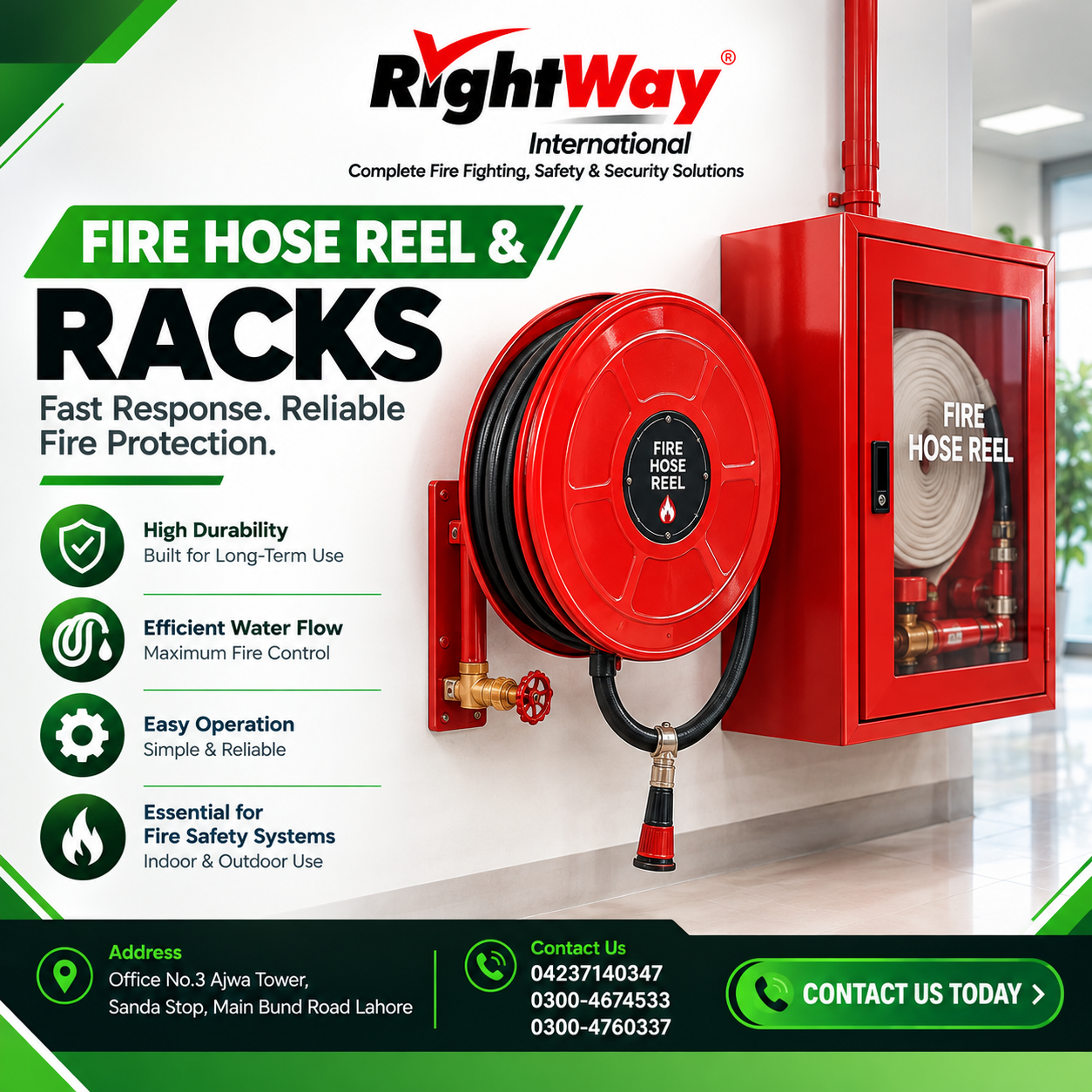
Fire Hose Reel and Racks: Types, Uses, Benefits & Buying Guide explains an important part of building fire protection systems. Fire hose reels provide a ready-to-use water hose for firefighting, while fire hose racks provide organized storage and support for firefighting hoses.
A properly installed fire hose reel can provide a convenient water discharge point during an emergency. Similarly, a suitable fire hose rack keeps the fire hose securely stored, organized, and accessible when required.
Fire hose reels and racks are commonly used in factories, warehouses, commercial buildings, offices, hospitals, hotels, schools, universities, shopping malls, industrial facilities, residential buildings, parking areas, and other properties where fixed firefighting equipment is required.
The correct equipment depends on the building’s fire protection design, water supply, pressure, hose length, hose diameter, installation location, applicable standards, and local requirements.
This guide explains what a fire hose reel and rack are, how they work, their types, uses, benefits, components, installation, maintenance, pressure requirements, safety considerations, and buying factors.
What Is a Fire Hose Reel?
A Fire Hose Reel is a permanently mounted firefighting device that stores a hose on a rotating reel and provides a controlled water supply for firefighting.
The hose remains wound around the reel when it is not being used. During an emergency, an authorized or trained user can pull the hose from the reel and direct the nozzle toward the fire.
Depending on the design, fire hose reels may include a manual or automatic valve, hose, reel drum, nozzle, mounting bracket, and connection to the building’s firefighting water supply.
Fire hose reels are commonly installed in accessible locations so users can quickly reach them during an emergency.
Common applications include:
- Commercial buildings
- Factories
- Warehouses
- Offices
- Hospitals
- Hotels
- Schools
- Universities
- Shopping malls
- Residential buildings
- Parking areas
- Industrial facilities
- Public buildings
What Is a Fire Hose Rack?
A Fire Hose Rack is a storage and mounting arrangement designed to hold a firefighting hose in an organized and accessible position.
Unlike a fire hose reel, a rack does not normally wind the hose onto a rotating drum. Instead, the hose can be folded, rolled, or arranged on the rack according to the equipment design and applicable firefighting procedures.
Fire hose racks can help keep hoses off the floor, reduce unnecessary damage, improve organization, and provide quick access during an emergency.
A fire hose rack may be installed with:
- Fire hose
- Fire hydrant valve
- Landing valve
- Fire nozzle
- Branch pipe
- Couplings
- Hose accessories
The exact arrangement depends on the approved fire protection system.
How Does a Fire Hose Reel Work?
A fire hose reel connects to the building’s firefighting water supply.
Under normal conditions, the hose remains stored on the reel. When firefighting is required, the user opens the appropriate valve and pulls out the required length of hose.
Water then travels from the building’s fire water pipe network through the hose and exits through the nozzle.
The basic process works as follows:
- Locate the fire hose reel.
- Make sure the equipment is accessible.
- Open or activate the water supply according to the system design.
- Pull the hose from the reel.
- Extend the hose toward a safe operating position.
- Open the nozzle or control valve according to the equipment design.
- Direct the water toward the fire.
- Maintain a safe position while operating the hose.
- Close the water supply after use.
- Return and inspect the hose according to the maintenance procedure.
Some fire hose reels use automatic valve arrangements that allow water to flow when the reel is pulled out or operated. However, the exact operation depends on the product design.
How Does a Fire Hose Rack Work?
A fire hose rack provides a designated storage point for a firefighting hose.
The hose is arranged on the rack in a way that allows personnel to remove it when necessary.
A typical fire hose rack arrangement can include:
- Fire hose
- Hose rack
- Fire hydrant or landing valve
- Fire nozzle
- Hose couplings
- Supporting brackets
During an emergency, trained personnel can remove the hose from the rack, connect it to the appropriate water outlet if necessary, and use the nozzle to direct water toward the fire.
The rack primarily provides storage and organization, while the connected firefighting system provides the water supply.
Where Are Fire Hose Reels and Racks Used?
Fire hose reels and racks can be installed in many types of buildings and facilities.
1. Factories
Factories can contain machinery, electrical equipment, combustible materials, chemicals, packaging, and production areas.
Fire hose reels and racks can provide designated firefighting equipment at suitable locations within the facility.
2. Warehouses
Warehouses often contain large quantities of stored goods and packaging.
Fire hose equipment can provide an accessible firefighting water point where required by the approved fire protection design.
3. Shopping Malls
Shopping malls contain shops, restaurants, storage areas, electrical systems, parking facilities, and large numbers of visitors.
Fire hose reels can provide strategically located firefighting equipment as part of the building’s fire protection system.
4. Hospitals
Hospitals require carefully planned fire protection because they contain patients, medical equipment, electrical systems, staff, and visitors.
Fire hose reels and racks may form part of the building’s fixed firefighting arrangements where required.
5. Hotels
Hotels contain guest rooms, kitchens, electrical equipment, storage areas, and public spaces.
Fire hose reels can provide accessible firefighting water equipment in designated locations.
6. Schools and Universities
Educational buildings contain classrooms, laboratories, offices, libraries, and electrical equipment.
Suitable firefighting hose equipment can support emergency response as part of the overall fire protection system.
7. Offices
Office buildings contain electrical equipment, furniture, documents, and other combustible materials.
Fire hose reels can provide fixed firefighting equipment in suitable locations.
8. Residential Buildings
Large apartment buildings and residential developments may include fixed firefighting systems.
Fire hose reels or hose racks may be included depending on the building design and applicable requirements.
9. Industrial Facilities
Industrial facilities can have different fire risks and large operating areas.
Fire hose equipment can provide designated firefighting water access at selected locations.
10. Parking Areas
Parking structures can contain vehicles, fuel, electrical systems, and other fire hazards.
Suitable fire hose equipment can form part of the site’s fire protection arrangements where required.
Types of Fire Hose Reels
Fire hose reels are available in different designs and configurations.
Fixed Fire Hose Reel
A fixed fire hose reel is permanently mounted to a wall or another approved structural surface.
The reel remains in a designated position and provides a ready-to-use firefighting hose.
Swinging Fire Hose Reel
A swinging fire hose reel is mounted on a mechanism that allows the reel to move or swing outward.
This design can improve hose positioning and access in certain installations.
Manual Fire Hose Reel
A manual fire hose reel requires the operator to control the water supply and hose operation manually.
The exact operating procedure depends on the equipment design.
Automatic Fire Hose Reel
An automatic fire hose reel can include an automatic valve arrangement that starts water flow when the hose reel is pulled out or activated.
The exact mechanism depends on the manufacturer’s design.
Recessed Fire Hose Reel
A recessed fire hose reel is installed within a cabinet or wall recess.
This arrangement can provide a cleaner appearance while protecting the equipment from unnecessary physical contact.
Surface-Mounted Fire Hose Reel
A surface-mounted fire hose reel is installed directly onto a wall or supporting structure.
This arrangement can provide easy visibility and access.
Fire Hose Reel Cabinet
A fire hose reel cabinet houses the reel and related firefighting equipment.
Depending on the design, the cabinet may also contain a nozzle, valve, hose, fire extinguisher, or other equipment.
Types of Fire Hose Racks
Fire hose racks can also have different designs.
Wall-Mounted Fire Hose Rack
A wall-mounted hose rack attaches directly to a wall or supporting structure.
It provides a designated location for storing a firefighting hose.
Hose Storage Rack
A hose storage rack is designed specifically to organize and store firefighting hoses.
Fire Hose Rack With Nozzle
Some arrangements provide storage space for both the hose and nozzle.
This can help keep the complete firefighting hose assembly together.
Fire Hose Rack With Landing Valve
A rack can be installed near a landing valve so that the hose and water outlet remain accessible from the same designated location.
Cabinet-Mounted Hose Rack
A hose rack can be installed inside a fire hose cabinet.
The cabinet can protect the equipment and provide a clearly identified storage location.
Main Components of a Fire Hose Reel
A fire hose reel can contain several components that work together to provide controlled water discharge.
Reel Drum
The reel drum stores the hose in an organized manner.
Fire Hose
The hose transports water from the water supply to the operating nozzle.
Nozzle
The nozzle directs and controls the water discharge.
Valve
The valve controls the water supply to the hose.
Inlet Connection
The inlet connects the reel to the building’s firefighting water pipe network.
Mounting Bracket
The mounting bracket supports the reel and keeps it securely attached to the installation surface.
Hose Guide
Some reels include a hose guide that helps the hose move smoothly during deployment and retraction.
Handle or Operating Mechanism
Depending on the design, the reel may include a handle or operating mechanism.
Cabinet
Some fire hose reels are installed inside dedicated cabinets for protection and organized storage.
Main Components of a Fire Hose Rack
A fire hose rack can include:
- Rack frame
- Mounting brackets
- Hose support
- Fire hose
- Hose nozzle
- Hose couplings
- Landing valve
- Fire hydrant valve
- Cabinet where applicable
- Identification signage
Each component should be suitable for the intended fire protection system.
Benefits of Fire Hose Reels and Racks
Properly selected and maintained fire hose reels and racks provide several benefits.
Quick Access to Firefighting Equipment
A fixed fire hose reel provides a designated firefighting water point that can be accessed quickly during an emergency.
Organized Hose Storage
Fire hose racks keep hoses organized and stored in a designated location.
Reduces Hose Damage
Proper storage can help reduce unnecessary contact with floors, vehicles, equipment, and other sources of physical damage.
Supports Emergency Response
Accessible firefighting equipment can support trained personnel during an emergency.
Efficient Hose Deployment
A reel can allow the hose to be pulled out in a controlled manner.
Space Efficient
Wall-mounted reels and racks can use vertical wall space instead of occupying floor space.
Improved Equipment Visibility
Properly installed and identified equipment can be easier to locate during an emergency.
Supports Fixed Fire Protection Systems
Fire hose reels and racks can work alongside:
- Fire hydrant valves
- Landing valves
- Fire hydrant pillars
- Fire pumps
- Fire water tanks
- Fire hoses
- Fire nozzles
- Wet risers
- Dry risers
- Fire alarm systems
- Fire sprinkler systems
Fire Hose Reel and Rack vs Fire Hydrant System
A fire hose reel or rack can be part of a larger fire protection system.
A typical system may include:
- Fire water tank
- Fire pump
- Jockey pump
- Diesel fire pump where required
- Fire water pipe network
- Fire hydrant
- Hydrant valve
- Landing valve
- Fire hose
- Fire hose reel
- Fire hose rack
- Fire nozzle
- Branch pipe
- Pressure gauges
- Isolation valves
- Check valves
- Test and drain arrangements
Each component performs a different function.
The fire pump supplies water pressure, the pipe network transports water, the valve controls water access, the hose carries water to the operating position, and the nozzle directs the water.
The reel stores and deploys the hose, while the rack primarily provides hose storage and organization.
Fire Hose Reel Installation
Proper installation helps the equipment remain accessible and ready for use.
Before installation, professionals should check:
- Installation location
- Wall or structural support
- Hose length
- Hose diameter
- Water supply
- Operating pressure
- Required flow rate
- Valve type
- Nozzle type
- Connection size
- Accessibility
- Coverage requirements
- Applicable standards
- Local fire safety requirements
The reel should remain clearly accessible.
Installers should avoid locations where doors, stored materials, vehicles, machinery, or other obstacles can prevent access.
The reel should also be positioned at a suitable height and location according to the approved design and applicable requirements.
Fire Hose Rack Installation
A fire hose rack should be securely mounted to a suitable supporting surface.
The installer should ensure that:
- The rack can support the stored hose.
- The hose remains accessible.
- The rack does not obstruct emergency exits.
- The hose can be removed without unnecessary difficulty.
- The nozzle remains accessible.
- Couplings remain protected from damage.
- The rack is clearly identified.
- The installation follows the approved fire protection design.
If the rack forms part of a hydrant or landing valve assembly, all connections should match the system specifications.
Fire Hose Reel Maintenance
Regular maintenance helps keep a fire hose reel ready for emergency use.
Technicians should inspect:
- Reel drum
- Fire hose
- Nozzle
- Valve
- Hose guide
- Mounting bracket
- Inlet connection
- Couplings
- Gaskets
- Seals
- Cabinet
- Corrosion
- Leakage
- Physical damage
- Hose condition
- Accessibility
The hose should be checked for cuts, cracks, deterioration, kinks, or other damage.
Technicians should also inspect the reel’s operating mechanism and verify that the hose can deploy correctly.
Maintenance should follow the applicable standards, manufacturer instructions, local requirements, and approved inspection program.
Fire Hose Rack Maintenance
Fire hose racks should also receive regular inspection.
Technicians should check:
- Rack frame
- Mounting points
- Hose condition
- Nozzle
- Couplings
- Gaskets
- Corrosion
- Physical damage
- Hose arrangement
- Accessibility
- Identification signage
If the rack becomes loose, damaged, corroded, or unstable, it should be repaired or replaced as appropriate.
Fire Hose Reel Pressure
Water pressure is an important consideration for fire hose reel performance.
The reel itself does not normally generate water pressure. Instead, the fire pump, water tank, and pipe network provide the water supply.
The hose, valve, reel, and nozzle should be suitable for the system’s design pressure and flow requirements.
Pressure affects the water discharge, reach, flow rate, and operating characteristics of the hose.
Therefore, buyers should check the manufacturer’s pressure specifications and ensure that the complete fire protection system provides the required operating conditions.
A qualified fire protection professional should evaluate the system before installation.
Fire Hose Rack Safety Considerations
Important safety practices include:
- Keep the rack accessible.
- Do not block the hose with stored materials.
- Keep the hose properly arranged.
- Inspect the hose regularly.
- Check couplings for damage.
- Check the nozzle before use.
- Protect the equipment from physical damage.
- Keep the rack securely mounted.
- Maintain clear identification.
- Follow the approved inspection schedule.
- Train authorized personnel in proper operation.
During a fire, evacuation remains the priority.
Only trained personnel should attempt firefighting when conditions allow safe intervention.
How to Choose the Best Fire Hose Reel
Selecting the right fire hose reel requires careful consideration.
1. Identify the Application
First, determine the type of building and fire risk.
Factories, warehouses, hospitals, hotels, commercial buildings, and residential projects may have different requirements.
2. Check Hose Length
Select a suitable hose length according to the required coverage and approved fire protection design.
3. Check Hose Diameter
The hose diameter affects water flow and system performance.
4. Check Operating Pressure
Confirm that the hose reel can safely operate at the system’s design pressure.
5. Check Flow Rate
The required flow rate should match the approved system design.
6. Select the Reel Type
Choose between fixed, swinging, manual, automatic, recessed, or surface-mounted designs according to the installation requirements.
7. Check Nozzle Type
The nozzle should provide a suitable discharge pattern and be compatible with the hose and system.
8. Check Material
Consider the reel, hose, valve, and nozzle materials according to the operating environment.
9. Consider Corrosion Protection
Outdoor, humid, or industrial environments may require additional corrosion protection.
10. Check Standards
Verify applicable fire safety standards, project specifications, manufacturer requirements, and local regulations.
11. Consider Warranty and Support
Consider warranty coverage, spare parts, technical support, and after-sales service before purchasing.
How to Choose the Best Fire Hose Rack
When selecting a fire hose rack, consider:
- Hose size
- Hose length
- Rack capacity
- Mounting arrangement
- Material
- Corrosion resistance
- Hose accessibility
- Nozzle storage
- Coupling protection
- Installation location
- Cabinet compatibility
- Applicable standards
- Manufacturer quality
- Warranty
- Technical support
The rack should securely hold the hose without making emergency deployment unnecessarily difficult.
Fire Hose Reel vs Fire Hose Rack
Fire hose reels and racks serve related but different purposes.
| Feature | Fire Hose Reel | Fire Hose Rack |
|---|---|---|
| Main function | Stores and deploys a hose | Stores and organizes a hose |
| Hose storage | Wrapped around a reel drum | Folded, rolled, or arranged on rack |
| Deployment | Hose pulls from rotating reel | Hose removed manually |
| Water connection | Can connect directly to fire water supply | May be used with separate hydrant/landing valve |
| Nozzle | Usually included | May be stored separately or with rack |
| Installation | Wall-mounted or cabinet-mounted | Wall-mounted or cabinet-mounted |
| Main advantage | Quick hose deployment | Simple and organized hose storage |
In simple terms, a fire hose reel is designed for hose storage and controlled deployment, while a fire hose rack primarily provides organized hose storage.
Fire Hose Reel vs Fire Hydrant Valve
These components have different functions.
| Feature | Fire Hose Reel | Fire Hydrant Valve |
|---|---|---|
| Main function | Stores and supplies/deploys firefighting hose | Controls water access |
| Hose | Usually permanently attached | Connected separately |
| Water supply | Connected to firefighting pipe network | Connected to fire water pipe network |
| Nozzle | Usually provided | Requires separate hose/nozzle |
| Typical use | Building firefighting point | Hydrant/riser hose connection |
| Main role | Hose deployment and water application | Water flow control |
Therefore, both components can work together within a broader fire protection strategy.
Fire Hose Reel Standards
Fire hose reels and racks should comply with the requirements applicable to the specific project and jurisdiction.
Depending on the system, professionals may consider:
- NFPA requirements
- Applicable local fire regulations
- Building regulations
- Project specifications
- Water authority requirements
- Relevant product standards
- Fire department requirements
Specific requirements can vary depending on the building, system design, hose type, water supply, installation location, and local regulations.
Therefore, always verify the applicable requirements before purchasing or installing fire hose reels and racks.
Fire Hose Reel and Racks in Pakistan
Fire hose reels and racks in Pakistan are used in many commercial, industrial, institutional, residential, and infrastructure fire protection projects.
Factories, warehouses, hospitals, hotels, shopping malls, offices, educational institutions, apartment buildings, parking facilities, and industrial plants may use fixed hose equipment as part of their firefighting systems.
When purchasing fire hose reels and racks in Pakistan, buyers should consider:
- Hose length
- Hose diameter
- Reel type
- Rack type
- Nozzle type
- Valve type
- Operating pressure
- Flow rate
- Material
- Corrosion protection
- Product quality
- Applicable standards
- Warranty
- Technical support
- Spare parts availability
Professional projects should use a properly designed fire protection system.
Qualified professionals should evaluate the building layout, fire risks, water supply, pumps, pipework, hose coverage, equipment locations, pressure, flow, and applicable requirements.
Common Mistakes When Using Fire Hose Reels and Racks
Blocking the Equipment
Vehicles, furniture, storage materials, and other objects can prevent access to firefighting equipment.
Always keep the area around the reel or rack clear.
Poor Hose Storage
A hose that is improperly stored can become difficult to deploy during an emergency.
Keep the hose correctly arranged according to the equipment design.
Ignoring Hose Damage
Cuts, cracks, kinks, abrasion, and deterioration can affect hose performance.
Inspect the hose regularly.
Ignoring Leakage
Leaks can occur from valves, couplings, gaskets, or hose connections.
Repair identified problems promptly.
Using the Wrong Hose or Nozzle
The hose, reel, rack, valve, and nozzle should be compatible.
Always verify the equipment specifications before installation.
Neglecting Maintenance
Fire hose equipment may remain unused for long periods.
Without inspection, hidden damage or operating problems may go unnoticed.
Poor Installation
Incorrect mounting can affect accessibility and equipment performance.
Qualified installers should follow the approved fire protection design.
Buying Only on Price
The cheapest equipment may not provide the required durability, pressure rating, flow, compatibility, or quality.
Instead, compare specifications, quality, standards, warranty, and technical support.
Frequently Asked Questions
What is a Fire Hose Reel?
A Fire Hose Reel is a permanently mounted firefighting device that stores a hose on a reel and provides access to a water supply for firefighting.
What is a Fire Hose Rack?
A Fire Hose Rack is a storage support used to keep firefighting hoses organized and accessible.
What is the difference between a Fire Hose Reel and a Fire Hose Rack?
A fire hose reel stores the hose on a rotating drum and allows controlled hose deployment. A fire hose rack primarily stores and organizes the hose.
Where are Fire Hose Reels used?
Fire hose reels can be used in factories, warehouses, offices, hospitals, hotels, schools, shopping malls, commercial buildings, industrial facilities, residential buildings, and other properties where required by the fire protection design.
How does a Fire Hose Reel work?
The reel stores the hose and connects it to the building’s firefighting water supply. When the hose is deployed and the water supply is operated, water flows through the hose and exits through the nozzle.
Does a Fire Hose Reel create water pressure?
No. The fire pump and water supply system normally provide the pressure. The reel, hose, valve, and nozzle control and deliver the water.
What are the types of Fire Hose Reels?
Common types include fixed fire hose reels, swinging fire hose reels, manual fire hose reels, automatic fire hose reels, recessed fire hose reels, and surface-mounted fire hose reels.
What are the types of Fire Hose Racks?
Common arrangements include wall-mounted hose racks, hose storage racks, racks with nozzle storage, racks near landing valves, and cabinet-mounted hose racks.
Can a Fire Hose Reel connect directly to the fire water system?
Yes. A properly designed fire hose reel can connect to a building’s firefighting water pipe network through a suitable valve and connection.
What hose length should a Fire Hose Reel have?
The required hose length depends on the building layout, coverage requirements, system design, and applicable standards. The approved fire protection design should determine the appropriate length.
What pressure should a Fire Hose Reel operate at?
The required pressure depends on the hose reel, water supply, nozzle, pipe network, and approved fire protection design. Always follow the manufacturer’s specifications and system requirements.
Can Fire Hose Reels be used outdoors?
Suitable fire hose reels can be installed outdoors when designed for outdoor conditions. Materials and corrosion protection should match the environment.
Are Fire Hose Reels important for factories?
Yes. They can provide designated firefighting water equipment in factories when included in a properly designed fire protection system.
Are Fire Hose Reels suitable for warehouses?
Yes. Fire hose reels can form part of warehouse firefighting arrangements where required by the approved design.
How often should Fire Hose Reels be inspected?
Inspection frequency depends on applicable standards, local requirements, manufacturer recommendations, and the site’s approved inspection and maintenance program.
How often should Fire Hose Racks be inspected?
Fire hose racks should be inspected according to the applicable maintenance program. Technicians should check the rack, hose, nozzle, couplings, mounting points, corrosion, and accessibility.
What should be checked during Fire Hose Reel maintenance?
Technicians should check the reel drum, hose, nozzle, valve, couplings, gaskets, hose guide, mounting bracket, leakage, corrosion, physical damage, and accessibility.
Can a Fire Hose Rack store a fire nozzle?
Yes. Some hose rack arrangements include designated storage for the fire nozzle and related hose equipment.
What material is best for a Fire Hose Reel?
The appropriate material depends on the installation environment, pressure, corrosion exposure, manufacturer design, and project requirements.
How do I choose the best Fire Hose Reel?
Consider hose length, hose diameter, reel type, nozzle, valve, pressure, flow rate, material, installation location, applicable standards, warranty, and technical support.
How do I choose a Fire Hose Rack?
Consider hose size, storage capacity, mounting arrangement, material, corrosion resistance, accessibility, nozzle storage, installation environment, applicable standards, and product quality.
Conclusion
Fire Hose Reels and Racks are important components of many fixed firefighting systems. A fire hose reel provides a permanently stored and deployable firefighting hose, while a fire hose rack provides an organized storage location for firefighting hoses.
A properly selected fire hose reel can help provide quick access to water during an emergency. Similarly, a suitable hose rack can keep firefighting equipment organized, accessible, and protected from unnecessary damage.
However, fire hose reels and racks work as part of a complete fire protection system. Therefore, buyers should also consider fire pumps, water tanks, pipework, hydrant valves, landing valves, hoses, nozzles, pressure, flow, and other related equipment.
When selecting fire hose reels and racks, always consider the application, hose size, hose length, pressure rating, flow rate, material, corrosion protection, installation location, applicable standards, warranty, and technical support.
Furthermore, proper installation, regular inspection, maintenance, and testing can help keep the equipment ready for emergency use.
A correctly selected and maintained fire hose reel and rack system can become an important part of a reliable fire protection arrangement for industrial, commercial, institutional, and residential properties.