




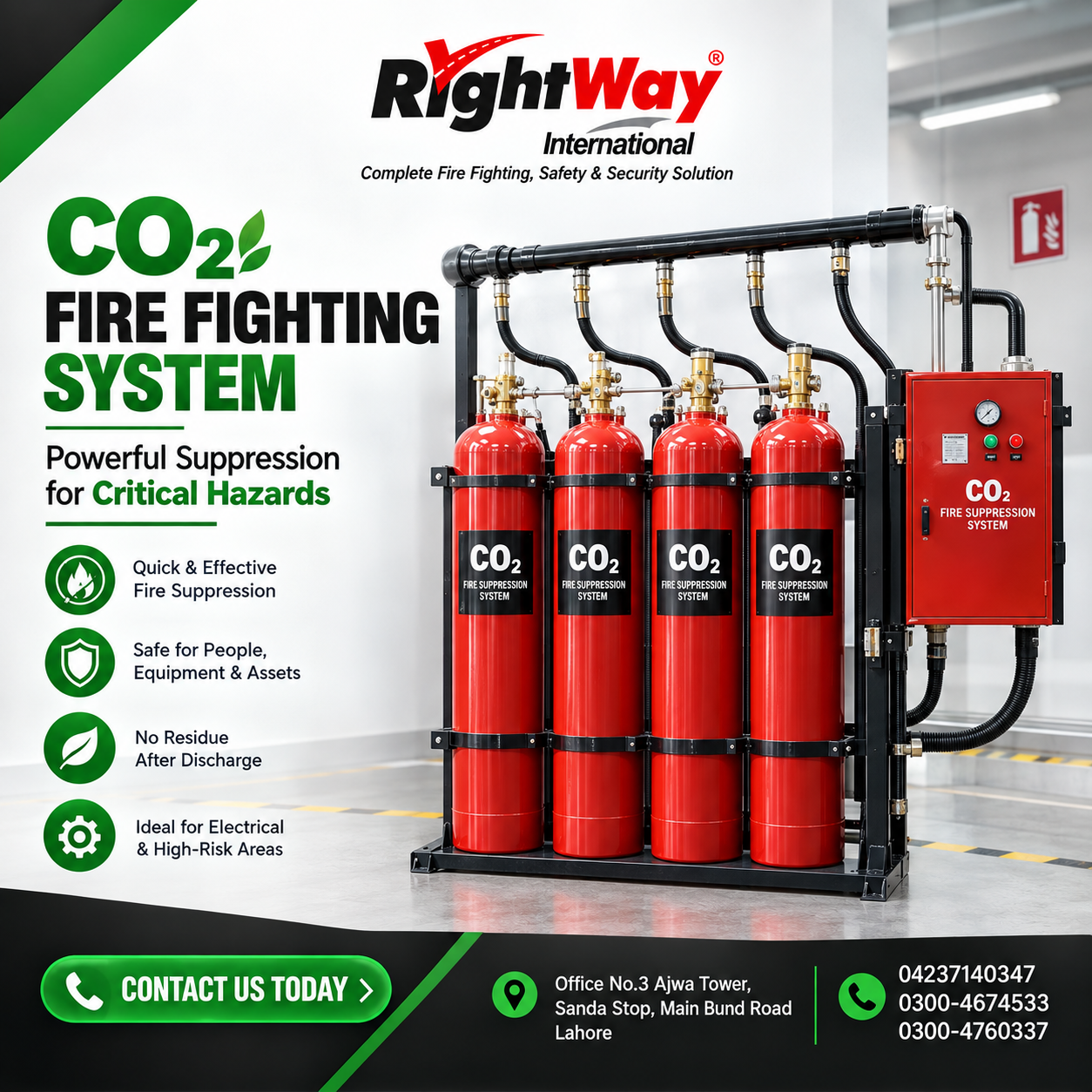
CO₂ Fire Fighting System: Types Uses Benefits & Buying Guide provides an effective fire suppression solution for specific fire hazards involving flammable liquids, electrical equipment, and industrial machinery. The system uses carbon dioxide gas to suppress fire by reducing the oxygen concentration around the fire and interrupting the combustion process.
In industrial facilities, power plants, electrical rooms, generator rooms, turbine areas, manufacturing plants, and other specialized environments, reliable fire protection is essential. Therefore, a properly designed CO₂ Fire Fighting System can provide rapid fire suppression for suitable applications.
Unlike water-based fire suppression systems, a CO₂ system does not leave water, foam, or powder residue. As a result, it can be useful for protecting electrical and mechanical equipment where water or other extinguishing agents may cause secondary damage.
However, carbon dioxide can be hazardous to people at fire-suppression concentrations. Therefore, CO₂ Fire Fighting Systems require carefully designed safety controls, warning alarms, time delays, ventilation arrangements, and evacuation procedures, particularly for normally occupied areas.
This guide covers the types, uses, benefits, components, working principle, installation requirements, maintenance practices, safety considerations, and buying factors for a CO₂ Fire Fighting System.
What Is a CO₂ Fire Fighting System?
A CO₂ Fire Fighting System is a fire suppression system that uses carbon dioxide as the extinguishing agent.
The system stores CO₂ in specially designed cylinders or storage containers. When the fire detection system identifies a confirmed fire condition, the control system activates the release sequence.
The stored CO₂ then travels through a dedicated piping network and discharges through specially designed nozzles into the protected area.
Carbon dioxide suppresses fire primarily by reducing the oxygen concentration around the combustion zone. It can also provide a cooling effect as the gas expands and discharges.
Because CO₂ does not leave a significant residue, it can be suitable for certain electrical and industrial hazards.
The system must, however, be designed according to the specific hazard, enclosure, occupancy, required concentration, storage arrangement, and applicable fire protection requirements.
How Does a CO₂ Fire Fighting System Work?
A CO₂ Fire Fighting System works through a coordinated detection, alarm, and suppression sequence.
First, smoke, heat, flame, or other approved detection devices monitor the protected area.
When the detection system identifies a fire condition, the signal reaches the fire suppression control panel.
Depending on the approved system design, multiple detection signals may be required before automatic CO₂ release occurs. This arrangement can help reduce the possibility of unwanted discharge.
Once the system confirms the fire condition, audible and visual alarms warn personnel that CO₂ discharge is about to occur.
A programmed time delay can provide occupants with an opportunity to evacuate the protected area.
The system then activates the CO₂ release mechanism. Carbon dioxide travels from the storage cylinders through the piping network and exits through the discharge nozzles.
The CO₂ concentration increases within the protected enclosure and reduces the oxygen concentration around the fire. Consequently, combustion can be suppressed when the designed concentration is achieved.
After discharge, the area must remain controlled until it has been properly ventilated and declared safe by authorized personnel.
Why Is a CO₂ Fire Fighting System Important?
A CO₂ Fire Fighting System can provide important protection for specialized fire hazards.
Effective Fire Suppression
Carbon dioxide can rapidly suppress suitable fires when the system achieves the required concentration.
Suitable for Electrical Equipment
CO₂ is electrically non-conductive and does not introduce water into the protected area. Therefore, it can be considered for certain energized electrical and electronic hazards.
No Significant Residue
CO₂ does not leave the type of solid residue associated with dry chemical extinguishing agents.
Consequently, cleanup after a discharge can be simpler, although the fire incident itself may still require equipment cleaning and inspection.
Protection of Industrial Equipment
CO₂ systems can protect selected industrial machinery, generators, turbines, and other equipment where the hazard and system design are appropriate.
Rapid Discharge
A properly engineered system can discharge CO₂ quickly throughout the protected enclosure.
Reduced Water Damage
Because the system does not use water, it can help avoid water-related damage to suitable electrical and mechanical equipment.
Types of CO₂ Fire Fighting Systems
CO₂ systems can be designed in different configurations depending on the protected hazard and project requirements.
Total Flooding CO₂ System
A Total Flooding CO₂ System releases a calculated quantity of carbon dioxide throughout an enclosed protected space.
The system is designed to achieve a specific CO₂ concentration throughout the enclosure.
Total flooding systems are generally considered for enclosed hazards where the protected space can maintain the required concentration.
Examples may include specially designed machinery rooms, electrical areas, industrial process equipment, and other suitable enclosures.
Because CO₂ concentrations used for fire suppression can be dangerous to people, total flooding systems require comprehensive life-safety controls.
Local Application CO₂ System
A Local Application CO₂ System discharges carbon dioxide directly onto a specific fire hazard rather than filling an entire room.
This approach can be useful for protecting particular equipment or areas such as machinery, industrial processes, or selected fuel hazards.
The nozzles are positioned to direct CO₂ toward the protected hazard.
High-Pressure CO₂ System
High-pressure CO₂ systems store carbon dioxide in cylinders at high pressure.
Multiple cylinders can be connected through a common manifold to provide the required agent quantity.
These systems can be suitable for various industrial and commercial applications when designed according to the required fire protection criteria.
Low-Pressure CO₂ System
Low-pressure CO₂ systems store carbon dioxide in refrigerated storage vessels.
They can provide large quantities of CO₂ for applications requiring substantial agent storage.
These systems are commonly associated with larger industrial applications where high volumes of carbon dioxide may be required.
Where Are CO₂ Fire Fighting Systems Used?
A CO₂ Fire Fighting System can be used for specific hazards across several industries.
Common applications include:
- Power plants
- Generator rooms
- Electrical rooms
- Transformer areas where appropriate
- Turbine rooms
- Industrial machinery
- Manufacturing plants
- Printing facilities
- Flammable liquid processing areas
- Engine rooms
- Compressor rooms
- Industrial process equipment
- Electrical control equipment
- Specialized production machinery
- Storage areas containing suitable fire hazards
- Certain telecommunications and electrical facilities
The exact application should always be evaluated by a qualified fire protection professional because CO₂ is not suitable for every fire hazard or occupied space.
Main Components of a CO₂ Fire Fighting System
A complete CO₂ Fire Fighting System consists of several interconnected components.
CO₂ Storage Cylinders
The cylinders store the carbon dioxide required for fire suppression.
The number and capacity of cylinders depend on the protected hazard, required concentration, discharge arrangement, and system design.
CO₂ Cylinder Valve
The cylinder valve controls the release of carbon dioxide from the storage cylinder.
Release Mechanism
The release mechanism activates the CO₂ cylinders when the suppression system receives the required release signal.
CO₂ Manifold
A manifold connects multiple CO₂ cylinders to the main discharge piping.
It helps distribute the stored agent into the system piping.
Fire Suppression Control Panel
The control panel receives signals from detection devices and controls the system release sequence.
It can activate alarms, initiate time delays, shut down connected equipment, and activate the CO₂ release mechanism.
Smoke Detectors
Smoke detectors can identify smoke at an early stage and provide a signal to the suppression control panel.
Heat Detectors
Heat detectors respond to elevated temperatures and can provide another method of fire detection.
Flame Detectors
Flame detectors can identify the optical characteristics of a flame and may be used for suitable high-risk applications.
CO₂ Discharge Nozzles
Discharge nozzles distribute carbon dioxide throughout the protected area or directly onto the hazard.
The number, type, location, and orifice size of the nozzles must follow the approved system design.
CO₂ Piping Network
The piping transports carbon dioxide from the cylinders to the discharge nozzles.
Pipe sizing and arrangement should follow the manufacturer’s approved design calculations.
Audible Alarm
An audible alarm warns occupants that a fire has been detected and that CO₂ release may occur.
Visual Alarm
Flashing visual indicators provide additional warning, particularly in areas where personnel may not hear an audible alarm.
Manual Release Station
A manual release station allows authorized personnel to activate the suppression system when the system design provides for manual release.
Abort Switch
An abort switch can temporarily interrupt or delay the automatic release sequence under approved conditions.
Pressure Switch
A pressure switch can provide system feedback when CO₂ discharge occurs.
Warning Signs
Warning signs identify the protected area and provide critical information regarding CO₂ hazards, evacuation, and entry restrictions.
Benefits of a CO₂ Fire Fighting System
Installing a properly engineered CO₂ Fire Fighting System can provide several benefits for suitable applications.
Fast Fire Suppression
CO₂ can discharge rapidly and reach the required concentration within the designed discharge period.
No Water Damage
The system does not use water, which can help protect suitable electrical and mechanical equipment from water-related damage.
No Solid Residue
CO₂ does not leave powder or foam residue after discharge.
Electrically Non-Conductive
Carbon dioxide is electrically non-conductive, making it suitable for certain energized electrical hazards.
Suitable for Industrial Applications
CO₂ systems can protect specialized industrial equipment and processes where the fire hazard is suitable.
Effective for Certain Flammable Liquid Fires
CO₂ can suppress certain Class B fire hazards involving flammable liquids when the system is properly designed.
Space Efficient
CO₂ cylinders and piping can provide a practical suppression solution where a water-based system may not be appropriate for the specific hazard.
CO₂ Fire Fighting System vs Clean Agent System
A CO₂ Fire Fighting System and a Clean Agent System both use gaseous extinguishing agents, but their applications and safety characteristics differ.
A CO₂ system uses carbon dioxide and can provide effective suppression for certain industrial and electrical hazards.
A clean agent system uses agents such as FK-5-1-12, HFC-227ea, or inert gases, depending on the system design.
The most important difference is occupant safety. CO₂ concentrations required for fire suppression can be dangerous to people. Therefore, CO₂ systems require particularly careful life-safety engineering.
Clean agent systems can be designed for certain normally occupied areas, depending on the selected agent, concentration, system design, and applicable requirements.
The appropriate system should be selected according to the fire hazard, occupancy, equipment, enclosure, and applicable standards.
CO₂ Fire Fighting System vs Water Fire Fighting System
Water-based systems and CO₂ systems use fundamentally different suppression methods.
A sprinkler or water-based fire protection system uses water to control or suppress fire.
A CO₂ system uses carbon dioxide to reduce oxygen concentration and suppress suitable fires.
Water systems can provide broad protection across many building occupancies. However, water may damage sensitive electrical equipment.
CO₂ systems do not introduce water into the protected hazard. Therefore, they can be considered for certain electrical and industrial applications.
However, CO₂ systems have significant personnel safety considerations. Therefore, they should not simply replace a water system without a proper hazard assessment.
How to Choose the Right CO₂ Fire Fighting System
Selecting a CO₂ Fire Fighting System requires detailed engineering.
1. Identify the Fire Hazard
Determine what materials and equipment could burn.
Consider electrical equipment, flammable liquids, machinery, fuels, and other combustible materials.
2. Determine the Protected Area
For total flooding applications, accurately determine the room dimensions and protected volume.
For local application systems, determine the size and configuration of the specific hazard.
3. Consider Occupancy
Determine whether personnel normally occupy the protected area.
Because CO₂ can create an oxygen-deficient atmosphere, occupancy is one of the most important factors in system selection and safety design.
4. Calculate the Required CO₂ Quantity
The required agent quantity depends on the hazard, protected volume, design concentration, temperature, enclosure characteristics, and system configuration.
A qualified fire protection engineer should perform the required calculations.
5. Select the Storage Arrangement
Choose between high-pressure cylinders and low-pressure storage according to the required CO₂ quantity and project requirements.
6. Review Nozzle Arrangement
Nozzles must be positioned and sized according to the approved system design.
7. Review Room Integrity
Total flooding systems require the protected enclosure to retain the required CO₂ concentration for the specified period.
Doors, dampers, ventilation openings, cable penetrations, and other openings should therefore be considered.
8. Check Applicable Requirements
Review applicable fire protection standards, local regulations, project specifications, and authority requirements before approving the system.
Installation of a CO₂ Fire Fighting System
Correct installation is essential for reliable and safe operation.
First, install the CO₂ cylinders in an approved and accessible location. The cylinder storage area should meet the required environmental and safety conditions.
Next, install the manifold and connect the cylinders according to the approved arrangement.
Afterward, install the CO₂ piping network and discharge nozzles according to the approved hydraulic or flow calculations.
Install the fire detection system, suppression control panel, alarms, manual release stations, abort switches, warning signs, and other required safety equipment.
Ventilation and equipment shutdown systems should also be connected where required by the approved cause-and-effect sequence.
Before commissioning, technicians should inspect the complete system, verify electrical connections, test detection devices, check alarms, inspect piping and nozzles, and confirm the cylinder and release arrangements.
A qualified fire protection professional should review and commission the system before it is placed into service.
Maintenance of a CO₂ Fire Fighting System
Regular maintenance helps keep a CO₂ Fire Fighting System ready for emergency operation.
A suitable maintenance program may include:
- Inspecting CO₂ cylinders
- Checking cylinder pressure or weight as applicable
- Inspecting cylinder valves
- Checking release mechanisms
- Inspecting the manifold
- Checking piping
- Inspecting discharge nozzles
- Testing smoke detectors
- Testing heat detectors
- Testing flame detectors where installed
- Testing the control panel
- Checking audible alarms
- Testing visual alarms
- Testing manual release stations
- Checking abort switches
- Inspecting warning signs
- Checking ventilation shutdown arrangements
- Inspecting enclosure integrity
- Reviewing system records
- Checking for physical damage
- Servicing equipment according to manufacturer requirements
Maintenance should follow the manufacturer’s instructions and applicable fire protection standards.
Any discharge, modification, or repair should be properly documented.
Common Problems With CO₂ Fire Fighting Systems
Several problems can affect CO₂ system performance.
Low Cylinder Pressure
A cylinder with abnormal pressure may indicate a maintenance or storage issue.
Therefore, technicians should inspect cylinders according to the manufacturer’s requirements.
Incorrect CO₂ Quantity
An improperly calculated or modified system may not provide the required extinguishing concentration.
The agent quantity should therefore be verified during system design and after significant changes to the protected area.
Room Leakage
Open doors, damaged seals, ventilation openings, and cable penetrations can allow CO₂ to escape.
Consequently, enclosure integrity is important for total flooding systems.
Blocked Nozzles
Dust, debris, paint, or other obstructions can interfere with agent discharge.
Discharge nozzles should remain clean and unobstructed.
Faulty Detection Devices
Damaged or poorly maintained detectors can delay fire detection or cause unwanted system activation.
Regular testing helps maintain reliable detection.
Poor Maintenance
A CO₂ system requires regular inspection and testing. Without appropriate maintenance, cylinders, valves, detectors, alarms, and control equipment may not operate correctly.
CO₂ Fire Fighting System in Pakistan
Fire protection is an important requirement for industrial, commercial, electrical, and power-related facilities across Pakistan. Consequently, a CO₂ Fire Fighting System in Pakistan can provide a specialized suppression solution for suitable fire hazards.
CO₂ Fire Fighting Systems in Pakistan are used for applications such as generator rooms, power plants, electrical equipment, industrial machinery, and other specialized facilities where carbon dioxide is appropriate.
When purchasing a CO₂ Fire Fighting System in Pakistan, consider the protected hazard, room volume, occupancy, CO₂ quantity, cylinder pressure, piping arrangement, discharge nozzles, detection system, alarm system, ventilation controls, maintenance requirements, and applicable standards.
For industrial and commercial projects, buyers should also consider installation expertise, commissioning, cylinder servicing, spare parts, testing facilities, and after-sales support.
Because CO₂ presents significant personnel hazards at fire-suppression concentrations, system design should receive particular attention to alarms, time delays, evacuation, warning signs, access control, ventilation, and post-discharge safety procedures.
CO₂ Fire Fighting System Buying Guide
Before purchasing a CO₂ Fire Fighting System, review the following points:
- Protected area
- Fire hazard
- Room volume
- Occupancy
- Required CO₂ quantity
- CO₂ cylinder capacity
- Cylinder operating pressure
- High-pressure or low-pressure storage
- Cylinder quantity
- Cylinder storage location
- CO₂ manifold
- Release mechanism
- Fire suppression control panel
- Smoke detectors
- Heat detectors
- Flame detectors
- Discharge nozzles
- Piping network
- Manual release station
- Abort switch
- Audible alarm
- Visual alarm
- Ventilation shutdown
- Room integrity
- Warning signs
- Emergency procedures
- Applicable standards
- Manufacturer specifications
- Testing and commissioning
- Maintenance requirements
- Warranty
- After-sales support
Additionally, compare technical specifications instead of selecting a system based only on price. A lower initial cost may not provide the required agent quantity, detection system, safety controls, or long-term maintenance support.
Safety Considerations
Safety is particularly important when installing a CO₂ Fire Fighting System because carbon dioxide can create an atmosphere that is dangerous or fatal to people.
Protected areas should have appropriate audible and visual pre-discharge alarms. Where required, the system should also provide a suitable time delay before CO₂ release.
Personnel should receive clear evacuation instructions and should not enter an area following CO₂ discharge until it has been properly ventilated and declared safe by authorized personnel.
The protected area should have appropriate warning signs at entrances and other relevant locations.
Do not modify the CO₂ piping, cylinders, nozzles, detection system, ventilation system, or protected enclosure without reviewing the impact on the approved system design.
Furthermore, the system should be inspected and maintained by appropriately qualified personnel.
If the system activates, personnel should follow the established emergency procedure rather than attempting to enter the protected area immediately after discharge.
Frequently Asked Questions
What is a CO₂ Fire Fighting System?
A CO₂ Fire Fighting System is a gaseous fire suppression system that uses carbon dioxide to suppress suitable fires by reducing the oxygen concentration around the combustion zone.
Where are CO₂ Fire Fighting Systems used?
CO₂ systems can be used for suitable hazards in power plants, generator rooms, electrical rooms, industrial machinery, manufacturing facilities, turbine areas, and other specialized applications.
How does a CO₂ Fire Fighting System work?
The system detects a fire, activates alarms and safety controls, and then releases carbon dioxide through specially designed nozzles. The CO₂ concentration increases around the fire and suppresses combustion when the designed conditions are achieved.
Is CO₂ suitable for electrical fires?
CO₂ can be suitable for certain energized electrical equipment because it is electrically non-conductive and does not leave water or powder residue. The specific hazard must be assessed before selecting the system.
Is a CO₂ Fire Fighting System safe for people?
CO₂ can be dangerous to people at fire-suppression concentrations. Therefore, systems require appropriate detection, warning, evacuation, time-delay, ventilation, and access-control measures.
What is a total flooding CO₂ system?
A total flooding system releases a calculated quantity of CO₂ throughout an enclosed protected space to achieve the required fire suppression concentration.
What is a local application CO₂ system?
A local application system directs CO₂ onto a specific fire hazard rather than flooding the entire room.
What is the difference between high-pressure and low-pressure CO₂ systems?
High-pressure systems store CO₂ in cylinders, while low-pressure systems store larger quantities of CO₂ in refrigerated storage vessels. The appropriate arrangement depends on the required agent quantity and project design.
How often should a CO₂ Fire Fighting System be inspected?
Inspection frequency depends on the system design, manufacturer requirements, applicable standards, and local regulations. Regular inspection helps identify pressure problems, damaged components, detector faults, and enclosure issues.
Can CO₂ systems be installed in occupied rooms?
CO₂ systems require particularly careful life-safety consideration in occupied areas because carbon dioxide can create dangerous concentrations. The suitability of the system depends on the hazard, occupancy, design, safeguards, and applicable requirements.
Conclusion
A CO₂ Fire Fighting System provides a specialized fire suppression solution for suitable electrical, industrial, machinery, and flammable-liquid hazards. The system uses carbon dioxide to suppress fire rapidly without introducing water or leaving significant solid residue.
Moreover, high-pressure and low-pressure CO₂ systems can provide different storage options for different project requirements. Total flooding and local application configurations can also address different types of fire hazards.
Whether you need a CO₂ Fire Fighting System for a generator room, power plant, electrical room, industrial machine, turbine area, or other specialized application, the system should be designed around the complete fire hazard rather than the equipment alone.
Proper detection, CO₂ quantity, cylinder arrangement, piping, discharge nozzles, alarms, evacuation controls, ventilation, commissioning, and maintenance all contribute to effective and safe system performance.