




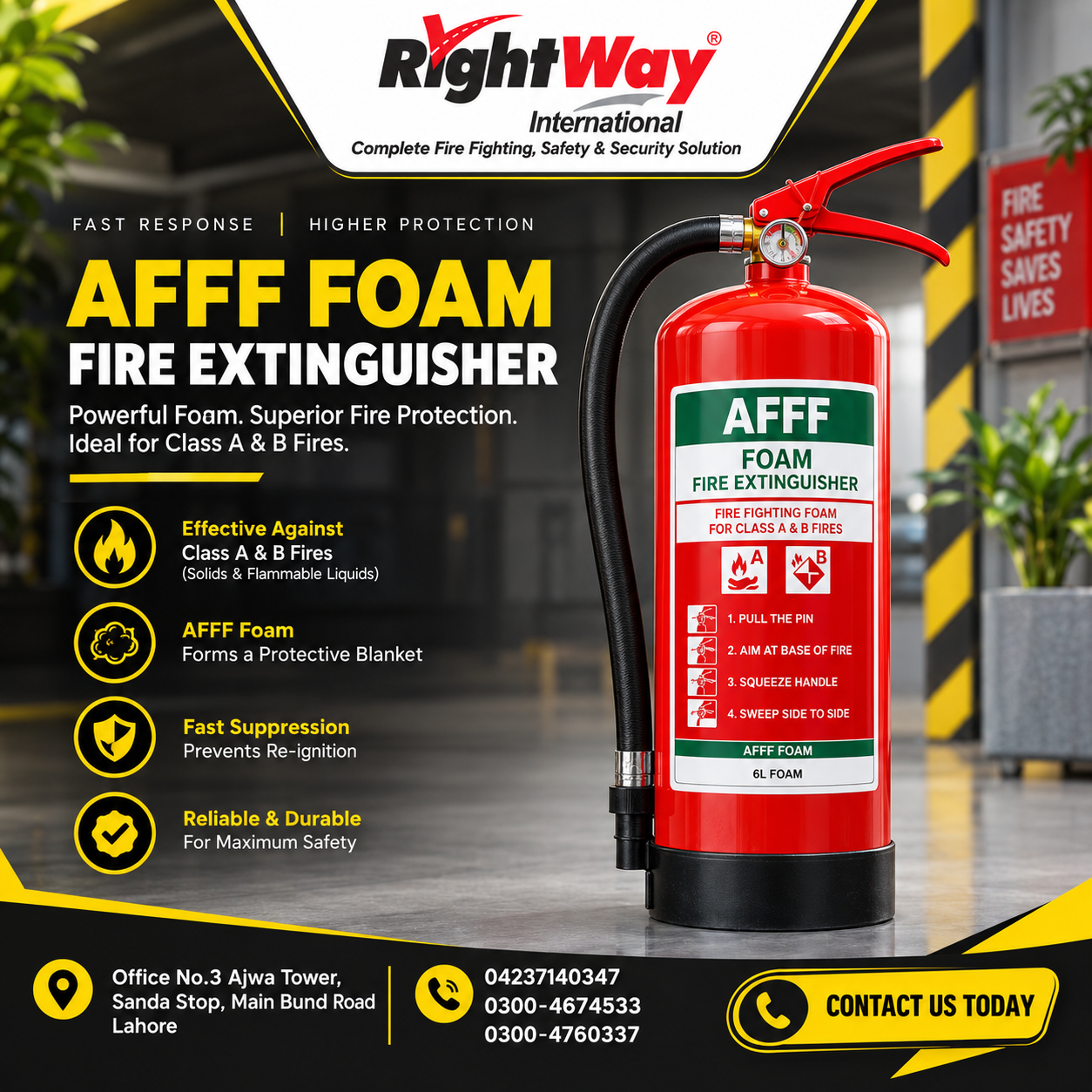
Importance Of AFFF Foam Fire Extinguisher AFFF Foam Fire Extinguisher plays an important role in protecting buildings, factories, warehouses, workshops, fuel storage areas, garages, commercial facilities, and other locations where flammable-liquid and combustible-material fire hazards may exist. AFFF stands for Aqueous Film Forming Foam, a foam-based extinguishing agent designed primarily for certain Class A and Class B fires, depending on the product’s certified rating.
This foam works by creating a layer of foam over the burning surface. This foam helps separate the fuel from oxygen while also suppressing flammable vapors. As a result, it can help control and extinguish compatible fires and reduce the risk of fire re-ignition.
Because AFFF foam can provide effective protection against certain flammable-liquid fires, businesses may use these extinguishers in areas where fuels, oils, solvents, and other compatible combustible liquids are present. However, users should always select an extinguisher according to its certified fire rating, application, manufacturer instructions, and applicable safety requirements.
What Is an AFFF Foam Fire Extinguisher?
An AFFF Foam Fire Extinguisher contains Aqueous Film Forming Foam, an extinguishing agent that combines water with foam-forming components.
When discharged, the extinguisher produces foam that spreads across the surface of a compatible burning liquid. The foam blanket helps separate the fuel from oxygen and suppresses flammable vapors.
AFFF foam extinguishers can commonly be used for compatible:
- Flammable-liquid fires
- Petrol and fuel fires
- Diesel fires
- Oil fires
- Solvent fires
- Paint-related liquid fires
- Ordinary combustible-material fires, where the extinguisher is appropriately rated
However, AFFF extinguishers are not suitable for every type of fire. Users should check the extinguisher label and certified fire rating before selecting or operating the equipment.
What Does AFFF Stand For?
AFFF stands for Aqueous Film Forming Foam.
The extinguishing agent forms a foam blanket over certain burning liquids. Depending on the formulation and certification, the foam can spread across the fuel surface and help suppress both flames and flammable vapors.
The exact performance of an AFFF extinguisher depends on its formulation, fire rating, application, and certification.
Why Is an AFFF Foam Fire Extinguisher Important?
The importance of an AFFF Foam Fire Extinguisher comes from its ability to provide protection against certain Class B flammable-liquid fires while also being suitable for some Class A combustible-material fires when appropriately rated.
Flammable liquids can spread quickly across floors and other surfaces. Therefore, ordinary water alone may not provide suitable protection for many liquid-fuel fires.
AFFF foam can form a blanket across the burning surface. Consequently, it helps control the fire and reduce the release of flammable vapors.
Businesses may therefore consider AFFF foam extinguishers for locations such as:
- Fuel storage areas
- Workshops
- Garages
- Industrial facilities
- Warehouses
- Manufacturing plants
- Vehicle maintenance areas
- Commercial premises
- Certain laboratories
- Areas containing compatible flammable liquids
1. Effective for Certain Flammable-Liquid Fires
One of the primary applications of AFFF foam extinguishers involves certain Class B fires.
Class B fires involve flammable liquids such as fuels, oils, solvents, and other compatible liquids.
When the foam reaches the burning liquid, it spreads over the surface and helps separate the fuel from oxygen. It also helps suppress flammable vapors.
Therefore, an appropriately rated AFFF extinguisher can provide an important first-response option for small, developing flammable-liquid fires.
2. Forms a Protective Foam Blanket
AFFF creates a foam layer across the surface of a compatible burning liquid.
This foam blanket helps:
- Separate fuel from oxygen
- Suppress flammable vapors
- Reduce flame spread
- Cool the burning surface
- Reduce the possibility of re-ignition
Because of these characteristics, foam extinguishers can be useful in areas where flammable-liquid hazards exist.
3. Suitable for Certain Class A Fires
Depending on its certification and fire rating, an AFFF extinguisher can also provide protection against certain Class A fires.
Class A fires involve ordinary combustible materials such as:
- Paper
- Wood
- Cardboard
- Cloth
- Certain plastics
- Other ordinary combustible materials
The water component of the foam helps cool the burning material, while the foam provides additional suppression.
However, users should always confirm the extinguisher’s certified rating before using it on a particular fire.
4. Helps Reduce Fire Re-Ignition
AFFF foam can help reduce the possibility of re-ignition by covering the fuel surface.
The foam layer can continue to separate the fuel from oxygen and suppress flammable vapors after the visible flames have been reduced.
However, users should never assume that a fire is completely safe simply because the flames have disappeared. The area should remain under observation and emergency procedures should be followed.
5. Useful for Industrial and Commercial Locations
Many industrial and commercial facilities contain combinations of combustible materials and flammable liquids.
For example, workshops may contain fuel, lubricants, oils, paints, machinery, packaging, and other materials.
A correctly selected AFFF foam extinguisher can therefore form part of a facility’s fire protection strategy when the fire risk assessment supports its use.
How Does an AFFF Foam Fire Extinguisher Work?
An AFFF Foam Fire Extinguisher works by releasing foam onto a compatible burning surface.
Fire requires three basic elements: heat, fuel, and oxygen. These elements are commonly represented by the fire triangle.
When AFFF foam is discharged, it spreads across the burning surface and forms a foam blanket.
The foam helps separate the fuel from oxygen while suppressing flammable vapors. At the same time, the water component helps cool the burning material.
As a result, the fire loses the conditions required to continue burning.
For example, if a small fuel fire occurs in a suitable industrial area, the operator can direct the foam toward the base of the flames and allow the foam to cover the fuel surface. The foam then helps suppress the flames and reduce vapor release.
Main Benefits of AFFF Foam Fire Extinguishers
AFFF foam extinguishers provide several benefits when they are selected for the correct fire hazards.
Foam-Based Fire Suppression
AFFF creates a foam blanket over compatible burning liquids. Therefore, it can help control both flames and flammable vapors.
Suitable for Certain Class B Fires
AFFF extinguishers are commonly selected for certain flammable-liquid fire risks, depending on their certified rating.
Suitable for Certain Class A Fires
Some AFFF extinguishers carry ratings for both Class A and Class B fires. Always check the product’s certification before use.
Cooling Effect
The water component of foam helps remove heat from the burning material.
Helps Control Re-Ignition
The foam blanket can remain over the fuel surface and help reduce the possibility of re-ignition.
Easy to Identify and Deploy
Foam extinguishers are commonly available in portable cylinder designs and can be installed near suitable fire hazards for quick access.
Where Are AFFF Foam Fire Extinguishers Used?
AFFF extinguishers can be used in locations where compatible Class A and Class B fire hazards exist.
Fuel Storage Areas
Fuel storage areas can contain significant flammable-liquid hazards. A correctly rated foam extinguisher can provide an important first-response option for suitable small fires.
Workshops
Workshops may contain petrol, diesel, lubricants, oils, paints, solvents, machinery, and combustible materials. Therefore, foam extinguishers can be considered where the risk assessment identifies compatible fire hazards.
Garages
Vehicle garages and maintenance facilities can contain fuels, oils, lubricants, and other combustible materials. An appropriately rated AFFF extinguisher can help provide protection against compatible fire risks.
Factories
Manufacturing facilities can contain machinery, oils, packaging materials, chemicals, and other fire hazards.
Fire safety professionals may select foam extinguishers where the facility contains suitable Class A and Class B risks.
Warehouses
Warehouses can contain large quantities of cardboard, paper, packaging, plastics, and other combustible materials. Some warehouses may also store compatible flammable liquids.
Therefore, extinguisher selection should follow a proper fire risk assessment.
Commercial Buildings
Certain commercial premises may use foam extinguishers where compatible fire hazards exist.
The extinguisher should always be positioned where it remains accessible and where its application matches the identified fire risk.
AFFF Foam Fire Extinguisher vs. CO₂ Fire Extinguisher
AFFF foam and CO₂ extinguishers use different extinguishing agents and are designed for different applications.
| Feature | AFFF Foam Fire Extinguisher | CO₂ Fire Extinguisher |
|---|---|---|
| Extinguishing agent | Aqueous Film Forming Foam | Carbon dioxide |
| Main applications | Certain Class A and Class B fires | Certain electrical and Class B fires |
| Foam blanket | Yes | No |
| Cooling effect | Yes | Limited cooling effect |
| Solid powder residue | No | No |
| Electrical equipment | Generally not the preferred choice for energized electrical equipment | Commonly selected for certain energized electrical hazards |
| Flammable-liquid fires | Suitable when appropriately rated | Suitable for certain Class B fires |
| Re-ignition control | Foam blanket can help reduce re-ignition | Limited persistence after discharge |
| Cleanup | Foam cleanup required | Minimal solid residue |
| Selection | Based on certified rating and fire hazard | Based on certified rating and fire hazard |
Therefore, businesses should not select an extinguisher simply because it is a foam or CO₂ model. The correct choice depends on the specific fire hazard, equipment, environment, certification, and applicable requirements.
AFFF Foam Fire Extinguisher vs. DCP Fire Extinguisher
AFFF foam and DCP (Dry Chemical Powder) extinguishers also have different characteristics.
| Feature | AFFF Foam | DCP |
|---|---|---|
| Agent | Foam solution | Dry chemical powder |
| Class A applications | Certain rated models | Certain rated models |
| Class B applications | Certain rated models | Certain rated models |
| Foam blanket | Yes | No |
| Powder residue | No | Yes |
| Cooling | Water component provides cooling | Generally limited compared with water-based agents |
| Re-ignition control | Foam blanket can help | Depends on fire and agent |
| Cleanup | Foam cleanup | Powder cleanup |
| Electrical equipment | Usually not preferred for energized electrical equipment | Certain DCP models can be rated for electrical hazards |
| Best choice | Depends on identified fire hazard | Depends on identified fire hazard |
The appropriate extinguisher should always match the hazard rather than being selected based only on general product type.
How to Use an AFFF Foam Fire Extinguisher
Only attempt to extinguish a fire when it is small, you have the correct extinguisher, and you have a clear escape route.
Follow the manufacturer’s operating instructions. In general:
- Remove the safety pin or seal according to the extinguisher design.
- Hold the extinguisher securely.
- Aim the nozzle toward the base of the fire or the appropriate surface area.
- Squeeze the operating handle.
- Apply the foam using a controlled sweeping motion.
- Allow the foam to cover the burning surface where appropriate.
- Continue monitoring the area for signs of re-ignition.
Do not take unnecessary risks. If the fire becomes larger, spreads rapidly, produces dangerous smoke, or blocks your escape route, evacuate immediately and contact emergency services.
Important Safety Precautions for AFFF Foam Extinguishers
AFFF extinguishers require proper selection and handling.
Do Not Use on Every Fire
AFFF is not a universal fire extinguisher. Always check its certified rating before use.
Be Careful Around Energized Electrical Equipment
Water-based foam extinguishing agents are generally not the preferred choice for energized electrical equipment unless the specific extinguisher is certified and approved for that application.
Follow the manufacturer’s instructions and applicable safety procedures.
Avoid Unnecessary Exposure
Fire produces smoke, toxic gases, heat, and other hazards. Only trained individuals should attempt to extinguish a small fire when it is safe to do so.
Maintain an Escape Route
Always keep a clear escape path behind you before attempting to use an extinguisher.
Do Not Approach a Spreading Liquid Fire
Flammable liquids can spread rapidly. Do not place yourself in danger by approaching a fire that is growing or spreading.
Train Employees
Businesses should provide appropriate fire safety awareness and extinguisher training to employees.
AFFF Foam Fire Extinguisher Maintenance
Regular inspection and servicing help ensure that an AFFF extinguisher remains ready for emergency use.
During routine inspections, check:
- Cylinder condition
- Safety pin
- Tamper seal
- Hose and nozzle
- Discharge mechanism
- Signs of corrosion
- Physical damage
- Leakage
- Accessibility
- Identification label
- Fire rating
- Inspection records
- Service dates
- Agent condition according to manufacturer requirements
Qualified technicians should perform required servicing and maintenance according to the manufacturer’s instructions and applicable regulations.
For foam extinguishers, proper attention to the extinguishing agent is particularly important because the foam formulation can have specific storage and servicing requirements.
How to Choose the Right AFFF Foam Fire Extinguisher
Before purchasing an AFFF extinguisher, consider several important factors.
Fire Hazard
First, identify the materials that could potentially catch fire.
Determine whether the area contains:
- Ordinary combustibles
- Petrol
- Diesel
- Oils
- Solvents
- Paints
- Other flammable liquids
Then select an extinguisher with the appropriate certified rating.
Fire Rating
Do not choose an extinguisher only by cylinder size. Check its certified fire rating and intended application.
Cylinder Capacity
AFFF extinguishers are available in different capacities. Select a suitable size according to the fire risk and installation location.
Certification
Choose products that comply with recognized standards and applicable local requirements.
Installation Location
Install the extinguisher where it is easily visible and accessible without exposing users to unnecessary danger.
Manufacturer
Purchase from a reputable manufacturer or fire safety supplier and ensure that replacement, servicing, and technical support are available.
Professional Fire Risk Assessment
Commercial and industrial facilities should consider a professional fire risk assessment before selecting and installing extinguishers.
Importance of AFFF Foam Fire Extinguisher in Pakistan
Fire safety remains important for offices, factories, warehouses, workshops, garages, fuel-related facilities, commercial buildings, and industrial sites throughout Pakistan.
Many businesses use vehicles, machinery, fuels, oils, solvents, paints, packaging materials, and other combustible products. Consequently, they need appropriate fire protection equipment for the hazards present at their facilities.
A correctly rated AFFF Foam Fire Extinguisher in Pakistan can provide a valuable first-response solution for compatible Class A and Class B fire risks.
However, businesses should not depend on extinguishers alone. Instead, they should combine portable extinguishers with:
- Fire alarm systems
- Fire detection systems
- Emergency exits
- Fire hydrant systems
- Fire hose reels
- Sprinkler systems
- Emergency lighting
- Evacuation plans
- Employee training
- Regular fire safety inspections
A complete fire protection strategy should address both fire prevention and emergency response.
Environmental Considerations of AFFF Foam
Businesses should also consider the environmental requirements associated with foam extinguishing agents.
AFFF formulations can contain fluorinated substances depending on the product formulation and manufacturing date. Because environmental regulations and restrictions concerning certain fluorinated firefighting foams have developed over time, businesses should verify the requirements applicable to their location and application before purchasing, replacing, or disposing of AFFF equipment.
For this reason, buyers should ask suppliers about:
- Foam formulation
- Applicable certifications
- Environmental requirements
- Storage requirements
- Disposal procedures
- Local regulations
- Replacement requirements
Businesses should use the product according to the manufacturer’s instructions and applicable environmental and fire-safety requirements.
Frequently Asked Questions About AFFF Foam Fire Extinguishers
What does AFFF stand for?
AFFF stands for Aqueous Film Forming Foam. It is a foam-based extinguishing agent used for certain Class A and Class B fire hazards, depending on the product’s certified rating.
What is an AFFF foam fire extinguisher used for?
AFFF foam extinguishers are commonly used for certain flammable-liquid fires and, when appropriately rated, certain ordinary combustible-material fires.
Is AFFF foam suitable for petrol fires?
An appropriately rated AFFF extinguisher can be used for certain petrol and other flammable-liquid fires. Always check the extinguisher’s certified fire rating before use.
Can AFFF extinguishers be used for diesel fires?
A correctly rated AFFF extinguisher can provide protection against certain diesel fires. The specific product rating and manufacturer’s instructions should always be checked.
Can AFFF foam be used on electrical fires?
Foam extinguishers are generally not the preferred option for energized electrical equipment. Users should check the specific extinguisher’s certification and follow the manufacturer’s instructions before use.
Does AFFF foam leave residue?
AFFF does not leave dry chemical powder residue like a DCP extinguisher. However, foam and its water-based components can leave liquid or wet residue that requires cleanup.
Is AFFF foam better than DCP?
AFFF and DCP extinguishers serve different applications. The appropriate choice depends on the fire hazard, certified fire rating, environment, equipment, and applicable safety requirements.
What is the difference between AFFF and CO₂ extinguishers?
AFFF uses foam to suppress compatible fires, while CO₂ uses carbon dioxide gas. AFFF is commonly associated with certain Class A and Class B hazards, whereas CO₂ is commonly selected for certain electrical and Class B hazards.
How does AFFF foam put out a fire?
AFFF foam spreads across the surface of a compatible burning liquid and forms a blanket that helps separate the fuel from oxygen and suppress flammable vapors. Its water component also helps provide cooling.
Where are AFFF foam extinguishers used?
They may be used in workshops, garages, factories, warehouses, fuel-related areas, commercial facilities, and other locations where compatible Class A and Class B fire hazards exist.
Can AFFF extinguishers prevent re-ignition?
The foam blanket can help reduce the possibility of re-ignition by continuing to cover the fuel surface and suppressing flammable vapors. However, the area should always be monitored after extinguishment.
How often should an AFFF fire extinguisher be inspected?
AFFF extinguishers should receive regular visual inspections and professional servicing according to the manufacturer’s instructions and applicable local requirements.
What size AFFF fire extinguisher should I buy?
The appropriate size depends on the fire hazard, area, fire rating, installation requirements, and risk assessment. A qualified fire safety professional can help determine the appropriate capacity.
Are AFFF extinguishers suitable for cooking-oil fires?
AFFF foam should not automatically be used for cooking-oil or deep-fat fryer fires. These hazards generally require an extinguisher specifically designed and certified for the relevant cooking-fire class.
The AFFF Foam Fire Extinguisher provides an important fire protection option for certain Class A and Class B fire hazards. Its foam blanket can help suppress flames, separate fuel from oxygen, control flammable vapors, and reduce the possibility of re-ignition.
Because of these characteristics, AFFF foam extinguishers can be useful in workshops, factories, warehouses, garages, fuel-related areas, and commercial facilities where compatible fire hazards exist.
However, no single extinguisher is suitable for every fire. Therefore, businesses should identify their specific fire risks and select extinguishers according to their certified ratings, manufacturer instructions, applicable standards, and local requirements.
Regular inspections, professional servicing, employee training, proper extinguisher placement, emergency planning, fire detection systems, and other fire protection measures should also form part of a comprehensive fire safety strategy.