




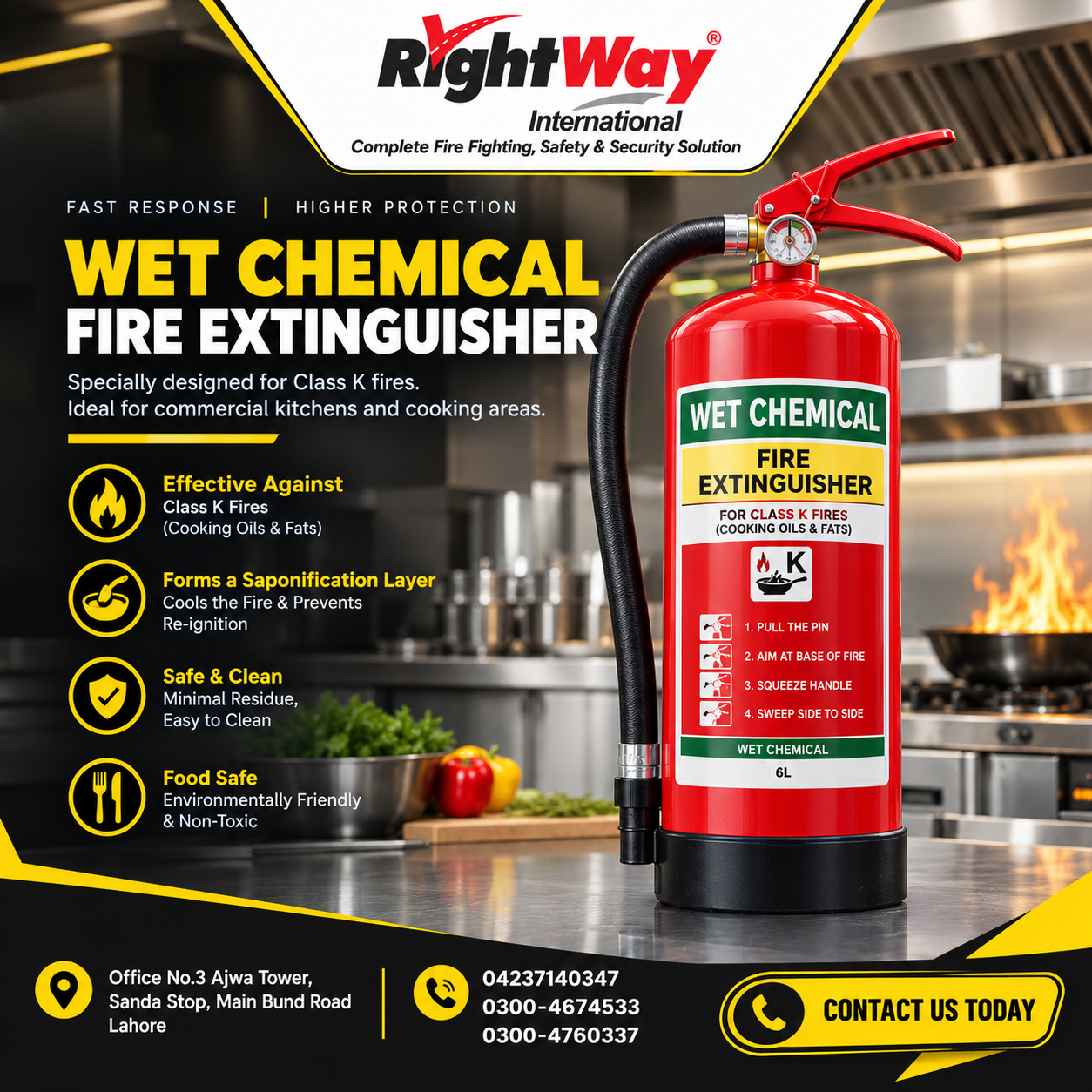
Importance Of Wet Chemical Fire Extinguisher. Wet Chemical Fire Extinguisher plays an important role in protecting commercial kitchens, restaurants, hotels, cafeterias, food-processing facilities, canteens, and other areas where cooking oils and fats can create serious fire hazards. Wet chemical extinguishers are specifically designed for cooking-oil and cooking-fat fires, commonly known as Class F fires in many classification systems and Class K fires in the United States.
Unlike conventional water, foam, CO₂, or dry powder extinguishers, a wet chemical extinguisher uses a specially formulated liquid extinguishing agent. When discharged onto a hot cooking-oil fire, the agent helps cool the burning oil and forms a soap-like layer over the surface. This process is known as saponification and helps prevent the fire from re-igniting.
Because commercial kitchens can contain deep-fat fryers, cooking oils, grease, and other high-temperature cooking equipment, the correct fire extinguisher is essential. However, users should always select an extinguisher according to its certified fire rating, manufacturer instructions, applicable standards, and the specific kitchen fire hazard.
What Is a Wet Chemical Fire Extinguisher?
A Wet Chemical Fire Extinguisher is a specialized fire extinguisher designed primarily for fires involving cooking oils and fats.
The extinguisher contains a wet chemical solution that is discharged through a specially designed nozzle. When the agent reaches the burning cooking oil, it helps cool the fuel and reacts with the hot oil to create a protective soap-like layer.
This layer helps separate the fuel from oxygen and reduces the possibility of re-ignition.
Wet chemical extinguishers are commonly used for:
- Deep-fat fryer fires
- Cooking-oil fires
- Cooking-fat fires
- Commercial kitchen fires
- Restaurant kitchen fire hazards
- Cafeteria cooking equipment
- Hotel kitchen equipment
- Food-processing cooking areas
- Certain other cooking-related fire hazards
The extinguisher’s certified rating should always be checked before use.
What Is a Wet Chemical Fire?
A wet chemical fire generally refers to a fire involving high-temperature cooking oils and fats.
These fires can occur when cooking oil becomes overheated and reaches its ignition temperature. If water is introduced to burning or extremely hot cooking oil, the water can rapidly turn into steam and cause the burning oil to splatter or spread violently.
Therefore, water should never be used on a cooking-oil fire.
A wet chemical extinguisher provides a specifically designed agent for this type of hazard.
Why Is a Wet Chemical Fire Extinguisher Important?
The importance of a Wet Chemical Fire Extinguisher comes from its ability to address one of the most dangerous fire hazards found in commercial kitchens: burning cooking oil and fat.
Restaurants and commercial kitchens often operate deep fryers and other cooking equipment at very high temperatures. If cooking oil overheats, it can ignite and quickly spread across the cooking area.
A properly rated wet chemical extinguisher helps tackle this hazard by:
- Cooling the burning cooking oil
- Creating a protective layer over the fuel
- Reducing oxygen contact
- Helping prevent re-ignition
- Suppressing flames
- Providing a suitable first-response option for small cooking-oil fires
For this reason, wet chemical extinguishers are an important component of commercial kitchen fire protection.
1. Specifically Designed for Cooking-Oil Fires
One of the main advantages of a wet chemical extinguisher is its specialized application.
Traditional extinguishers may not provide the same level of protection for high-temperature cooking oils. Wet chemical extinguishers are designed specifically for cooking-oil and fat fire hazards.
They are therefore commonly installed near:
- Deep fryers
- Commercial cooking ranges
- Grills
- Restaurant kitchens
- Hotel kitchens
- Food courts
- Cafeterias
- Catering kitchens
2. Helps Cool Burning Cooking Oil
Wet chemical extinguishing agents contain a significant water component.
When the agent is discharged onto a cooking-oil fire, it helps reduce the temperature of the burning oil.
Cooling is particularly important because cooking oils can remain extremely hot even after visible flames disappear.
Reducing the temperature helps prevent the oil from reaching its ignition temperature again.
3. Creates a Protective Layer
When the wet chemical agent contacts hot cooking oil, it can react with the oil and form a soap-like layer across the surface.
This process is known as saponification.
The resulting layer helps separate the fuel from oxygen and can reduce the possibility of re-ignition.
This makes wet chemical extinguishers particularly suitable for deep-fat fryer fire hazards.
4. Helps Prevent Re-Ignition
Cooking-oil fires can be difficult to control because the oil may remain extremely hot.
Simply removing visible flames does not necessarily mean the fire hazard has disappeared.
Wet chemical agents help cool the oil and create a protective layer over the surface. Consequently, they can provide better control of re-ignition compared with extinguishing methods that do not provide the same cooling and surface-sealing effects.
5. Important for Commercial Kitchens
Commercial kitchens can contain multiple fire hazards, including:
- Cooking oil
- Deep fryers
- Gas appliances
- Electrical equipment
- Grease
- Ovens
- Grills
- Exhaust hoods
- Combustible packaging
Therefore, a proper kitchen fire protection plan should include appropriate extinguishers and other fire safety equipment.
How Does a Wet Chemical Fire Extinguisher Work?
A Wet Chemical Fire Extinguisher works through a combination of cooling, chemical reaction, and surface separation.
When a user discharges the extinguisher onto a suitable cooking-oil fire, the wet chemical agent spreads across the burning surface.
The water component helps reduce the temperature of the cooking oil.
At the same time, the chemical components react with the hot oil and create a soap-like layer. This process is called saponification.
The resulting layer helps isolate the fuel from oxygen and reduces the release of flammable vapors.
As the temperature decreases and oxygen contact is reduced, the fire can be suppressed.
For example, if a deep fryer catches fire, the operator can use the appropriately rated wet chemical extinguisher according to the manufacturer’s instructions. The agent should cover the burning oil surface without unnecessarily disturbing or spreading the oil.
Main Benefits of Wet Chemical Fire Extinguishers
Wet chemical extinguishers offer several important benefits for suitable kitchen fire hazards.
Designed for Cooking Oil and Fat Fires
Their primary advantage is their suitability for cooking-oil and cooking-fat fires when appropriately certified.
Excellent Cooling Effect
The water-based agent helps reduce the temperature of burning cooking oil.
Helps Prevent Re-Ignition
The chemical reaction can create a protective layer that helps prevent the hot oil from reigniting.
Suitable for Commercial Kitchens
Wet chemical extinguishers are commonly selected for restaurants, hotels, cafeterias, food courts, and other commercial cooking facilities.
Specialized Nozzle
Many wet chemical extinguishers use a specialized discharge nozzle designed to apply the agent gently across the burning cooking surface.
Easy to Access
Portable wet chemical extinguishers can be installed near suitable kitchen hazards for quick access.
Where Are Wet Chemical Fire Extinguishers Used?
Wet chemical extinguishers are primarily used in locations where cooking oils and fats create a fire hazard.
Restaurants
Restaurants use deep fryers, grills, ovens, cooking ranges, and other equipment that can create high-temperature fire hazards.
A wet chemical extinguisher can provide an important first-response option for suitable cooking-oil fires.
Hotel Kitchens
Hotels often operate large commercial kitchens that prepare food for guests and events.
Because these kitchens may use significant quantities of cooking oil, appropriate wet chemical extinguishers can form part of their fire protection arrangements.
Cafeterias
Schools, hospitals, offices, factories, and institutions may operate cafeterias containing cooking equipment.
Where cooking-oil hazards exist, appropriately rated wet chemical extinguishers can provide additional protection.
Fast-Food Restaurants
Fast-food restaurants frequently use deep fryers and other high-temperature cooking equipment.
Consequently, wet chemical extinguishers can be particularly relevant to their fire protection plans.
Catering Kitchens
Large catering facilities may use multiple cooking appliances simultaneously.
A suitable wet chemical extinguisher can provide protection against compatible cooking-oil and fat fire hazards.
Food-Processing Facilities
Some food-processing operations involve heated oils and fats.
Fire protection professionals can assess these hazards and select suitable extinguishing equipment according to the facility’s risk profile.
Wet Chemical Fire Extinguisher vs. CO₂ Fire Extinguisher
Wet chemical and CO₂ extinguishers are designed for different applications.
| Feature | Wet Chemical Fire Extinguisher | CO₂ Fire Extinguisher |
|---|---|---|
| Main agent | Wet chemical solution | Carbon dioxide |
| Main application | Cooking oils and fats | Certain electrical and Class B fires |
| Cooking-oil fires | Specifically designed for suitable cooking-oil fires | Not the preferred choice |
| Cooling effect | Strong cooling effect | Limited |
| Saponification | Yes | No |
| Protective layer | Yes | No |
| Electrical equipment | Depends on product rating; check label | Commonly used for certain electrical hazards |
| Re-ignition control | Helps reduce re-ignition of cooking oil | Limited persistence |
| Typical location | Commercial kitchens | Electrical rooms, offices, server areas, workshops |
Therefore, a CO₂ extinguisher should not automatically be substituted for a wet chemical extinguisher in a commercial kitchen.
Wet Chemical Fire Extinguisher vs. DCP Fire Extinguisher
DCP stands for Dry Chemical Powder.
DCP extinguishers can be effective against several fire types depending on their certified rating, but they are not the specialized choice for high-temperature cooking-oil fires.
| Feature | Wet Chemical | DCP |
|---|---|---|
| Primary application | Cooking oils and fats | Various fire hazards depending on rating |
| Cooking-oil fires | Specifically designed for suitable cooking-oil fires | Not generally the specialized choice |
| Cooling effect | Strong | Limited |
| Saponification | Yes | No |
| Protective surface layer | Yes | No |
| Powder residue | No | Yes |
| Commercial kitchen application | Commonly selected | May not provide the same specialized protection |
| Cleanup | Liquid/chemical cleanup | Powder cleanup |
For cooking-oil hazards, the extinguisher should be selected based on the appropriate cooking-fire classification and certification.
Wet Chemical Fire Extinguisher vs. Foam Fire Extinguisher
Wet chemical and traditional foam extinguishers should not be treated as interchangeable.
| Feature | Wet Chemical | Foam |
|---|---|---|
| Cooking-oil fires | Designed for suitable cooking-oil fires | Not generally the preferred choice |
| Flammable liquids | Application depends on certification | Commonly used for certain Class B fires |
| Cooling | Strong | Yes |
| Saponification | Yes | No |
| Protective layer | Yes | Foam blanket |
| Commercial kitchen use | Highly relevant | Depends on hazard |
| Main application | Cooking oils and fats | Certain Class A/Class B hazards |
The correct extinguisher should always be selected based on the actual fire risk.
How to Use a Wet Chemical Fire Extinguisher
Only attempt to extinguish a fire when it remains small, you have the correct extinguisher, and you have a safe escape route.
Follow the manufacturer’s instructions. In general:
- Raise the alarm and ensure people are moving to safety.
- Switch off the cooking appliance or heat source if this can be done safely.
- Remove the safety pin or activate the extinguisher according to its design.
- Hold the extinguisher securely.
- Aim the specialized nozzle toward the burning cooking oil.
- Discharge the wet chemical agent according to the manufacturer’s instructions.
- Allow the agent to cover the burning surface.
- Continue monitoring the area for re-ignition.
Never place yourself between the fire and your escape route.
If the fire grows, spreads, produces dangerous smoke, or becomes difficult to control, evacuate immediately and contact emergency services.
Why Should You Never Use Water on a Cooking-Oil Fire?
Using water on a cooking-oil fire can be extremely dangerous.
Water is denser than oil. When water reaches very hot cooking oil, it can rapidly turn into steam. The expanding steam can force burning oil outward and cause flames to spread violently.
As a result:
Never throw water onto a burning deep fryer or cooking-oil fire.
Instead, follow the kitchen’s emergency procedure and use an appropriately rated cooking-fire extinguisher when it is safe to do so.
Important Safety Precautions for Wet Chemical Extinguishers
Never Use Water on Burning Oil
Water can cause burning oil to spread violently. Use the appropriate cooking-fire extinguisher.
Do Not Disturb the Burning Oil
Avoid actions that could splash or spread hot cooking oil.
Switch Off the Heat if Safe
If you can safely turn off the cooking equipment without approaching the fire dangerously, do so.
Maintain an Escape Route
Always keep a safe route behind you.
Do Not Take Unnecessary Risks
A fire extinguisher is intended for small, developing fires. If the fire is too large or spreading, evacuate.
Train Kitchen Employees
Kitchen employees should understand how to recognize cooking-oil fires and how to respond safely.
Wet Chemical Fire Extinguisher Maintenance
Regular maintenance is important to keep a wet chemical extinguisher ready for use.
During routine inspections, check:
- Cylinder condition
- Safety pin
- Tamper seal
- Discharge nozzle
- Hose, where fitted
- Operating handle
- Leakage
- Corrosion
- Physical damage
- Accessibility
- Fire rating label
- Inspection records
- Service dates
- Agent condition according to manufacturer requirements
The discharge nozzle is particularly important because it must operate correctly to apply the wet chemical agent properly.
Qualified technicians should perform required servicing according to the manufacturer’s instructions and applicable local requirements.
Wet Chemical Fire Extinguisher for Kitchen Fire Safety
A commercial kitchen should not rely on a portable extinguisher alone.
A comprehensive kitchen fire protection system may include:
- Wet chemical fire extinguishers
- Automatic kitchen suppression systems
- Fire alarm systems
- Smoke and heat detection
- Emergency lighting
- Gas shut-off systems
- Fire blankets
- Emergency exits
- Staff fire safety training
- Regular kitchen equipment inspections
- Proper exhaust and ventilation maintenance
Grease and oil accumulation around cooking equipment can also increase fire risk. Therefore, regular cleaning and maintenance are important parts of kitchen fire prevention.
How to Choose the Right Wet Chemical Fire Extinguisher
Before purchasing a wet chemical extinguisher, consider the following factors.
Cooking Equipment
Identify the equipment being protected.
For example:
- Deep fryers
- Grills
- Cooking ranges
- Commercial ovens
- Frying stations
- Food-processing equipment
Fire Classification
Check that the extinguisher carries the appropriate certified rating for the cooking-fire hazard.
Capacity
Select an appropriate extinguisher size according to the cooking equipment and risk level.
Discharge Nozzle
Make sure the extinguisher has the correct nozzle design and is intended for the identified application.
Certification
Choose a product that meets recognized standards and applicable local requirements.
Installation
Install the extinguisher in an accessible location where kitchen staff can reach it quickly without approaching the fire unnecessarily.
Professional Assessment
For restaurants, hotels, industrial kitchens, and large food-processing facilities, consult a qualified fire safety professional to assess the complete fire risk.
Importance of Wet Chemical Fire Extinguisher in Pakistan
Commercial kitchens throughout Pakistan operate in restaurants, hotels, hospitals, schools, universities, factories, offices, catering businesses, bakeries, cafeterias, and food-processing facilities.
Many of these facilities use cooking oil, deep fryers, grills, gas appliances, and other high-temperature cooking equipment.
Consequently, suitable fire protection equipment is essential.
A correctly rated Wet Chemical Fire Extinguisher in Pakistan can provide an important first-response option for compatible cooking-oil and cooking-fat fires.
However, businesses should not depend on extinguishers alone. They should also consider:
- Kitchen fire suppression systems
- Fire alarms
- Heat detectors
- Emergency exits
- Fire blankets
- Gas shut-off systems
- Staff training
- Regular kitchen cleaning
- Fire safety inspections
- Emergency evacuation procedures
A complete fire protection strategy can help businesses manage kitchen fire risks more effectively.
Frequently Asked Questions About Wet Chemical Fire Extinguishers
What is a wet chemical fire extinguisher?
A wet chemical fire extinguisher is a specialized extinguisher designed primarily for fires involving cooking oils and fats. Its agent helps cool the fuel and form a protective layer over the burning surface.
What is a wet chemical extinguisher used for?
It is primarily used for suitable cooking-oil and cooking-fat fires, especially in commercial kitchens, restaurants, hotels, cafeterias, and food-processing facilities.
What class of fire is a wet chemical extinguisher used for?
Wet chemical extinguishers are commonly associated with Class F cooking fires in many classification systems. In the United States, cooking-oil fires are generally classified as Class K. The exact classification depends on the applicable standard and jurisdiction.
Can a wet chemical extinguisher be used on cooking oil?
Yes, an appropriately rated wet chemical extinguisher is specifically designed for suitable cooking-oil fires.
Can you use water on a cooking-oil fire?
No. Water can rapidly turn into steam when it contacts extremely hot oil and can cause burning oil to spread violently.
How does a wet chemical extinguisher work?
The wet chemical agent cools the burning oil and can react with the hot oil to create a soap-like protective layer. This process helps separate the fuel from oxygen and reduces the possibility of re-ignition.
What is saponification in a wet chemical extinguisher?
Saponification is a chemical reaction between the wet chemical agent and hot cooking fats or oils that produces a soap-like layer over the fuel surface.
Can wet chemical extinguishers be used for electrical fires?
They should not automatically be used on energized electrical equipment. Always check the specific extinguisher’s certification and manufacturer’s instructions before using it around electrical hazards.
Can a wet chemical extinguisher be used on a gas fire?
A wet chemical extinguisher should not automatically be considered the correct solution for a gas fire. The gas supply should be isolated if it can be done safely, and the fire protection equipment should match the identified hazard.
What is the difference between wet chemical and DCP extinguishers?
Wet chemical extinguishers are specifically designed for suitable cooking-oil and fat fires, while DCP extinguishers use dry chemical powder and have different fire ratings and applications.
What is the difference between wet chemical and CO₂ extinguishers?
Wet chemical extinguishers are primarily designed for cooking-oil and fat fires, while CO₂ extinguishers are commonly selected for certain electrical and Class B fire hazards.
Where should a wet chemical fire extinguisher be installed?
It should be installed in an accessible location near suitable cooking hazards, such as commercial fryers and cooking areas, while remaining safely accessible during an emergency.
How often should a wet chemical extinguisher be inspected?
It should receive regular inspections and professional servicing according to the manufacturer’s instructions and applicable local requirements.
Is a wet chemical extinguisher suitable for a restaurant?
Yes, wet chemical extinguishers are commonly used in restaurant kitchens where suitable cooking-oil and fat fire hazards exist.
Is a wet chemical extinguisher suitable for a deep fryer?
Yes, an appropriately rated wet chemical extinguisher is specifically designed for suitable deep-fryer fire hazards.
Conclusion
The Wet Chemical Fire Extinguisher is an important part of fire protection for commercial kitchens and other areas where cooking oils and fats create a significant fire hazard.
Its specialized extinguishing agent helps cool burning oil, suppress flames, form a protective layer, and reduce the possibility of re-ignition. This makes wet chemical extinguishers particularly important for restaurants, hotels, cafeterias, catering facilities, food-processing plants, and commercial kitchens.
However, wet chemical extinguishers are not a universal solution for every fire. Businesses should identify their fire hazards and select extinguishers according to their certified ratings, manufacturer instructions, applicable standards, and local requirements.
Regular inspection, professional servicing, employee training, kitchen cleaning, appropriate fire suppression systems, emergency planning, and safe cooking practices should all form part of a comprehensive kitchen fire safety strategy.