




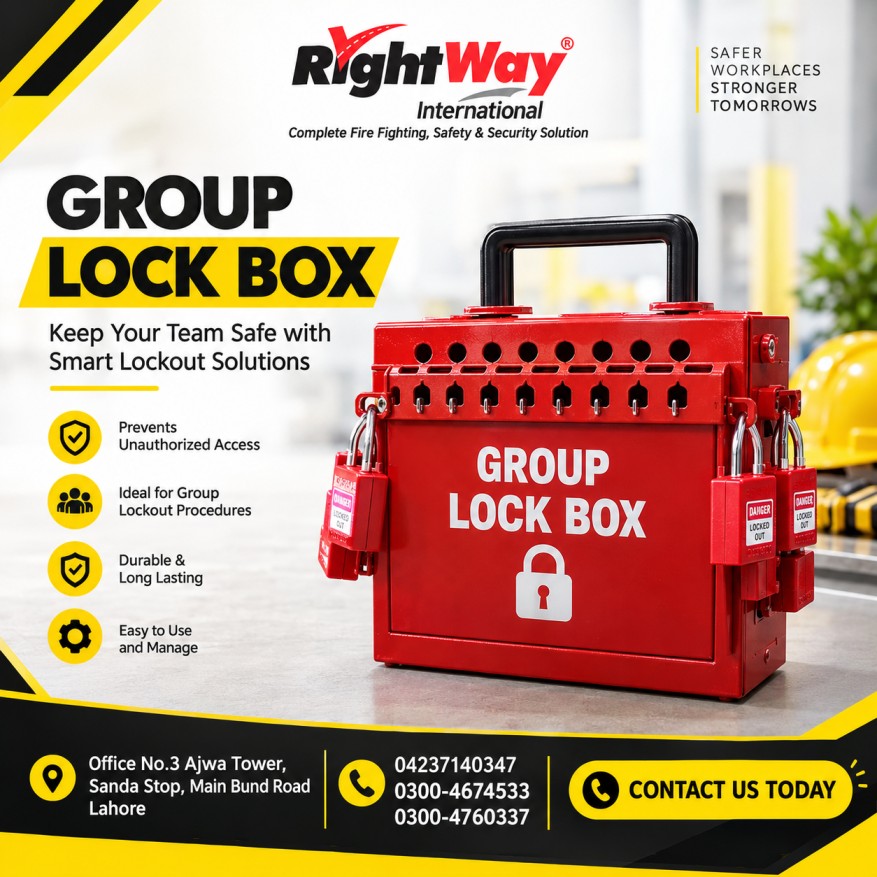
Importance of Group Lock Box. Group Lock Box plays an important role in workplace safety. It helps organizations manage Lockout/Tagout (LOTO) procedures when multiple workers perform maintenance, repairs, or equipment servicing. Workers use a group lock box to help ensure that hazardous energy remains isolated while authorized employees complete their tasks.
A group lock box provides a central location for securing keys from energy-isolation devices. After authorized workers isolate the equipment and apply the appropriate locks, they place the keys inside the lock box. Each worker involved in the maintenance task can then apply their personal safety padlock to the box. This arrangement helps prevent access to the isolation keys until every participating worker has removed their personal lock according to the approved procedure.
A well-managed group lock box supports coordinated maintenance activities. It helps teams follow established LOTO procedures, manage multiple personal locks, and protect workers from unexpected equipment startup or hazardous energy release.
Main Importance of Group Lock Box
- Protects Multiple Workers: A group lock box allows several authorized workers to secure their personal padlocks to one central box during a shared maintenance task.
- Supports Group Lockout Procedures: It helps maintenance teams coordinate Lockout/Tagout activities when multiple employees work on the same equipment.
- Helps Prevent Accidental Startup: By securing isolation keys inside the box, the system helps prevent equipment re-energization while workers maintain their personal locks.
- Improves Worker Protection: Each participating worker can apply their personal safety padlock, helping ensure that the isolation keys remain inaccessible until the required locks are removed.
- Centralizes Isolation Keys: A group lock box keeps keys from multiple isolation points in one controlled location.
- Improves LOTO Organization: It provides a structured method for managing group lockout activities involving several workers and energy sources.
- Supports Hazardous Energy Control: Workers can use a group lock box as part of procedures for controlling electrical, mechanical, hydraulic, pneumatic, and other hazardous energy sources.
- Reduces the Risk of Unauthorized Access: A properly managed lock box helps restrict access to isolation keys during maintenance.
- Simplifies Complex Maintenance Tasks: It helps teams coordinate lockout activities when several employees or departments work on the same equipment.
- Improves Accountability: Personal locks help identify which workers remain involved in the maintenance activity.
- Supports Workplace Safety Procedures: A group lock box helps organizations implement their approved energy-control procedures more consistently.
- Helps Organize Multiple Isolation Points: It can hold keys from several properly locked isolation devices, making it useful for complex machinery and industrial systems.
Why Is a Group Lock Box Important?
During maintenance, several workers may need to work on the same machine or system. Each worker must remain protected from the unexpected release of hazardous energy. Managing multiple isolation points and personal locks can become complicated without a suitable group lockout arrangement.
A Group Lock Box helps simplify this process by providing a central location for isolation keys. After the authorized employees isolate the equipment and secure the isolation devices, they place the keys inside the group lock box. Each worker involved in the task then applies their personal safety padlock to the box.
This arrangement helps ensure that the isolation keys remain secured while any participating worker still has a personal lock attached. It also allows workers to maintain individual control over their protection rather than relying solely on another employee’s lock.
However, a group lock box alone does not isolate hazardous energy or make equipment safe. Authorized employees must identify all energy sources, isolate them, apply the appropriate energy-isolating devices, and verify that the equipment has reached a safe state. Workers must also follow the facility’s approved LOTO procedure and the manufacturer’s instructions.
How to Use a Group Lock Box Correctly
Follow these steps to support safe and effective group lockout procedures:
- Identify Hazardous Energy Sources: Determine all electrical, mechanical, hydraulic, pneumatic, and other energy sources associated with the equipment.
- Shut Down and Isolate Equipment: Follow the approved shutdown procedure and apply suitable energy-isolating devices to prevent hazardous energy from reaching the equipment.
- Apply Isolation Locks: Authorized employees secure the required isolation points using appropriate lockout devices and locks.
- Secure the Isolation Keys: Place the keys from the isolation locks inside the designated group lock box and secure it according to the approved procedure.
- Apply Personal Safety Padlocks: Each participating worker attaches their personal padlock to the group lock box before beginning work.
- Verify Zero-Energy Conditions: Follow the required verification procedure, including testing and checking for stored or residual energy where applicable.
- Perform Maintenance Safely: Workers complete the assigned tasks while maintaining their personal lockout protection.
- Remove Personal Locks Correctly: Each worker removes their own lock after completing their work and following the site’s established removal procedure.
- Restore Equipment Safely: After confirming that personnel are clear, guards are restored, and all required checks are complete, authorized personnel can remove the isolation locks and return the equipment to service according to the approved procedure.
- Inspect and Maintain the Lock Box: Check the box, locking points, labels, and associated lockout equipment regularly to ensure they remain suitable for use.
Where Are Group Lock Boxes Used?
Group lock boxes are useful in workplaces where several employees must participate in the same hazardous energy control procedure. Common applications include:
- Manufacturing Plants: Protecting maintenance teams working on production machinery and automated equipment.
- Industrial Facilities: Coordinating group lockout activities across multiple energy-isolation points.
- Power Plants: Supporting approved maintenance procedures for equipment with multiple energy sources.
- Oil and Gas Facilities: Helping manage group lockout arrangements during equipment inspection and servicing.
- Construction Sites: Supporting coordinated maintenance of machinery and equipment where group LOTO procedures apply.
- Water Treatment Plants: Helping maintenance teams manage isolation keys for pumps, motors, and related equipment.
- Commercial and Industrial Buildings: Supporting maintenance of electrical systems, HVAC equipment, and other machinery.
The exact application depends on the equipment, energy sources, site procedures, and applicable safety requirements.
Benefits of Using a Group Lock Box
A group lock box offers several practical benefits when organizations implement it as part of a comprehensive Lockout/Tagout program. It helps centralize isolation keys, coordinate personal locks, and manage maintenance tasks involving multiple workers.
It also supports better communication among maintenance teams. Workers can identify their participation through their personal locks, while supervisors can follow the established procedure for coordinating isolation and equipment restoration. As a result, the group lock box can help improve organization, accountability, and consistency during maintenance operations.
A Group Lock Box is an important component of group Lockout/Tagout procedures. It provides a controlled location for isolation keys and allows multiple authorized workers to apply their personal safety padlocks during maintenance activities. This arrangement helps protect workers from unexpected equipment startup and the release of hazardous energy.
For effective protection, organizations should use group lock boxes alongside suitable safety padlocks, isolation devices, lockout tags, energy verification procedures, and employee training. Always follow the facility’s approved LOTO procedure and applicable safety requirements. Proper implementation helps create a safer, more organized, and more efficient working environment.
Lockout Station
Workers often use different lockout devices to control hazardous energy during maintenance. Without proper storage, these devices can become difficult to locate. Workers may also waste time searching for the correct equipment.
A Lockout Station provides a central place to store essential safety devices. It helps maintenance teams keep their equipment organized and ready for use. Clear organization also makes it easier to identify missing or misplaced items. Read More