




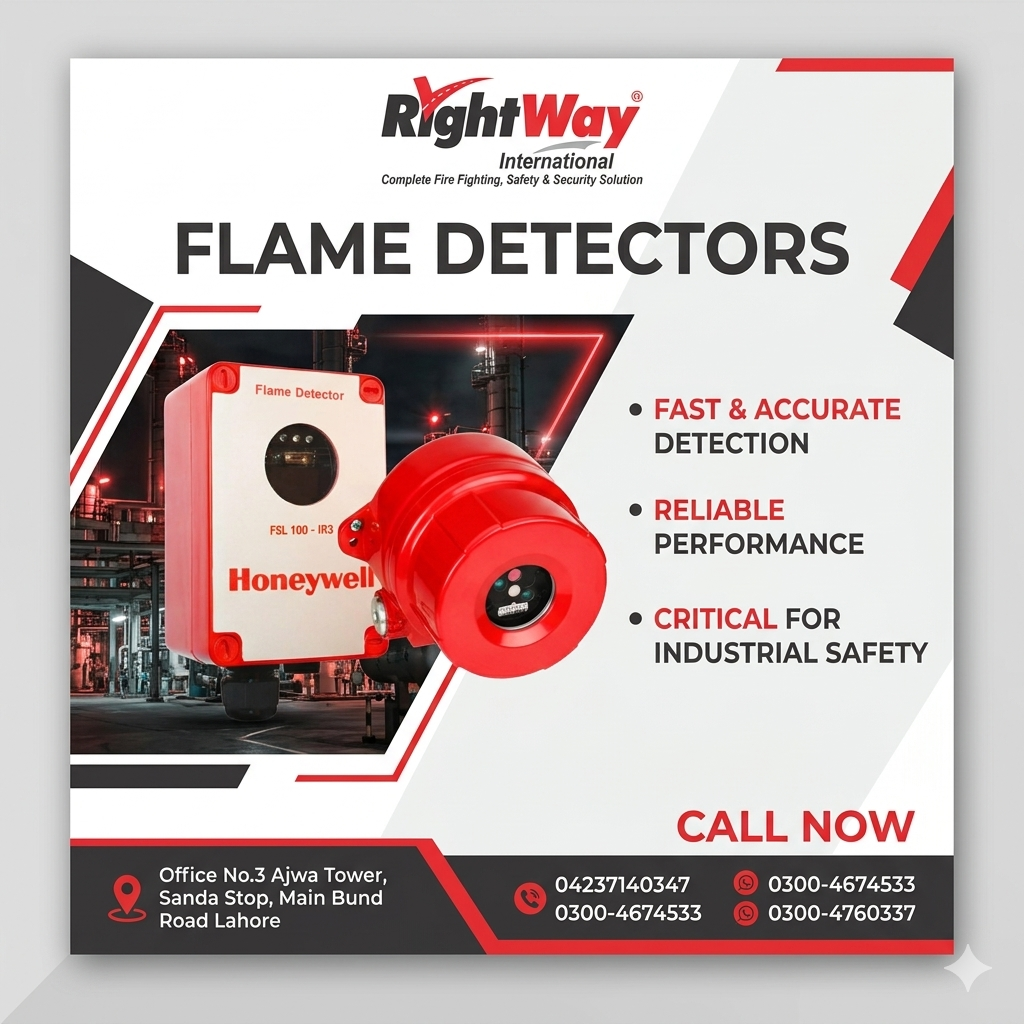
Flame Detector – Complete Guide. This is an advanced fire detection device that identifies fire by sensing flame radiation (UV, IR, or visible light) rather than heat or smoke. Therefore, it provides extremely fast fire detection, especially in high-risk industrial environments.
As per National Fire Protection Association standards, flame detectors are essential in areas where rapid fire ignition and spread can occur, such as oil & gas facilities, chemical plants, and fuel storage areas.
What is a Flame Detector?
A flame detector is an electronic safety device that detects the presence of flames by analyzing light wavelengths emitted during combustion.
Unlike heat detectors, which respond to temperature, or smoke detectors, which sense particles, flame detectors react almost instantly to fire.
Because of this, they are highly effective in high-risk and open-area environments.
How Does a Flame Detector Work?
Flame detectors operate using optical sensors that detect specific radiation patterns.
1. Normal Condition
First, the detector continuously monitors the environment for flame signatures. It remains inactive during safe conditions.
2. Flame Occurrence
Next, when a fire starts, it emits ultraviolet (UV) or infrared (IR) radiation.
3. Detection Mechanism
The detector analyzes this radiation and confirms whether it matches a real flame pattern.
4. Alarm Activation
Finally, once confirmed, the system triggers an alarm within milliseconds to seconds.
Thus, flame detectors provide ultra-fast fire detection, much quicker than a Heat Detector.
Types of Flame Detectors
1. Ultraviolet (UV) Flame Detector
Detects UV radiation from flames.
- Very fast response
- Suitable for indoor applications
- May be affected by welding arcs
2. Infrared (IR) Flame Detector
Detects infrared radiation emitted by flames.
- Works well in outdoor environments
- Less sensitive to false alarms
3. UV/IR Flame Detector
Combines both UV and IR sensing.
- Higher accuracy
- Reduced false alarms
- Widely used in industries
4. Triple IR (IR3) Flame Detector
Uses three IR sensors for precise detection.
- Highly reliable
- Ideal for hazardous environments
- Resistant to false triggers
Key Characteristics
- Detects flame radiation instead of heat or smoke
- Extremely fast response time
- Suitable for high-risk industrial areas
- Works in open spaces
- Can detect invisible fires (e.g., hydrogen flames)
Fire Types Detected
Flame detectors are highly effective for:
- Fast-flaming fires
- Gas fires
- Liquid fuel fires
- Explosive fire hazards
However, they are less effective for smoldering fires, where a Heat Detector or smoke detector performs better.
Where Flame Detectors Are Used
Flame detectors are commonly installed in:
- Oil and gas facilities
- Chemical plants
- Refineries
- Aircraft hangars
- Power plants
- Fuel storage areas
Because these environments involve rapid ignition risks, flame detectors are critical.
Where NOT to Use
Avoid using flame detectors in:
❌ Bedrooms and residential sleeping areas
❌ Offices and enclosed clean environments
❌ Areas with obstructions blocking line-of-sight
❌ Locations with constant light interference
In such places, smoke detectors or a Heat Detector are more appropriate.
Advantages
1. Ultra-Fast Detection
Flame detectors respond within milliseconds.
2. High Accuracy
Advanced sensors reduce false alarms.
3. Long Detection Range
They can cover large open areas.
4. Ideal for High-Risk Areas
Perfect for industrial and hazardous environments.
Disadvantages
- Requires direct line-of-sight to fire
- Can be expensive compared to heat detectors
- Sensitive to environmental interference (sunlight, welding)
- Not suitable for enclosed residential spaces
Flame Detector vs Heat Detector
| Feature | Flame Detector | Heat Detector |
|---|---|---|
| Detection Method | Flame radiation | Temperature |
| Response Time | Very fast | Slower |
| Best For | Industrial hazards | Harsh environments |
| Fire Type | Flaming fires | High-heat fires |
| Coverage | Large/open areas | Localized areas |
Overall, both devices complement each other. Using flame detectors alongside a Heat Detector ensures comprehensive fire protection.
NFPA Standards for Flame Detectors
According to National Fire Protection Association:
- Flame detectors must be properly positioned for clear line-of-sight
- Installation should follow NFPA 72 (National Fire Alarm and Signaling Code)
- Regular testing and maintenance are mandatory
- Environmental factors must be considered during installation
Compliance ensures maximum reliability and safety.
Maintenance Tips
To maintain performance:
- Test detectors regularly
- Clean optical sensors
- Check alignment and field of view
- Inspect wiring and connections
- Follow manufacturer and NFPA guidelines
Frequently Asked Questions (FAQs)
1. Are flame detectors better than heat detectors?
Not necessarily. Flame detectors are faster, but a Heat Detector is better in dusty or enclosed environments.
2. Do flame detectors detect smoke?
No, they only detect flame radiation.
3. Where should I install a flame detector?
Install in industrial areas like refineries, fuel storage, and chemical plants.
4. Are flame detectors suitable for homes?
Generally, no. Smoke detectors and heat detectors are more suitable.
5. What is their lifespan?
Typically, flame detectors last 10–15 years, depending on usage and environment.
Conclusion
In conclusion, a flame detector is a high-speed fire detection device designed for environments where fires can ignite and spread rapidly. By detecting flame radiation, it provides instant alerts, making it essential in industrial safety systems.
However, since it requires line-of-sight and is not effective for smoldering fires, it should be used alongside other devices like a Heat Detector for complete protection.