




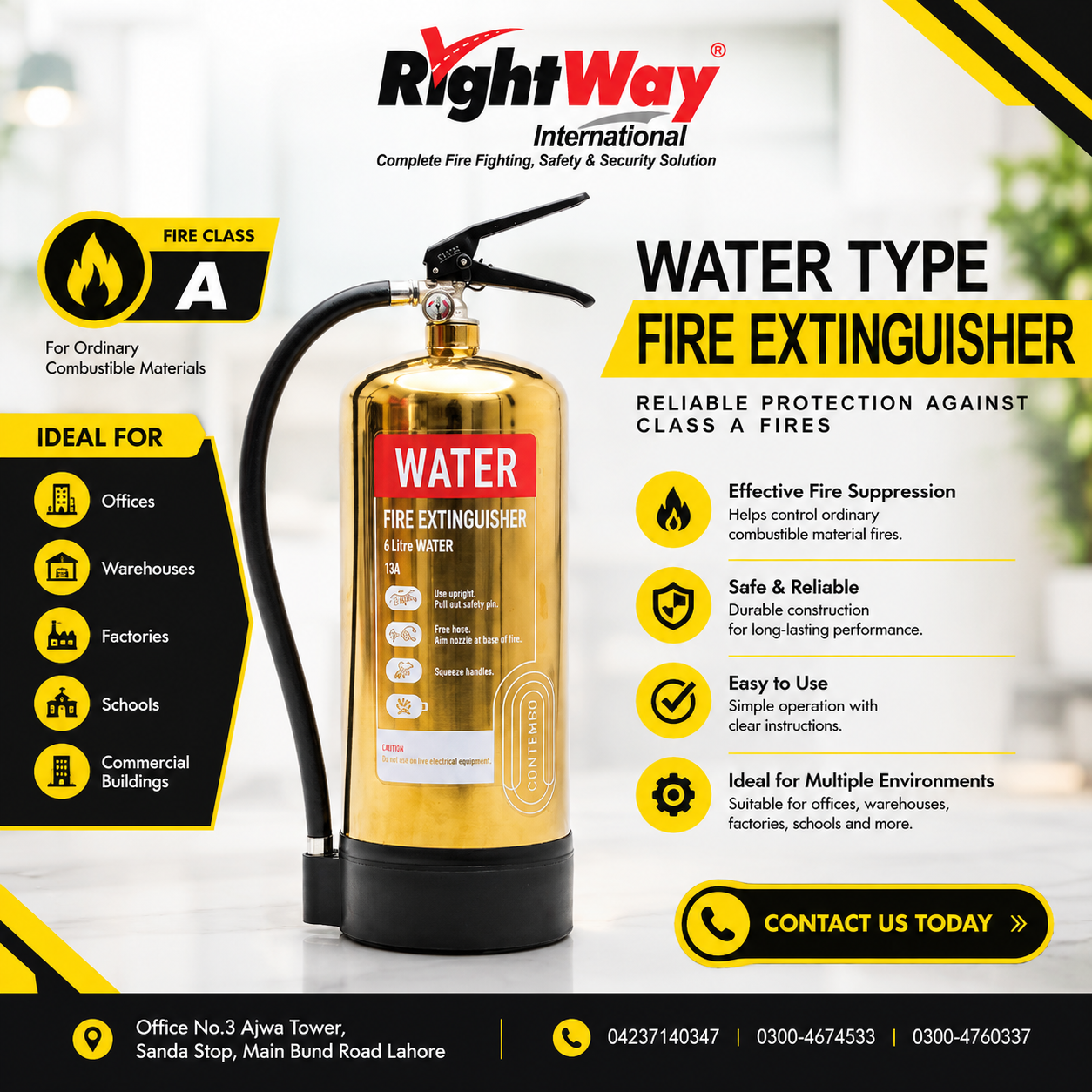
Importance Water Type Fire Extinguisher provides effective protection against fires involving ordinary combustible materials such as wood, paper, cardboard, cloth, and other similar materials. Because of its simple extinguishing method, it remains a common choice for offices, schools, warehouses, commercial buildings, and other locations with Class A fire hazards.
Water extinguishers work mainly through cooling. When water reaches the burning material, it reduces the temperature and helps stop the combustion process. As a result, the fire loses the heat it needs to continue burning.
However, water extinguishers do not suit every type of fire. For example, users should never use water on energized electrical equipment or burning cooking oil. Therefore, understanding the correct application remains essential for safe fire protection.
What Is a Water Type Fire Extinguisher?
A Water Type Fire Extinguisher contains water as its primary extinguishing agent. The extinguisher releases water through a hose or nozzle when the user activates the operating mechanism.
The water absorbs heat from the burning material and lowers its temperature below the level needed to sustain combustion.
Consequently, water extinguishers work particularly well on Class A fires, which involve ordinary combustible materials.
Common Class A materials include:
- Wood
- Paper
- Cardboard
- Cloth
- Textiles
- Some types of plastic
- Other ordinary solid combustibles
However, always check the extinguisher’s label and fire rating before use.
What Type of Fire Can a Water Fire Extinguisher Handle?
Water fire extinguishers primarily protect against Class A fires.
These fires involve solid combustible materials that can leave ash after burning.
Class A Fires
Examples include:
- Wooden furniture
- Paper products
- Cardboard packaging
- Curtains
- Clothing
- Textiles
- Books
- Wooden structures
- General office materials
A water extinguisher can cool these materials and help stop the fire from continuing.
Nevertheless, water does not provide suitable protection for every fire class. Users should select an extinguisher according to the actual hazard.
Why Is a Water Type Fire Extinguisher Important?
Fire can spread rapidly through ordinary combustible materials. Therefore, having the correct extinguisher nearby can provide an important first-response option when a small fire develops.
Water extinguishers provide strong cooling action. In addition, their straightforward operation makes them practical for locations with primarily Class A fire risks.
For example, a school may have paper, furniture, books, and other combustible materials. Similarly, a warehouse may store large quantities of cardboard and packaging.
In these environments, a correctly rated water extinguisher can form an important part of the overall fire safety plan.
Main Benefits of Water Type Fire Extinguishers
1. Effective Cooling Action
Water absorbs a significant amount of heat from burning materials.
As the temperature falls, the fire loses the heat required to continue combustion. Therefore, cooling plays the main role in water-based fire suppression.
2. Suitable for Class A Fires
Water extinguishers specifically target ordinary combustible materials.
They can provide suitable protection for paper, wood, cardboard, cloth, and similar materials when the extinguisher carries the required Class A rating.
3. Simple Operation
Water extinguishers generally use a straightforward operating mechanism.
With proper training, users can quickly identify the extinguisher and follow the operating instructions during a small fire emergency.
4. Useful for Many Commercial Areas
Offices, schools, warehouses, factories, shops, and other commercial facilities can contain significant Class A fire hazards.
Therefore, water extinguishers can form part of a suitable fire protection arrangement in these environments.
5. Helps Reduce Fire Spread
Early action can help prevent a small Class A fire from spreading to nearby combustible materials.
However, users should only attempt to extinguish a fire when it remains small and conditions allow a safe escape.
How Does a Water Type Fire Extinguisher Work?
A water extinguisher suppresses fire mainly through heat removal.
When the user activates the extinguisher, pressurized water travels through the hose and exits through the nozzle.
The water then reaches the burning material and absorbs heat. As the material cools, it becomes more difficult for combustion to continue.
Furthermore, continued cooling can help reduce the temperature of nearby combustible materials.
Therefore, water extinguishers provide a simple but effective method for controlling suitable Class A fires.
Where Are Water Type Fire Extinguishers Used?
Water extinguishers can suit many environments where ordinary combustible materials create the primary fire risk.
1. Offices
Offices contain paper documents, cardboard, furniture, books, and other combustible materials.
Therefore, a suitable Class A extinguisher can provide useful protection in these areas.
2. Schools and Educational Institutions
Classrooms, libraries, offices, and storage areas can contain large quantities of paper, books, furniture, and other combustible materials.
Consequently, educational facilities should include suitable fire protection equipment as part of their emergency planning.
3. Warehouses
Warehouses often store cardboard boxes, packaging materials, paper products, textiles, and other solid combustibles.
A properly rated water extinguisher can help address suitable Class A fire hazards.
4. Factories
Manufacturing facilities can contain different types of fire risks. Where ordinary combustible materials represent the primary hazard, water extinguishers may provide suitable protection.
However, factories should assess all fire hazards before selecting their extinguishers.
5. Commercial Buildings
Shops, offices, storage areas, and commercial properties can contain many ordinary combustible materials.
Therefore, water extinguishers may form part of the portable fire protection equipment in suitable locations.
6. Residential and Institutional Areas
Certain residential, educational, and institutional areas can also contain Class A hazards.
The facility should select extinguisher types according to the materials and equipment present.
Water Fire Extinguisher vs CO₂ Fire Extinguisher
A CO₂ Fire Extinguisher and a water extinguisher serve different fire hazards.
Water extinguishers primarily target Class A fires involving ordinary combustible materials.
CO₂ extinguishers commonly provide protection for suitable electrical and flammable-liquid hazards, depending on their rating.
For example, water may suit a fire involving cardboard, while CO₂ may suit a suitable energized electrical equipment fire.
Therefore, businesses should not treat these extinguishers as interchangeable.
Water Fire Extinguisher vs DCP Fire Extinguisher
A DCP Fire Extinguisher uses dry chemical powder to suppress suitable fires across several fire classes, depending on its certification and rating.
Water extinguishers focus primarily on Class A combustible materials.
DCP extinguishers can provide broader applications, but their powder can create significant cleanup requirements after discharge.
In contrast, water does not create the same type of dry chemical powder residue.
Consequently, businesses should select the extinguisher according to the specific fire hazard rather than simply choosing one based on general availability.
Water Fire Extinguisher vs Foam Fire Extinguisher
Foam extinguishers can provide protection against certain Class A and Class B fires.
Water extinguishers, on the other hand, primarily target Class A combustible materials.
Therefore, a facility that contains flammable liquids may require a different extinguisher from a location that only contains ordinary solid combustibles.
Always check the extinguisher rating before installation.
How to Use a Water Type Fire Extinguisher
Only trained personnel should attempt to use a portable fire extinguisher.
Follow these general steps:
Step 1: Raise the Alarm
Alert people in the surrounding area and activate the fire alarm if one is available.
Step 2: Assess the Fire
Make sure the fire remains small and manageable. If flames spread rapidly or smoke becomes dangerous, evacuate immediately.
Step 3: Check the Extinguisher
Confirm that the extinguisher is suitable for the fire and carries the appropriate Class A rating.
Step 4: Pull the Safety Pin
Remove the safety pin to unlock the operating handle.
Step 5: Aim at the Base of the Fire
Point the nozzle toward the base of the flames rather than the top.
Step 6: Squeeze the Handle
Press the operating handle to release the water.
Step 7: Sweep Across the Fire
Move the nozzle from side to side while directing the water toward the burning material.
Step 8: Monitor the Area
After the flames disappear, watch the area for signs of re-ignition.
Always keep a clear escape route behind you. If the fire grows beyond your control, stop immediately and evacuate.
Why Should You Never Use Water on Electrical Fires?
Water can conduct electricity and create a serious electric shock hazard.
Therefore, users should never use a standard water extinguisher on energized electrical equipment unless the specific product carries an appropriate rating and the manufacturer explicitly approves that application.
Electrical equipment can include:
- Computers
- Electrical panels
- Switchboards
- Servers
- Machinery
- Power equipment
- Live wiring
- Electrical appliances
Instead, use an extinguisher specifically approved for the electrical hazard and follow the facility’s emergency procedures.
Why Should You Never Use Water on Cooking Oil Fires?
Water can create an extremely dangerous reaction when it contacts burning cooking oil.
The intense heat can rapidly convert the water into steam. The expanding steam can force burning oil outward and spread flames across the surrounding area.
As a result, a small cooking-oil fire can become a major kitchen emergency.
Therefore:
Never throw water onto a cooking-oil or grease fire.
Use a properly rated Wet Chemical Fire Extinguisher for suitable commercial cooking-oil and fat fire hazards.
Safety Precautions for Water Fire Extinguishers
Proper handling helps improve emergency response and reduce unnecessary risks.
Follow these precautions:
- Use water extinguishers only for suitable fire classes.
- Never use standard water extinguishers on energized electrical equipment.
- Never use water on burning cooking oil.
- Check the extinguisher label before use.
- Inspect the cylinder regularly.
- Check the pressure indicator where applicable.
- Keep the safety pin and tamper seal intact.
- Store the extinguisher in an accessible location.
- Keep the hose and nozzle unobstructed.
- Train employees in basic fire extinguisher operation.
- Do not use a damaged or leaking extinguisher.
- Recharge the extinguisher after discharge.
- Maintain a clear escape route while fighting a fire.
- Evacuate immediately if the fire becomes too large to control.
Most importantly, portable extinguishers should support a complete fire safety plan rather than replace fire alarms, emergency exits, detection systems, suppression systems, and staff training.
Maintenance of Water Type Fire Extinguishers
Regular inspection helps keep a water fire extinguisher ready for emergency use.
During routine checks, inspect the cylinder, hose, nozzle, operating handle, safety pin, tamper seal, pressure indicator, and mounting bracket.
Also, look for corrosion, leakage, physical damage, or other signs of deterioration.
After discharge, arrange professional servicing or replacement according to the manufacturer’s instructions.
A suitable maintenance program should include:
- Regular visual inspections
- Pressure checks where applicable
- Cylinder inspections
- Hose and nozzle checks
- Safety pin inspection
- Tamper seal inspection
- Professional servicing
- Recharging after discharge
- Replacement of damaged components
- Maintenance records
Consequently, proper maintenance helps ensure that the extinguisher remains ready when an emergency occurs.
Water Type Fire Extinguisher for Offices
Offices commonly contain paper, cardboard, wooden furniture, books, packaging, and textiles.
These materials can support Class A fires.
Therefore, a suitable water extinguisher can provide an important first-response option in areas where these hazards dominate.
However, offices also contain computers, electrical appliances, printers, networking equipment, and other electrical devices.
For this reason, office fire protection should include appropriate extinguishers for the different hazards present.
Water Type Fire Extinguisher for Warehouses
Warehouses can contain large quantities of combustible packaging and stored materials.
Cardboard boxes, wooden pallets, paper products, textiles, and other solid materials can contribute to rapid fire development.
Therefore, warehouse managers should conduct a fire risk assessment and position suitable extinguishers where employees can access them quickly.
Larger facilities may also require fire detection systems, hydrants, sprinklers, emergency lighting, fire alarms, and other protection measures.
How to Choose the Right Water Fire Extinguisher
Before purchasing a water fire extinguisher, consider the following factors.
Fire Rating
First, identify the fire classes present at the location.
For water extinguishers, the primary focus should remain on suitable Class A hazards.
Extinguisher Capacity
Choose a suitable cylinder capacity according to the size and risk level of the protected area.
Certification
Select products that meet applicable certification and safety requirements.
Construction Quality
Look for durable cylinders, reliable operating components, suitable hoses, and properly designed nozzles.
Installation Location
Place extinguishers where trained personnel can reach them quickly without exposing themselves to unnecessary danger.
Maintenance Support
Choose a supplier that can provide inspection, servicing, recharging, and technical assistance.
Importance of Water Type Fire Extinguishers in Pakistan
Fire safety remains important across offices, schools, warehouses, factories, commercial buildings, shops, institutions, and other facilities throughout Pakistan.
Many of these locations contain ordinary combustible materials such as paper, cardboard, wood, furniture, packaging, and textiles.
Therefore, a properly selected Water Type Fire Extinguisher in Pakistan can provide useful protection against suitable Class A fire hazards.
At the same time, businesses should assess other risks within the same facility. Electrical equipment, flammable liquids, cooking oils, gases, and machinery may require different fire protection equipment.
For example, a commercial kitchen may require wet chemical extinguishers, while an electrical equipment area may require a suitable non-conductive extinguishing agent.
Consequently, a complete fire risk assessment should guide extinguisher selection.
Water Type Fire Extinguisher for Commercial Buildings
Commercial buildings can contain offices, shops, storage areas, electrical rooms, kitchens, and other spaces with different fire hazards.
Because each area may contain different combustible materials, one extinguisher type may not provide complete protection throughout the building.
Water extinguishers can address suitable Class A hazards. However, facility managers should also consider electrical, flammable-liquid, cooking-oil, and other risks.
Therefore, professional fire safety planning should determine the correct combination of portable extinguishers and other fire protection systems.
Frequently Asked Questions About Water Type Fire Extinguishers
What Is a Water Type Fire Extinguisher?
A Water Type Fire Extinguisher uses water as its primary extinguishing agent. It mainly protects against Class A fires involving ordinary combustible materials such as wood, paper, cardboard, and cloth.
What Class of Fire Does a Water Extinguisher Put Out?
Water extinguishers primarily protect against Class A fires.
These fires involve ordinary solid combustible materials.
Can a Water Fire Extinguisher Be Used on Electrical Fires?
A standard water extinguisher should not be used on energized electrical equipment unless the specific extinguisher carries an appropriate rating and the manufacturer approves the application.
Always follow the product label and electrical safety procedures.
Can You Use Water on a Cooking-Oil Fire?
No. Water can rapidly turn into steam when it contacts extremely hot cooking oil and can spread burning oil and flames.
Use a properly rated wet chemical extinguisher for suitable cooking-oil and fat fires.
Where Are Water Fire Extinguishers Used?
Water extinguishers can suit offices, schools, warehouses, factories, commercial buildings, storage areas, and other locations where Class A combustible materials create the primary fire hazard.
Is a Water Extinguisher Good for Wood Fires?
Yes. Wood represents a typical Class A combustible material. A properly rated water extinguisher can help cool and suppress a small wood fire.
Is Water Better Than DCP for Fire Protection?
Water and DCP extinguishers serve different applications. Water extinguishers primarily address suitable Class A hazards, while DCP extinguishers can cover a broader range of fire classes depending on their rating.
Therefore, the correct choice depends on the specific fire risk.
How Often Should a Water Fire Extinguisher Be Inspected?
Inspection and servicing requirements depend on the manufacturer, local requirements, workplace conditions, and applicable fire safety standards.
Facilities should include regular visual inspections within their fire safety program.
Can Anyone Use a Water Fire Extinguisher?
Only trained personnel should attempt to fight a small fire with a portable extinguisher.
If the fire grows rapidly, produces dangerous smoke, or blocks the escape route, evacuate immediately and contact emergency services.
Conclusion
A Water Type Fire Extinguisher provides practical fire protection for suitable Class A hazards involving ordinary combustible materials such as wood, paper, cardboard, cloth, and textiles.
Its primary extinguishing action comes from cooling. By reducing the temperature of the burning material, water helps interrupt the combustion process.
However, water extinguishers do not suit every fire. Never use a standard water extinguisher on energized electrical equipment or burning cooking oil unless the specific product carries an appropriate rating and the manufacturer approves the application.
Therefore, businesses should assess their fire risks before selecting portable extinguishers.
For offices, schools, warehouses, factories, commercial buildings, and other locations with Class A hazards, a properly selected and maintained water fire extinguisher can form an important part of a complete fire safety strategy.
Most importantly, employees should receive proper fire safety training and understand when to use an extinguisher and when to evacuate.