




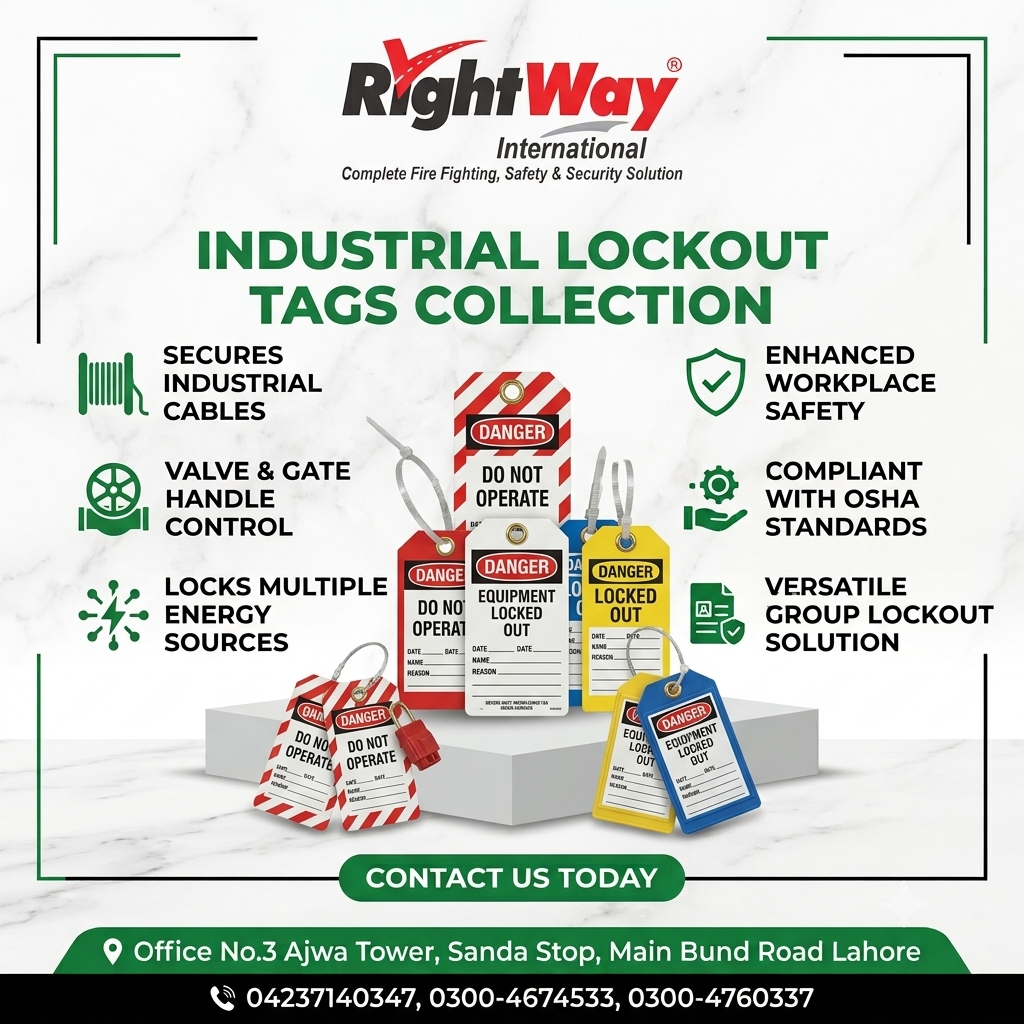
Lockout Tags in Pakistan are an essential visual communication component of any facility safety management and hazard control program. Specifically, safety engineers design them to display critical warning messages, identify authorized personnel, and state the exact status of machinery undergoing maintenance. By securely fastening heavy-duty warning markers directly onto energy-isolating devices—such as circuit breakers, valves, and switches—these tags prevent workers from accidentally re-energizing equipment. Consequently, facility teams extensively implement lockout tags across manufacturing plants, oil and gas refineries, power generation stations, and industrial complexes throughout Pakistan.
Importantly, these safety tags reinforce workplace safety and prevent severe multi-source energy accidents during equipment servicing. Moreover, they support compliance with Occupational Safety and Health Administration (OSHA)1910.147 LOTO standards, National Electrical Code (NEC) guidelines, ISO 45001 safety frameworks, and local Pakistan industrial safety regulations.
Manufacturers build modern lockout tags using industrial-grade PVC, heavy-duty cardstock, or weather-resistant synthetic polymers featuring high-visibility hazard colors. Additionally, they incorporate write-on matte surfaces, brass-reinforced eyelets, and high pull-resistance structures to deliver dependable performance in demanding industrial environments.
Benefits of Lockout Tags
- Clear Hazard Communication: Prominently displays standardized warnings such as “DO NOT OPERATE” or “DO NOT ENERGIZE” to instantly alert personnel.
- Individual Accountability: Features dedicated spaces for technicians to write their name, department, contact info, and the expected completion date.
- OSHA LOTO Compliance: Fully satisfies OSHA 1910.147 Lockout/Tagout requirements for administrative hazard communication and equipment identification.
- Weather & Environment Resistant: Built using moisture-resistant, tear-proof PVC or laminated plastics that withstand grease, oil, and outdoor UV aging.
- High-Visibility Safety Color Coding: Utilizes striking red, black, and safety-yellow visual panels compliant with ANSI Z535 standards to command immediate attention.
- Secure Fastening Strength: Incorporates heavy-duty brass or reinforced fiber eyelets that withstand high pull force without ripping off the shackle.
- Customizable Writable Surface: Accommodates permanent markers, ballpoint pens, or industrial stamps for quick, clear data recording on the shop floor.
- Lightweight & Versatile: Easily pairs with safety padlocks, lockout hasps, and cable ties across virtually any mechanical or electrical isolation point.
- Global & Local Regulatory Compliance: Fully supports international OSHA, NEC, and ISO standards while meeting all local Pakistan industrial safety codes.
Types of Lockout Tags
- Standard “Do Not Operate” PVC Tag: Heavy-duty plastic tag featuring bold warning headers and write-on fields for routine machinery maintenance.
- Heavy-Duty Self-Laminating Tag: Includes a clear clear-seal flap that covers and protects handwritten operational details from chemical splashes and dirt.
- Electrical Danger Warning Tag: Bright yellow-and-black specialized tag highlighting high-voltage electrical hazards, transformer servicing, and panel isolation.
- Multi-Lingual Safety Tag: Features bilingual text (such as English and Urdu or Arabic) to ensure absolute clarity among diverse workforces in Pakistani plants.
- Reusable Heavy-Duty Vinyl Tag: Rigid plastic tag designed for repetitive use in harsh environments, cleaned and re-stamped after each project.
- Miniature Equipment Tag: Compact warning marker tailored for tight spaces, small switches, and delicate instrumentation controls.
Common Lockout Tag Components
Engineers construct modern lockout tags using precision-engineered physical parts:
- Industrial Polymer Body: Tear-resistant PVC, synthetic paper, or cardstock engineered for high durability and tensile toughness.
- Reinforced Eyelet Ring: Brass or heavy-duty fiber grommet designed to prevent the shackle or cable tie from ripping through the material.
- Standardized Header Panel: High-contrast background color block featuring signal words like “DANGER” or “WARNING”.
- Graphic Hazard Icon: Pictogram warning against unauthorized machine startup or valve manipulation.
- Writable Data Fields: Structured lines for recording the authorized worker’s name, department, date, and reason for isolation.
- Anti-Tamper Backside: Secondary information fields or tracking numbers for internal facility auditing and safety logs.
Common Uses in Pakistan
Technicians strategically attach lockout tags to isolation points and control mechanisms in:
- Oil, Gas & Petrochemical Refineries: Pipeline valves, high-pressure pumps, and refinery distribution manifolds.
- Manufacturing & Heavy Industry: Assembly lines, hydraulic presses, and conveyor belt control stations.
- Power Generation & Utilities: Electrical switchgear rooms, transformer yards, and turbine control panels.
- Chemical Processing Plants: Corrosive chemical lines, mixing vats, and emergency shut-off valves.
- Construction & Infrastructure: Heavy earthmoving machinery, site generators, and temporary electrical hookups.
- Textile & Composite Mills: Loom electrical boxes, massive spinning frames, and central utility feeds.
Benefits Compared to Standard Improvised Methods
| Feature | Engineered Lockout Tag | Improvised Paper / Masking Tape |
| Material Durability | Tear-proof, chemical-resistant PVC or heavy-duty polymer | Easily rips, dissolves in oil/water, or disintegrates outdoors |
| Legal Compliance | Fully compliant with OSHA 1910.147 and international safety standards | Completely non-compliant, inviting severe penalties during safety audits |
| Information Clarity | Standardized headers, pictograms, and structured write-on fields | Messy handwriting on tape that fades or gets easily misunderstood |
| Attachment Strength | Reinforced eyelets built to withstand high pulling force | Weak attachment points that easily detach or fall off machinery |
| Visual Warning | High-visibility ANSI-compliant color-coding and clear danger messaging | Lacks formal safety structure or professional warning impact |
Cable Lockout Devices
A cable lockout acts as a flexible mechanical barrier that threads through multiple energy isolation points to prevent equipment activation.
First, an authorized technician shuts down all relevant energy sources (such as valves and switches) across the target machine, ensuring zero energy input. Next, they select the appropriate cable lockout device with sufficient cable length.
How a Lockout Tag Works
A lockout tag functions as an indispensable administrative safety barrier that communicates equipment status and warns workers not to restore power.
First, an authorized technician shuts down the target machine and ensures zero energy input. Before or during the attachment of a physical padlock, they fill out a lockout tag with their name, department, and the date.
Next, they thread the safety padlock shackle or a heavy-duty cable tie through the tag’s reinforced eyelet and secure it directly to the energy-isolating device (such as a valve handle or breaker switch) alongside their lock. Finally, the tag serves as an immediate visual warning to anyone approaching the machinery.
Consequently, no worker will attempt to operate the equipment because the tag clearly indicates that active maintenance is underway. The tag remains firmly in place until the job is fully completed and the authorized technician removes it.
Maintenance & Servicing Requirements
To remain operational and compliant with safety guidelines, lockout tags require basic tracking and handling care:
- Pre-Use Integrity Checks: Inspect tags before every shift to ensure text remains legible and eyelets are free from rips or tears.
- Storage Management: Keep clean, unused tags stored neatly in wall-mounted LOTO stations or partitioned safety kits away from direct chemical degradation.
- Post-Task Removal Audit: Ensure completed or damaged tags are properly removed and disposed of to prevent clutter and misinformation on active equipment.
- Marker Permanence Verification: Verify that handwritten entries use waterproof, fade-resistant permanent markers that survive harsh facility climates.