




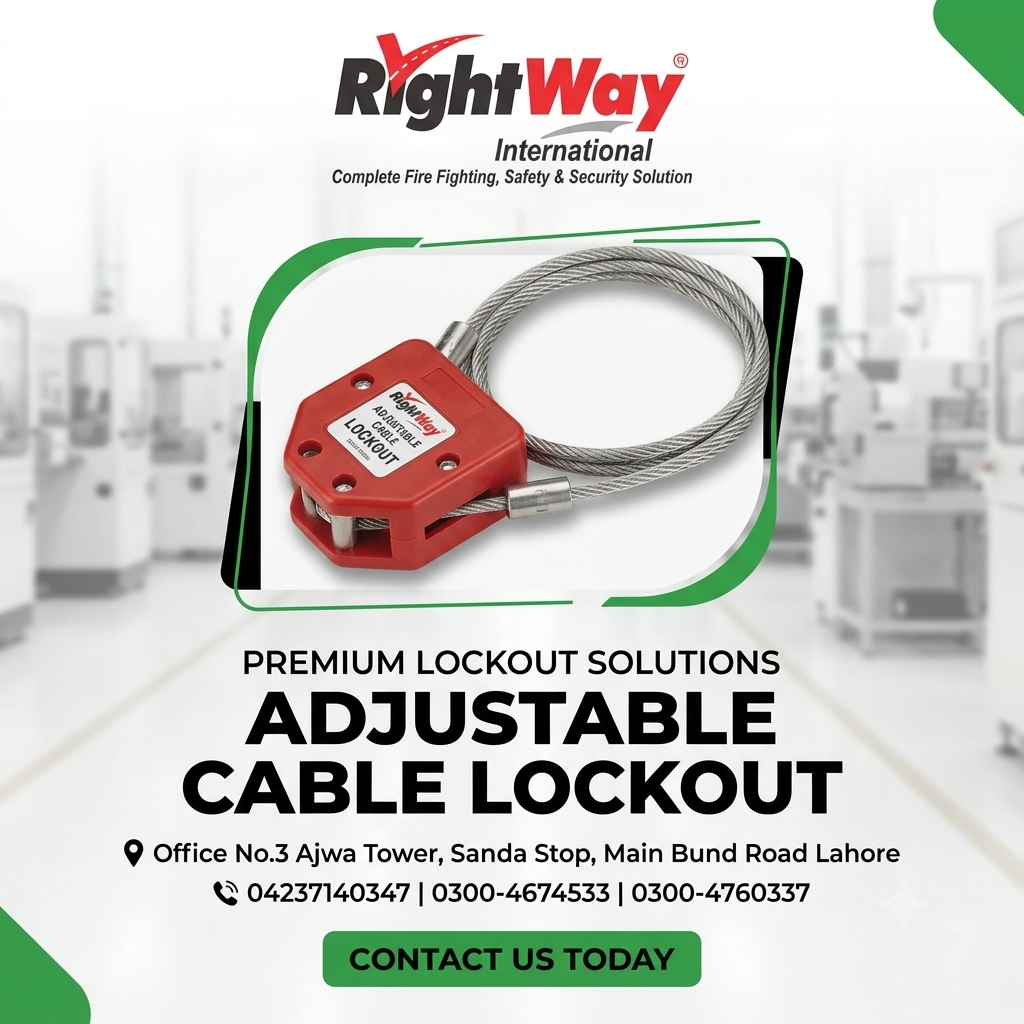
Adjustable Cable Lockouts in Pakistan are an essential mechanical containment and administrative safety component of any facility energy control and hazard isolation program. Specifically, safety engineers design them to secure awkward, multi-point, or hard-to-reach energy-isolating devices—such as gate valves, butterfly valves, circuit breaker levers, and grouped electrical switches. By feeding a flexible, heavy-duty cable through multiple isolation points and cinching it tight through a central clamping body, these specialized lockout devices prevent workers from accidentally re-energizing equipment while team members are still working.
Consequently, industrial safety teams extensively implement adjustable cable lockouts across manufacturing plants, oil and gas refineries, power generation stations, chemical processing facilities, and heavy engineering complexes throughout Pakistan.
Importantly, these flexible safety isolation units reinforce workplace safety and prevent severe multi-source energy accidents during major turnarounds, shutdowns, and complex equipment servicing. Moreover, they support compliance with
Occupational Safety and Health Administration (OSHA) 1910.147 LOTO standards, National Electrical Code (NEC) guidelines, ISO 45001 safety frameworks, and local Pakistan industrial safety regulations.
Manufacturers build modern adjustable cable lockouts using high-impact thermoplastic housing, non-conductive nylon, or rugged metal alloy bases coupled with multi-stranded vinyl-coated steel cables or dielectric nylon cables in high-visibility hazard colors. Additionally, they incorporate ergonomic cinching wheels, multi-padlock retention holes, integrated cable management slots, and chemical-resistant finishes to deliver dependable performance in demanding industrial environments.
Benefits of Adjustable Cable Lockouts
- Versatile Multi-Point Isolation: Safely secures multiple energy isolation devices simultaneously with a single, continuous flexible cable to streamline complex Lockout/Tagout setups.
- Custom-Fit Cinching Action: Adjusts smoothly to pull slack out of the line, creating a tight, custom fit that prevents lever movement or valve rotation on non-standard machinery.
- OSHA LOTO Compliance: Fully satisfies OSHA 1910.147 multi-person and group lockout requirements for effective physical energy blockage.
- Weather & Chemical Resistance: Built using UV-protected thermoplastic bodies and vinyl-sheathed steel or stainless steel cables that withstand moisture, grease, oil, and aggressive chemicals.
- High-Visibility Safety Color Coding: Utilizes striking safety red or yellow finishes compliant with ANSI Z535 standards to command immediate visual attention across industrial work areas.
- Multi-Padlock Capacity: Features multiple lockout holes (typically accommodating 4 to 6 padlocks) on the housing body to allow full crew accountability without needing extra lockout hasps.
- Dielectric Options Available: Offers non-conductive nylon and Kevlar® cable variants specifically engineered for high-voltage electrical panels and substation environments.
- Compact & Highly Portable: Replaces bulky rigid valve covers with a single lightweight tool that fits easily into a technician’s LOTO pouch or safety crib.
- Global & Local Regulatory Compliance: Fully supports international OSHA, NEC, and ISO standards while meeting all local Pakistan industrial safety codes.
Types of Adjustable Cable Lockouts
- Steel Cable Lockout Device: Features a heavy-gauge vinyl-coated braided steel cable paired with a high-impact ABS housing, ideal for general mechanical and valve isolations.
- Dielectric Nylon Cable Lockout: Constructed completely without metallic parts using non-conductive nylon rope, engineered for high-voltage switchgear and electrical enclosures.
- Scissor-Style Cable Lockout: Uses an interlocking squeeze handle that allows technicians to thread, pull tight, and squeeze to clamp the cable down firmly in place.
- Wheel-Driven Cable Lockout: Incorporates a top ergonomic tensioning dial or knob that allows precise mechanical cinching before padlocks are applied.
- Miniature Cable Lockout: Compact, pocket-sized lockout unit designed for tight electrical disconnects, breaker switches, and small instrument panel valves.
- Stainless Steel Cable Lockout: Heavy-duty, corrosion-proof cable design built specifically for marine, offshore, and offshore chemical processing environments.
Common Adjustable Cable Lockout Components
Engineers construct modern adjustable cable lockouts using precision-engineered physical parts:
- Flexible Steel Cable: Braided multi-strand steel core encapsulated in a clear or red protective vinyl sleeve to resist corrosion, abrasion, and electrical conductivity.
- High-Impact Thermoplastic Body: Heavy-duty ABS or polycarbonate casing designed for impact toughness, UV resistance, and chemical exposure endurance.
- Internal One-Way Cleat Mechanism: Precision metal or reinforced resin gripping teeth inside the casing that lock the cable tightly into position when pulled.
- Ergonomic Cinching Lever/Wheel: Molded grip mechanism that enables safety technicians to pull slack easily and lock down tension without extra tools.
- Multi-Lock Perimeter Holes: Reinforced holes through the clamping body designed to hold multiple padlock shackles and prevent the internal mechanism from releasing.
- Cable Storage Strap: Integrated hook-and-loop fastener or clip for keeping long coiled cables tidy during storage and transportation.
Common Uses in Pakistan
Technicians strategically deploy adjustable cable lockouts during multi-person servicing tasks in:
- Oil, Gas & Petrochemical Refineries: Complex multi-valve manifold isolation on fractionating towers, pipeline headers, and gas compression lines.
- Manufacturing & Heavy Industry: Locking out interlocking levers, large gate valves, and automated robotic line power sources simultaneously.
- Power Generation & Utilities: Annual turbine maintenance, multi-switch disconnects, and electrical substation grid servicing.
- Chemical Processing Plants: Batch reactor cleaning, corrosive acid line shutdowns, and staggered chemical feed valve lockouts.
- Fertilizer & Cement Plants: Multi-point conveyor belt drives, rotary kiln motor switches, and pneumatic line isolations.
- Textile & Composite Mills: Factory-wide steam pipeline distribution valves, spinning frame main power levers, and boiler utility room maintenance.
Benefits Compared to Standard Improvised Methods
| Feature | Engineered Adjustable Cable Lockout | Improvised Storage / Rope & Wire Chains |
| Material Durability | UV-protected thermoplastic and vinyl-coated stainless/galvanized steel cable | Flimsy wire, hemp rope, or basic metal hardware chains that rust, fray, or snap easily |
| Legal Compliance | Fully compliant with OSHA 1910.147 and ISO 45001 multi-person lockout rules | Non-compliant, inviting severe OSHA/audit penalties, citations, and operational shutdowns |
| Team Accountability | Direct multi-padlock housing guarantees equipment cannot be re-energized until every worker finishes | Relies on unsecured single-point ties, inviting catastrophic human error and accidental removal |
| Security Integrity | Tamper-proof internal cleat mechanism prevents loosening or back-slippage under tension | Prone to slipping, stretching, cut wires, or accidental manual untying during maintenance work |
| Visual Warning | High-visibility ANSI safety colors instantly signal locked-out hazardous equipment | Lacks formal safety structure and standardized colors, creating confusion on the plant floor |
Lockout Tags
A lockout tag functions as an indispensable administrative safety barrier that communicates equipment status and warns workers not to restore power.
First, an authorized technician shuts down the target machine and ensures zero energy input. Before or during the installation of the adjustable cable lockout, they fill out a lockout tag with their name, department, and the date.
Next, they thread the safety padlock shackle through both the cable lockout body’s padlock hole and the tag’s reinforced eyelet, securing it directly to the isolation setup alongside their lock. Finally, the tag serves as an immediate visual warning to anyone approaching the machinery.
How an Adjustable Cable Lockout Works
An adjustable cable lockout functions as an indispensable administrative and physical safety barrier that coordinates multi-person machinery maintenance safely.
First, the authorized lead technician or shift supervisor shuts down all relevant energy sources across the target machine, ensures zero energy input, and identifies all required isolation points (such as multiple valve handles or adjacent electrical switches).
Next, the supervisor threads the flexible vinyl-coated cable through all isolation handles, loops the free end back into the clamping channel of the device body, and pulls the cable tight until all slack is eliminated.
Finally, each member of the maintenance crew attaches their own personal safety padlock and corresponding lockout tag directly through the body slots of the cable lockout. As long as even one technician’s padlock remains attached, the internal ratchet mechanism remains locked, the cable cannot be loosened or removed, and the equipment cannot be re-energized throughout the entire shift.
Lockout Scissors
Technicians strategically deploy lockout scissors during multi-person servicing tasks in:
- Oil, Gas & Petrochemical Refineries: Multi-craft pipefitting and valve isolation on high-pressure gas headers and pumping stations.
- Textile & Apparel Mills: Electrical disconnect isolation during spinning frame repairs, loom overhauls, and boiler maintenance.
- Power Generation & Sub-Stations: Securing high-voltage circuit breakers, transformer disconnects, and switchgear panels during grid maintenance.
- Cement & Fertilizer Plants: Locking out main conveyor belt drives, rotary kilns, and chemical batch mixing machinery.
- Pharmaceutical & Chemical Processing: Multi-valve manifold isolation and reactor vessel cleaning protocol adherence.
- Automotive & Steel Assembly Facilities: Stamping press overhauls, robotic welding cell maintenance, and overhead crane power isolations.
Maintenance & Servicing Requirements
To remain operational and compliant with safety guidelines, adjustable cable lockouts require basic tracking and handling care:
- Pre-Use Cable Checks: Inspect the full length of the vinyl-coated cable before every shift to ensure there are no frayed wires, cracked sheathing, or severe kinks.
- Cleat & Catch Audits: Test the internal locking teeth and cinching lever to ensure the cable locks instantly when pulled and does not slip backward under pressure.
- Storage Management: Keep cable lockouts stored neatly in wall-mounted LOTO stations, localized tool cribs, or carrying pouches away from direct chemical exposure.
- Debris & Grease Removal: Periodically wipe down the cable and housing with mild industrial cleaners to prevent dirt or grease accumulation inside the internal clamping jaw.