




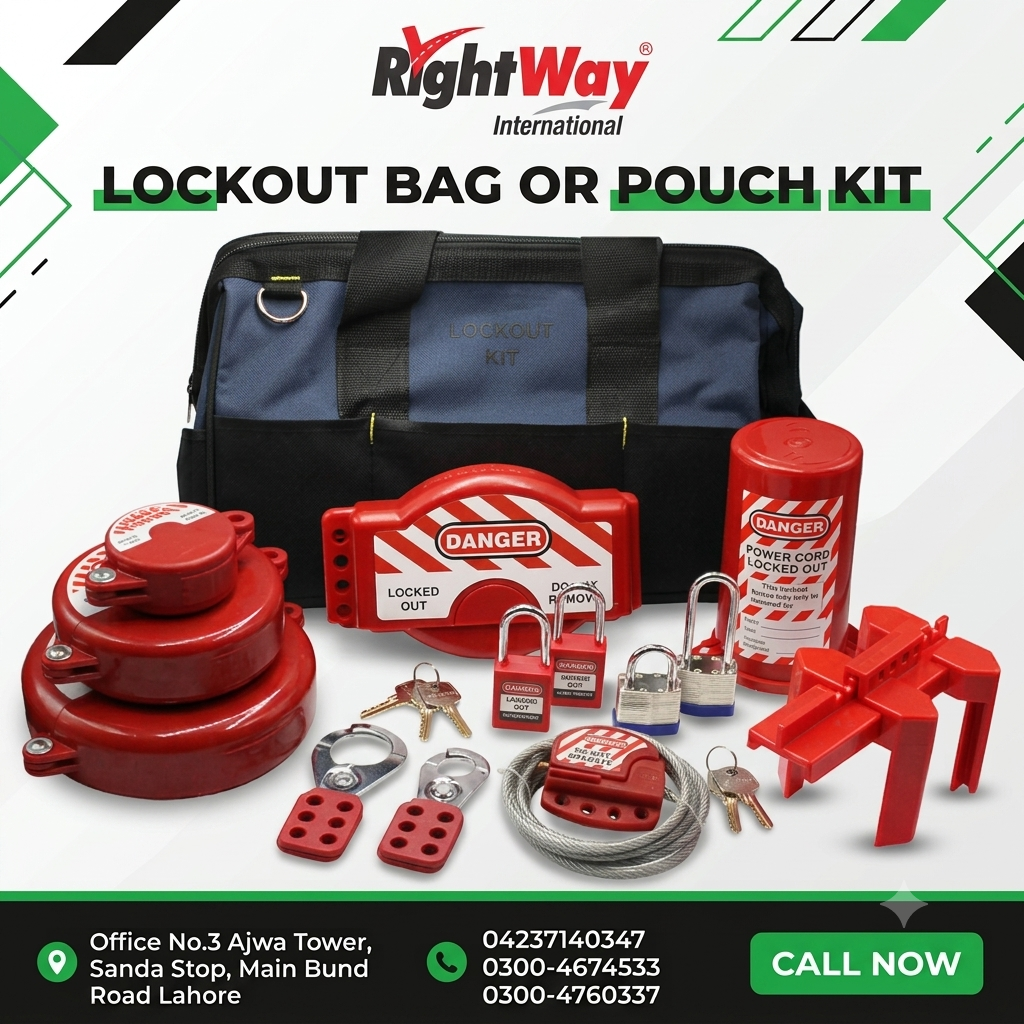
Lockout Bags and Pouches in Pakistan.are an essential portable containment and administrative safety component of any facility energy control and hazard isolation program. Specifically, safety engineers design them to organize, store, and transport key energy-isolating devices—such as safety padlocks, lockout hasps, circuit breaker lockouts, lockout tags, and cable lockout units. By consolidating essential Lockout/Tagout (LOTO) hardware into a dedicated, highly visible, and durable carrying unit, these specialized safety bags ensure that field technicians always have immediate access to necessary safety equipment, preventing unauthorized machine operation during servicing.
Consequently, industrial safety teams extensively implement lockout bags and pouches across manufacturing plants, oil and gas refineries, power generation stations, chemical processing facilities, and heavy engineering complexes.
Importantly, these flexible storage units reinforce workplace safety, streamline shift transitions, and prevent severe multi-source energy accidents during major turnarounds, shutdowns, and emergency repairs. Moreover, they support compliance with Occupational Safety and Health Administration (OSHA) 1910.147 LOTO standards, National Electrical Code (NEC) guidelines, ISO 45001 safety frameworks, and local industrial safety regulations.
Manufacturers build modern lockout bags and pouches using high-density Oxford nylon, heavy-duty canvas, or chemical-resistant PVC coated fabrics coupled with heavy-duty non-corrosive zippers, reinforced belt loops, and multi-pocket organization sleeves in high-visibility hazard colors. Additionally, they incorporate ergonomic carrying handles, clear document pockets, transparent identifier windows, and water-resistant linings to deliver dependable performance in demanding industrial environments.
Benefits of Industrial Lockout Bags and Pouches
- Mobile Hazard Control: Enables maintenance personnel to carry a complete personal LOTO kit directly to the job site, reducing downtime spent retrieving isolation devices from distant tool cribs.
- Customizable Capacity & Layout: Designed with varied pocket sizes, internal dividers, and exterior loops to securely hold diverse lockout devices ranging from small breaker lockouts to long safety cables.
- OSHA LOTO Compliance: Satisfies OSHA 1910.147 requirements for providing employees with standardized, dedicated, and readily available energy-control hardware.
- Weather & Chemical Resistance: Constructed using UV-protected nylon, heavy canvas, or vinyl sheathing that withstands oil, grease, moisture, and harsh industrial environments without tearing or degrading.
- High-Visibility Safety Color Coding: Utilizes striking safety red or yellow finishes compliant with ANSI Z535 standards to ensure immediate identification during emergency procedures or plant audits.
- Personal Accountability: Features transparent ID badge slots or custom embroidery spaces so workers can clearly label bags with their name, department, and employee ID.
- Dielectric & Spark-Resistant Options: Available in anti-static, metal-free, and fire-retardant fabric configurations specifically engineered for explosive atmospheres (ATEX zones) and electrical substations.
- Compact & Ergonomic Mobility: Replaces bulky rigid toolboxes with lightweight belt-mounted, waist-pack, or shoulder-strap designs that free up technicians’ hands when climbing ladders or navigating tight spaces.
- Global & Local Regulatory Compliance: Fully supports international OSHA, NEC, and ISO safety management standards alongside domestic workplace safety regulations.
Types of Lockout Bags and Pouches
- Personal Belt-Mounted Lockout Pouch: Compact pouch featuring heavy-duty belt loops or carabiner clips, designed for individual technicians to carry essential padlocks, hasps, and warning tags on their waist.
- Zippered Canvas LOTO Bag: Rugged, medium-sized storage bag constructed from high-denier canvas fabric with a reinforced base, ideal for holding standard department lockout kits.
- Waist/Fanny Pack Lockout Pouch: Ergonomic waist-worn pouch with adjustable quick-release straps that allows hands-free movement while climbing scaffolding or servicing overhead equipment.
- Large Capacity Hand-Held Lockout Bag: Heavy-duty duffel or briefcase-style bag featuring multi-tier storage compartments, designed for group lockout leads or shift supervisors managing extensive isolation turnarounds.
- Transparent Window LOTO Pouch: Heavy-duty pouch incorporating clear vinyl panels to allow quick visual inventory checks of internal devices without opening the main compartment.
- Waterproof & Chemical-Proof Lockout Bag: Sealed, PVC-coated storage bag equipped with water-resistant zippers, engineered specifically for offshore oil platforms, marine environments, and chemical washdown zones.
Common Lockout Bag & Pouch Components
Engineers construct modern lockout storage units using durable, functional components designed for harsh field environments:
+-----------------------------------------------------------------+
|                      HEAVY-DUTY NYLON FABRIC                    |
|       (Abrasion-Resistant, High-Visibility Safety Red/Yellow)   |
+-----------------------------------------------------------------+
|  [Clear Window] | [Reinforced Zipper] | [Belt Loop / Strap]     |
|   Worker ID &   | Non-Corrosive Metal  | Hands-Free Waist/Belt   |
|   LOTO Tag Slot |   or Resin Closure  |    Mount System         |
+-----------------------------------------------------------------+
|                    INTERNAL ELASTIC SLOTS / DIVIDERS            |
|       (Holds Padlocks, Hasps, Breakers, & Cable Lockouts)       |
+-----------------------------------------------------------------+
- High-Denier Synthetic Fabric: Ultra-tough 600D to 1680D polyester or Oxford nylon casing treated for water repellency, UV stability, and tear resistance.
- Heavy-Duty Non-Corrosive Zippers: Molded resin or coated metallic zipper tracks equipped with oversized pulls for easy operation while wearing industrial work gloves.
- Internal Elastic Retention Loops: Stretchable webbing straps engineered to hold padlock shackles, valve lockout arms, and circuit breaker switches securely in place during transport.
- Reinforced Belt Loops & D-Rings: Double-stitched webbing loops and corrosion-resistant D-rings for anchoring the pouch to safety harnesses, tool belts, or wall hooks.
- Clear PVC Identifier Window: Transparent external pocket designed to display employee identification cards, equipment checklists, or active LOTO permit documents.
- Rigid Reinforced Base: Molded rubber or dual-layer fabric bottom panel that prevents sagging, protects inner tools from wet ground, and extends product lifespan.
Common Uses Across Heavy Industry
Technicians strategically deploy lockout bags and pouches during multi-person servicing tasks across critical sectors:
| Industry Sector | Primary Application | Key Gear Carried |
| Oil, Gas & Petrochemical Refineries | Remote pipeline header isolation, offshore platform turnarounds, and pump room lockouts | Cable lockouts, brass padlocks, gate valve covers, danger tags |
| Manufacturing & Heavy Assembly | Stamping press overhauls, automated conveyor maintenance, and robotic cell isolation | Multi-lock hasps, breaker lockouts, personal padlocks |
| Power Generation & Utilities | Switchgear room servicing, turbine overhauls, and high-voltage substation grid maintenance | Dielectric nylon padlocks, breaker lockouts, LOTO permit tags |
| Chemical & Fertilizer Plants | Batch reactor cleaning, corrosive acid line isolation, and utility line shutdowns | Chemical-resistant padlocks, plastic hasps, waterproof tags |
| Textile & Material Mills | Boiler utility room maintenance, spinning frame repairs, and steam distribution valve locks | Standard safety padlocks, scissor hasps, miniature cable lockouts |
Engineered Lockout Bags vs. Standard Improvised Storage
| Feature | Engineered Lockout Bag / Pouch | Improvised Storage (Standard Canvas Bag, Cardboard Box, Plastic Tub) |
| Material Durability | Abrasion, UV, oil, and chemical-resistant high-denier polyester or coated PVC. | Standard cotton or thin plastic prone to tearing, rotting, or degrading when exposed to industrial fluids. |
| Legal Compliance | Fully compliant with OSHA 1910.147 and ISO 45001 standardized safety gear requirements. | Non-compliant; increases audit risk, fails standardization checks, and leads to misplaced safety devices. |
| Organization & Access | Tailored internal elastic loops, dividers, and external pockets keep devices organized for fast deployment. | Cluttered interior causes lost padlocks, tangled safety cables, and delayed maintenance operations. |
| Security & Identification | Dedicated ID window and lockable zippers prevent gear mix-ups and ensure accountability. | Lacks clear ownership labeling, inviting gear theft, accidental swapping, or loss on busy jobsites. |
| Visual Warning | High-visibility ANSI safety colors (Safety Red/Yellow) instantly signal hazardous energy control gear. | Blends into standard work environments, creating confusion or misplacement on the plant floor. |
Adjustable Cable Lockouts
An adjustable cable lockout functions as an indispensable administrative and physical safety barrier that coordinates multi-person machinery maintenance safely.
First, the authorized lead technician or shift supervisor shuts down all relevant energy sources across the target machine, ensures zero energy input, and identifies all required isolation points (such as multiple valve handles or adjacent electrical switches).
Next, the supervisor threads the flexible vinyl-coated cable through all isolation handles, loops the free end back into the clamping channel of the device body, and pulls the cable tight until all slack is eliminated.
How to Implement a Lockout Bag in a LOTO Procedure
Using a dedicated lockout bag ensures seamless physical execution of hazard control procedures:
1.Inspect & Transport Gear:Pre-job setup.
The authorized technician pulls their personal lockout pouch from the LOTO station, inspects internal padlocks, hasps, and tags for damage, and secures the pouch to their belt or harness.
2.Zero Energy Verification:Machine shutdown.
After the machine is shut down and isolated from power sources, the technician pulls the required lockout devices (such as circuit breaker lockouts or cable lockouts) directly from the pouch compartments.
3.Device Installation & Locking:Physical energy isolation.
The technician applies the isolation hardware onto the switches or valves, attaches a personal multi-lock hasp from the pouch, and secures their personal safety padlock through the hasp.
4.Tagging & Verification:Administrative barrier.
The technician retrieves a safety tag from the pouch’s document sleeve, fills out their identification details, attaches it to the padlock shackle, and verifies zero energy state before starting work.
Maintenance & Inspection Requirements
To maintain operational integrity and meet international safety standards, lockout bags and pouches require routine care:
Proper Storage: Store clean lockout bags in designated wall-mounted LOTO stations, localized safety cribs, or vehicle cabs away from prolonged direct sunlight and standing moisture.
Fabric & Stitching Inspection: Inspect seams, zippers, belt loops, and main body fabric monthly to detect tears, fraying, or weakened load-bearing points.
Zipper & Fastener Audits: Test zippers, velcro closures, and quick-release buckles to ensure they open cleanly and close securely without jamming or slipping.
Inventory Audits: Regularly cross-check the contents of the pouch against the facility’s standardized LOTO kit inventory list to replace missing padlocks, worn tags, or damaged lockouts.
Debris & Chemical Cleaning: Wipe down exterior surfaces with mild industrial soap and water to remove accumulated oil, grease, or dirt. Allow the bag to dry completely before storing electrical lockout gear inside.