




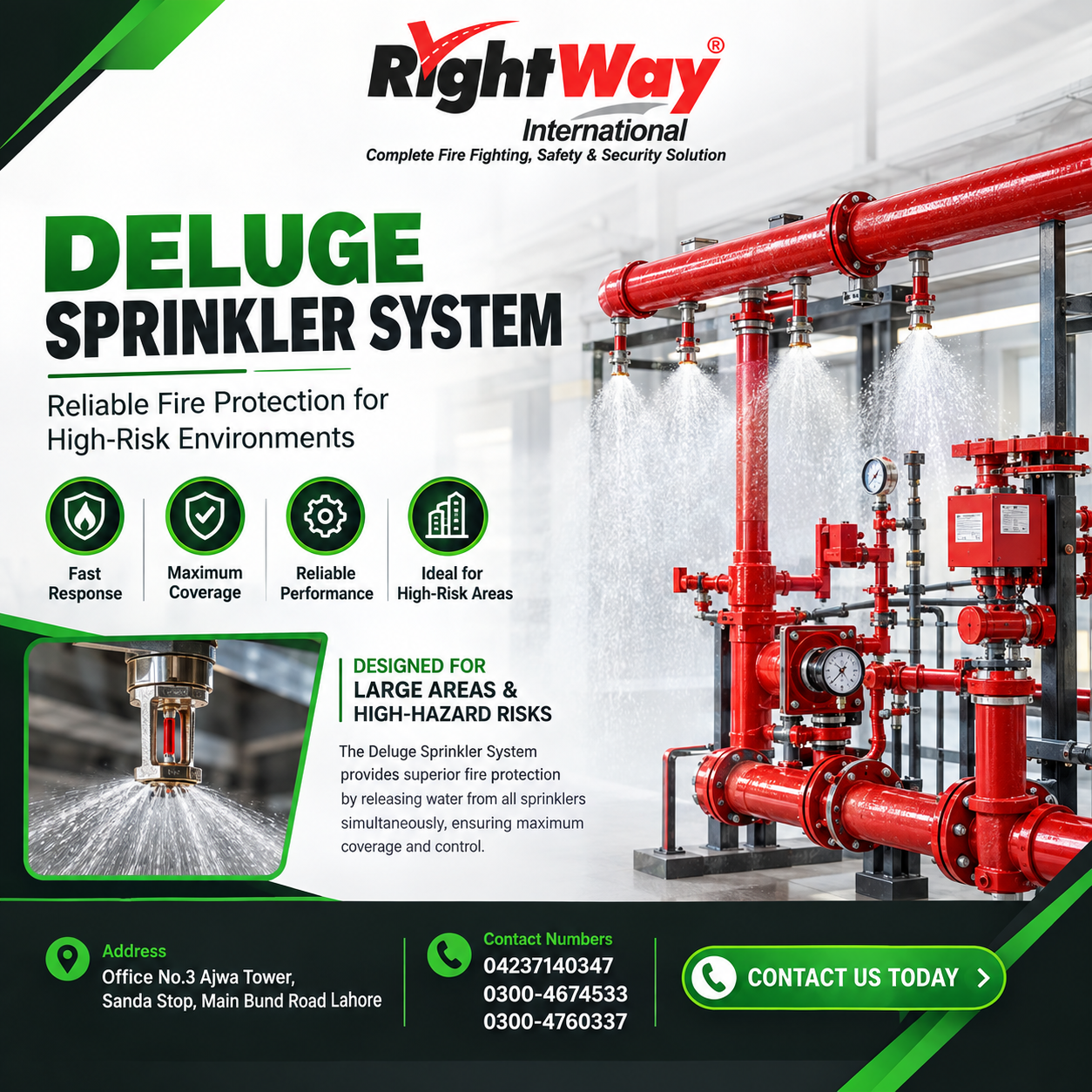
Deluge Sprinkler System: Types Uses Benefits & Buying Guide is a specialized automatic fire protection system designed for areas where fire can spread rapidly and where immediate water discharge over a large area is required. Unlike conventional wet pipe or dry pipe sprinkler systems, a deluge system uses open sprinkler heads or nozzles, meaning the outlets are not individually closed by heat-sensitive elements.
When a fire detection system activates, the deluge valve opens, allowing water to enter the sprinkler piping. As a result, water is discharged simultaneously through all open sprinklers or nozzles connected to the protected zone. This provides rapid and extensive water coverage to help control or suppress a developing fire.
What Is a Deluge Sprinkler System?
A Deluge Sprinkler System is an automatic fire suppression system designed for high-hazard areas where rapid fire development is possible.
Its main components may include:
- Deluge valve
- Open sprinkler heads or spray nozzles
- Fire detection system
- Sprinkler piping
- Water supply
- Fire pump
- Alarm devices
- Pressure gauges
- Manual release station
- Test and drain assembly
- Control valves
- Water-flow alarm
- Supervisory devices
Unlike a wet pipe sprinkler system, the sprinkler outlets in a deluge system are normally open. Therefore, when the deluge valve operates, water can discharge from multiple outlets at the same time.
How Does a Deluge Sprinkler System Work?
First, the deluge valve keeps water from entering the sprinkler piping under normal conditions.
The protected area is monitored by a suitable fire detection system, such as heat, flame, smoke, or other approved detection technology depending on the application.
When the detection system identifies a fire condition, it sends a signal to the releasing system. The deluge valve then opens.
Next, water enters the sprinkler piping and flows to all open sprinklers or nozzles in the protected zone.
Finally, water is discharged simultaneously across the designated area, providing rapid fire protection and helping control the spread of flames.
A deluge system can also include manual release arrangements and water-flow alarms for additional emergency response.
Where Are Deluge Sprinkler Systems Used?
Deluge sprinkler systems are generally used in high-hazard environments where rapid fire growth or intense heat exposure is expected.
Common applications include:
- Oil and gas facilities
- Petroleum storage areas
- Chemical plants
- Refineries
- Power plants
- Aircraft hangars
- Fuel loading areas
- Transformer protection areas
- Flammable-liquid processing facilities
- Industrial manufacturing areas
- Conveyor systems
- Storage tanks
- Process equipment
- High-hazard industrial facilities
For example, an oil processing facility may require rapid water application over a large area. Therefore, a deluge system can provide simultaneous discharge across the protected zone when the releasing system operates.
Types of Deluge Sprinkler Systems
Water Deluge System
A water deluge system uses water as the primary extinguishing medium. When the deluge valve opens, water is discharged through all open sprinklers or nozzles in the protected area.
Foam Deluge System
A foam deluge system combines water with an approved foam solution for applications where foam is appropriate, such as certain flammable-liquid hazards.
Air-Actuated Deluge System
Some systems use pneumatic releasing arrangements to operate the deluge valve when the detection and releasing conditions are satisfied.
Electric Release Deluge System
An electric deluge system can use an electrically operated releasing arrangement connected to a fire detection and releasing control panel.
Manual Release Deluge System
A manual release station can provide an additional method of activating the system when required by the system design.
Benefits of a Deluge Sprinkler System
A deluge sprinkler system offers several important benefits:
- Rapid water discharge: Water can reach multiple outlets simultaneously after system activation.
- Large-area coverage: A single system can protect a designated high-hazard zone.
- Fast fire response: Detection and releasing systems can initiate water discharge quickly.
- High-hazard protection: Suitable for applications involving significant fire risks.
- Cooling effect: Water application can help cool equipment and surrounding surfaces.
- Exposure protection: Properly designed systems can help protect nearby equipment from intense heat.
- Alarm integration: Deluge systems can integrate with fire alarm and detection systems.
- Flexible design: Different nozzles and discharge arrangements can be selected according to the hazard and engineering requirements.
Deluge vs Wet Pipe Sprinkler System
The main difference is how the sprinkler outlets operate and when water enters the piping.
| Feature | Deluge System | Wet Pipe System |
|---|---|---|
| Sprinkler outlets | Normally open | Normally closed |
| Pipe contents | Normally no water downstream of the deluge valve | Water |
| Activation | Detection/releasing system operates deluge valve | Heat activates individual sprinkler |
| Water discharge | Multiple outlets simultaneously | Usually only activated sprinklers discharge |
| Typical use | High-hazard areas | Ordinary commercial and industrial areas |
| Response objective | Rapid area-wide water application | Localized automatic fire suppression |
Therefore, the appropriate system depends on the fire hazard, occupancy, required water application, detection arrangement, and applicable design standards.
Deluge vs Pre-Action Sprinkler System
Although both systems normally keep water out of the sprinkler piping, they operate differently.
A pre-action sprinkler system generally uses closed automatic sprinklers and a separate detection system. Depending on the pre-action arrangement, detection can allow water into the piping before sprinkler operation.
A deluge sprinkler system, on the other hand, normally uses open sprinklers or nozzles. Once the deluge valve is released, water can discharge from all outlets in the protected zone.
Therefore, deluge systems are generally selected where rapid, simultaneous water application is required.
Deluge Sprinkler System Installation
Proper installation is essential for reliable operation. Before installation, professionals should consider:
- Protected area
- Fire hazard
- Required water discharge
- Deluge valve size
- Nozzle type
- Sprinkler spacing
- Pipe layout
- Water supply
- Fire pump capacity
- Detection system
- Releasing system
- Drainage
- Alarm connections
- Manual release arrangements
- Valve accessibility
The system should be designed and installed according to applicable fire protection standards, manufacturer requirements, and the specific hazard assessment.
Deluge Sprinkler System Maintenance
Regular inspection, testing, and maintenance help keep the system ready for an emergency.
Technicians should check:
- Deluge valve
- Open sprinklers or nozzles
- Fire detection system
- Releasing control panel
- Manual release station
- Fire pump
- Water supply
- Pressure gauges
- Control valves
- Alarm devices
- Piping
- Test and drain assembly
- Electrical connections
- Supervisory devices
Additionally, maintenance personnel should investigate damaged nozzles, blocked discharge outlets, valve problems, detection faults, corrosion, leaks, and unusual pressure conditions.
How to Choose the Best Deluge Sprinkler System
Before purchasing a deluge sprinkler system, consider:
- Protected area – Determine the exact zone requiring protection.
- Fire hazard – Identify combustible, flammable, or hazardous materials.
- Required discharge – Determine the required water application based on the design.
- Deluge valve – Select a reliable valve compatible with the system.
- Sprinkler/nozzle type – Choose suitable open sprinklers or spray nozzles.
- Detection system – Select an appropriate fire detection and releasing arrangement.
- Water supply – Confirm available flow, pressure, and duration.
- Fire pump – Ensure the pump can meet the system’s hydraulic requirements.
- Alarm integration – Check compatibility with the building fire alarm system.
- Technical support – Consider installation, testing, maintenance, spare parts, and warranty.
Deluge Sprinkler System in Pakistan
A deluge sprinkler system in Pakistan can provide fire protection for suitable high-hazard industrial and commercial applications, including oil and gas facilities, chemical plants, power plants, petroleum storage areas, aircraft hangars, industrial facilities, and other areas where rapid fire development is a concern.
When purchasing a deluge sprinkler system in Pakistan, consider the deluge valve, open sprinklers or nozzles, fire detection system, releasing panel, fire pump, water supply, piping, alarm integration, installation, inspection, maintenance, warranty, and technical support.
A professional fire protection company should assess the hazard and system requirements before selecting and installing the equipment.
Common Mistakes
Avoid these common deluge sprinkler system problems:
- Choosing the wrong deluge valve
- Using unsuitable spray nozzles
- Incorrect nozzle spacing
- Poor hydraulic design
- Insufficient water supply
- Incorrect detection arrangement
- Blocking sprinkler or nozzle discharge
- Leaving control valves improperly positioned
- Neglecting fire pump maintenance
- Ignoring alarm and releasing-system faults
- Skipping inspections and testing
- Failing to maintain drainage
- Installing the system without proper hazard assessment
Instead, ensure the system is professionally designed, installed, tested, and maintained according to applicable requirements.
Frequently Asked Questions
What is a deluge sprinkler system?
A deluge sprinkler system is an automatic fire protection system that uses open sprinklers or nozzles and a deluge valve to provide rapid water discharge across a designated protected area.
How does a deluge sprinkler system work?
A fire detection and releasing system activates the deluge valve. The valve opens and allows water to enter the sprinkler piping, after which water discharges through the open sprinklers or nozzles.
Do deluge sprinklers contain water?
Normally, the piping downstream of the deluge valve is not filled with water. Water enters the piping when the deluge valve operates.
Are deluge sprinklers normally open?
Yes. Deluge systems generally use open sprinklers or open spray nozzles, unlike conventional wet pipe systems that use closed automatic sprinklers.
Where are deluge systems used?
They are commonly considered for high-hazard applications such as oil and gas facilities, chemical plants, refineries, power plants, aircraft hangars, fuel areas, and other industrial hazards.
Do all sprinklers discharge at once?
In a deluge system, the open sprinklers or nozzles connected to the activated deluge zone can discharge simultaneously when water enters the piping.
Is a deluge system better than a wet pipe system?
Not necessarily. A deluge system is intended for specific high-hazard applications requiring rapid area-wide water application, while wet pipe systems are commonly used where individual sprinkler activation is appropriate.
Does a deluge system require a fire detection system?
Deluge systems commonly use an automatic detection and releasing arrangement to initiate operation, although the exact arrangement depends on the system design and application.
A Deluge Sprinkler System provides rapid automatic fire protection for high-hazard environments where fire can develop quickly and simultaneous water application is required. By using open sprinklers or nozzles and a deluge valve, the system can deliver water across a designated area when the releasing system operates.
Moreover, proper deluge valve selection, hydraulic design, fire detection, fire pump capacity, installation, inspection, testing, and maintenance are essential for dependable performance.
For stronger overall fire protection, a deluge system can be integrated with fire alarm systems, fire detection systems, fire fighting pumps, fire hydrants, fire extinguishers, emergency procedures, and trained personnel.
Dry Pipe Sprinkler System
What Is a Dry Pipe Sprinkler System?
A Dry Pipe Sprinkler System is an automatic fire protection system designed mainly for cold or unheated areas. Its main components include:
- Dry pipe valve
- Automatic sprinkler heads
- Sprinkler piping
- Air compressor or nitrogen supply
- Pressure gauges
- Water supply
- Alarm devices
- Test and drain assembly
Because the pipes normally contain air or nitrogen, the system reduces the risk of water freezing inside the sprinkler network. Read More