




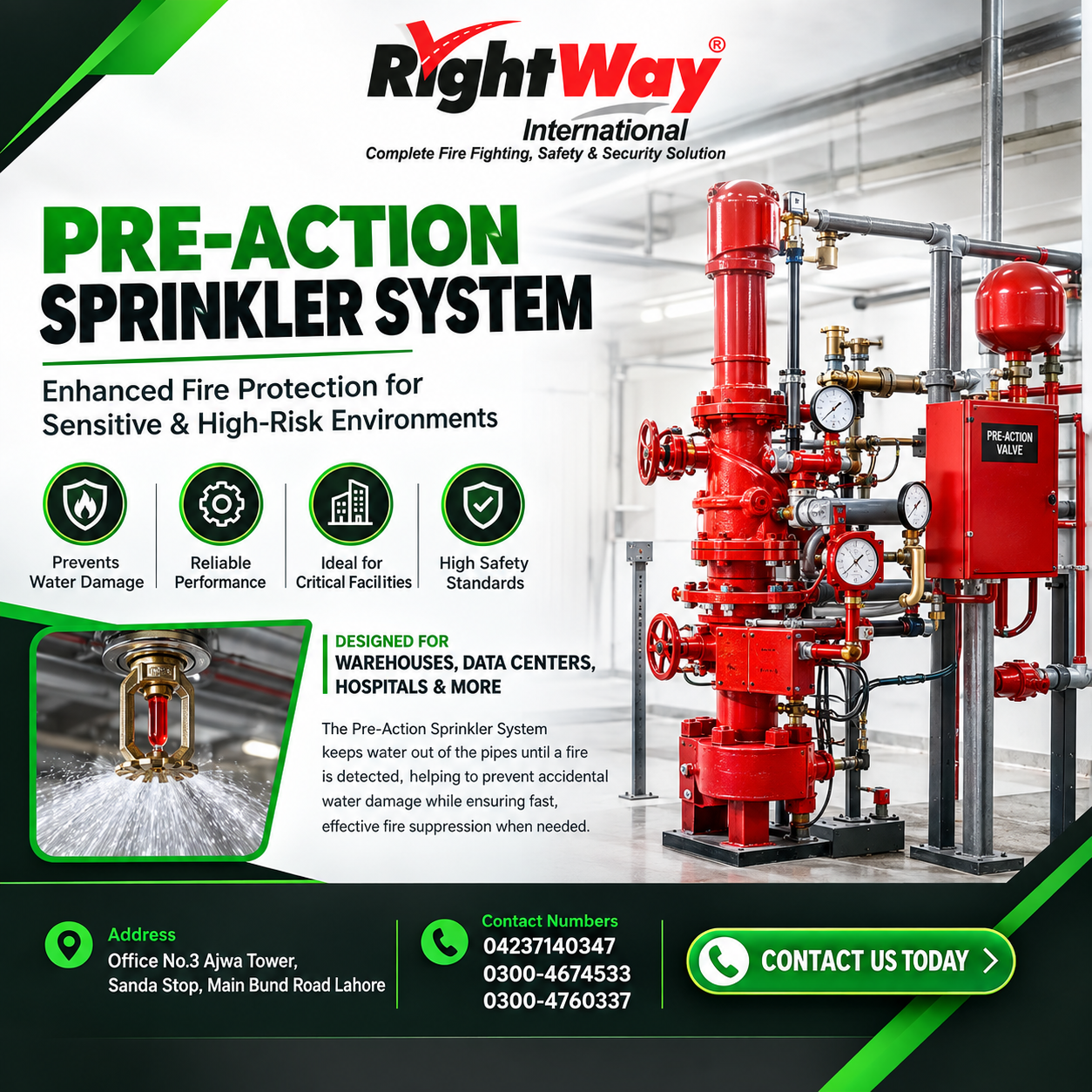
Pre-Action Sprinkler System: Types Uses Benefits & Buying Guide is an advanced automatic fire protection system designed for areas where accidental water discharge could cause serious damage. Unlike a conventional wet pipe sprinkler system, a pre-action system normally keeps water out of the sprinkler piping until a separate detection system identifies a potential fire condition.
When the detection system operates, the pre-action valve opens and allows water to enter the sprinkler piping. Depending on the type of pre-action system, the sprinkler head may also need to activate before water is discharged. This provides an additional layer of protection against unwanted water release.
What Is a Pre-Action Sprinkler System?
A Pre-Action Sprinkler System is an automatic fire sprinkler system that combines sprinkler protection with a separate fire detection and releasing system.
Its main components may include:
- Pre-action valve
- Automatic sprinkler heads
- Sprinkler piping
- Fire detection system
- Releasing control panel
- Air compressor or nitrogen supply
- Pressure gauges
- Water supply
- Fire pump
- Alarm devices
- Manual release station
- Test and drain assembly
- Supervisory devices
Because water is normally held outside the sprinkler piping, the system can provide additional protection against accidental water discharge in sensitive environments.
How Does a Pre-Action Sprinkler System Work?
First, the sprinkler piping is normally filled with pressurized air or nitrogen, while water remains behind the pre-action valve.
Next, a separate detection system monitors the protected area for signs of fire. Depending on the system configuration, the detection system may use smoke detectors, heat detectors, flame detectors, or other approved detection devices.
When the detection system identifies a fire condition, it sends a signal to the releasing control panel.
The releasing system then operates the pre-action valve, allowing water to enter the sprinkler piping.
Afterward, when an automatic sprinkler activates because of heat, water is discharged through the activated sprinkler to help control the fire.
The exact sequence depends on whether the system is non-interlock, single-interlock, or double-interlock.
Types of Pre-Action Sprinkler Systems
Single-Interlock Pre-Action System
A single-interlock pre-action system normally requires activation of the detection system before water enters the sprinkler piping.
After the pre-action valve opens, the piping fills with water. If a sprinkler subsequently activates, water can discharge through that sprinkler.
This arrangement is commonly considered where accidental water discharge needs to be minimized.
Double-Interlock Pre-Action System
A double-interlock pre-action system requires two conditions before water enters the sprinkler piping: an appropriate detection-system operation and a loss of air pressure caused by sprinkler activation.
This provides additional protection against unintended water entry into the sprinkler piping.
Non-Interlock Pre-Action System
A non-interlock pre-action system can allow water into the piping when either the detection system operates or a sprinkler activates, depending on the approved system design.
This arrangement can provide faster water availability while still using a separate detection system.
Where Are Pre-Action Sprinkler Systems Used?
Pre-action sprinkler systems are particularly useful in locations where accidental water discharge could damage valuable equipment, documents, or sensitive materials.
Common applications include:
- Data centers
- Server rooms
- Computer rooms
- Telecommunications facilities
- Museums
- Libraries
- Archives
- Record storage rooms
- Electrical rooms
- Control rooms
- Laboratories
- Hospitals
- Cold storage areas
- High-value storage facilities
- Critical infrastructure facilities
For example, a data center contains sensitive electronic equipment that could be damaged by unwanted water discharge. Therefore, a properly designed pre-action sprinkler system can provide fire protection while adding an additional level of protection against accidental activation.
Benefits of a Pre-Action Sprinkler System
A pre-action sprinkler system offers several important benefits:
- Reduced accidental water discharge: Water is normally kept out of the sprinkler piping.
- Additional detection layer: A separate detection system helps initiate system operation.
- Protection for sensitive areas: Suitable for locations containing valuable or water-sensitive equipment.
- Automatic fire protection: The system can operate automatically when required.
- Alarm integration: Detection, releasing, and sprinkler alarms can work together.
- Flexible system design: Different pre-action arrangements can be selected according to the application.
- Reduced risk of pipe water damage: Keeping water outside the piping during normal conditions can provide additional protection against accidental discharge.
Pre-Action vs Wet Pipe Sprinkler System
The main difference is how water is controlled inside the sprinkler piping.
| Feature | Pre-Action System | Wet Pipe System |
|---|---|---|
| Normal pipe condition | Air or nitrogen | Water |
| Detection system | Required as part of the pre-action arrangement | Generally not required for sprinkler activation |
| Water enters piping | After pre-action valve operation | Already present |
| Accidental water protection | Higher | Lower |
| System complexity | Higher | Lower |
| Typical applications | Sensitive or high-value areas | Heated commercial and industrial areas |
Therefore, a wet pipe system may be appropriate for many ordinary applications, while a pre-action system can be considered when additional protection against accidental water discharge is important.
Pre-Action vs Dry Pipe Sprinkler System
Both systems can normally keep water out of sprinkler piping, but their operating principles are different.
A dry pipe sprinkler system generally uses pressurized air or nitrogen to hold the dry pipe valve closed. When a sprinkler activates, the pressure changes and the valve allows water into the piping.
A pre-action sprinkler system incorporates a separate fire detection and releasing arrangement. Depending on the configuration, detection and sprinkler operation may be required before water is discharged.
Therefore, pre-action systems are often selected for water-sensitive environments, while dry pipe systems are commonly selected for freezing or low-temperature areas.
Pre-Action Sprinkler System Installation
Proper installation is essential for reliable operation. Before installation, professionals should consider:
- Protected area
- Fire hazard
- Building occupancy
- Environmental conditions
- Sprinkler type
- Pre-action valve
- Detection system
- Releasing control panel
- Pipe layout
- Air or nitrogen pressure
- Water supply
- Fire pump capacity
- Drainage
- Alarm connections
- Manual release arrangements
- Valve accessibility
The system should be designed and installed according to applicable fire protection standards, manufacturer requirements, and the specific requirements of the protected facility.
Pre-Action Sprinkler System Maintenance
Regular inspection, testing, and maintenance help ensure that the system remains ready for an emergency.
Technicians should inspect:
- Pre-action valve
- Sprinkler heads
- Fire detectors
- Releasing control panel
- Air compressor
- Nitrogen supply
- Pressure gauges
- Control valves
- Fire pump
- Water supply
- Alarm devices
- Piping
- Test and drain assembly
- Manual release station
- Supervisory devices
Additionally, maintenance personnel should investigate low air pressure, leaks, damaged sprinklers, detection faults, valve problems, corrosion, and abnormal system conditions.
How to Choose the Best Pre-Action Sprinkler System
Before purchasing a pre-action sprinkler system, consider:
- Protected area – Identify the rooms or facility requiring protection.
- Fire hazard – Evaluate the type and quantity of combustible materials.
- Water sensitivity – Determine how serious accidental water discharge could be.
- System type – Select single-interlock, double-interlock, or non-interlock according to the design requirements.
- Detection system – Choose suitable detection technology.
- Pre-action valve – Select a reliable and compatible valve.
- Sprinkler type – Choose sprinklers appropriate for the hazard.
- Air or nitrogen supply – Ensure the system can maintain the required supervisory pressure.
- Water supply – Confirm sufficient flow and pressure.
- Fire pump – Ensure the pump can satisfy the hydraulic requirements.
- Alarm integration – Confirm compatibility with the fire alarm and releasing system.
- Technical support – Consider installation, testing, maintenance, spare parts, and warranty.
Pre-Action Sprinkler System in Pakistan
A pre-action sprinkler system in Pakistan can provide an effective fire protection solution for data centers, server rooms, telecommunications facilities, museums, archives, hospitals, laboratories, electrical rooms, control rooms, and other sensitive environments.
When purchasing a pre-action sprinkler system in Pakistan, consider the pre-action valve, sprinkler heads, detection system, releasing control panel, air compressor, nitrogen supply, fire pump, water supply, piping, alarm integration, installation, testing, maintenance, warranty, and technical support.
A professional fire protection company should evaluate the protected environment and fire hazard before selecting and installing the system.
Common Mistakes
Avoid these common pre-action sprinkler system problems:
- Selecting the wrong pre-action system type
- Using unsuitable sprinkler heads
- Poor detection-system design
- Incorrect air or nitrogen pressure
- Incorrect pre-action valve installation
- Insufficient water supply
- Poor hydraulic design
- Blocking sprinkler heads
- Closing control valves without authorization
- Ignoring alarm or releasing-system faults
- Neglecting fire pump maintenance
- Skipping inspection and testing
- Failing to maintain the system according to manufacturer requirements
Proper system design, professional installation, regular inspection, and testing are essential for dependable fire protection.
Frequently Asked Questions
What is a pre-action sprinkler system?
A pre-action sprinkler system is an automatic fire protection system that normally keeps water out of the sprinkler piping and uses a separate fire detection and releasing arrangement to control when water enters the system.
Why are pre-action sprinkler systems used?
They are mainly used where accidental water discharge could cause significant damage to valuable or water-sensitive equipment and materials.
Where are pre-action sprinkler systems used?
They are commonly used in data centers, server rooms, museums, libraries, archives, hospitals, laboratories, telecommunications facilities, electrical rooms, and other sensitive areas.
Does a pre-action sprinkler system contain water?
Normally, water is held behind the pre-action valve while the sprinkler piping is maintained with air or nitrogen, depending on the system design.
Are pre-action sprinklers normally open?
No. Pre-action systems generally use closed automatic sprinkler heads. The exact operating sequence depends on the type of pre-action system.
What is the difference between single and double interlock?
A single-interlock system generally requires detection-system operation to allow water into the piping. A double-interlock system generally requires both detection operation and sprinkler operation/air-pressure loss before the valve allows water into the piping.
Is pre-action better than wet pipe?
Not necessarily. A pre-action system is more complex and is typically selected when the application requires additional protection against accidental water discharge. Wet pipe systems are often simpler and suitable for many standard applications.
Does a pre-action system require a fire detection system?
Yes, a separate detection and releasing arrangement is an important part of a pre-action system.
How often should a pre-action sprinkler system be maintained?
Inspection, testing, and maintenance should follow applicable requirements, manufacturer instructions, and the system’s approved maintenance program.
A Pre-Action Sprinkler System provides advanced automatic fire protection for environments where accidental water discharge could cause significant damage. By normally keeping water out of the sprinkler piping and using a separate detection and releasing arrangement, the system provides an additional layer of control before water reaches the sprinklers.
Moreover, proper pre-action valve selection, detection system design, sprinkler selection, hydraulic design, fire pump capacity, installation, inspection, testing, and maintenance are essential for reliable performance.
For comprehensive fire protection, a pre-action sprinkler system can be integrated with fire alarm systems, smoke detection, fire fighting pumps, fire hydrants, fire extinguishers, emergency procedures, and trained personnel.
Deluge Sprinkler System
What Is a Deluge Sprinkler System?
A Deluge Sprinkler System is an automatic fire suppression system designed for high-hazard areas where rapid fire development is possible.
Its main components may include:
- Deluge valve
- Open sprinkler heads or spray nozzles
- Fire detection system
- Sprinkler piping
- Water supply
- Fire pump
- Alarm devices
- Pressure gauges
- Manual release station
- Test and drain assembly
- Control valves
- Water-flow alarm
- Supervisory devices
Unlike a wet pipe sprinkler system, the sprinkler outlets in a deluge system are normally open. Therefore, when the deluge valve operates, water can discharge from multiple outlets at the same time. Read More