




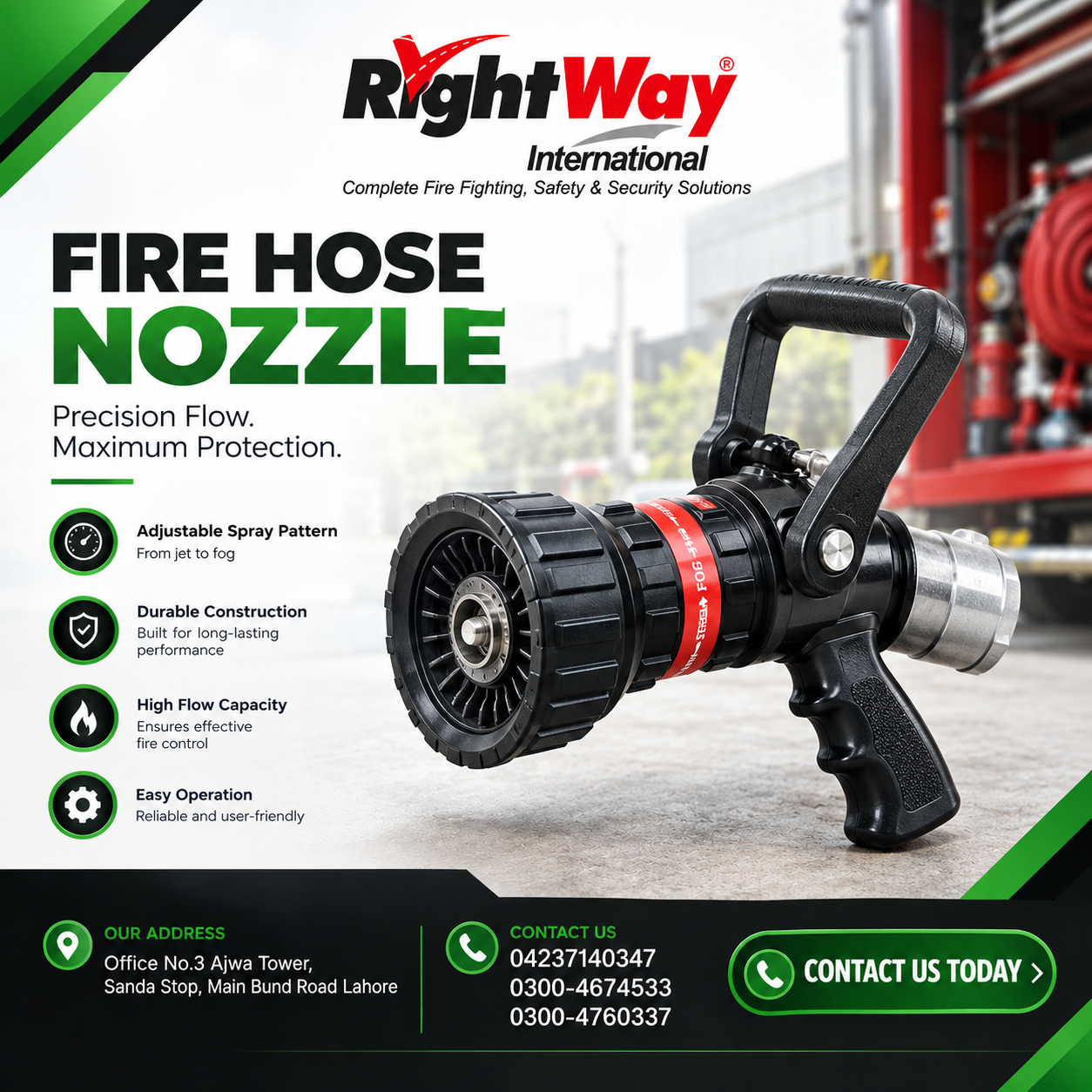
Fire Hose Nozzle: Types Uses Benefits & Buying Guide plays an important role in firefighting systems. It connects to a fire hose and allows firefighters or trained personnel to control the direction, flow, and pattern of water during a fire emergency.
Fire hose nozzles work with fire hydrants, fire hose reels, standpipe systems, fire pumps, and firefighting hoses. Therefore, choosing the right nozzle can help deliver water effectively and support safer firefighting operations.
Different applications require different nozzle designs. For example, some nozzles produce a straight stream, while others provide a fog pattern. As a result, users should select a nozzle according to the fire protection system, water pressure, flow requirements, and intended application.
What Is a Fire Hose Nozzle?
A Fire Hose Nozzle is a firefighting device that attaches to the end of a fire hose. It controls the water discharge and directs the water toward the fire.
The nozzle allows the operator to control the water stream according to the nozzle design. Depending on the model, it may provide different spray patterns, flow rates, or shut-off functions.
Moreover, a suitable nozzle can improve water application and help firefighters manage the firefighting process more effectively.
How Does a Fire Hose Nozzle Work?
A fire hose nozzle receives pressurized water from the connected fire hose. The nozzle then directs and shapes the water as it exits the discharge opening.
First, trained personnel connect the nozzle to a compatible fire hose. Next, they open the water supply and control the nozzle according to the required discharge pattern.
For example, a straight-stream setting can direct water over a greater distance. On the other hand, a fog setting can create a wider water spray.
Therefore, the nozzle design and operating pressure should match the requirements of the fire protection system.
Types of Fire Hose Nozzles
1. Straight Stream Fire Hose Nozzle
A Straight Stream Fire Hose Nozzle produces a concentrated water stream.
This type of nozzle can help deliver water over a greater distance. Consequently, firefighters can use it for applications where they need a focused stream of water.
2. Fog Fire Hose Nozzle
A Fog Fire Hose Nozzle produces a wider spray pattern.
Because the nozzle distributes water across a larger area, it can support certain firefighting applications where wider water coverage provides an advantage.
3. Adjustable Fire Hose Nozzle
An Adjustable Fire Hose Nozzle allows the operator to change the water spray pattern.
Depending on the nozzle design, the user may switch between different discharge patterns. Therefore, adjustable nozzles can provide greater flexibility during firefighting operations.
4. Combination Fire Hose Nozzle
A Combination Fire Hose Nozzle can provide both straight-stream and fog-stream patterns.
As a result, firefighters can adjust the discharge according to changing conditions during an emergency.
5. Shut-Off Fire Hose Nozzle
A Shut-Off Fire Hose Nozzle includes a mechanism that allows the operator to stop or control the water flow.
This feature can make hose handling more convenient and allows trained personnel to control water discharge when necessary.
6. High Pressure Fire Hose Nozzle
A High Pressure Fire Hose Nozzle supports firefighting systems that operate at higher pressures.
However, users should always verify the nozzle’s pressure rating before connecting it to a high-pressure fire pump or water supply.
Where Are Fire Hose Nozzles Used?
Fire Hose Nozzles can support firefighting operations in many locations, including:
- High-rise buildings
- Commercial buildings
- Industrial facilities
- Factories
- Warehouses
- Hospitals
- Hotels
- Shopping centers
- Schools
- Parking structures
- Fire stations
- Manufacturing plants
- Construction sites
- Oil and gas facilities
- Residential buildings
These locations can have different fire risks and firefighting requirements. Therefore, the nozzle should match the connected hose and the overall fire protection system.
Main Components of a Fire Hose Nozzle
A typical Fire Hose Nozzle may contain several components, including:
- Nozzle body
- Discharge opening
- Handle
- Shut-off mechanism
- Spray-pattern control
- Hose connection
- Coupling
- Internal components
- Protective components
The exact design depends on the nozzle type and manufacturer.
Furthermore, the connection must match the fire hose coupling to create a secure and reliable connection.
Benefits of Fire Hose Nozzles
Fire Hose Nozzles provide several important benefits:
- Control water discharge
- Direct water toward the fire
- Provide different spray patterns
- Support efficient water application
- Connect with compatible fire hoses
- Help firefighters manage water flow
- Support different firefighting applications
- Provide convenient hose operation
- Improve control during emergency response
In addition, adjustable and combination nozzles can provide greater flexibility when firefighting conditions change.
Fire Hose Nozzle vs Fire Hose
| Feature | Fire Hose Nozzle | Fire Hose |
|---|---|---|
| Main purpose | Controls and directs water discharge | Carries water to the firefighting point |
| Location | Connected to the end of the hose | Runs between the water source and nozzle |
| Main function | Controls water stream and spray pattern | Transports pressurized water |
| Connection | Attaches to compatible hose coupling | Connects to hydrant, pump, valve, or nozzle |
| Available types | Straight stream, fog, adjustable, combination | Delivery, hose reel, layflat, suction, industrial |
| Operation | Controlled by trained personnel | Deployed and handled during firefighting |
Both components work together. The fire hose transports the water, while the nozzle controls and directs the discharge.
Fire Hose Nozzle Sizes
Fire hose nozzles come in different sizes and connection configurations. The correct size depends on the fire hose, required water flow, operating pressure, and firefighting system.
Before selecting a nozzle, consider:
- Hose diameter
- Connection size
- Required flow rate
- Operating pressure
- Water supply
- Nozzle discharge
- Fire protection system design
Therefore, avoid selecting a nozzle based only on its physical size. Instead, match the nozzle with the complete firefighting system.
Fire Hose Nozzle Pressure Rating
The Fire Hose Nozzle pressure rating determines whether the nozzle can safely operate at the pressure supplied by the connected system.
Before purchasing a nozzle, check its:
- Working pressure
- Test pressure
- Flow rate
- Pressure range
- Connection specifications
For example, a nozzle connected to a high-pressure fire pump needs a suitable pressure rating. Similarly, the nozzle should provide the required flow at the system’s operating pressure.
Always follow the manufacturer’s specifications and the requirements of the fire protection system.
Fire Hose Nozzle Materials
Manufacturers produce fire hose nozzles using different materials. Common options include:
- Brass
- Aluminum
- Stainless steel
- Reinforced metal
- Durable engineered materials
Each material provides different characteristics.
For example, brass can provide durability and corrosion resistance, while aluminum can offer a lighter-weight option. Stainless steel can provide strong corrosion resistance for demanding environments.
Consequently, buyers should select the material according to the operating environment and application.
Fire Hose Nozzle Installation
Installing a fire hose nozzle correctly helps maintain a secure connection and reliable water discharge.
Before installation, check:
- Hose coupling compatibility
- Nozzle connection size
- Operating pressure
- Required flow rate
- Thread type
- Water supply
- Hose condition
- Nozzle condition
First, inspect the hose and nozzle connections. Next, securely attach the nozzle to the hose. Finally, test the connection according to the applicable system procedures.
Qualified fire protection professionals should handle fixed firefighting system installation and testing.
Fire Hose Nozzle Maintenance and Inspection
Regular inspection helps keep a Fire Hose Nozzle ready for emergency use.
During inspection, check for:
- Cracks
- Physical damage
- Corrosion
- Blocked discharge openings
- Damaged threads
- Loose components
- Leaks
- Damaged handles
- Worn shut-off mechanisms
- Incorrect connections
Also, keep the nozzle clean and store it in a suitable location.
If the nozzle shows serious damage or does not operate correctly, remove it from service and follow the appropriate repair or replacement procedure.
How to Choose a Fire Hose Nozzle
Before purchasing a Fire Hose Nozzle, consider the following factors:
1. Nozzle Type
First, identify the required spray pattern. Straight-stream, fog, adjustable, and combination nozzles serve different purposes.
2. Flow Rate
Next, check the required water flow. The nozzle should provide the flow needed by the fire protection system.
3. Pressure Rating
Always verify the operating pressure and make sure the nozzle can handle the pressure supplied by the connected system.
4. Connection Size
Check the hose coupling and nozzle connection carefully. Both components should fit securely and correctly.
5. Material
Choose a durable material that suits the installation environment, temperature, moisture, corrosion exposure, and frequency of use.
6. Handle and Shut-Off
If the application requires flow control, consider a nozzle with a suitable shut-off mechanism and ergonomic handle.
7. Quality
Choose products from a reliable manufacturer or fire safety equipment supplier. Quality construction can support dependable performance and longer service life.
8. Compliance
Finally, check applicable fire protection standards, project specifications, and system requirements before purchasing.
Fire Hose Nozzle in Pakistan
Fire Hose Nozzles in Pakistan support firefighting systems in commercial buildings, factories, warehouses, hospitals, hotels, residential projects, and industrial facilities.
When purchasing a Fire Hose Nozzle in Pakistan, consider the nozzle type, material, flow rate, pressure rating, connection size, and compatibility with the existing fire protection system.
Moreover, a reliable fire safety equipment supplier can help buyers identify a nozzle that matches their application.
Before placing an order, ask for complete product specifications and confirm that the nozzle works with your fire hose, hydrant, fire pump, or hose reel system.
Common Fire Hose Nozzle Mistakes to Avoid
Users can reduce equipment problems by avoiding these common mistakes:
- Choosing the wrong nozzle size
- Ignoring pressure requirements
- Using incompatible hose connections
- Selecting the wrong spray pattern
- Ignoring flow requirements
- Using poor-quality nozzles
- Failing to inspect the nozzle
- Allowing discharge openings to become blocked
- Ignoring corrosion or physical damage
- Using damaged fittings
- Skipping regular testing and maintenance
Therefore, always match the nozzle with the hose and the complete fire protection system.
FAQs
What is a Fire Hose Nozzle?
A Fire Hose Nozzle is a device that attaches to a fire hose and controls the direction, flow, and discharge pattern of water during firefighting operations.
What are the common types of fire hose nozzles?
Common types include straight-stream nozzles, fog nozzles, adjustable nozzles, combination nozzles, shut-off nozzles, and high-pressure nozzles.
What does a fog fire hose nozzle do?
A fog nozzle produces a wider spray pattern. Therefore, it can provide broader water coverage for suitable firefighting applications.
Can a fire hose nozzle connect to a fire hydrant?
Usually, the nozzle connects to the end of a compatible fire hose rather than directly to the hydrant. The fire hose then connects to the hydrant or another suitable water source.
How do I choose the right fire hose nozzle?
Consider the required flow rate, operating pressure, hose size, connection type, spray pattern, material, and overall fire protection system requirements.
What material is best for a fire hose nozzle?
The appropriate material depends on the application. Brass, aluminum, and stainless steel can all serve different firefighting requirements. Consider durability, corrosion resistance, weight, and operating conditions before choosing.
Why is the nozzle pressure rating important?
The pressure rating shows whether the nozzle can safely operate within the pressure range of the connected fire protection system.
How should I maintain a fire hose nozzle?
Inspect the nozzle regularly for corrosion, cracks, leaks, blocked openings, damaged threads, and worn components. Keep it clean and store it correctly when not in use.
A Fire Hose Nozzle provides essential control over water during firefighting operations. It connects to a compatible fire hose and allows trained personnel to direct and manage the water discharge.
Different nozzle types provide different spray patterns and operating characteristics. Therefore, buyers should consider the application, flow rate, pressure rating, connection size, material, and system requirements before purchasing.
When buying a Fire Hose Nozzle in Pakistan, choose a reliable product that matches your fire hose and overall fire protection system. In addition, inspect and maintain the nozzle regularly to help keep the equipment ready for emergency use.
Most importantly, follow applicable fire safety requirements and use qualified professionals for the design, installation, inspection, and testing of fire protection systems.
Fire Fighting Hose
How Does a Fire Fighting Hose Work?
A fire fighting hose carries water from a pressurized water supply to the point where firefighters need it.
First, trained personnel connect the hose to a compatible fire hydrant, valve, pump, or hose reel. Next, they secure the connections and open the water supply. The pressurized water then travels through the hose and reaches the fire hose nozzle.
Finally, the operator controls the water stream and directs it toward the fire.
Therefore, the hose must provide sufficient strength, flexibility, and pressure resistance for its intended application.