




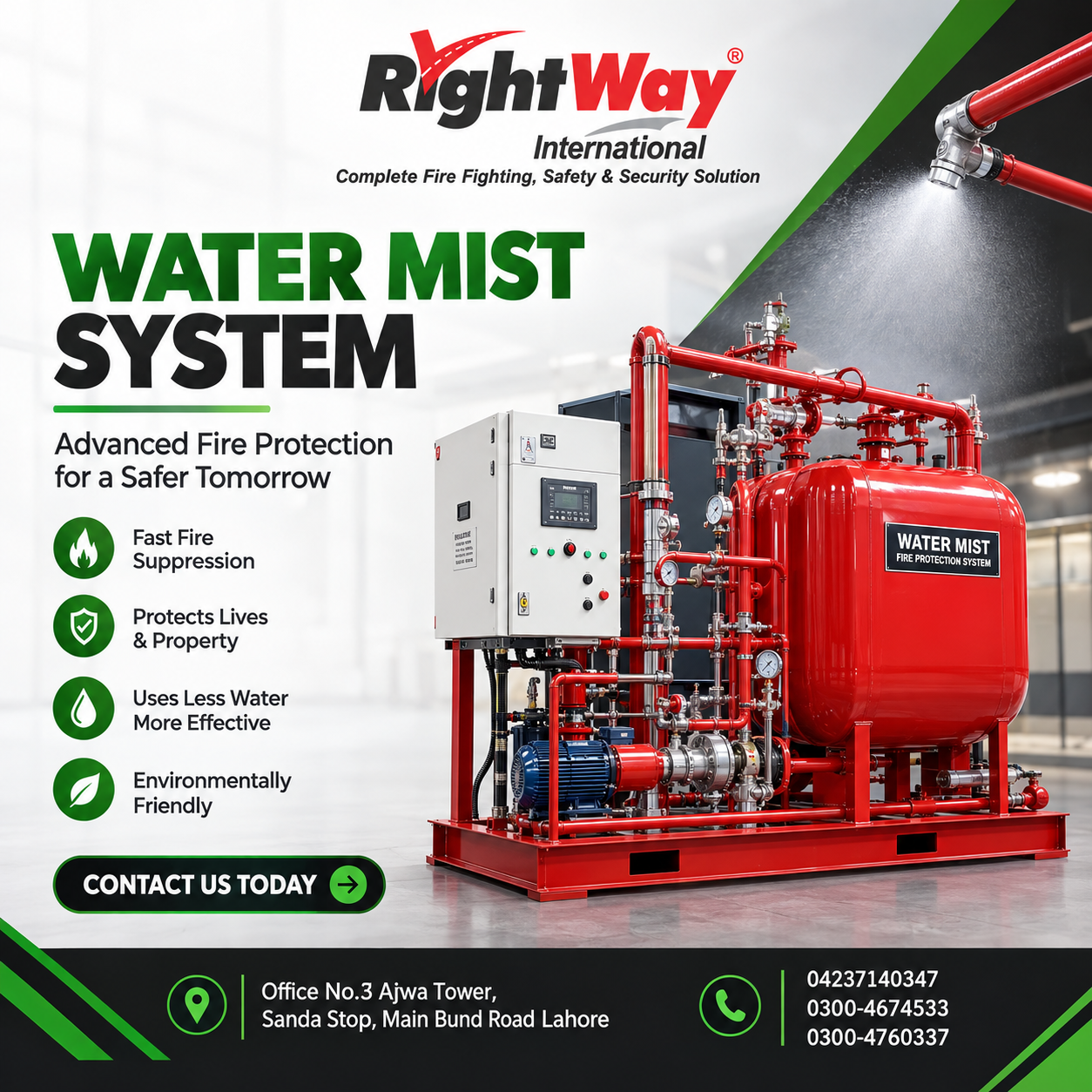
Water Mist System: Types Uses Benefits & Buying Guide provides an efficient fire suppression solution for a wide range of fire hazards involving combustible materials, flammable liquids, machinery, electrical equipment, and industrial processes. The system uses very fine water droplets to control, suppress, or extinguish fire while using significantly less water than many conventional water-based fire suppression systems.
In commercial buildings, industrial facilities, power plants, hotels, warehouses, engine rooms, data-related facilities, manufacturing plants, and other specialized environments, reliable fire protection is essential. Therefore, a properly designed Water Mist System can provide effective fire protection while reducing overall water consumption.
Unlike conventional sprinkler systems that generally discharge larger water droplets, a water mist system produces very small droplets through specially designed nozzles. These fine droplets can absorb heat rapidly, produce steam, reduce the temperature around the fire, and help reduce the oxygen concentration near the combustion zone.
Water mist technology can be particularly useful where traditional sprinkler systems may require large water supplies or where minimizing water damage is an important consideration. However, the system must be carefully engineered for the specific hazard, enclosure, fire type, operating pressure, nozzle arrangement, and applicable requirements.
This guide covers the types, uses, benefits, components, working principle, installation requirements, maintenance practices, safety considerations, and buying factors for a Water Mist System.
What Is a Water Mist System?
A Water Mist System is a fire suppression system that uses finely divided water droplets to control, suppress, or extinguish fire.
The system stores and supplies water through a specially designed piping network. When a fire is detected, water is discharged through engineered water mist nozzles.
These nozzles convert water into very small droplets. Because the droplets have a large surface area compared with their volume, they can absorb heat rapidly when exposed to the fire.
The water droplets can also evaporate and form steam. This process can reduce the temperature of the fire area and, depending on the system design and enclosure conditions, help reduce the oxygen concentration around the flame.
A Water Mist Fire Suppression System can therefore provide effective fire control while using considerably less water than some conventional water-based systems.
The system must, however, be designed according to the specific fire hazard, room configuration, required water density, nozzle characteristics, operating pressure, detection arrangement, and applicable fire protection requirements.
How Does a Water Mist System Work?
A Water Mist System works through a coordinated detection, control, water supply, and discharge process.
First, smoke, heat, flame, or other approved detection devices monitor the protected area.
When the detection system identifies a fire condition, the signal is sent to the fire suppression control panel.
Depending on the approved system design, the detection system may activate an alarm and initiate the water mist release sequence.
Once the system receives the required activation signal, the control valve or release mechanism opens.
Pressurized water then travels through the piping network toward the specially designed water mist nozzles.
The nozzles atomize the water into very fine droplets and distribute the mist throughout the protected area or directly toward the fire hazard.
The fine droplets absorb heat rapidly. As the water evaporates, it can also produce steam and help reduce the temperature around the fire.
Depending on the system design, the mist can also reduce the oxygen concentration close to the combustion zone.
Consequently, the fire can be controlled or suppressed while the surrounding temperature is reduced.
After activation, the system should remain under controlled conditions until the fire has been fully assessed and the area has been declared safe by authorized personnel.
Why Is a Water Mist System Important?
A Water Mist System can provide several important advantages for specialized fire protection applications.
Efficient Fire Suppression
Water mist can rapidly absorb heat because its small droplets provide a large surface area for heat transfer.
Reduced Water Consumption
Water mist systems can achieve effective fire control with less water than some conventional water-based systems, depending on the hazard and system design.
Reduced Water Damage
Because the system uses finely divided water droplets and can require less total water discharge, it may help reduce secondary water damage in suitable applications.
Rapid Cooling
The fine droplets can absorb heat quickly and help cool the protected equipment and surrounding environment.
Suitable for Different Fire Hazards
Depending on the approved system design, water mist can be used for various hazards involving combustible materials, flammable liquids, machinery, and selected electrical or industrial equipment.
Flexible Installation
Water mist systems can be designed as localized protection systems or as systems covering an entire protected enclosure.
Environmentally Friendly Extinguishing Medium
Water is readily available and does not create the same long-term environmental concerns associated with certain chemical extinguishing agents.
Types of Water Mist Systems
Water mist systems can be categorized according to operating pressure, application method, and system configuration.
Low-Pressure Water Mist System
A Low-Pressure Water Mist System operates at pressures that are generally lower than medium- and high-pressure mist systems.
These systems can provide finely divided water droplets through specially designed nozzles.
Low-pressure systems may be suitable for selected commercial and industrial applications depending on the fire hazard and system design.
Medium-Pressure Water Mist System
A Medium-Pressure Water Mist System operates at a higher pressure than conventional low-pressure systems.
The increased pressure can produce smaller droplets and improve mist distribution.
These systems may be considered for various industrial and commercial fire protection applications.
High-Pressure Water Mist System
A High-Pressure Water Mist System uses significantly higher operating pressures to produce very fine water droplets.
The small droplet size provides a large surface area, allowing the water mist to absorb heat rapidly.
High-pressure systems can be used for specialized applications such as machinery spaces, engine rooms, industrial equipment, and other hazards where the system has been specifically tested and approved.
Local Application Water Mist System
A Local Application Water Mist System directs water mist toward a specific piece of equipment or hazard.
This configuration can be useful for protecting machinery, turbines, generators, industrial processes, cooking equipment, and other localized hazards.
The nozzle arrangement is designed to cover the specific fire risk rather than the entire room.
Total Compartment Water Mist System
A compartment or enclosure protection system distributes water mist throughout a designated protected area.
The system is designed according to the enclosure dimensions, fire hazard, nozzle arrangement, water supply, and required fire suppression performance.
Open Nozzle Water Mist System
An open-nozzle system uses nozzles that remain open and discharge water mist when the system activates.
A separate detection and release arrangement normally controls system activation.
Automatic Water Mist System
An Automatic Water Mist Fire Suppression System combines detection and automatic water mist discharge.
When the detection system identifies the required fire condition, the system activates automatically according to the approved cause-and-effect sequence.
Where Are Water Mist Systems Used?
A Water Mist System can be used across many commercial, industrial, and specialized applications.
Common applications include:
- Power plants
- Generator rooms
- Engine rooms
- Turbine areas
- Machinery rooms
- Industrial manufacturing facilities
- Warehouses
- Hotels
- Commercial buildings
- Marine applications
- Offshore facilities
- Data-related equipment areas where specifically approved
- Flammable liquid hazards
- Fuel storage and processing areas
- Printing facilities
- Paint and coating facilities
- Cable areas
- Electrical equipment areas where specifically designed and approved
- Industrial process equipment
- Transformers where suitable and approved
- Gas turbine enclosures
- Diesel generator enclosures
- Hydraulic equipment
- CNC machinery
- Specialized production equipment
The exact application should always be evaluated by a qualified fire protection professional because water mist performance depends heavily on the fire hazard, nozzle design, water pressure, enclosure, and system approval.
Main Components of a Water Mist System
A complete Water Mist Fire Suppression System consists of several interconnected components.
Water Storage Tank
The water storage tank provides the required water supply for the system.
Tank capacity depends on the hazard, system flow rate, discharge duration, and approved system design.
Water Mist Pump
The pump supplies water at the pressure required by the water mist system.
High-pressure systems may require specialized high-pressure pumps designed for water mist applications.
High-pressure systems may use dedicated pump units capable of delivering the required flow and pressure to the mist nozzles.
Water Mist Nozzles
Water mist nozzles are one of the most important components of the system.
They convert water into finely divided droplets and distribute the mist across the protected hazard.
Nozzle type, orifice size, operating pressure, spacing, and installation height must follow the approved system design.
Control Valve
The control valve controls water flow into the distribution piping.
The valve can be activated automatically through the detection and release system.
Piping Network
The piping transports water from the water supply and pump assembly to the water mist nozzles.
Pipe sizing, material, pressure rating, and layout should comply with the approved design.
Fire Detection System
Smoke detectors, heat detectors, flame detectors, or other approved detection devices can identify a fire condition.
Fire Suppression Control Panel
The control panel receives signals from detection devices and controls the system activation sequence.
It can also operate alarms, equipment shutdowns, time delays, and other connected safety functions.
Audible Alarm
An audible alarm warns occupants when a fire has been detected or when the suppression system is about to activate.
Visual Alarm
Visual indicators provide additional warning, especially in noisy environments where audible alarms may not be sufficient.
Manual Release Station
A manual release station can allow authorized personnel to activate the system when provided by the approved system design.
Pressure Gauges
Pressure gauges allow technicians to monitor water pressure within the system.
Filters
Filters can help prevent particles and debris from entering the water mist nozzles.
This is particularly important because small nozzle openings can be sensitive to contamination.
Test and Drain Arrangement
A test and drain arrangement allows technicians to inspect, test, and service the system without unnecessary disruption.
Benefits of a Water Mist System
Installing a properly engineered Water Mist System can provide several benefits for suitable applications.
Lower Water Consumption
One of the key advantages of water mist technology is its ability to provide effective fire control with comparatively low water flow in appropriately tested applications.
Excellent Cooling
Fine water droplets can absorb heat quickly and reduce temperatures around the fire.
Reduced Secondary Water Damage
Lower water discharge can potentially reduce water-related damage compared with conventional systems in suitable applications.
Rapid Fire Control
A properly designed water mist system can quickly control developing fires.
No Toxic Chemical Residue
Water does not leave the powder or chemical residue associated with some chemical extinguishing systems.
Environmentally Friendly
Water is a naturally available extinguishing medium and is widely used for fire protection.
Suitable for Specialized Hazards
Water mist technology can provide protection for machinery, engines, turbines, industrial processes, and other hazards where the system has been appropriately tested.
Flexible System Design
Water mist systems can be configured for local application, compartment protection, or other specialized applications.
Water Mist System vs Sprinkler System
A Water Mist System and a conventional sprinkler system both use water for fire protection, but they operate differently.
A sprinkler system generally discharges comparatively larger water droplets through sprinkler heads.
A water mist system produces much smaller droplets through specialized nozzles.
Because water mist droplets have a high surface-area-to-volume ratio, they can absorb heat rapidly and evaporate more efficiently.
Conventional sprinklers can provide broad fire protection across many building occupancies, while water mist systems are often selected for specific hazards where their tested performance provides an appropriate solution.
The correct choice depends on the building occupancy, fire hazard, water availability, system approval, design requirements, and applicable standards.
Water Mist System vs Clean Agent System
A Water Mist System and a Clean Agent Fire Suppression System use different extinguishing principles.
Water mist uses finely divided water droplets to absorb heat and control or suppress fire.
Clean agent systems use gaseous or vapor-form extinguishing agents that suppress fire through mechanisms such as heat absorption or interruption of the combustion process.
Water mist does introduce water into the protected area. However, the quantity can be significantly lower than some conventional water-based systems.
Clean agents may be preferred for certain sensitive equipment and normally occupied spaces, depending on the selected agent and application.
The appropriate system should be selected according to the fire hazard, equipment sensitivity, occupancy, enclosure, environmental conditions, and applicable requirements.
Water Mist System vs CO₂ Fire Fighting System
A Water Mist System and a CO₂ Fire Fighting System have significantly different operating principles.
A water mist system uses fine water droplets to absorb heat and suppress or control fire.
A CO₂ system uses carbon dioxide to reduce the oxygen concentration around the fire.
Water mist can introduce a relatively small quantity of water into the protected area, while CO₂ systems do not use water.
However, CO₂ can create dangerous concentrations for people. Therefore, CO₂ systems require particularly strict life-safety controls.
Water mist may be considered for certain occupied or equipment-sensitive areas when the specific system has been tested and approved for the hazard.
How to Choose the Right Water Mist System
Selecting a Water Mist System requires detailed fire protection engineering.
1. Identify the Fire Hazard
Determine the materials, equipment, fuels, and processes that could be involved in a fire.
2. Determine the Application
Decide whether the hazard requires local application, compartment protection, or another approved configuration.
3. Select the Operating Pressure
Determine whether a low-pressure, medium-pressure, or high-pressure system is appropriate for the hazard.
4. Determine Water Requirements
Calculate the required water flow, discharge duration, storage capacity, and pump performance according to the approved system design.
5. Select the Correct Nozzles
Water mist nozzles must be selected according to their tested performance, pressure range, spray pattern, droplet characteristics, and installation arrangement.
6. Consider Room Configuration
For enclosure applications, consider room dimensions, ceiling height, ventilation, openings, equipment arrangement, and potential obstructions.
7. Consider Occupancy
Determine whether people normally occupy the protected area.
The system should be designed to provide appropriate alarms, evacuation procedures, and safety controls.
8. Review Water Quality
Water quality can affect filters, piping, pumps, and nozzle performance.
Therefore, water quality requirements should be reviewed during system design.
9. Check Applicable Standards
Review applicable fire protection standards, local regulations, project specifications, manufacturer requirements, and authority requirements.
Installation of a Water Mist System
Correct installation is essential for reliable system performance.
First, install the water storage tank or approved water supply arrangement according to the system design.
Next, install the pump unit, valves, filters, pressure gauges, and associated equipment.
Afterward, install the water mist piping network according to the approved hydraulic calculations and system drawings.
Install the water mist nozzles at their specified locations, heights, orientations, and spacing.
The fire detection system should then be installed and connected to the suppression control panel.
Install audible and visual alarms, manual release stations, monitoring equipment, and other required safety devices.
Where required, connect equipment shutdown systems, ventilation controls, fuel shutoff systems, and other interlocks according to the approved cause-and-effect sequence.
Before commissioning, technicians should inspect the complete system, test detection devices, verify alarms, inspect piping and nozzles, test pumps, confirm valve operation, and verify system pressure and flow.
A qualified fire protection professional should review and commission the system before it is placed into service.
Maintenance of a Water Mist System
Regular maintenance helps keep a Water Mist System ready for emergency operation.
A suitable maintenance program may include:
- Inspecting water storage tanks
- Checking water levels
- Inspecting water quality
- Testing water mist pumps
- Checking pump pressure
- Inspecting control valves
- Checking pressure gauges
- Inspecting piping
- Checking pipe supports
- Inspecting water mist nozzles
- Cleaning nozzle openings
- Inspecting filters
- Testing smoke detectors
- Testing heat detectors
- Testing flame detectors where installed
- Testing the control panel
- Checking audible alarms
- Testing visual alarms
- Testing manual release stations
- Checking monitoring devices
- Inspecting electrical connections
- Checking system valves
- Testing equipment shutdowns
- Checking enclosure conditions
- Reviewing system records
Maintenance should follow the manufacturer’s instructions, approved maintenance procedures, applicable fire protection standards, and local regulations.
Any system discharge, modification, or repair should be properly documented.
Common Problems With Water Mist Systems
Several issues can affect water mist system performance.
Blocked Nozzles
Because water mist nozzles can have specialized small discharge openings, dirt, corrosion, paint, or debris can interfere with proper mist formation.
Therefore, nozzles should remain clean and unobstructed.
Poor Water Quality
Contaminated or unsuitable water can affect filters, valves, pumps, piping, and nozzles.
The required water quality should therefore be considered during system design and maintenance.
Incorrect Pump Pressure
Insufficient pressure can prevent the nozzles from producing the required water mist characteristics.
Pump performance should therefore be tested regularly.
Damaged Piping
Leaks, corrosion, mechanical damage, or incorrect modifications can affect system pressure and water distribution.
Faulty Detection Devices
A damaged or poorly maintained detection system can delay fire detection or cause unwanted activation.
Incorrect Nozzle Position
Changing nozzle locations without engineering review can create coverage gaps.
Nozzles should remain installed according to the approved design.
Poor Maintenance
Without regular inspection and testing, pumps, valves, filters, detectors, control equipment, and nozzles may not operate correctly during an emergency.
Water Mist System in Pakistan
Fire protection is an important requirement for industrial, commercial, hospitality, power, manufacturing, and specialized facilities across Pakistan. Consequently, a Water Mist System in Pakistan can provide an efficient fire suppression solution for suitable hazards.
Water Mist Systems in Pakistan can be considered for applications such as generator rooms, engine rooms, industrial machinery, power facilities, hotels, commercial buildings, manufacturing plants, and other specialized areas where water mist technology is appropriate.
When purchasing a Water Mist System in Pakistan, consider the protected hazard, room dimensions, occupancy, required operating pressure, water supply, pump capacity, nozzle type, piping arrangement, detection system, control panel, alarm system, maintenance requirements, and applicable standards.
For industrial and commercial projects, buyers should also consider installation expertise, system testing, commissioning, spare parts, nozzle availability, pump servicing, and after-sales support.
Because water mist performance depends heavily on the specific hazard and tested system configuration, buyers should select a system based on engineering requirements rather than simply comparing equipment prices.
Water Mist System Buying Guide
Before purchasing a Water Mist System, review the following points:
- Protected area
- Fire hazard
- Room volume
- Room height
- Occupancy
- Fire type
- Local application or compartment protection
- Operating pressure
- Water flow rate
- Water storage capacity
- Pump capacity
- Pump pressure
- Water mist nozzle type
- Nozzle spacing
- Nozzle discharge characteristics
- Piping material
- Pipe pressure rating
- Filters
- Control valves
- Fire detection system
- Fire suppression control panel
- Smoke detectors
- Heat detectors
- Flame detectors
- Manual release station
- Audible alarm
- Visual alarm
- Pressure gauges
- Test and drain arrangement
- Equipment shutdown
- Ventilation controls
- Water quality
- Applicable standards
- Manufacturer specifications
- System testing
- Commissioning
- Maintenance requirements
- Warranty
- Spare parts
- After-sales support
Additionally, compare technical specifications rather than selecting a system based only on price. A lower initial cost may not provide the required pump performance, nozzle coverage, detection equipment, testing, commissioning, or long-term maintenance support.
Safety Considerations
Safety is an important part of every Water Mist Fire Suppression System.
Protected areas should have appropriate fire detection and alarm systems.
Personnel should receive clear evacuation instructions and should understand the system activation sequence.
Water mist can reduce visibility during discharge and may affect electrical or mechanical equipment depending on the specific application. Therefore, the system should only be used where its performance has been appropriately evaluated and approved.
Personnel should not enter an active fire area unless they are authorized and trained to do so.
The water supply, pump equipment, valves, piping, nozzles, and detection system should be inspected and maintained regularly.
Do not modify nozzle locations, piping arrangements, pump settings, detection systems, or other critical components without reviewing the impact on the approved system design.
If the system activates, personnel should follow the established emergency procedure and allow trained responders to assess the area.
Frequently Asked Questions
What is a Water Mist System?
A Water Mist System is a fire suppression system that uses very small water droplets to absorb heat and control, suppress, or extinguish suitable fires.
How does a Water Mist System work?
The system detects a fire and activates a water supply. Pressurized water travels through specially designed nozzles, which produce fine droplets that absorb heat and help control the fire.
What are the main types of Water Mist Systems?
Common configurations include low-pressure, medium-pressure, high-pressure, local application, compartment protection, open-nozzle, and automatic water mist systems.
Where are Water Mist Systems used?
Water mist systems can be used in suitable power plants, generator rooms, engine rooms, machinery spaces, industrial facilities, hotels, manufacturing plants, marine facilities, and other specialized applications.
Is a Water Mist System better than a sprinkler system?
Water mist and sprinkler systems are designed for different applications and operate differently. The appropriate choice depends on the fire hazard, occupancy, building design, water supply, system approval, and applicable requirements.
Does a Water Mist System use less water?
Water mist systems can use significantly less water than some conventional water-based systems in suitable applications. Actual water consumption depends on the system design, hazard, pressure, nozzle arrangement, and required discharge duration.
Can Water Mist Systems protect electrical equipment?
Water mist can be considered for certain electrical hazards when the specific system has been appropriately tested and approved for that application. The electrical equipment, voltage, enclosure, and fire hazard must be evaluated before selection.
What is a High-Pressure Water Mist System?
A high-pressure water mist system operates at elevated pressure to produce very fine water droplets. These droplets provide a large surface area for heat absorption and can provide effective fire control for suitable hazards.
What is the difference between water mist and conventional sprinklers?
Conventional sprinklers generally discharge larger water droplets, while water mist systems produce much finer droplets through specialized nozzles. Water mist can therefore provide efficient heat absorption with lower water flow in appropriately tested applications.
How often should a Water Mist System be inspected?
Inspection frequency depends on the system design, manufacturer requirements, applicable fire protection standards, and local regulations. Regular inspection helps identify blocked nozzles, pump problems, valve faults, water-quality issues, and detection-system failures.
Can a Water Mist System be used in an occupied building?
Water mist systems can be designed for certain occupied environments, but suitability depends on the specific hazard, system design, discharge characteristics, visibility, evacuation requirements, and applicable safety requirements.
What is the difference between high-pressure and low-pressure water mist?
High-pressure systems use higher operating pressures to produce finer droplets, while low-pressure systems operate at lower pressures. The correct pressure category depends on the hazard, nozzle technology, system approval, and project requirements.
Conclusion
A Water Mist System provides a specialized and efficient fire suppression solution for suitable commercial, industrial, machinery, power, hospitality, and other fire hazards. The system uses finely divided water droplets to absorb heat, cool the fire area, and control or suppress combustion while potentially using significantly less water than some conventional water-based systems.
Moreover, low-pressure, medium-pressure, and high-pressure water mist systems can provide different solutions for different fire protection requirements. Local application and compartment protection configurations can also address different types of hazards.
Whether you need a Water Mist System for a generator room, engine room, machinery area, power plant, hotel, manufacturing facility, industrial process, or other specialized application, the system should be designed around the complete fire hazard.
Proper nozzle selection, operating pressure, water supply, pump capacity, piping, detection, alarms, system controls, commissioning, and maintenance all contribute to reliable system performance.
A professionally designed and maintained Water Mist Fire Suppression System can provide effective fire protection while helping reduce water consumption and potential secondary water damage for suitable applications.