




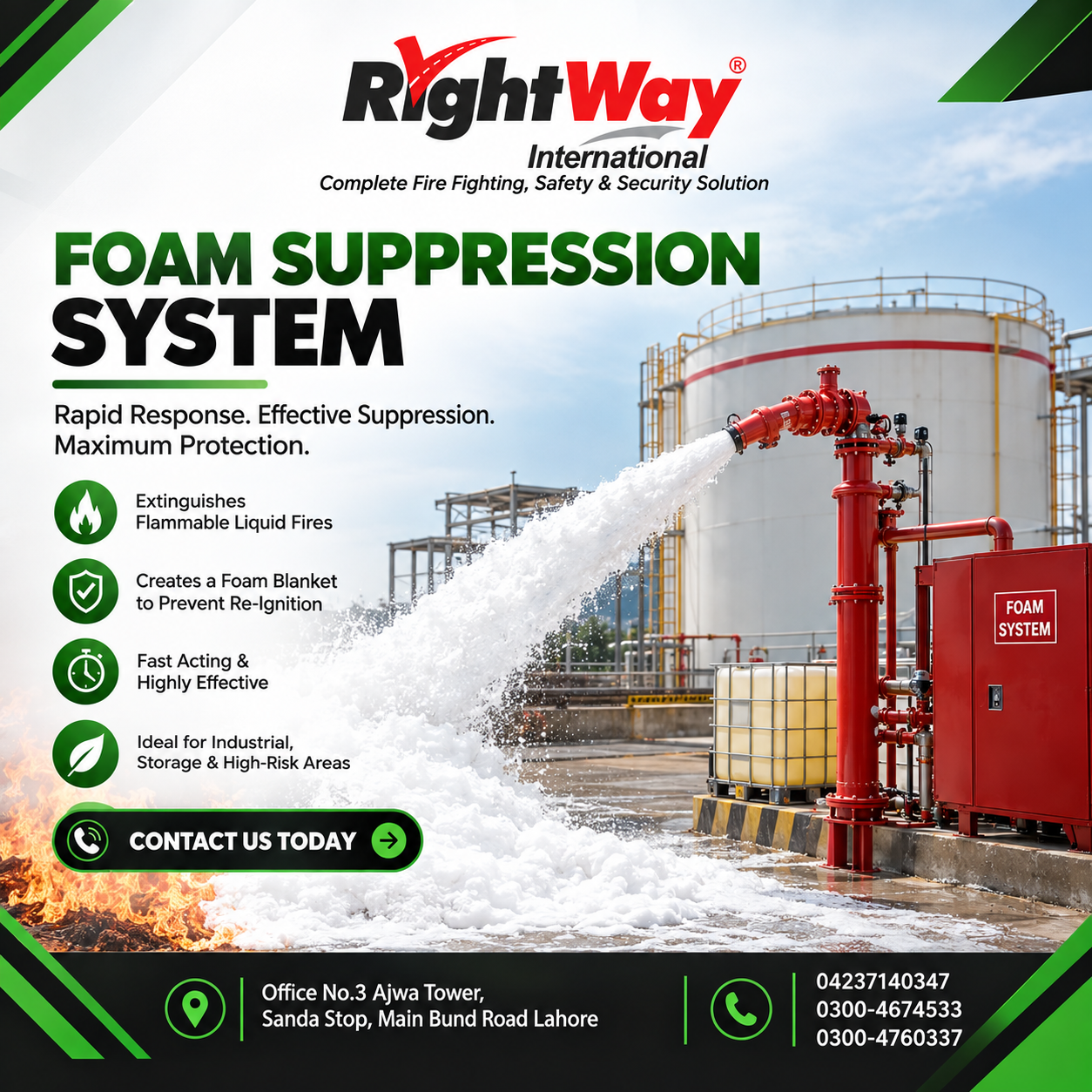
Foam Suppression System: Types Uses Benefits & Buying Guide provides specialized fire protection for hazards involving flammable and combustible liquids. Unlike ordinary water-based fire protection, foam forms a blanket over the burning surface. As a result, it helps separate the fuel from oxygen, suppresses flammable vapors, and controls the fire.
These systems play an important role in facilities such as fuel storage terminals, chemical plants, aircraft hangars, refineries, warehouses, and industrial processing areas. However, the correct foam type and application method depend on the fuel, hazard, system design, and applicable fire-protection requirements.
Therefore, businesses should select a Foam Suppression System according to the specific fire risk rather than using a one-size-fits-all solution.
What Is a Foam Suppression System?
A Foam Suppression System uses water, foam concentrate, and specialized equipment to create and distribute firefighting foam. Once activated, the system delivers foam through sprinklers, nozzles, monitors, chambers, pourers, or other discharge devices.
The foam spreads across the fuel surface and creates a protective layer. Consequently, it reduces contact between the fuel and air while helping control heat and flammable vapors.
Depending on the application, engineers can design foam systems for automatic or manual activation. In addition, different foam expansion ratios and discharge arrangements allow the system to protect a wide range of industrial hazards.
How Does a Foam Suppression System Work?
The operating process begins when a fire detection or manual activation signal triggers the system. After detection, the control system activates the appropriate valves and firefighting equipment.
Next, water enters the proportioning arrangement, where the equipment mixes it with the required amount of foam concentrate. The resulting foam solution then travels through the fire-protection piping.
Finally, discharge devices apply the solution to the protected area. Air mixes with the foam solution through suitable equipment, producing finished foam.
Once the foam reaches the fuel surface, it spreads across the burning area. Therefore, it can:
- Separate the fuel from oxygen
- Reduce the release of flammable vapors
- Control flame spread
- Reduce heat exposure
- Help prevent fire re-ignition
- Support faster fire suppression
The exact operating sequence depends on the system design, foam concentrate, discharge equipment, and hazard classification.
Why Is a Foam Suppression System Important?
Industrial fires involving flammable liquids can spread rapidly across large areas. Ordinary water alone may not provide the required level of protection for every liquid-fuel hazard.
A properly designed foam system addresses this challenge by covering the fuel surface with a foam blanket. Furthermore, the system can provide continuous foam application for the required design duration.
Foam protection becomes particularly important in areas where fuel spills, storage tanks, process equipment, or aircraft operations create a significant fire risk.
For this reason, many high-risk facilities include foam-based protection as part of their overall fire-safety strategy.
Types of Foam Suppression Systems
Different hazards require different foam application methods. Therefore, engineers select the system according to the fuel characteristics, hazard configuration, required discharge rate, and applicable standards.
1. Low-Expansion Foam System
Low-expansion foam produces a relatively dense foam blanket with a lower expansion ratio. It works well for many flammable-liquid hazards because the foam can spread across the fuel surface.
Typical applications include:
- Fuel storage areas
- Petroleum facilities
- Loading areas
- Chemical processing plants
- Tank farms
2. Medium-Expansion Foam System
Medium-expansion foam produces more foam volume than low-expansion systems. As a result, it can cover larger spaces with a comparatively greater foam volume.
Facilities may use this type of protection for selected industrial and chemical hazards where the design requires increased foam expansion.
3. High-Expansion Foam System
High-expansion foam creates a large volume of foam from a relatively small amount of foam solution. Consequently, it can fill enclosed or partially enclosed spaces quickly.
Typical applications may include:
- Warehouses
- Aircraft hangars
- Storage areas
- Large industrial rooms
- Selected process facilities
Engineers must evaluate ventilation, enclosure geometry, fuel type, and drainage before selecting high-expansion foam.
4. Foam-Water Sprinkler System
A foam-water sprinkler system combines foam concentrate with a sprinkler-based discharge arrangement.
When the system activates, the proportioning equipment supplies the correct foam solution to the sprinkler network. The sprinklers then distribute the solution over the protected area.
This arrangement can provide both fire control and cooling depending on the system design.
5. Foam-Water Deluge System
A deluge system uses open discharge devices rather than individually closed sprinklers.
When detection occurs, the deluge valve opens and allows water or foam solution to flow through the entire connected network. Therefore, multiple discharge devices can operate simultaneously.
This approach suits hazards that require rapid and wide-area foam application.
6. Foam Monitor System
Foam monitors deliver foam over comparatively large distances and areas. Operators can use fixed or movable monitors depending on the facility design.
For example, tank farms, loading areas, aircraft facilities, and industrial yards may use foam monitors to protect large outdoor hazards.
7. Foam Chamber System
Foam chambers commonly protect storage tanks containing flammable or combustible liquids.
The chamber introduces foam into the tank area and directs it onto the fuel surface. As the foam spreads, it helps control the fire and reduce vapor release.
8. Foam Pourer System
Foam pourers distribute foam over a defined surface or into a protected area. Engineers may select them for storage tanks and other specialized hazards.
The correct arrangement depends on the tank design, fuel characteristics, discharge requirements, and applicable standards.
Where Are Foam Suppression Systems Used?
A Foam Suppression System can protect many facilities where flammable or combustible liquids create a significant fire hazard.
Common applications include:
- Oil refineries
- Fuel storage terminals
- Petroleum facilities
- Chemical plants
- Aircraft hangars
- Airports
- Fuel loading stations
- Tank farms
- Marine facilities
- Power plants
- Industrial warehouses
- Process plants
- Flammable-liquid storage areas
- Fuel dispensing and transfer areas
However, not every facility needs the same foam solution. The design should match the specific hazard and fuel involved.
Main Components of a Foam Suppression System
A complete foam system normally includes several interconnected components. Each component performs a specific function during detection, proportioning, distribution, or discharge.
Foam Concentrate Storage Tank
The storage tank holds the selected foam concentrate. Its capacity depends on the system’s required discharge rate and operating duration.
Foam Concentrate
Foam concentrate provides the firefighting agent that forms the finished foam solution. Different concentrates suit different fuels and applications.
Foam Proportioner
The proportioner mixes foam concentrate with water at the required concentration. Accurate proportioning plays an important role in system performance.
Foam Pump
Some systems use a dedicated foam pump to move concentrate or support the required system arrangement. The exact configuration depends on the system design.
Deluge Valve
A deluge valve controls water or foam solution flow in systems using open discharge devices. Once the valve opens, the system can deliver foam solution to multiple outlets.
Foam Chambers
Foam chambers commonly deliver foam into storage tanks. Their design helps distribute the foam over the protected fuel surface.
Foam Monitors
Foam monitors project foam solution toward large or difficult-to-reach hazards. Fixed and movable versions are available for different applications.
Foam Discharge Devices
These may include sprinklers, nozzles, pourers, chambers, monitors, and other specialized outlets.
Piping Network
The piping system transports water and foam solution from the supply and proportioning equipment to the discharge points.
Fire Detection and Control System
Detection equipment identifies a developing fire and can initiate automatic system operation when the design includes automatic activation.
Benefits of a Foam Suppression System
A properly engineered foam system can provide several important fire-protection benefits.
Rapid Fire Control
Foam can spread across a burning liquid surface and help control flames quickly when the system delivers the required application rate.
Vapor Suppression
The foam blanket helps reduce the release of flammable vapors from the fuel surface. Therefore, it can also help limit the possibility of continued flame spread.
Large-Area Protection
Foam monitors and other discharge arrangements can cover large industrial areas. This makes them useful for tank farms, loading zones, and similar facilities.
Reduced Re-Ignition Risk
A stable foam blanket can continue covering the fuel surface after initial flame control. Consequently, it may help reduce the chance of re-ignition.
Specialized Protection
Foam systems provide a specialized solution for hazards where conventional water protection alone may not meet the design requirements.
Flexible System Design
Engineers can configure foam systems with sprinklers, deluge systems, monitors, chambers, or other discharge devices.
Foam Suppression System vs Water Sprinkler System
Both systems can provide fire protection, but they serve different hazard conditions.
| Feature | Foam Suppression System | Water Sprinkler System |
|---|---|---|
| Primary medium | Foam solution | Water |
| Typical use | Flammable-liquid hazards | General building hazards |
| Fuel surface protection | Yes | Limited |
| Vapor suppression | Possible | Generally limited |
| Large liquid-fuel hazards | Suitable for selected hazards | May not provide adequate protection alone |
| Application equipment | Monitors, chambers, sprinklers, nozzles | Sprinklers and other water outlets |
Therefore, facilities should select the system according to the actual fire hazard rather than simply choosing the most familiar option.
Foam Suppression System vs CO₂ Fire Suppression System
Foam and CO₂ systems operate differently.
A foam system creates a protective blanket over suitable fuel surfaces. In contrast, a CO₂ system uses carbon dioxide to reduce the oxygen concentration around the fire.
Foam systems often suit flammable-liquid surface hazards. CO₂ systems, meanwhile, can protect certain enclosed hazards and equipment where gaseous suppression is appropriate.
However, CO₂ presents serious life-safety considerations in occupied spaces. Therefore, engineers must evaluate occupancy, enclosure conditions, detection, alarm, and discharge safety before selecting a CO₂ system.
Foam Suppression System vs Water Mist System
Water mist systems use very small water droplets to control fire through mechanisms such as cooling, heat absorption, and, depending on the application, oxygen displacement.
Foam systems instead focus on forming a protective layer over suitable fuel surfaces.
As a result, water mist may suit certain machinery, equipment, turbine, electrical, or specialized hazards, while foam often suits selected flammable-liquid applications.
The correct choice depends on the fuel, hazard, enclosure, application method, and approved system design.
How to Choose the Right Foam Suppression System
Choosing a foam system requires careful evaluation of several factors.
1. Identify the Fuel
First, determine the type of fuel or combustible liquid involved. Different fuels can require different foam characteristics and application methods.
2. Evaluate the Hazard
Consider the storage arrangement, spill potential, tank size, process equipment, enclosure, drainage, and surrounding exposure.
3. Select the Foam Type
Choose a foam concentrate that suits the fuel and intended application. Environmental requirements and local regulations should also influence the selection.
4. Determine the Application Method
Next, decide whether the hazard requires sprinklers, deluge outlets, monitors, foam chambers, pourers, or another discharge method.
5. Calculate Water and Foam Requirements
Engineers should determine the required flow rate, pressure, foam concentration, operating duration, and storage capacity according to the applicable design criteria.
6. Check Approvals and Compatibility
Use suitable listed, approved, or otherwise compliant equipment where the applicable project requirements call for it. Also, verify compatibility between the concentrate and system components.
7. Consider Maintenance Requirements
Finally, select equipment that the facility can inspect, test, refill, and maintain properly throughout its service life.
Foam Suppression System Installation
Professional installation plays an important role in system reliability.
Before installation, engineers should review the hazard, system design, equipment specifications, piping arrangement, discharge locations, and foam concentrate requirements.
During installation, technicians should correctly position the proportioning equipment, valves, piping, detection equipment, and discharge devices.
Afterward, the team should perform appropriate testing and commissioning. These checks help confirm that the system operates according to its design.
Furthermore, installation should follow the applicable fire-protection standards, manufacturer instructions, project specifications, and local authority requirements.
Foam Suppression System Maintenance
Regular maintenance helps keep the system ready for an emergency.
A maintenance program may include:
- Inspecting foam concentrate storage
- Checking valves and piping
- Inspecting foam monitors
- Checking foam chambers and pourers
- Testing detection equipment
- Testing alarms and control panels
- Inspecting proportioning equipment
- Checking pumps and water supplies
- Reviewing foam concentrate condition
- Testing system operation according to the approved maintenance procedure
- Recording inspection and testing results
In addition, technicians should address leaks, damaged components, blocked discharge devices, corrosion, or other defects without unnecessary delay.
The exact inspection frequency should follow the applicable standards, manufacturer recommendations, and site-specific maintenance program.
Common Foam Suppression System Problems
Several issues can reduce system performance if technicians do not address them properly.
Incorrect Foam Proportioning
If the system does not mix concentrate and water at the required ratio, the finished foam may not perform as intended.
Low Water Pressure
Insufficient pressure can reduce discharge performance. Therefore, technicians should verify the water supply and pumping arrangement.
Blocked Discharge Devices
Debris, corrosion, or mechanical damage can affect foam discharge. Regular inspection helps identify these problems.
Foam Concentrate Degradation
Improper storage conditions or unsuitable concentrate can affect foam quality. Facilities should follow the manufacturer’s storage and handling requirements.
Valve Problems
A damaged, incorrectly positioned, or poorly maintained valve can prevent the system from operating correctly.
Detection Failure
Automatic systems depend on suitable detection and control equipment. Consequently, detection devices and control circuits require regular testing.
Foam Suppression System in Pakistan
Industrial facilities in Pakistan may require specialized fire protection for fuel, chemical, petroleum, manufacturing, and other high-risk operations.
A Foam Suppression System in Pakistan can protect selected hazards such as fuel storage areas, petroleum facilities, chemical plants, airports, tank farms, and industrial processing locations.
However, local site conditions can vary significantly. For example, climate, water availability, fuel type, facility layout, maintenance capability, and authority requirements can influence the final design.
Therefore, businesses should work with qualified fire-protection professionals to assess the hazard before purchasing or installing a foam system.
When selecting a supplier in Pakistan, consider:
- Product quality
- Foam concentrate compatibility
- System design capability
- Installation experience
- Testing and commissioning support
- Spare parts availability
- Maintenance services
- Technical documentation
- Applicable approvals and certifications
- After-sales support
Foam Suppression System Buying Guide
Before purchasing a Foam Suppression System, create a clear specification based on the actual fire hazard.
Start by identifying the fuel and protected area. Then determine the required foam type, application method, discharge rate, operating duration, water supply, and storage capacity.
Additionally, review the supplier’s technical documentation and confirm that the proposed equipment matches the project requirements.
A professional supplier should be able to provide information about:
- Foam concentrate type
- Foam concentration
- Proportioning equipment
- Flow requirements
- Pressure requirements
- Pump requirements
- Storage capacity
- Discharge devices
- Piping requirements
- Detection and control equipment
- Testing procedures
- Maintenance requirements
- Applicable approvals or certifications
Most importantly, avoid selecting equipment based only on price. A lower initial cost does not necessarily provide the correct protection for a high-risk application.
Foam Suppression System Safety Considerations
Safety should remain a priority during design, installation, operation, and maintenance.
First, identify the fuel and its fire characteristics. Next, select a compatible foam concentrate and appropriate discharge method.
For automatic systems, provide suitable detection, alarms, controls, and emergency procedures. Occupants should also understand what happens when the system activates.
Furthermore, facilities should consider drainage because large quantities of foam solution and water may require controlled discharge and cleanup.
Environmental considerations also matter. Foam formulations have different environmental characteristics, so the facility should select and manage the concentrate according to applicable regulations and project requirements.
Finally, trained personnel should carry out inspections, testing, maintenance, and system modifications.
Frequently Asked Questions
What is a Foam Suppression System?
A Foam Suppression System uses foam solution to control or suppress fires involving suitable flammable or combustible-liquid hazards. The foam forms a blanket over the fuel surface and helps reduce flame spread and vapor release.
Where are Foam Suppression Systems used?
These systems are commonly considered for fuel storage terminals, refineries, chemical plants, aircraft hangars, tank farms, loading areas, and other facilities with suitable liquid-fuel hazards.
What is the difference between foam and water fire suppression?
Water primarily controls fire through cooling and heat absorption. Foam can also form a protective blanket over suitable fuel surfaces, helping separate the fuel from oxygen and reduce vapor release.
Is foam suitable for every fire?
No. Foam is not suitable for every fire or every fuel. The facility must select the foam type and application method according to the specific hazard.
What are the main components of a Foam Suppression System?
Common components include foam concentrate storage, proportioning equipment, valves, piping, discharge devices, detection and control equipment, water supply equipment, and specialized devices such as monitors or foam chambers.
How often should a Foam Suppression System be maintained?
Maintenance frequency depends on the system design, manufacturer requirements, applicable standards, and site conditions. Regular inspection and testing help maintain system readiness.
Can foam systems protect fuel storage tanks?
Yes. Specialized foam arrangements, including foam chambers and other approved discharge methods, can protect selected fuel storage tanks when engineers design the system for the specific tank and fuel.
Is a Foam Suppression System expensive?
The cost varies according to the hazard, protected area, foam type, storage capacity, water supply, discharge equipment, piping, detection system, and installation requirements.
A Foam Suppression System provides specialized protection for selected flammable and combustible-liquid hazards. By creating a foam blanket over the fuel surface, the system can help control flames, reduce vapor release, and limit fire spread.
However, successful protection depends on correct system selection and engineering. The foam concentrate, proportioning equipment, discharge devices, water supply, detection system, and maintenance program must work together.
Therefore, businesses should assess their specific fire risks before selecting a foam solution. With proper design, installation, commissioning, and maintenance, a foam suppression system can become an important part of a comprehensive industrial fire-protection strategy.