




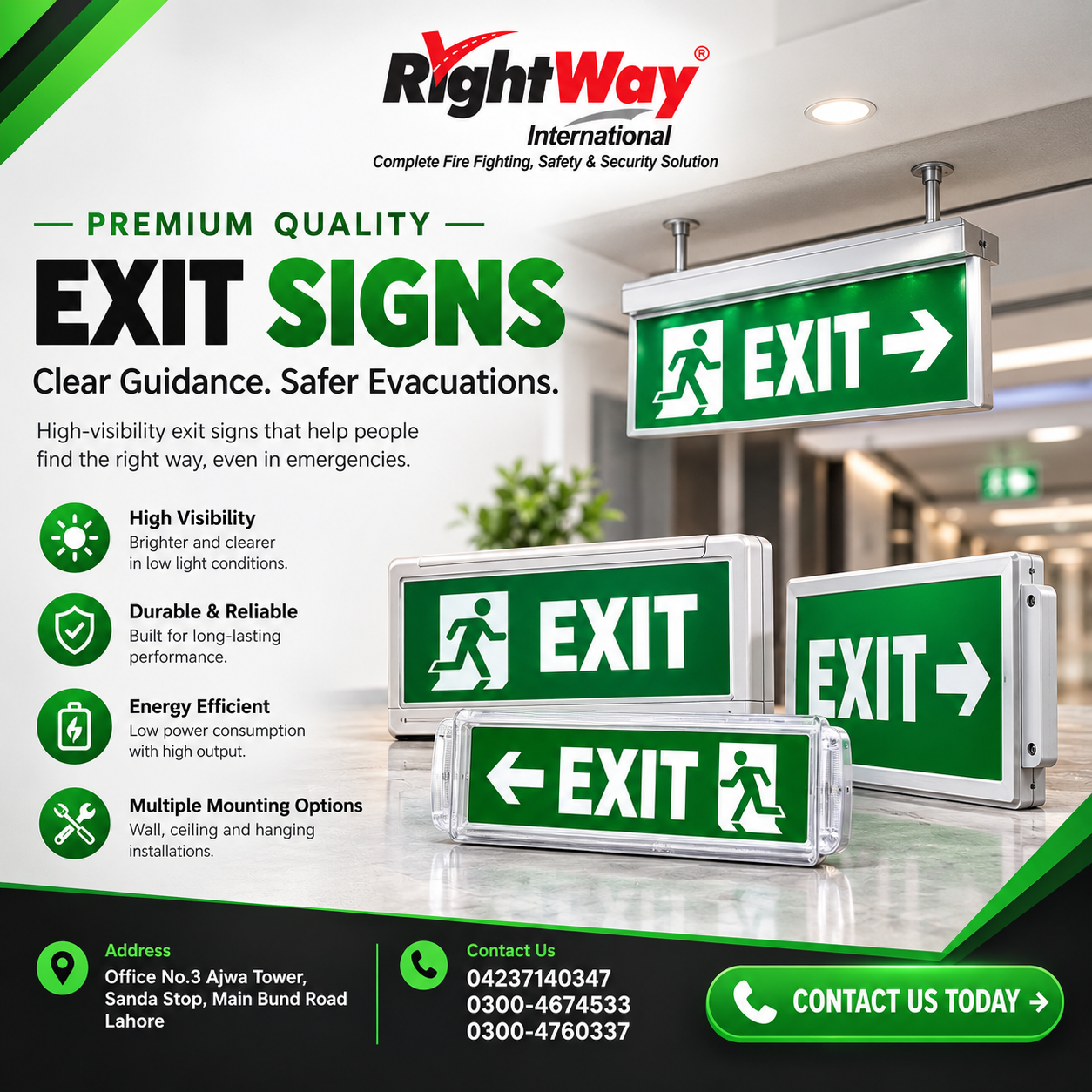
Exit Signs: Types Uses Benefits are an important part of building and fire safety. They help occupants quickly identify safe exit routes during normal operation and emergencies. Clear and visible exit signs are especially important in buildings where smoke, darkness, panic, or unfamiliar layouts can make evacuation difficult.
Exit signs are commonly used in offices, factories, warehouses, hospitals, shopping centers, schools, hotels, commercial buildings, and other public or industrial facilities.
What Is an Exit Sign?
An Exit Sign is a safety sign that clearly identifies an emergency exit or evacuation route. It normally uses highly visible lettering, symbols, arrows, or illumination to guide people toward an exit.
Depending on the application, exit signs can be:
- Illuminated exit signs
- LED exit signs
- Photoluminescent exit signs
- Ceiling-mounted exit signs
- Wall-mounted exit signs
- Double-sided exit signs
- Emergency exit signs
- Arrow-direction exit signs
The correct type depends on the building layout, visibility requirements, emergency lighting arrangement, and applicable safety requirements.
Why Are Exit Signs Important?
During an emergency, people need clear information to find the nearest available exit. Smoke, power failure, fire, or crowded conditions can make normal signs difficult to see.
Properly installed Exit Signs can:
- Identify emergency exits
- Guide occupants toward safe routes
- Improve evacuation visibility
- Reduce confusion during emergencies
- Support emergency evacuation planning
- Remain visible during power failures when equipped with emergency backup
- Improve overall building safety
For this reason, exit signs should remain clearly visible and unobstructed.
Types of Exit Signs
1. LED Exit Signs
LED exit signs use energy-efficient LEDs to illuminate the exit message. They are commonly used in commercial and industrial buildings because of their low energy consumption and long service life.
2. Emergency Exit Signs
Emergency exit signs are designed to remain operational during an emergency. Many models include a battery backup so the sign can continue operating when the main power supply fails.
3. Photoluminescent Exit Signs
Photoluminescent signs absorb available light and can provide visible guidance in low-light conditions. They do not require continuous electrical illumination, depending on the product design and application.
4. Wall-Mounted Exit Signs
Wall-mounted signs are installed above or beside doors and along evacuation routes. They are suitable for many commercial, industrial, and public buildings.
5. Ceiling-Mounted Exit Signs
Ceiling-mounted exit signs can provide visibility from multiple directions, depending on their design and installation position.
6. Double-Sided Exit Signs
Double-sided signs display the exit message on both sides. They are useful in corridors, open areas, and locations where people may approach the sign from different directions.
7. Directional Exit Signs
Directional exit signs use arrows to guide occupants toward the correct evacuation route when the exit door is not directly visible.
Where Are Exit Signs Used?
Exit Signs are commonly installed in:
- Offices
- Factories
- Warehouses
- Hospitals
- Schools
- Universities
- Hotels
- Shopping malls
- Restaurants
- Airports
- Parking buildings
- Commercial properties
- Industrial facilities
- Apartment buildings
- Public buildings
- Assembly areas
The exact placement depends on the building layout and applicable fire and life-safety requirements.
Main Features of Exit Signs
A good exit sign should provide clear and easily recognizable information.
High Visibility
The sign should remain easy to identify from the intended viewing distance.
Clear Lettering
The word EXIT should be clearly readable without unnecessary design elements that could create confusion.
Emergency Backup
Battery-backed models can continue operating during a main power failure.
Durable Construction
Outdoor or industrial applications may require materials that can withstand environmental conditions.
Directional Arrows
Where necessary, arrows can direct occupants toward the correct evacuation route.
Benefits of Exit Signs
Improved Emergency Navigation
Exit signs help occupants quickly identify available evacuation routes.
Better Visibility
Illuminated signs can remain visible in dark or low-light conditions.
Reduced Confusion
Clear exit information can help people understand where to move during an emergency.
Emergency Power Operation
Battery-backed models can continue providing guidance when normal electricity is unavailable.
Professional Safety Compliance
Suitable exit signage forms an important part of a properly planned emergency evacuation system.
Exit Signs vs Emergency Exit Signs
The terms are sometimes used interchangeably, but their application can differ.
| Feature | Exit Sign | Emergency Exit Sign |
|---|---|---|
| Main purpose | Identify an exit | Identify an exit during emergencies |
| Illumination | May be illuminated | Commonly designed for emergency visibility |
| Battery backup | Model dependent | Commonly available |
| Directional use | Possible | Common |
| Application | General exit identification | Emergency evacuation |
The appropriate product should be selected according to the building’s evacuation and safety requirements.
How to Choose the Right Exit Sign
1. Check the Building Layout
Identify corridors, stairways, doors, exits, and areas where occupants may need additional directional guidance.
2. Select the Sign Type
Choose between LED, photoluminescent, wall-mounted, ceiling-mounted, single-sided, or double-sided designs according to the application.
3. Consider Emergency Power
For areas requiring continued visibility during power failure, consider an exit sign with suitable emergency battery backup.
4. Check Visibility
Make sure the sign can be clearly seen from the required distance and is not blocked by doors, decorations, equipment, or other objects.
5. Consider Installation Location
Install the sign at appropriate decision points and above or near exits according to the applicable design requirements.
6. Check Quality and Certification
Where required, select products with appropriate testing, approvals, or certifications for the intended application.
Exit Signs in Pakistan
Exit Signs in Pakistan are widely used in commercial buildings, factories, warehouses, hospitals, offices, shopping centers, schools, hotels, and industrial facilities.
When purchasing exit signs in Pakistan, consider:
- Sign visibility
- LED quality
- Battery backup
- Battery operating duration
- Construction quality
- Mounting options
- Emergency operation
- Product durability
- Applicable approvals
- Supplier support
The selected sign should match the building’s evacuation plan and applicable local requirements.
Exit Sign Buying Guide
Before purchasing an Exit Sign, determine where it will be installed and how occupants will approach the exit.
A supplier should be able to provide information about:
- Sign dimensions
- LED type
- Power requirements
- Battery backup
- Emergency operating time
- Mounting method
- Single or double-sided design
- Arrow direction
- Housing material
- Product approvals
- Testing information
- Maintenance requirements
Avoid choosing an exit sign based only on price. Visibility, reliability, emergency operation, and suitable installation are also important.
Exit Sign Installation
Correct installation helps ensure that occupants can see exit signs when they need them.
During installation, consider:
- Exit door location
- Corridor direction
- Viewing distance
- Mounting height
- Emergency lighting
- Obstructions
- Directional requirements
- Building evacuation routes
Electrical connections and emergency battery systems should be installed and tested by suitably qualified personnel.
Exit Sign Maintenance
Regular inspection helps ensure that exit signs remain ready for emergencies.
Check for:
- Failed LEDs
- Weak or damaged batteries
- Flickering illumination
- Physical damage
- Loose mounting
- Dirty sign surfaces
- Blocked visibility
- Incorrect directional arrows
- Battery charging problems
Any damaged or non-functional sign should be repaired or replaced promptly.
Frequently Asked Questions
What is an Exit Sign?
An Exit Sign is a safety sign that identifies an emergency exit or guides occupants toward an available evacuation route.
Why are Exit Signs important?
They help occupants quickly locate exits and evacuation routes, particularly during emergencies, darkness, smoke, or power failures.
Are LED Exit Signs better for emergency use?
LED exit signs provide efficient illumination and are widely used for emergency and general exit identification. The exact suitability depends on the product and application requirements.
Do Exit Signs work during a power failure?
Many emergency exit signs include battery backup that allows the sign to remain illuminated when the main power supply fails.
Where should Exit Signs be installed?
They are generally positioned above exits and along evacuation routes where occupants need clear guidance. Exact placement should follow the applicable fire and life-safety requirements.
Can Exit Signs have arrows?
Yes. Directional exit signs can include arrows to guide occupants toward an exit when the exit door is not directly visible.
Exit Signs provide essential visual guidance during building evacuation. LED, emergency, photoluminescent, wall-mounted, ceiling-mounted, and directional designs are available for different applications.
For effective emergency guidance, choose an exit sign based on visibility, location, emergency power, mounting method, durability, directional requirements, and applicable safety requirements. Regular inspection and maintenance are also important to ensure that the signs remain operational when needed.