




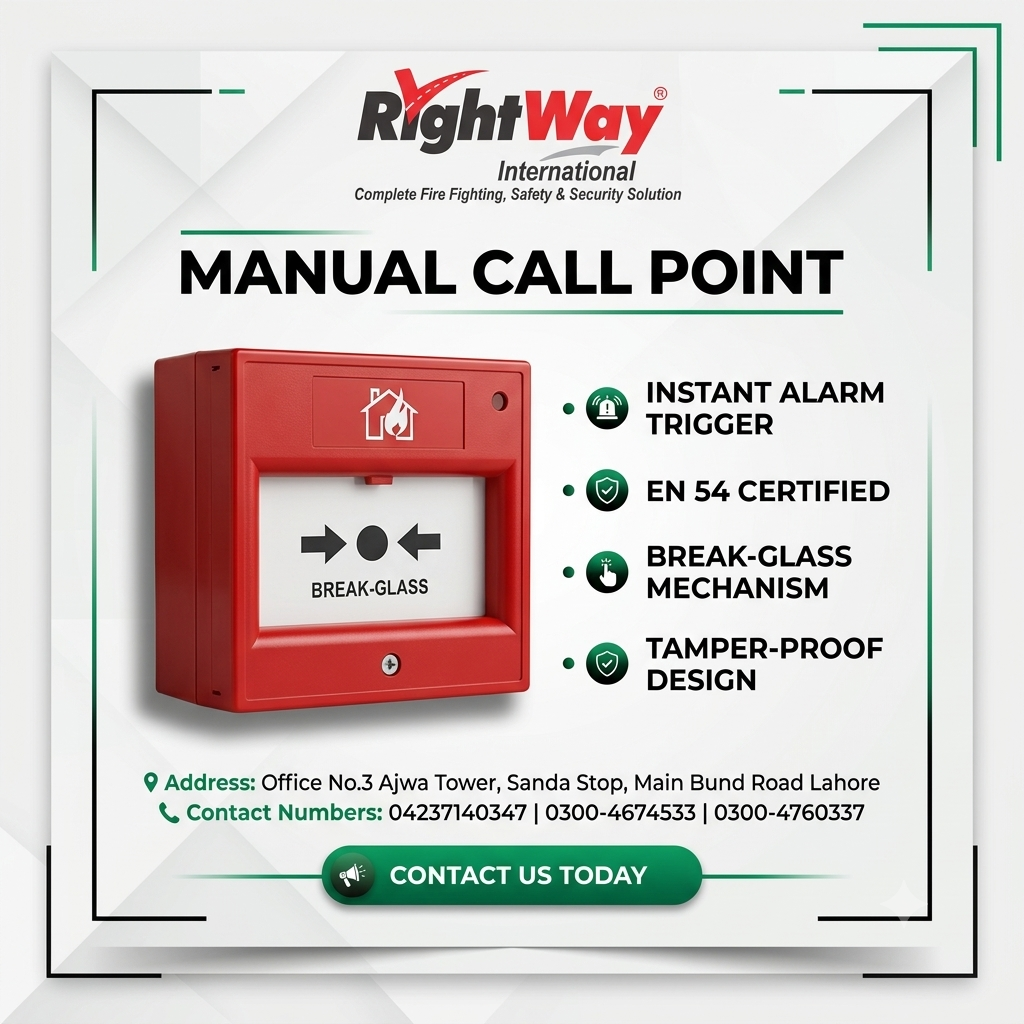
Manual Call Point (MCP) in Pakistan is a vital manual initiation device of a fire alarm system, designed to allow occupants or facility staff to immediately trigger a fire alarm upon visually spotting a fire or emergency condition before automatic detectors react. By physically pressing a element or breaking a glass face, the Manual Call Point sends an immediate electrical signal to the central Fire Alarm Control Panel (FACP), which instantly activates sirens, strobes, building evacuations, emergency notifications, and fire suppression protocols.
Manual Call Points are extensively installed across commercial buildings, industrial facilities, factories, warehouses, manufacturing plants, hospitals, hotels, shopping malls, educational institutions, airports, railway stations, residential towers, government offices, pharmaceutical plants, laboratories, power plants, oil and gas facilities, chemical facilities, data centers, electrical substations, marine vessels, mining operations, logistics hubs, and public spaces throughout Pakistan.
These life safety devices enhance emergency response speeds, facilitate immediate building evacuations, minimize fire spread and property damage, reduce business interruptions, and ensure compliance with National Fire Protection Association 72, NFPA 70, EN 54-11 standards, UL standards, FM Approved guidelines, ISO standards, IEC standards, OSHA safety standards, and local Pakistan Civil Defence fire safety regulations.
Modern Manual Call Points are manufactured using flame-retardant ABS plastic or heavy-duty metal enclosures, high-visibility red or yellow housings, resettable flexible elements or break-glass mechanisms, LED status indicators, built-in addressable microchip modules, tamper-evident flip covers, waterproof IP-rated weatherproof seals, key reset mechanisms, and anti-vandalism designs to deliver long-lasting protection in demanding environments.
Benefits of Manual Call Points
- Instant Human Trigger: Allows occupants to manually initiate a building-wide alarm seconds before heat or smoke reaches automatic ceiling detectors.
- Immediate Evacuation: Triggers sounders and visual strobes instantly to ensure fast and orderly building evacuation.
- High Visibility: Housed in bright red (or yellow/green for emergency doors/suppression) enclosures so they can be easily spotted along exit routes.
- False Alarm Reduction: Requires deliberate human action (breaking glass or pushing a element), significantly reducing accidental triggers compared to sensitive smoke sensors.
- Addressable Location Tracking: Addressable models transmit the exact panel loop and zone ID so emergency responders know the precise location of activation.
- Built-In LED Status: Features visual LED indicators to show normal monitoring, alarm activation, and communication status.
- Simple Reset Capabilities: Modern flexible resettable call points can be easily reset using a master key without needing to replace glass panes after testing or activation.
- Durable & Weatherproof Options: Available with IP66/IP67 ingress protection for harsh outdoor, wet, or dusty industrial environments across Pakistan.
- Tamper Prevention: Compatible with protective hinged flip covers and local buzzers to deter malicious misuse in schools and public venues.
- Global & Local Regulatory Compliance: Supports compliance with NFPA 72, EN 54-11, UL, FM, and local Pakistan fire department standards.
Types of Manual Call Points
- Break-Glass Manual Call Point: Traditional design where thin glass breaks under pressure to release a spring-loaded switch and trigger the alarm.
- Resettable (Plastic Element) Manual Call Point: Uses a flexible plastic element that snaps back into place using a special reset key after activation, eliminating glass replacement costs.
- Addressable Manual Call Point: Integrates a microchip module that assigns a unique digital address, reporting its exact geographic location to the main control panel.
- Conventional Manual Call Point: Connects to standard hardwired zones; ideal for simpler, small-to-medium building layouts.
- Weatherproof / Outdoor Manual Call Point (IP67): Features silicone gaskets and heavy-duty seals to protect against rain, dust, moisture, and high humidity in outdoor or wash-down areas.
- Explosion-Proof Manual Call Point: Encased in heavy cast aluminum or stainless steel enclosures for hazardous zones in oil refineries, gas facilities, and chemical processing plants.
- Wireless Manual Call Point: Communicates with the main panel via RF signals, avoiding structural drilling in historic sites or temporary installations.
- Dual-Action Pull Station: Requires two separate physical motions (e.g., lift cover and pull down lever) to prevent accidental collisions from triggering an alarm.
- Key-Operated Manual Call Point: Designed for high-security facilities, mental health units, or prisons where only authorized personnel with keys can initiate an alarm.
- Specialized Colour Call Points: Includes yellow (extinguishing system trigger/abort), blue (door release/HVAC shutdown), and green (emergency door release) call points.
Common Manual Call Point Components
Modern Manual Call Points are engineered with precision internal and external components:
- High-Impact Casing: Flame-retardant ABS plastic or cast metal housing painted in high-visibility safety red.
- Operating Element: Breakable thin glass or reusable flexible plastic push element marked with directional arrows.
- Microswitch Mechanism: Heavy-duty internal electrical contacts (NO/NC) that change state upon activation.
- Addressable Module / PCB: Built-in circuit board with DIP switches or soft-addressing memory for system identification.
- LED Status Indicator: Red LED for active alarm and green/blinking LED for normal loop communication supervision.
- Reset Key Slot: Keyhole mechanism at the base or top to reset the operating element back to normal state.
- Protective Flip Cover: Clear polycarbonate hinged cover protecting the operating element from physical impacts or inadvertent bumps.
- Gaskets & Cable Glands: Weatherproof rubber rings providing IP66/IP67 sealing against moisture and dust ingress.
- Terminal Blocks: Screw or push-in electrical terminals for robust field wiring connections.
Common Uses in Pakistan
Manual Call Points are strategically placed along all escape routes, exit doors, stairwell landings, and corridors in:
- Commercial Properties: Corporate offices, shopping malls, banks, high-rise office towers, and retail outlets.
- Industrial Facilities: Textile mills, steel plants, automotive assembly plants, packaging factories, and manufacturing workshops.
- Warehouses & Logistics: Storage hubs storing combustible goods, cold storage units, and distribution centers.
- Healthcare Institutions: Hospitals, surgical centers, diagnostic laboratories, and pharmaceutical manufacturing facilities.
- Educational Environments: Universities, colleges, schools, libraries, and vocational training centers.
- Hospitality Industry: 5-star hotels, resorts, banquet halls, restaurants, and commercial kitchens.
- Energy & Utilities: Power plants, solar farms, electrical substations, gas compressor stations, and fuel depots.
- Transport Infrastructure: Airports, railway stations, metro stops, marine ports, and toll plazas.
Benefits Compared to Automatic Fire Detectors
| Feature | Manual Call Point (MCP) | Automatic Smoke/Heat Detector |
| Initiation Source | Immediate human perception | Thermal or smoke particle threshold |
| Response Time | Instant upon human discovery | Requires smoke/heat to reach ceiling sensor |
| False Alarm Rate | Extremely low (deliberate action) | Moderate (susceptible to dust, steam, fumes) |
| Placement Height | Mounted at eye/hand level (1.2m–1.4m) | Ceiling mounted |
| Air Movement Sensitivity | Unaffected by HVAC airflow | Affected by high air changes and drafts |
| Maintenance | Visual inspection and key test | Periodic chamber cleaning and calibration |
How a Manual Call Point Works
A Manual Call Point operates as a normally open or normally closed contact switch within a fire alarm loop circuit.
Under normal monitoring conditions, the switch contact is held in a supervisory state, and the panel confirms loop integrity. When an individual discovers a fire, they apply pressure to the central operating element.
Breaking the glass or pressing the flexible element releases the internal microswitch actuator. This action instantly changes the circuit impedance or transmits an addressable digital data packet back to the Fire Alarm Control Panel. Upon receiving this signal, the control panel shifts into full alarm mode—activating evacuation sounders, visual strobes, releasing fire doors, recalling elevators, shutting down ventilation fans, and alerting emergency monitoring centers.
Maintenance & Servicing Requirements
To remain fully operational and compliant with Pakistan Civil Defence standards, Manual Call Points require routine maintenance:
- Weekly Visual Inspections: Checking for physical damage, obstructed access, missing glasses, or tampered seals.
- Functional Key Testing: Periodically inserting the test key to depress the switch element and confirm signal arrival at the control panel without breaking glass.
- Glass Replacement: Promptly replacing broken glass panes or cracked elements after operational tests or real emergencies.
- Terminal & Wiring Integrity Checks: Inspecting screw terminal tightness and loop resistance to prevent open-circuit faults.
- Cleaning & Debris Removal: Cleaning dust, grease, and moisture buildup from outer casings and internal switch tracks.
- Protective Cover Audits: Ensuring hinged flip covers swing open freely without binding.
- Annual Servicing: Comprehensive end-to-end circuit response testing during full facility fire safety audits.
High-quality Manual Call Points are essential building blocks of any comprehensive fire protection strategy. When correctly specified, installed along escape routes, and routinely maintained, these initiation devices provide a direct, reliable method for building occupants to sound the alarm. Furthermore, they are essential to safeguard human life. Additionally, they protect valuable physical assets. Ultimately, they maintain full compliance with international and local fire safety codes throughout Pakistan.