




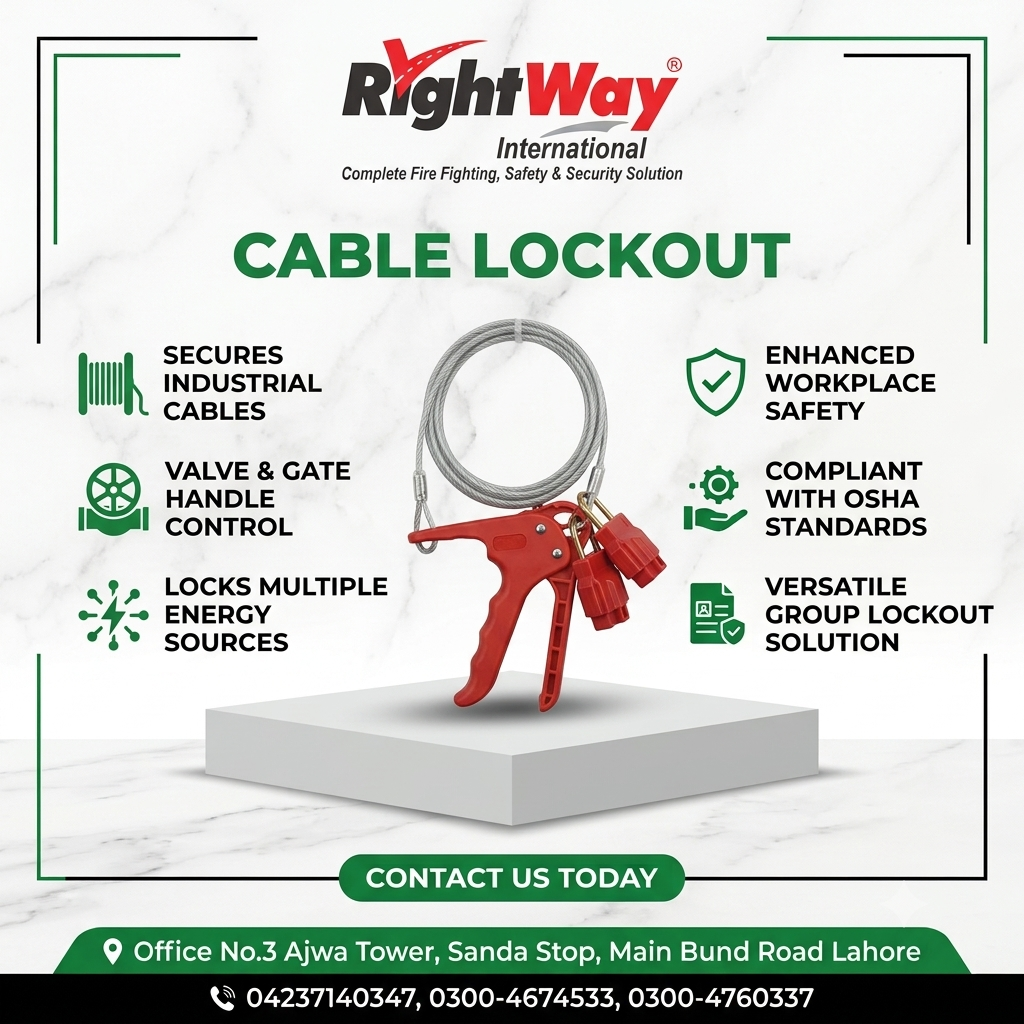
Cable Lockout Devices in Pakistan are a vital electrical and mechanical isolation device for any facility safety management program. Specifically, safety engineers design them to secure multi-point energy sources, gate valves, circuit breakers, and complex equipment cables during maintenance. By physically threading heavy-duty steel cables through multiple isolation points and locking them tight, these devices prevent technicians and workers from accidentally re-energizing complex machinery. Consequently, facility teams extensively install these cable lockout devices across manufacturing plants, oil and gas refineries, chemical processing units, and industrial complexes throughout Pakistan.
Importantly, these safety devices enhance workplace security and prevent severe multi-source energy hazards during complex equipment servicing. Moreover, they support compliance with Occupational Safety and Health Administration (OSHA) 1910.147 LOTO standards, National Electrical Code (NEC) guidelines, ISO 45001 safety frameworks, and local Pakistan industrial safety regulations.
Manufacturers build modern cable lockouts using flexible multi-stranded steel cables, insulated PVC coatings, rugged aluminum or thermoplastic bodies, and bright hazard-warning colors. Additionally, they feature adjustable cable tensioning mechanisms, multi-hole locking bodies, and compact designs to deliver dependable performance in demanding industrial environments.
Benefits of Cable Lockouts
- Multi-Point Isolation: Securely locks out multiple control valves, switches, or circuit breakers simultaneously using a single flexible cable.
- Versatile Reach & Length: Features adjustable cable lengths that accommodate large, awkward, or widely spaced isolation points across Pakistani industrial facilities.
- OSHA LOTO Compliance: Fully satisfies OSHA 1910.147 Lockout/Tagout requirements for complex, multi-source energy control applications.
- Non-Conductive & Insulated Options: Available with robust, high-grade PVC-coated steel cables that minimize electrical conductivity risks near live electrical panels.
- High-Visibility Safety Color Coding: Bright red and safety-yellow locking bodies stand out instantly, allowing workers to quickly spot isolated equipment.
- Tool-Free Adjustment: Incorporates intuitive squeeze-to-lock clamping mechanisms for fast, secure cable tensioning without requiring special tools.
- Tamper-Resistant Design: Features internal locking mechanisms that grip the cable tightly and prevent unauthorized pulling or slack creation while locked.
- Durable & Chemical Resistant: Withstands thermal exposure, chemical splashes, oil mist, and UV aging across harsh Pakistani industrial environments.
- Lightweight & Ergonomic Structure: Easy for maintenance personnel to carry in standard LOTO tool pouches without adding excess weight.
- Global & Local Regulatory Compliance: Fully supports international OSHA, NEC, and ISO standards while meeting all local Pakistan industrial safety codes.
Types of Cable Lockouts
- Standard Adjustable Cable Lockout: Features a built-in locking body with a retractable multi-stranded steel cable for general valve and switch isolation.
- Heavy-Duty Multi-Hole Cable Lockout: Designed with multiple padlock holes to allow several technicians to apply their personal safety locks simultaneously.
- Insulated Circuit Breaker Cable Lockout: Utilizes a fully non-conductive nylon cable and body specifically for electrical panel and breaker lockout.
- Miniature Cable Lockout: Compact version engineered for tight spaces, small control buttons, and delicate miniature valves.
- Squeeze-Lock Cable Lockout Device: Incorporates a pistol-grip or squeeze handle mechanism to easily pull the cable tight before locking.
- Modular Interchangeable Cable Lockout: Allows technicians to swap out different cable lengths and thicknesses depending on the specific facility requirement.
Common Cable Lockout Components
Engineers construct modern cable lockouts using high-precision internal and external parts:
- Flexible Steel Cable: Multi-stranded galvanized or stainless steel wire core providing high tensile strength and cut resistance.
- Protective PVC Coating: Clear or colored plastic jacket protecting equipment surfaces from scratches and preventing electrical conductivity.
- Locking Body / Clamping Mechanism: Rugged thermoplastic or die-cast aluminum housing that grips the cable securely when padlocked.
- Padlock Attachment Eyelets: Molded or drilled loop holes designed to accept standard safety padlock shackles and lockout hasps.
- Tensioning Handle or Cleat: Ergonomic grip used to pull the cable taut before final engagement.
- Warning Legend Area: Embossed international danger icons or text warning against unauthorized removal.
Common Uses in Pakistan
Technicians strategically apply cable lockouts to complex machinery and multi-point energy sources in:
- Oil, Gas & Petrochemical Refineries: Large gate valves, pipeline networks, and complex multi-valve manifolds.
- Manufacturing & Heavy Industry: Overhead cranes, large assembly lines, and multi-motor drive systems.
- Power Generation & Utilities: Electrical switchgear panels, circuit breaker racks, and turbine control valves.
- Chemical Processing Plants: Corrosive fluid lines, agitator switches, and emergency shutdown valves.
- Mining & Infrastructure: Heavy extraction machinery, conveyor belt systems, and remote electrical disconnects.
- Logistics & Warehouses: Automated sorting systems, large roller doors, and multi-phase electrical panels.
Benefits Compared to Standard Improvised Methods
| Feature | Engineered Cable Lockout | Improvised Wire / Chain Methods |
| Mechanical Security | Locks cable tightly at any length, preventing sliding or slack creation | Wires or chains can slip, stretch, or be easily untied by unauthorized workers |
| Energy Isolation | Effectively secures multiple disparate isolation points simultaneously | Fails to provide structured multi-point tension or reliable mechanical hold |
| Compliance | Purpose-built for OSHA 1910.147 complex energy control compliance | Completely non-compliant, leading to heavy regulatory penalties |
| Ease of Use | Fast, adjustable pull-through design with secure internal locking | Time-consuming, frustrating, and unreliable makeshift fixes |
| Visual Warning | High-visibility safety colors with clear danger markings | Lacks standardized safety communication or professional hazard warnings |
Plug Lockout Devices
A plug lockout acts as a physical mechanical barrier enclosing an equipment power plug to prevent its insertion into an electrical outlet.
First, an authorized technician unplugs the target machine from the wall socket, ensuring zero electrical energy input. Next, they select the appropriate plug lockout device (such as a standard clamshell or heavy-duty cylindrical housing).
Then, they place the electrical plug inside the lockout cavity, allowing the cord to exit through the designated slot, and snap or close the shell shut. Finally, they insert their personal safety padlock shackle and lockout hasp through the device’s aligned eyelets and lock it closed.
How a Cable Lockout Works
A cable lockout acts as a flexible mechanical barrier that threads through multiple energy isolation points to prevent equipment activation.
First, an authorized technician shuts down all relevant energy sources (such as valves and switches) across the target machine, ensuring zero energy input. Next, they select the appropriate cable lockout device with sufficient cable length.
Then, they thread the flexible steel cable through each isolation point—such as valve handles, breaker switches, or levers—and back through the locking body’s clamping port. Next, they pull the cable taut to eliminate any slack. Finally, they insert their personal safety padlock shackle and lockout hasp through the device’s aligned eyelets and lock it closed.
Consequently, no other worker can loosen the cable or re-energize the equipment until maintenance concludes and every technician removes their padlock.
Maintenance & Servicing Requirements
To remain operational and compliant with safety standards, cable lockouts require routine care:
- Monthly Visual Inspections: Inspect steel cables regularly for frayed wires, cuts, kinks, or peeling PVC coatings.
- Clamping Mechanism Audits: Test the internal locking jaws or gears periodically to ensure they grip the cable securely without slipping.
- Padlock Hole Checks: Verify that padlock attachment eyelets are not warped, cracked, or distorted from physical stress.
- Clean Storage Maintenance: Store unused cable lockouts neatly coiled in designated wall-mounted shadow boards or portable LOTO kits to prevent tangling.