




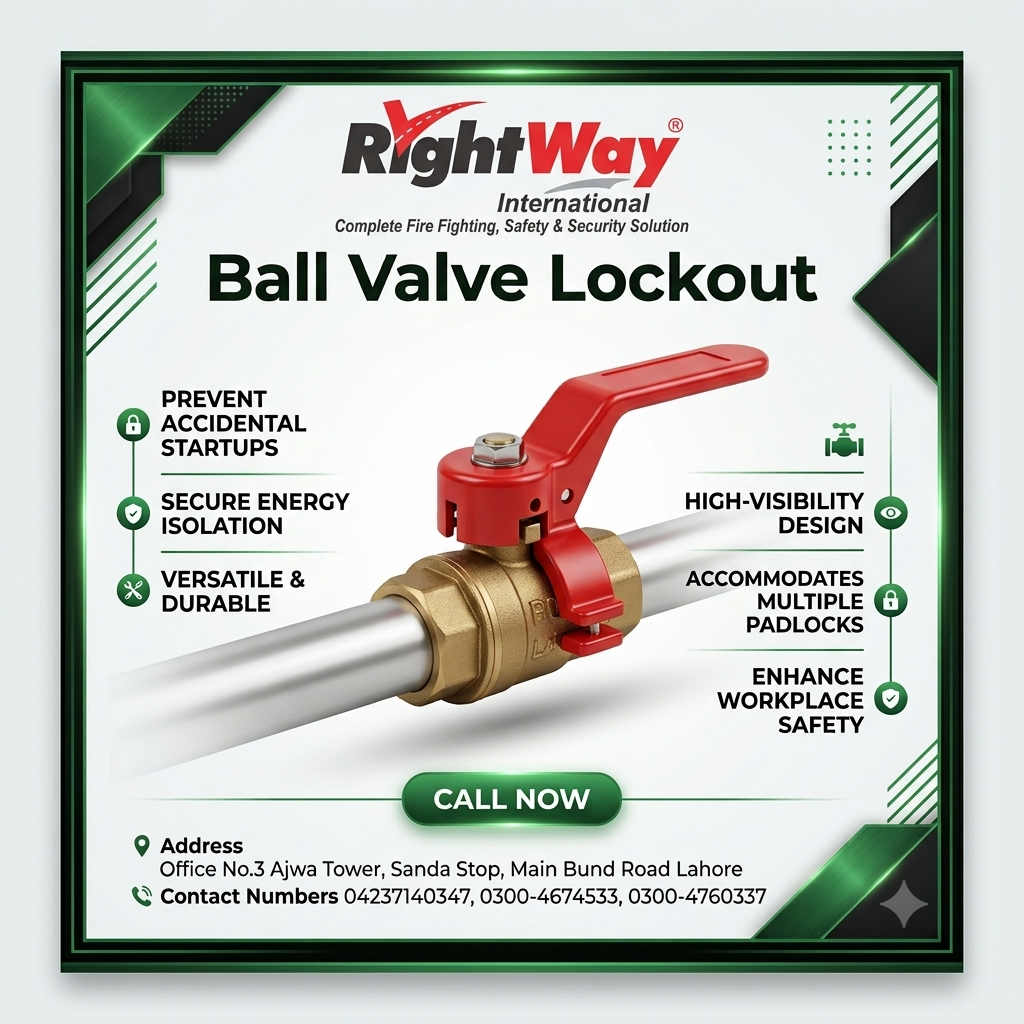
Ball Valve Lockout Devices in Pakistan. are an essential physical containment and administrative safety component of any facility energy control and hazard isolation program. Specifically, safety engineers design them to secure quarter-turn ball valves in the shut-off (or open) position across fluid, gas, and chemical piping systems.
By clamping over the valve handle and locking it securely against the pipe or valve body, these specialized lockout devices physically prevent accidental handle rotation, ensuring hazardous materials or high-pressure lines cannot be re-energized while maintenance teams are at work.
Consequently, industrial safety teams extensively implement ball valve lockouts across manufacturing plants, oil and gas refineries, power generation stations, chemical processing facilities, and water treatment plants throughout Pakistan.
Importantly, these physical isolation units reinforce workplace safety, streamline plant maintenance, and prevent severe chemical leaks or pressurized discharge accidents during major turnarounds, pipe overhauls, and routine servicing. Moreover, they support compliance with Occupational Safety and Health Administration (OSHA) 1910.147 LOTO standards, ISO 45001 occupational health frameworks, and local Pakistan industrial safety regulations.
Manufacturers build modern ball valve lockouts using high-impact polypropylene, heavy-duty ABS plastic, or powder-coated steel alloys in high-visibility hazard colors. Additionally, they incorporate adjustable slider arms, multi-padlock retention holes, non-conductive bodies, and chemical-resistant finishes to deliver dependable performance in demanding industrial environments.
Benefits of Ball Valve Lockout Devices
- Positive Physical Isolation: Encapsulates or clamps firmly onto quarter-turn valve handles, physically preventing handle lever rotation even under heavy manual force.
- Versatile Pipe Compatibility: Available in both adjustable and fixed-size designs to fit pipe diameters ranging from small laboratory tubing to large industrial pipelines.
- OSHA LOTO Compliance: Satisfies OSHA 1910.147 requirements for providing standardized, effective physical energy blockage on liquid, gas, and steam lines.
- Weather & Chemical Resistance: Constructed using UV-stabilized polypropylene or coated steel that withstands exposure to acids, solvents, grease, and extreme temperature variations.
- High-Visibility Safety Color Coding: Utilizes striking safety red or yellow finishes compliant with ANSI Z535 standards to command immediate visual attention across industrial piping corridors.
- Multi-Padlock Capacity: Features multiple padlock holes on the locking body to allow full crew accountability during multi-craft group lockout procedures without needing extra lockout hasps.
- Dual-Position Locking Capability: Engineered to lock valves in both the fully closed position (standard maintenance safety) and the fully open position (for critical fire deluge lines or drainage systems).
- Compact & Easy to Apply: Installs in seconds without requiring tools, replacing bulky improvised clamping methods with a clean, standardized device.
- Global & Local Regulatory Compliance: Fully supports international OSHA and ISO standards alongside domestic Pakistan factory and chemical safety codes.
Types of Ball Valve Lockout Devices
- Standard Two-Piece Ball Valve Lockout: Features two interlocking clamshell-style halves that slide over the valve handle and lock together around the pipe, ideal for standard inline pipe valves.
- Adjustable Slide Ball Valve Lockout: Incorporates a sliding track mechanism that adjusts to fit various handle lengths and valve bodies, accommodating non-standard machinery setups.
- Universal Handle-Clamping Lockout: Uses a versatile clamping arm that attaches directly to the handle lever and features a blocking arm that physically rests against the pipe or wall.
- Wedge-Style Ball Valve Lockout: Features a compact wedge design that slides between the handle and the pipe body, preventing handle movement on tight, hard-to-reach manifold lines.
- Heavy-Duty Steel Ball Valve Lockout: Constructed from heavy-gauge, powder-coated steel for maximum tamper resistance in outdoor, marine, or high-risk industrial environments.
- High-Impact Thermoplastic Casing: Injection-molded polypropylene or polycarbonate body designed for high dielectric strength, impact resistance, and thermal tolerance.
- Sliding Adjustment Channel: Internal ratchet or track mechanism that allows safety technicians to pull slack tight against the valve handle for a custom fit.
- Pipe Stop Bar: A physical extension or notch on the housing that presses firmly against the pipeline to block any lever rotation.
- Multi-Lock Perimeter Holes: Precision-drilled holes designed to hold multiple padlock shackles to enforce multi-person accountability.
- High-Traction Gripping Teeth: Internal metal or ribbed plastic cleats that bite onto the valve handle to prevent slippage during application.
Common Uses Across Heavy Industry in Pakistan
Technicians strategically deploy ball valve lockouts during routine servicing, pipe purging, and plant turnarounds:
| Industry Sector | Primary Application | Key Valve Types Locked |
| Oil, Gas & Petrochemical Refineries | Hydrocarbon transfer lines, gas manifold headers, and pressure relief isolation | High-pressure steel ball valves, flanged pipeline valves |
| Chemical & Fertilizer Plants | Batch reactor feed lines, acid distribution pipes, and solvent line isolation | PVC and stainless steel ball valves, multi-port valves |
| Power Generation & Steam Utilities | Boiler feed water systems, turbine fuel lines, and auxiliary cooling pipes | High-temperature threaded and socket-weld ball valves |
| Manufacturing & Heavy Assembly | Compressed air main drops, pneumatic line servicing, and hydraulic fluid manifolds | Inline brass and iron ball valves |
| Textile & Material Mills | Chemical dosing lines, steam distribution pipes, and dye house valve isolation | Large-diameter PVC and ductile iron ball valves |
Engineered Ball Valve Lockout vs. Standard Improvised Methods
| Feature | Engineered Ball Valve Lockout | Improvised Storage / Rope, Wire & Chains |
| Material Durability | Impact-modified polypropylene or powder-coated steel resistant to UV, grease, and chemicals. | Flimsy wire, hemp rope, or basic hardware chains that rust, fray, or snap easily. |
| Legal Compliance | Fully compliant with OSHA 1910.147 and ISO 45001 standardized energy isolation standards. | Non-compliant; invites severe OSHA/audit penalties, citations, and operational shutdowns. |
| Security Integrity | Tamper-proof rigid housing and ratchet channels physically block handle rotation under force. | Prone to slipping, stretching, cut wires, or accidental manual untying during maintenance. |
| Team Accountability | Multi-padlock holes guarantee equipment cannot be re-energized until every worker finishes. | Relies on unsecured single-point ties, inviting catastrophic human error and accidental removal. |
| Visual Warning | High-visibility ANSI safety colors instantly signal locked-out hazardous equipment. | Lacks formal safety structure and standardized colors, creating confusion on the plant floor. |
Lockout Tags
A lockout tag functions as an indispensable administrative safety barrier that communicates equipment status and warns workers not to restore power.
First, an authorized technician shuts down the target machine and ensures zero energy input. Before or during the installation of the ball valve lockout, they fill out a lockout tag with their name, department, and the date.
Next, they thread the safety padlock shackle through both the valve lockout body’s padlock hole and the tag’s reinforced eyelet, securing it directly to the isolation setup alongside their lock. Finally, the tag serves as an immediate visual warning to anyone approaching the machinery.
How a Ball Valve Lockout Device Works
A ball valve lockout functions as an indispensable administrative and physical safety barrier that coordinates multi-person machinery maintenance safely.
First, the authorized lead technician or shift supervisor shuts down all relevant energy sources across the target pipeline, ensures zero energy/fluid pressure input, and identifies the target valve handle.
Next, the supervisor places the main housing of the ball valve lockout over the valve handle, adjusts the sliding mechanism or clamps the interlocking body tightly, and ensures the stop-arm rests firmly against the pipe.
Finally, each member of the maintenance crew attaches their own personal safety padlock and corresponding lockout tag directly through the body slots of the valve lockout. As long as even one technician’s padlock remains attached, the locking body remains locked, the valve handle cannot be rotated, and the line cannot be re-energized throughout the entire shift.
Maintenance & Inspection Requirements
To remain operational and compliant with safety guidelines, ball valve lockouts require basic tracking and handling care:
Debris & Chemical Cleaning: Periodically wipe down the body and clamping components with mild industrial cleaners to remove dirt, oil, or chemical residue.
Pre-Use Visual Checks: Inspect the thermoplastic body and sliding arms before every shift to ensure there are no cracks, severe wear, or broken internal teeth.
Fit & Catch Audits: Test the internal locking teeth and sliding mechanism to ensure the device clamps firmly and does not slip backward under pressure.
Storage Management: Keep valve lockouts stored neatly in wall-mounted LOTO stations, localized tool cribs, or carrying pouches away from direct chemical exposure.