




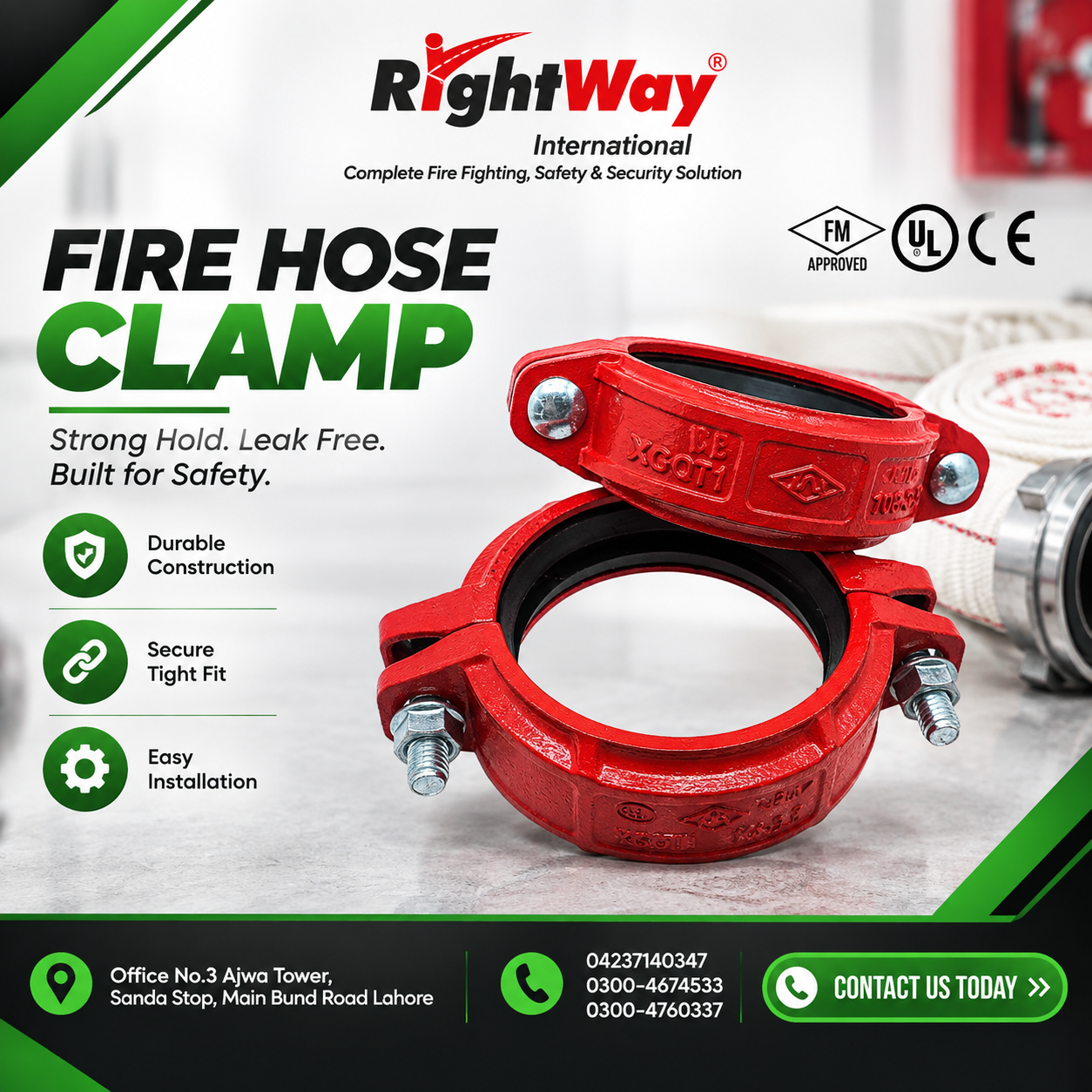
Fire Hose Clamps: Types Uses Benefits & Buying Guide play an important role in firefighting and emergency hose management. These tools help trained firefighters and emergency personnel control or temporarily restrict water flow through a fire hose. As a result, they can isolate a damaged section, replace equipment, or manage a hose during maintenance and emergency operations.
Fire hose clamps come in different sizes, designs, materials, and clamping ranges. Therefore, you should select a clamp according to the hose diameter, hose construction, operating pressure, application, and working conditions.
This guide explains fire hose clamp types, uses, benefits, sizes, materials, pressure considerations, maintenance, and buying factors. It also covers important information for buyers looking for fire hose clamps in Pakistan.
What Is a Fire Hose Clamp?
A fire hose clamp is a specialized firefighting tool that temporarily restricts or stops water flow through a fire hose. The clamp applies controlled pressure to the hose and compresses its walls. Consequently, it reduces or stops the flow through the clamped section.
Firefighters can use a hose clamp when they need to isolate part of a hose without shutting down the complete water supply. For example, trained personnel may use it while replacing a hose section, repositioning equipment, or carrying out emergency hose management.
However, the correct clamp size matters. A clamp that does not match the hose diameter can reduce performance or damage the hose. For this reason, always check the manufacturer’s specifications before use.
How Does a Fire Hose Clamp Work?
A fire hose clamp works by applying mechanical pressure to the hose.
First, the operator positions the clamp around the selected section of the hose. Next, the operator activates the adjustment mechanism or handle. The clamp then moves its jaws or pressure plates toward the hose.
As the pressure increases, the clamp compresses the hose. This action restricts the internal water passage and controls the water flow.
When the operator needs to restore the flow, they gradually release the clamp. Therefore, trained personnel should always handle a pressurized hose carefully because sudden pressure changes can create dangerous hose movement.
Types of Fire Hose Clamps
Manufacturers produce different fire hose clamp types for different firefighting applications. The most common options include the following:
1. Standard Fire Hose Clamp
A standard fire hose clamp provides basic temporary flow control for compatible fire hoses. It offers a practical solution for fire stations, emergency response teams, and routine hose management.
These clamps generally feature a strong body, pressure jaws, and a mechanical adjustment system.
2. Adjustable Fire Hose Clamp
An adjustable fire hose clamp allows the operator to accommodate different hose diameters within its specified clamping range.
Therefore, adjustable models can provide greater flexibility when a firefighting team works with multiple hose sizes. However, users should always stay within the manufacturer’s specified range.
3. Heavy-Duty Fire Hose Clamp
A heavy-duty fire hose clamp uses a robust construction for demanding firefighting and industrial applications.
Industrial facilities, factories, warehouses, and emergency response teams may require heavy-duty equipment for challenging working environments. In addition, these clamps often use strong metal components to provide durability during repeated use.
4. Large Diameter Fire Hose Clamp
Large-diameter hoses require clamps with an appropriate clamping range and mechanical capacity.
A large diameter fire hose clamp is designed for compatible larger hoses. Therefore, buyers should check the hose diameter, wall thickness, construction, and clamp specifications before selecting this type.
5. Double Fire Hose Clamp
A double fire hose clamp can provide flow control across suitable hose configurations. Its design may incorporate two clamping points or a configuration intended for specific firefighting applications.
The exact design varies by manufacturer, so users should follow the product’s operating instructions.
6. Portable Fire Hose Clamp
A portable fire hose clamp provides a compact solution for firefighting teams that need equipment they can transport easily.
Because emergency teams often carry several tools, a practical portable design can make equipment handling easier during field operations.
Where Are Fire Hose Clamps Used?
Fire hose clamps support temporary hose flow control in several environments.
Common applications include:
- Fire stations
- Industrial facilities
- Factories
- Warehouses
- Manufacturing plants
- Construction sites
- Power plants
- Oil and gas facilities
- Storage facilities
- Fire hydrant systems
- Municipal firefighting operations
- Emergency response teams
- Industrial firefighting systems
- Fire hose maintenance areas
For example, a trained team may use a hose clamp to isolate a section of hose while maintaining control of the remaining hose system. Similarly, maintenance personnel can use compatible equipment during hose servicing.
Main Components of a Fire Hose Clamp
Although designs differ between manufacturers, a fire hose clamp may include several important components.
Clamp Body
The clamp body provides the main structural support. Strong construction helps the tool withstand regular handling and mechanical loads.
Jaws or Pressure Plates
The jaws apply pressure to the hose. Their design should match the intended hose application and avoid unnecessary hose damage.
Handle
The handle allows the operator to control the clamping mechanism. A practical handle design can make operation easier, particularly when personnel wear protective gloves.
Adjustment Mechanism
The adjustment mechanism controls how much pressure the clamp applies to the hose.
Threaded Mechanism
Some designs use threaded components to move the jaws gradually. This system can provide controlled adjustment during operation.
Locking Components
Certain models include locking mechanisms that help maintain the selected position during use.
Pins and Bolts
Pins, bolts, and other mechanical components connect and secure the clamp assembly.
Benefits of Fire Hose Clamps
A properly selected fire hose clamp can provide several practical benefits.
Temporary Water Flow Control
The main purpose of a hose clamp involves temporary control of water flow through a compatible hose.
Hose Section Isolation
Firefighters can isolate a particular hose section when they need to manage equipment or address an issue.
Emergency Hose Management
During emergency operations, teams may need to control hoses quickly. A suitable clamp can support organized hose management.
Useful During Hose Replacement
A clamp can help trained personnel manage water flow while replacing or servicing a hose section, depending on the firefighting procedure.
Portable Design
Many models have compact designs. Therefore, teams can carry them with other firefighting tools.
Durable Construction
Metal construction can provide durability for demanding environments. However, the actual service life depends on the material, design, maintenance, and frequency of use.
Multiple Size Options
Manufacturers offer clamps for different hose diameters. Consequently, buyers can select equipment according to their specific hose system.
Fire Hose Clamp vs Hose Repair Clamp
A fire hose clamp and a hose repair clamp serve different purposes.
A fire hose clamp primarily controls or restricts water flow through a hose. In contrast, a hose repair clamp supports a repair application on a damaged hose or connection.
Therefore, you should not automatically use one as a replacement for the other.
If a hose has serious damage, follow the manufacturer’s instructions and the applicable firefighting procedures. A temporary flow-control clamp does not automatically make a damaged hose safe for continued service.
Fire Hose Clamp Sizes
Choosing the correct fire hose clamp size requires more than simply measuring the outside diameter.
Consider the following factors:
- Hose nominal diameter
- Actual hose dimensions
- Hose wall thickness
- Hose construction
- Clamping range
- Clamp jaw dimensions
- Application
- Operating pressure
- Manufacturer specifications
For example, a clamp designed for a smaller hose may not provide sufficient coverage on a larger hose. Conversely, using an unsuitable oversized clamp may prevent proper operation.
Therefore, always match the clamp with the hose manufacturer’s specifications and the clamp manufacturer’s approved range.
Fire Hose Clamp Materials
Manufacturers use different materials to produce fire hose clamps. The selected material affects strength, corrosion resistance, weight, durability, and service conditions.
Steel Fire Hose Clamp
Steel provides strong mechanical construction and can suit demanding applications.
Stainless Steel Fire Hose Clamp
Stainless steel offers improved corrosion resistance compared with many standard steel options. As a result, it can work well in environments where moisture or corrosion presents a concern.
Aluminum Fire Hose Clamp
Aluminum provides a lightweight alternative. Therefore, it can help reduce equipment weight while maintaining suitable mechanical performance for the intended application.
The correct material depends on the operating environment, expected use, maintenance requirements, and manufacturer specifications.
Fire Hose Clamp Pressure Considerations
Pressure plays an important role when selecting and operating a fire hose clamp.
A pressurized fire hose can generate significant forces. Therefore, users should never assume that a clamp can handle every hose pressure simply because it physically fits the hose.
Before use, check:
- Hose operating pressure
- Water pressure
- Hose diameter
- Hose construction
- Clamp design
- Clamp capacity
- Manufacturer specifications
- Intended application
- Operating procedure
Always use the clamp within its specified operating conditions. In addition, trained personnel should follow appropriate firefighting safety procedures.
How to Use a Fire Hose Clamp
Correct operation helps protect both the equipment and the operator.
Step 1: Inspect the Equipment
Before use, inspect the hose clamp for cracks, corrosion, damaged jaws, loose bolts, worn threads, bent components, or other defects.
Step 2: Inspect the Hose
Check the hose condition and confirm that the clamp matches the hose diameter and construction.
Step 3: Position the Clamp
Place the clamp around the appropriate section of the hose according to the manufacturer’s instructions.
Step 4: Adjust the Clamp
Operate the handle or adjustment mechanism gradually. Apply only the required pressure for the intended application.
Step 5: Monitor the Hose
Observe the hose while applying the clamp. Watch for unusual movement, deformation, leakage, or other signs of a problem.
Step 6: Release Carefully
When you need to restore water flow, release the clamp gradually and carefully. Sudden release can cause rapid water movement or hose movement.
Only trained personnel should operate firefighting equipment on pressurized systems.
Fire Hose Clamp Maintenance and Inspection
Regular inspection helps keep a fire hose clamp ready for emergency use.
Check the following components regularly:
- Clamp body
- Jaws
- Pressure plates
- Handles
- Threads
- Bolts
- Pins
- Locking mechanisms
- Adjustment components
- Corrosion
- Mechanical wear
- Deformation
Clean the clamp after use and keep it in a suitable storage location. Furthermore, lubricate mechanical parts only when the manufacturer recommends lubrication.
If you find serious damage, remove the clamp from service until a qualified person evaluates it.
How to Choose the Right Fire Hose Clamp
Choosing the right clamp requires careful consideration of the application.
1. Check the Hose Diameter
First, identify the exact hose diameter. Then compare it with the clamp’s approved clamping range.
2. Consider Hose Construction
Different hoses have different constructions and wall thicknesses. Therefore, select a clamp that suits the intended hose type.
3. Check Clamp Capacity
Review the manufacturer’s specifications for mechanical capacity and operating conditions.
4. Select the Right Material
Choose steel, stainless steel, aluminum, or another approved material according to the environment and application.
5. Consider Portability
If firefighters need to carry the clamp frequently, a compact and lightweight design may provide practical advantages.
6. Check Handle Design
A suitable handle can make operation easier, especially when personnel use protective gloves.
7. Consider Durability
For industrial and emergency applications, select a product with construction suitable for frequent handling and demanding conditions.
8. Review Manufacturer Specifications
Finally, always review the technical specifications before purchasing or using a fire hose clamp.
Fire Hose Clamps in Pakistan
Fire hose clamps are useful accessories for fire protection teams, industrial facilities, factories, warehouses, construction projects, and firefighting departments in Pakistan.
When purchasing a fire hose clamp in Pakistan, buyers should consider more than the price. Instead, compare the hose diameter, clamp type, material, clamping range, construction quality, application, and technical specifications.
Local environmental conditions can also affect equipment selection. For example, areas with high moisture exposure may require materials with better corrosion resistance.
Businesses looking for fire hose clamps in Pakistan should also consider product availability, technical support, replacement components, and supplier reliability.
Common Fire Hose Clamp Selection Mistakes
Buyers and users should avoid several common mistakes.
Choosing the Wrong Size
A clamp must match the intended hose diameter and approved clamping range.
Ignoring Hose Construction
Hose wall thickness and construction can affect clamp compatibility.
Using an Incompatible Clamp
Do not assume that every clamp works with every firefighting hose.
Applying Excessive Force
Excessive clamping force can damage the hose. Therefore, follow the manufacturer’s operating procedure.
Ignoring Operating Conditions
Always consider water pressure, hose construction, temperature, environment, and application.
Using Damaged Equipment
Inspect the clamp before every important use. Replace or remove damaged equipment from service.
Ignoring Corrosion
Corrosion can affect mechanical components and overall equipment condition. Therefore, inspect metal surfaces regularly.
Treating a Clamp as a Permanent Repair
A flow-control clamp does not automatically repair a damaged fire hose. Use the correct repair or replacement procedure for damaged equipment.
Skipping Maintenance
Regular cleaning, inspection, and proper storage help maintain equipment readiness.
Frequently Asked Questions About Fire Hose Clamps
What is a fire hose clamp?
A fire hose clamp is a firefighting tool that temporarily restricts or controls water flow through a compatible fire hose.
What are fire hose clamps used for?
Fire hose clamps help trained personnel manage water flow, isolate a hose section, and support certain emergency or maintenance procedures.
What sizes are available?
Fire hose clamps come in different sizes and clamping ranges. The correct size depends on the hose diameter, construction, and manufacturer specifications.
Can a fire hose clamp completely stop water flow?
A suitable clamp can restrict or stop flow when used correctly on a compatible hose. However, performance depends on the clamp design, hose construction, pressure, and operating conditions.
What materials are used for fire hose clamps?
Common materials include steel, stainless steel, and aluminum. Each material offers different characteristics related to strength, weight, and corrosion resistance.
Are fire hose clamps reusable?
Many fire hose clamps are designed for repeated use. However, users should inspect the equipment after each use and remove damaged components from service.
Can a fire hose clamp repair a damaged hose?
No. A fire hose clamp primarily controls water flow. It should not automatically serve as a permanent repair for a damaged firefighting hose.
How do I choose a fire hose clamp?
Start with the hose diameter and construction. Then check the clamping range, material, pressure conditions, application, durability, and manufacturer specifications.
Where can I buy fire hose clamps in Pakistan?
Buyers can source fire hose clamps from fire protection equipment suppliers and firefighting equipment manufacturers in Pakistan. Always verify product specifications and compatibility before purchasing.
How should I maintain a fire hose clamp?
Inspect the body, jaws, handles, threads, bolts, pins, locking mechanism, and adjustment components regularly. Keep the clamp clean and dry, and follow the manufacturer’s maintenance instructions.
A fire hose clamp provides a practical method for temporary water flow control during suitable firefighting, emergency, and maintenance operations. Because different hoses require different clamp designs, users should select equipment according to hose diameter, construction, clamping range, material, pressure conditions, and intended application.
For businesses purchasing fire hose clamps in Pakistan, technical specifications should remain a key part of the buying process. In addition, proper inspection, maintenance, storage, and trained operation can help keep firefighting equipment ready when it matters.
Always follow the manufacturer’s instructions and applicable firefighting procedures when selecting and operating a fire hose clamp.