




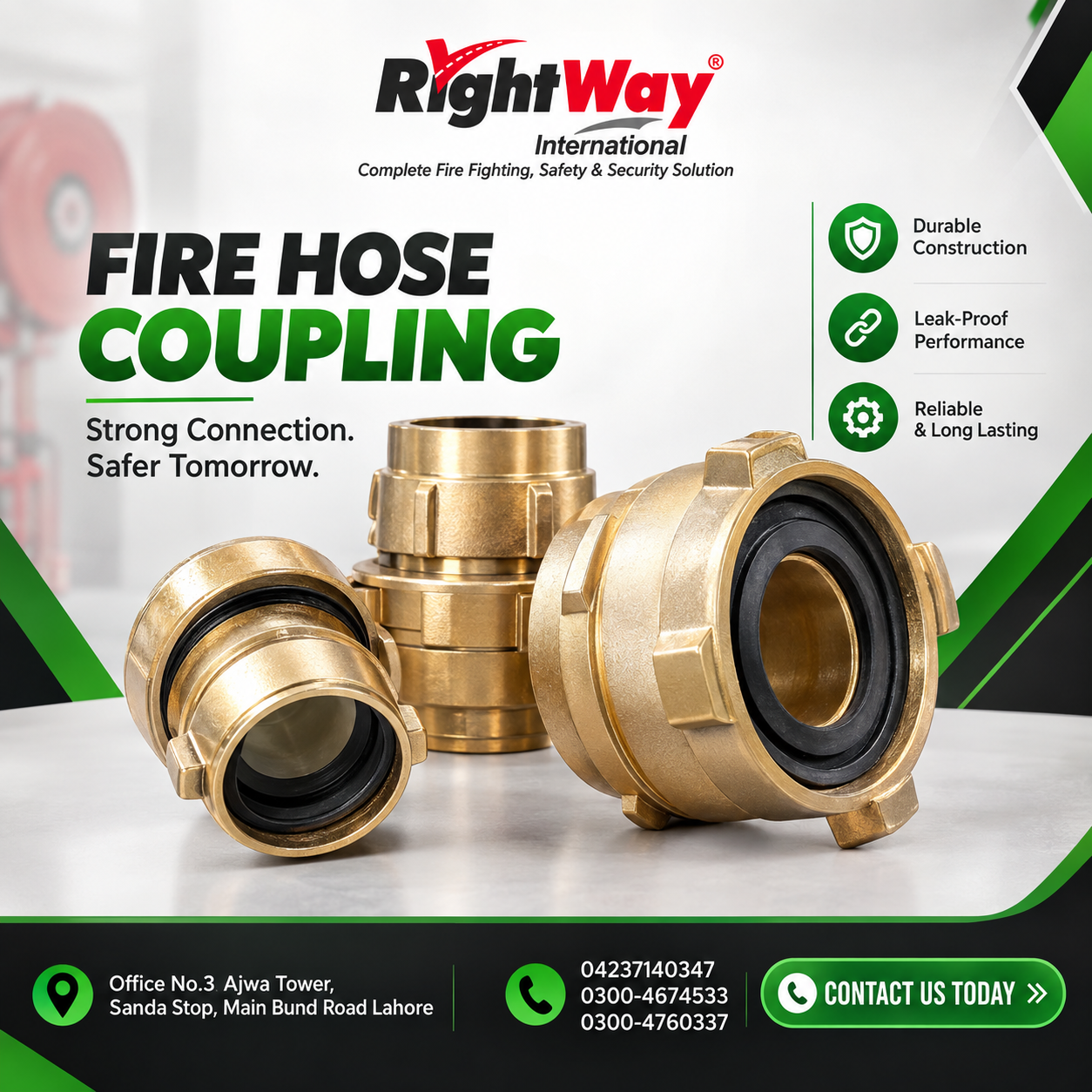
Fire Hose Coupling: Types Uses Benefits & Buying Guide explains one of the most important connection components used in firefighting systems. A fire hose coupling connects a fire hose to equipment such as fire hydrants, fire hose nozzles, fire pumps, hose reels, standpipes, valves, and other firefighting equipment.
A properly selected Fire Hose Coupling helps create a secure connection between the hose and connected equipment. It also supports reliable water flow during firefighting operations when the coupling, hose, and connected equipment have compatible specifications.
Fire hose couplings are available in different materials, sizes, connection types, thread configurations, and pressure ratings. Therefore, selecting the correct coupling requires careful consideration of hose diameter, connection type, operating pressure, material, applicable standards, and the requirements of the complete fire protection system.
What Is a Fire Hose Coupling?
A Fire Hose Coupling is a mechanical fitting used to connect a fire hose to another hose, nozzle, hydrant, valve, pump, standpipe, or firefighting equipment.
The coupling attaches securely to the end of a fire hose and provides a connection that allows water to pass from the water supply into the hose or from the hose into another piece of firefighting equipment.
Depending on the design, fire hose couplings may use threaded connections, quick-connect mechanisms, or other connection configurations.
Fire hose couplings are available in various sizes and materials to meet different firefighting applications.
A coupling must match the hose and connected equipment in terms of size, connection type, pressure rating, and applicable specifications.
How Does a Fire Hose Coupling Work?
A Fire Hose Coupling creates a connection between a fire hose and another component of a firefighting system.
First, the coupling is attached to the end of the fire hose. The operator then connects the coupling to a compatible nozzle, hydrant, valve, pump, hose, or other equipment.
Once the connection is properly secured, water can pass through the coupling and into the connected hose or equipment.
The coupling must provide a secure connection during operation. Its performance depends on factors such as connection design, sealing components, operating pressure, hose condition, and compatibility between the connected components.
Some coupling designs allow operators to connect and disconnect hoses quickly, which can be useful during emergency firefighting operations.
Types of Fire Hose Couplings
Fire hose couplings are available in different designs for different firefighting applications.
1. Threaded Fire Hose Coupling
A Threaded Fire Hose Coupling uses internal or external threads to connect the fire hose with compatible firefighting equipment.
Threaded couplings are available in different thread standards and sizes.
Before selecting a threaded coupling, verify the thread type, diameter, connection configuration, pressure rating, and compatibility with the connected equipment.
2. Quick Connect Fire Hose Coupling
A Quick Connect Fire Hose Coupling allows operators to connect or disconnect compatible firefighting components more quickly than some conventional threaded connections.
Quick-connect designs can be useful where rapid hose connection is required.
However, the coupling must be specifically designed to work with the corresponding connection system.
3. Storz Fire Hose Coupling
A Storz Fire Hose Coupling uses a non-threaded symmetrical connection system.
Storz couplings are commonly used in various firefighting and industrial applications because compatible couplings can be connected without requiring traditional male and female threads.
The appropriate Storz coupling size depends on the hose diameter, connection requirements, and system specifications.
4. Instantaneous Fire Hose Coupling
An Instantaneous Fire Hose Coupling is designed for rapid connection and disconnection of compatible fire hoses and firefighting equipment.
These couplings are commonly associated with firefighting applications where quick hose deployment is important.
Users should confirm that the coupling configuration matches the required hose and equipment connections.
5. Male Fire Hose Coupling
A Male Fire Hose Coupling has an external connection configuration designed to connect with a compatible female connection.
The exact design varies according to the applicable coupling standard and manufacturer.
6. Female Fire Hose Coupling
A Female Fire Hose Coupling has an internal connection configuration designed to connect with a compatible male connection.
The coupling must have the correct size and thread or connection standard to ensure proper compatibility.
7. Fire Hose Adapter Coupling
A Fire Hose Adapter Coupling allows users to connect components with different connection configurations.
Adapters can be useful when existing firefighting equipment uses different connection sizes or standards.
The adapter must be suitable for the required pressure and application.
8. Fire Hose Reducer Coupling
A Fire Hose Reducer Coupling allows connection between components with different connection sizes.
For example, a reducer may connect a larger hose connection to a smaller compatible connection.
The reducer must be selected according to the required flow, pressure, connection type, and system specifications.
9. Double Male Fire Hose Adapter
A Double Male Fire Hose Adapter provides male connections on both ends.
It can connect two compatible female connections where the system configuration requires this type of adapter.
10. Double Female Fire Hose Adapter
A Double Female Fire Hose Adapter provides female connections on both ends.
It can connect two compatible male connections in suitable firefighting applications.
Where Are Fire Hose Couplings Used?
Fire Hose Couplings are used in many firefighting and fire protection applications, including:
- Commercial buildings
- Industrial facilities
- Factories
- Warehouses
- Hospitals
- Hotels
- Shopping centers
- Schools
- High-rise buildings
- Residential buildings
- Parking structures
- Manufacturing plants
- Fire stations
- Construction sites
- Oil and gas facilities
- Power plants
- Storage facilities
- Fire hydrant systems
- Standpipe systems
- Fire hose reel systems
- Fire pump systems
The required coupling type depends on the firefighting equipment, hose size, water supply, connection standard, operating pressure, and system configuration.
Main Components of a Fire Hose Coupling
A typical Fire Hose Coupling may include:
- Coupling body
- Male or female connection
- Threads or connection mechanism
- Hose attachment section
- Sealing gasket
- Locking mechanism
- Coupling teeth or gripping components
- Protective components
- Retaining components
The exact construction depends on the coupling type and manufacturer.
The coupling body provides the main structural connection, while sealing components help reduce the risk of leakage at the connection point.
Benefits of Fire Hose Couplings
Fire hose couplings provide several important benefits in firefighting systems.
1. Secure Hose Connection
A properly selected coupling provides a secure connection between the fire hose and compatible firefighting equipment.
2. Reliable Water Transfer
A correctly installed coupling allows water to pass between connected components while maintaining the required connection.
3. Easy Hose Connection
Depending on the design, some couplings allow operators to connect and disconnect fire hoses quickly.
4. Wide Range of Applications
Fire hose couplings can be used with hydrants, nozzles, pumps, hose reels, standpipes, valves, and other firefighting equipment.
5. Different Connection Options
Manufacturers offer threaded, quick-connect, Storz, instantaneous, and other coupling configurations.
6. Different Material Options
Fire hose couplings are available in materials such as aluminum, brass, stainless steel, and other suitable materials.
7. Compatibility With Different Hose Sizes
Different coupling sizes allow suitable connections with different fire hose diameters.
8. Support for Emergency Operations
A properly maintained coupling can help trained personnel establish reliable hose connections during firefighting operations.
Fire Hose Coupling vs Fire Hose Connector
Although the terms Fire Hose Coupling and Fire Hose Connector are sometimes used interchangeably, they can refer to different types of connection components depending on the manufacturer and application.
A fire hose coupling generally refers to the fitting attached to a hose end that allows the hose to connect to another hose or firefighting component.
The term connector can have a broader meaning and may refer to various components used to establish a connection between firefighting equipment.
Always check the manufacturer’s technical specifications to understand the exact connection type and intended application.
Fire Hose Coupling Sizes
Fire Hose Couplings are available in different sizes.
The appropriate coupling size depends on:
- Fire hose diameter
- Connection size
- Thread size
- Coupling standard
- Required flow rate
- Operating pressure
- Connected equipment
- Hose construction
- Fire protection system requirements
Do not select a coupling based only on its physical dimensions.
Instead, verify the hose diameter, connection configuration, pressure rating, and applicable standard before purchasing.
Fire Hose Coupling Pressure Rating
The Fire Hose Coupling pressure rating indicates the pressure range for which the coupling is designed.
Before purchasing, check:
- Working pressure
- Test pressure
- Maximum pressure
- Hose pressure rating
- Connection specifications
- Manufacturer’s technical data
- Applicable standards
The coupling must be suitable for the operating pressure of the connected fire hose and water supply.
Never use a coupling beyond the manufacturer’s specified pressure rating.
Fire Hose Coupling Flow Rate
The Fire Hose Coupling flow rate depends on the coupling design, internal diameter, hose size, connection configuration, pressure, and complete system design.
Important factors include:
- Coupling size
- Internal diameter
- Hose diameter
- Operating pressure
- Water supply
- Connection design
- Hose length
- Nozzle requirements
- Fire protection system configuration
A coupling should not unnecessarily restrict the required water flow.
When designing or modifying a firefighting system, review the complete hydraulic requirements rather than considering the coupling independently.
Fire Hose Coupling Materials
Manufacturers use different materials to produce fire hose couplings.
Common materials include:
- Aluminum
- Brass
- Stainless steel
- Ductile iron
- Reinforced metal
- Other engineered materials
Aluminum Fire Hose Coupling
Aluminum provides a lightweight option and can be useful where equipment weight is an important consideration.
Brass Fire Hose Coupling
Brass provides durability and corrosion resistance and is widely used in various firefighting equipment applications.
Stainless Steel Fire Hose Coupling
Stainless steel provides strong corrosion resistance and can be suitable for demanding environments where durability and corrosion resistance are important.
The appropriate material depends on the operating environment, corrosion exposure, weight requirements, durability, temperature, and application.
Fire Hose Coupling Connection Types
A Fire Hose Coupling must connect securely to the compatible hose or firefighting equipment.
Before purchasing, check:
- Connection size
- Thread type
- Thread standard
- Coupling type
- Hose diameter
- Connection standard
- Pressure rating
- Material
- Sealing arrangement
The hose and coupling must be compatible.
An incorrect connection can prevent proper installation, cause leakage, or affect the performance of the firefighting system.
Fire Hose Coupling Installation
Correct installation helps create a secure and reliable hose connection.
Before installation, inspect:
- Fire hose
- Coupling
- Threads
- Gasket
- Sealing components
- Locking mechanism
- Coupling body
- Hose attachment area
- Connection surfaces
First, inspect the hose and coupling for visible damage.
Next, ensure that the coupling and hose connection are clean and compatible.
Connect the coupling to the appropriate firefighting equipment according to the manufacturer’s instructions.
Secure the connection without damaging the threads, gasket, or coupling components.
Finally, test the connection according to the applicable system procedures.
Fixed firefighting systems should be installed, commissioned, and tested by qualified fire protection professionals.
Fire Hose Coupling Maintenance and Inspection
Regular inspection helps keep a Fire Hose Coupling ready for emergency use.
Inspect the coupling for:
- Cracks
- Corrosion
- Physical damage
- Damaged threads
- Worn connection surfaces
- Damaged gaskets
- Water leaks
- Loose components
- Deformation
- Blockages
- Damaged locking mechanisms
- Incorrect connections
Keep the coupling clean and free from dirt, debris, and contaminants.
Check the gasket and sealing components regularly.
Also inspect the hose attachment area for signs of damage or separation.
If the coupling shows serious damage or does not provide a secure connection, remove it from service and follow the manufacturer’s repair or replacement instructions.
How to Choose a Fire Hose Coupling
Before purchasing a Fire Hose Coupling, consider the following factors.
1. Coupling Type
Determine whether you require a threaded, Storz, quick-connect, instantaneous, adapter, reducer, male, female, or another coupling type.
2. Hose Size
Check the diameter and construction of the fire hose.
The coupling must be suitable for the hose size and hose-end configuration.
3. Connection Type
Verify the connection type, thread configuration, coupling standard, and connected equipment.
4. Pressure Rating
Check the working and test pressure of the coupling.
Make sure it is suitable for the operating pressure of the complete firefighting system.
5. Material
Select a material suitable for the operating environment.
Consider corrosion, durability, weight, temperature, and frequency of use.
6. Flow Requirements
Consider the required water flow through the hose and coupling.
The coupling should support the required system flow without creating an unsuitable restriction.
7. Gasket and Sealing
Check the gasket and sealing arrangement.
A suitable seal helps reduce leakage at the connection.
8. Compatibility
Ensure that the coupling matches the fire hose, nozzle, hydrant, valve, pump, standpipe, or other connected equipment.
9. Product Quality
Choose a reliable manufacturer or fire safety equipment supplier.
Review product specifications, technical documentation, manufacturing quality, and applicable approvals or certifications.
10. Compliance
Check the applicable fire protection standards, project specifications, and system requirements before purchasing.
Fire Hose Coupling in Pakistan
Fire Hose Couplings in Pakistan are used in firefighting systems for commercial buildings, factories, warehouses, hospitals, hotels, industrial facilities, and other properties.
When purchasing a Fire Hose Coupling in Pakistan, consider:
- Coupling type
- Material
- Hose size
- Connection type
- Thread standard
- Working pressure
- Test pressure
- Flow requirements
- Gasket type
- Hose compatibility
- Product specifications
- Applicable standards
A reliable fire safety equipment supplier can help buyers select a fire hose coupling that matches their firefighting system.
Before placing an order, request complete product specifications and confirm compatibility with the existing fire hose, fire hydrant, fire pump, hose reel, nozzle, valve, or standpipe system.
Common Fire Hose Coupling Mistakes to Avoid
Avoid these common mistakes when selecting or using a Fire Hose Coupling:
- Choosing the wrong coupling size
- Ignoring the hose diameter
- Using incompatible thread types
- Ignoring pressure requirements
- Using incompatible connection standards
- Selecting the wrong coupling material
- Ignoring gasket condition
- Using damaged couplings
- Operating beyond the pressure rating
- Ignoring corrosion
- Failing to inspect threads
- Using damaged hose ends
- Installing the coupling incorrectly
- Ignoring water leakage
- Failing to inspect locking mechanisms
- Skipping required testing and maintenance
Always select the coupling according to the complete fire protection system rather than choosing it based only on appearance or price.
FAQs
What is a Fire Hose Coupling?
A Fire Hose Coupling is a fitting used to connect a fire hose to another hose, nozzle, hydrant, valve, pump, standpipe, or other firefighting equipment.
What are the benefits of a Fire Hose Coupling?
A fire hose coupling provides a secure connection between compatible firefighting components. Depending on the design, it can also support quick hose connections and reliable water transfer.
What types of Fire Hose Couplings are available?
Common types include threaded fire hose couplings, Storz couplings, instantaneous couplings, quick-connect couplings, male couplings, female couplings, adapters, and reducer couplings.
Can a Fire Hose Coupling be connected to a fire hose?
Yes. A fire hose coupling can be attached to a compatible fire hose when the hose size, coupling configuration, pressure rating, and connection requirements are suitable.
What is a Storz Fire Hose Coupling?
A Storz Fire Hose Coupling is a non-threaded, symmetrical coupling system designed to connect compatible hoses and firefighting equipment.
What material is best for a Fire Hose Coupling?
Aluminum, brass, and stainless steel can all be suitable depending on the application. Consider corrosion resistance, durability, weight, operating environment, and manufacturer specifications.
How do I choose the right Fire Hose Coupling?
Consider hose diameter, coupling type, connection standard, thread type, pressure rating, material, flow requirements, gasket type, and compatibility with the complete fire protection system.
What size Fire Hose Coupling do I need?
The required size depends on the fire hose diameter and the connection requirements of the equipment. Always verify the coupling and hose specifications before purchasing.
Can Fire Hose Couplings be used with fire hydrants?
Yes. Compatible fire hose couplings can connect fire hoses to fire hydrants and other firefighting equipment. The connection type, size, pressure rating, and applicable standard must match.
How should I maintain a Fire Hose Coupling?
Inspect the coupling regularly for corrosion, cracks, damaged threads, worn components, leaks, gasket damage, and other signs of deterioration. Keep the coupling clean and follow the manufacturer’s inspection and maintenance instructions.
Where can I buy a Fire Hose Coupling in Pakistan?
Fire hose couplings are available through fire safety equipment manufacturers and suppliers in Pakistan. Before purchasing, verify the coupling type, hose size, material, pressure rating, connection standard, and compatibility with your firefighting system.
A Fire Hose Coupling is an essential connection component that helps connect fire hoses with nozzles, hydrants, valves, pumps, standpipes, and other firefighting equipment. The correct coupling can provide a secure connection and support reliable water transfer during firefighting operations.
When selecting a fire hose coupling, consider the coupling type, hose diameter, connection configuration, thread standard, pressure rating, material, gasket, flow requirements, and compatibility with the complete fire protection system.
For buyers searching for a Fire Hose Coupling in Pakistan, technical specifications should take priority over appearance alone. The coupling should match the fire hose and connected firefighting equipment and should meet the applicable project and fire protection requirements.
Regular inspection, maintenance, and testing can help keep the coupling ready for emergency use. Always follow applicable fire safety requirements and use qualified professionals for fire protection system design, installation, inspection, and testing.