




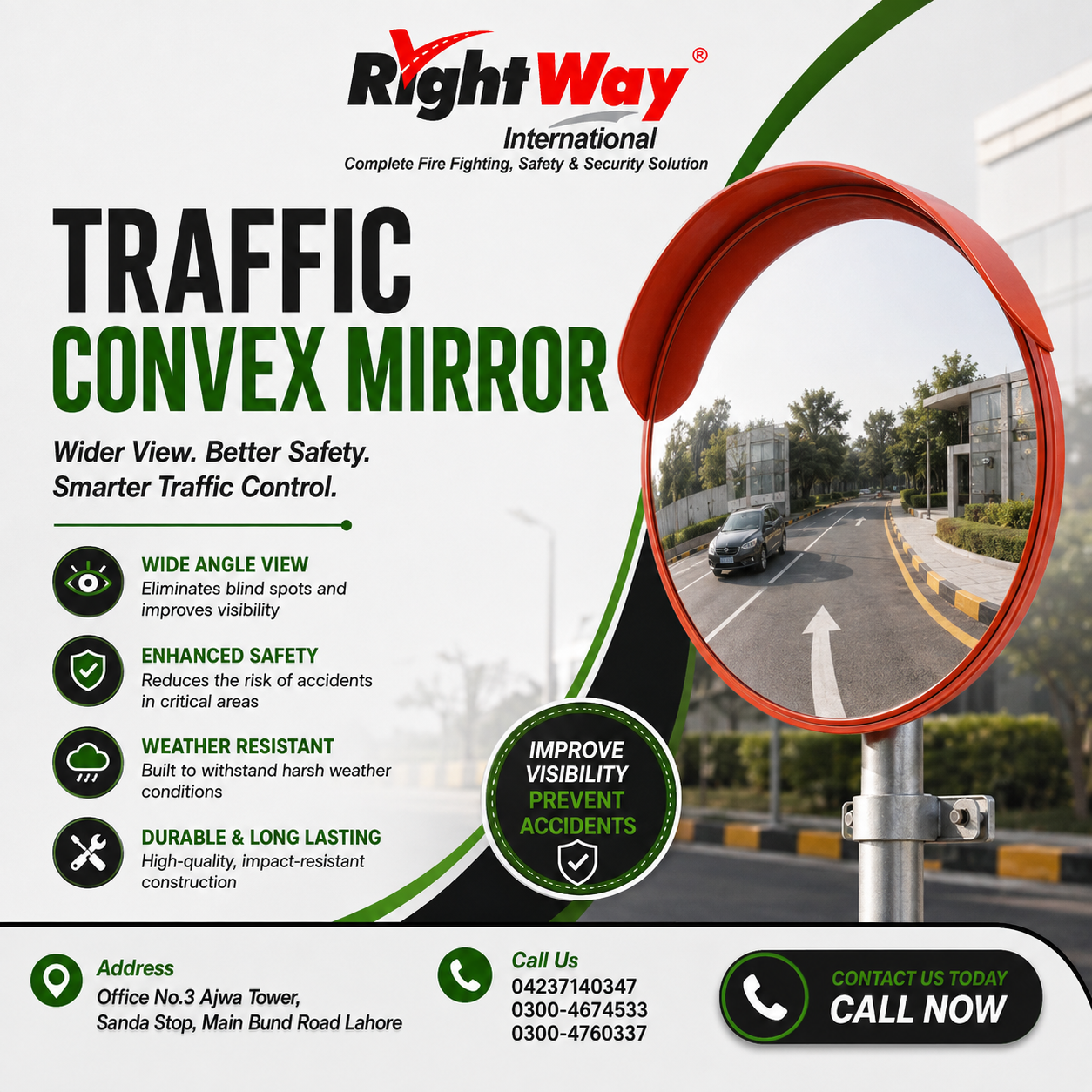
Traffic Convex Mirrors are important road-safety devices that help drivers see vehicles, pedestrians, and other hazards around blind corners and obstructed areas. Their curved reflective surface provides a wider field of view than a standard flat mirror.
Moreover, convex traffic mirrors work well at road intersections, sharp bends, parking areas, driveways, factories, warehouses, shopping malls, and other locations where limited visibility can increase accident risks.
What Is a Traffic Convex Mirror?
A Traffic Convex Mirror is a curved safety mirror designed to improve visibility in areas with restricted sightlines. Its outward-curved surface allows users to see a wider area than they could see directly.
Drivers can use these mirrors to check approaching vehicles, pedestrians, cyclists, and other potential hazards before entering or crossing a blind area.
Common names include:
- Traffic convex mirror
- Road safety mirror
- Convex traffic mirror
- Road safety convex mirror
- Blind spot mirror
- Traffic safety mirror
- Outdoor convex mirror
- Road intersection mirror
- Driveway safety mirror
- Parking safety mirror
Why Are Traffic Convex Mirrors Important?
Blind corners and restricted views can create serious safety challenges. A properly positioned road safety mirror gives drivers an additional visual reference before they move into an area with limited visibility.
Traffic convex mirrors can help:
- Improve visibility at blind corners
- Reduce blind spots
- Help drivers see approaching vehicles
- Improve visibility at intersections
- Support safer parking areas
- Increase pedestrian awareness
- Improve visibility around sharp bends
- Support safer traffic movement
Therefore, convex mirrors can become a useful part of a broader road-safety system.
How Does a Traffic Convex Mirror Work?
A convex mirror uses an outward-curved reflective surface.
First, a driver approaches an area with restricted visibility. Next, the driver looks toward the installed mirror. The curved surface then reflects a wider section of the surrounding area.
As a result, the driver can see approaching traffic or other hazards that may remain outside the direct line of sight.
However, the curved surface makes reflected objects appear smaller and farther away than they actually are. Drivers should therefore use the mirror as an additional visual aid rather than relying on it alone.
Types of Traffic Convex Mirrors
1. Acrylic Convex Mirrors
Acrylic convex mirrors offer lightweight construction and good outdoor visibility. They can suit parking areas, driveways, commercial properties, and selected road-safety applications.
2. Polycarbonate Convex Mirrors
Polycarbonate traffic mirrors provide strong impact resistance. Consequently, they can work well in demanding environments where accidental impacts may occur.
3. Stainless Steel Convex Mirrors
Stainless steel safety mirrors offer strong durability and resistance to outdoor exposure. They can suit industrial locations and other demanding environments.
4. Outdoor Convex Mirrors
Outdoor traffic mirrors use weather-resistant materials to handle exposure to rain, sunlight, dust, and temperature changes.
5. Indoor Convex Mirrors
Indoor convex mirrors can improve visibility inside warehouses, factories, garages, stores, and other facilities with blind corners.
6. Heavy-Duty Traffic Mirrors
Heavy-duty convex mirrors provide additional durability for industrial sites, warehouses, factories, loading areas, and busy vehicle routes.
Where Are Traffic Convex Mirrors Used?
Traffic safety mirrors can support visibility in many locations, including:
- Road intersections
- Blind corners
- Sharp bends
- Narrow roads
- Parking lots
- Parking garages
- Driveways
- Factory entrances
- Warehouse aisles
- Industrial facilities
- Shopping malls
- Hospitals
- Schools
- Residential areas
- Loading areas
- Construction sites
In addition, facility managers can install convex mirrors near gates, ramps, exits, and other areas with restricted visibility.
Traffic Convex Mirrors for Road Intersections
Intersections can create blind spots when buildings, walls, trees, barriers, or road geometry block a driver’s view.
A properly positioned road intersection convex mirror can provide a wider view of approaching traffic. Consequently, drivers can better assess the road before entering an intersection.
However, authorities should carefully select the mirror location and orientation to provide useful visibility without creating additional confusion.
Traffic Convex Mirrors for Parking Areas
Parking areas often contain moving vehicles, pedestrians, columns, walls, and narrow driving lanes.
Therefore, parking convex mirrors can help drivers see around corners, ramps, exits, and obstructed sections.
They can support:
- Parking-area visibility
- Vehicle movement
- Pedestrian awareness
- Blind-corner visibility
- Safer garage exits
Traffic Convex Mirrors for Industrial Areas
Factories and warehouses often have forklifts, trucks, delivery vehicles, and pedestrians moving through shared spaces.
Industrial convex mirrors can improve visibility around warehouse corners, production areas, loading zones, gates, and internal vehicle routes.
As a result, facility operators can create clearer sightlines in areas where direct visibility remains limited.
Important Features of High-Quality Traffic Convex Mirrors
When choosing a traffic safety convex mirror, consider:
- Wide viewing angle
- Clear reflection
- Durable mirror surface
- Impact resistance
- Weather resistance
- UV resistance
- Strong frame
- Secure mounting bracket
- Corrosion resistance
- Suitable mirror diameter
- Easy installation
- Long service life
Furthermore, choose the mirror according to the viewing distance, traffic environment, installation height, and required field of view.
How to Choose the Right Traffic Convex Mirror
1. Identify the Location
First, determine whether you need the mirror for a road intersection, parking area, driveway, warehouse, factory, or another blind spot.
2. Check the Viewing Distance
Next, consider the distance between the mirror and the approaching driver or pedestrian.
3. Select the Correct Size
Larger mirrors can provide a wider and more useful viewing area from greater distances. Therefore, choose the diameter according to the application.
4. Select the Material
Compare acrylic, polycarbonate, stainless steel, and other available materials according to durability and environmental requirements.
5. Consider Outdoor Exposure
For outdoor locations, choose a mirror with suitable resistance to rain, sunlight, dust, humidity, and temperature changes.
6. Check the Mounting System
A strong and adjustable bracket allows installers to position the mirror toward the required viewing area.
Traffic Convex Mirror Installation
Correct positioning plays an important role in mirror performance.
- Identify the Blind Spot: Find the exact location where visibility remains restricted.
- Select the Mounting Point: Choose a safe position with a clear view.
- Set the Height: Install the mirror at a suitable height for the intended users.
- Adjust the Angle: Point the mirror toward the approaching traffic area.
- Secure the Bracket: Tighten all mounting hardware.
- Test the View: Check the reflection from the driver’s or pedestrian’s normal approach position.
Finally, make adjustments if the mirror does not provide sufficient visibility.
Maintenance of Traffic Convex Mirrors
Regular maintenance keeps the mirror clear and useful.
Inspect the mirror for:
- Dust
- Mud
- Scratches
- Cracks
- Frame damage
- Loose brackets
- Corrosion
- Poor alignment
- Reduced visibility
Clean the reflective surface regularly with suitable cleaning materials. In addition, check mounting hardware and adjust the mirror whenever its position changes.
Benefits of Traffic Convex Mirrors
Traffic Convex Mirrors offer several practical benefits:
- Improve visibility around blind spots
- Provide a wider field of view
- Support safer intersections
- Help drivers check approaching traffic
- Improve parking-area visibility
- Support pedestrian awareness
- Work without electrical power
- Offer simple installation
- Require relatively low maintenance
- Suit indoor and outdoor applications
Consequently, convex mirrors provide a practical solution for locations where physical sightlines remain limited.
Traffic Convex Mirror vs Flat Mirror
A flat mirror provides a more natural image but covers a narrower viewing area. In contrast, a convex mirror provides a much wider field of view but makes reflected objects appear smaller.
Therefore, convex mirrors generally suit blind corners and traffic-safety applications, while flat mirrors work better where accurate image size and detail matter.
Traffic Convex Mirror vs Traffic Signs
Traffic signs communicate warnings, instructions, or information. Meanwhile, convex mirrors provide visual assistance by showing areas outside the user’s direct line of sight.
For this reason, traffic mirrors should complement appropriate road signs, road markings, barriers, traffic cones, delineator posts, and other safety devices rather than replace them.
Traffic Convex Mirrors in Pakistan
Traffic Convex Mirrors in Pakistan can support safer movement at road intersections, parking areas, factories, warehouses, commercial buildings, residential driveways, hospitals, schools, and industrial facilities.
When buying a traffic convex mirror in Pakistan, consider mirror size, viewing angle, material, weather resistance, UV protection, impact resistance, frame quality, mounting hardware, installation location, and expected service life.
Moreover, choose the mirror according to the specific visibility problem rather than selecting a size based only on price.
Best Practices for Traffic Convex Mirrors
For effective use:
- Identify the actual blind spot first
- Select an appropriate mirror size
- Choose durable materials
- Use weather-resistant models outdoors
- Install the mirror at a suitable height
- Adjust the viewing angle correctly
- Keep the reflective surface clean
- Inspect mounting brackets regularly
- Replace cracked or damaged mirrors
- Combine mirrors with other safety measures
- Follow local road-safety requirements
Frequently Asked Questions
What is a traffic convex mirror?
A traffic convex mirror is a curved safety mirror that provides a wider field of view around blind corners, intersections, driveways, parking areas, and other restricted-visibility locations.
What are traffic convex mirrors used for?
They help drivers and pedestrians see approaching vehicles, pedestrians, cyclists, and other hazards that may remain outside their direct line of sight.
Are convex mirrors suitable for outdoor use?
Yes. Outdoor models can handle weather exposure when manufacturers use suitable weather-resistant materials and protective frames.
What materials are used for traffic mirrors?
Common materials include acrylic, polycarbonate, stainless steel, and other durable reflective materials.
Where should I install a traffic convex mirror?
Common locations include blind road intersections, sharp corners, parking exits, driveways, warehouse aisles, factory routes, and industrial vehicle areas.
Are larger convex mirrors better?
Not always. The correct size depends on viewing distance, installation location, traffic conditions, and the required field of view.
Do convex mirrors require electricity?
No. Traditional convex mirrors work through reflected light and do not require electrical power.
How do I maintain a traffic convex mirror?
Keep the reflective surface clean, inspect it for cracks and scratches, check the mounting bracket, and maintain the correct viewing angle.
Traffic Convex Mirrors provide a simple and effective way to improve visibility around blind spots, corners, intersections, parking areas, driveways, warehouses, and industrial facilities.
By selecting the correct mirror size, material, viewing angle, and mounting position, businesses, contractors, property owners, and road-management teams can improve visibility and support safer movement in areas with restricted sightlines.
Road Safety Wheel Stoppers
Why Are Wheel Stoppers Important?
A well-planned parking area needs clear vehicle-positioning points. Wheel stoppers provide that control while also helping protect surrounding property.
For example, they can help:
- Prevent vehicle over-parking
- Protect walls and structures
- Maintain organized parking spaces
- Reduce accidental impacts
- Protect pedestrian walkways
- Improve driver awareness
- Create consistent stopping points
- Support safer parking management
Furthermore, reflective models improve visibility in dark or poorly lit parking areas.