




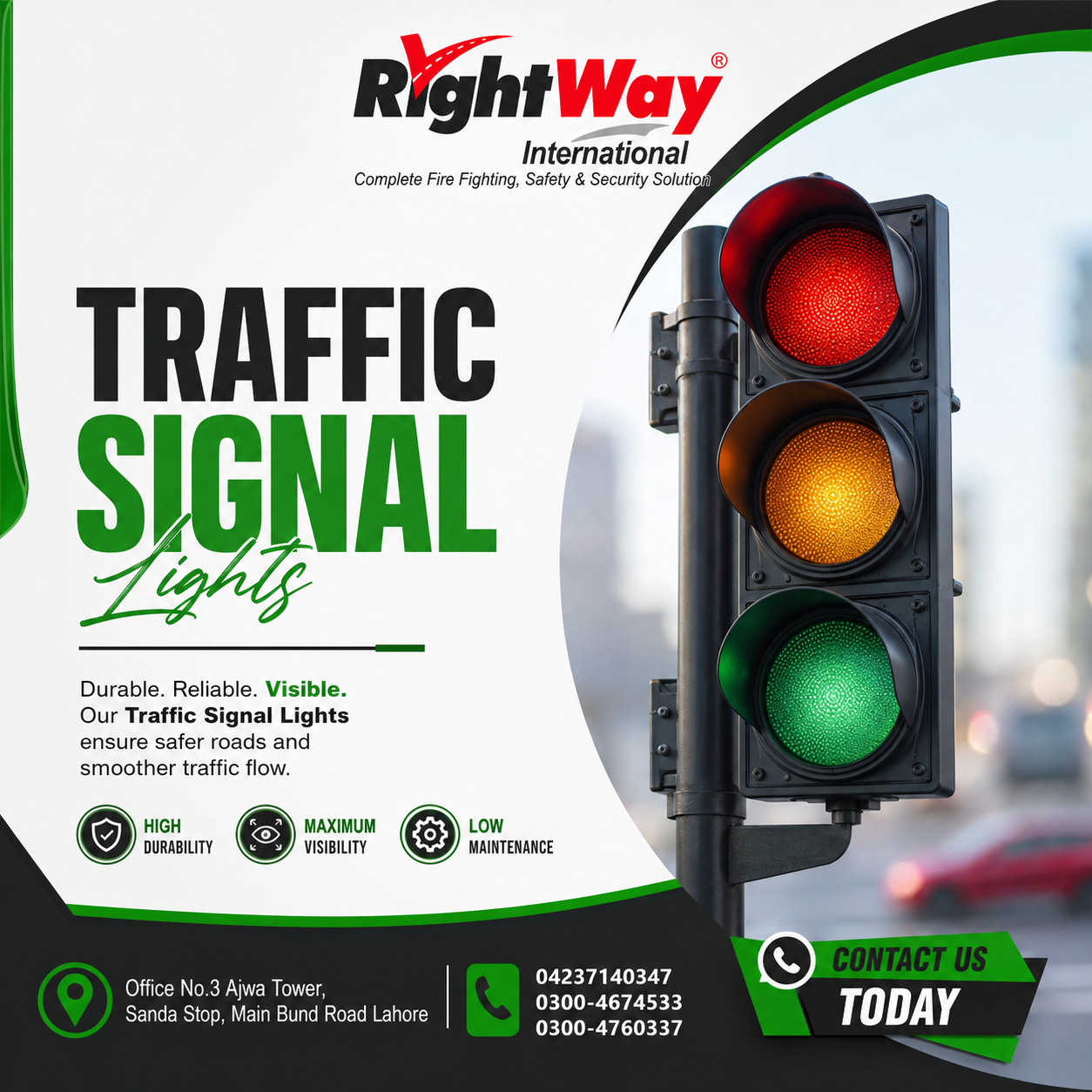
Traffic Signal Lights are essential road safety and traffic-management devices designed to control vehicle movement, regulate intersections, guide pedestrians, and improve the overall flow of traffic. These signals use colored lights and standardized indications to communicate when road users should stop, wait, proceed, or give priority to other traffic.
Moreover, traffic signal lights play a critical role at busy intersections, pedestrian crossings, highways, urban roads, roundabouts, railway crossings, and other locations where controlled movement is necessary. By providing clear visual instructions, traffic signals help reduce confusion, improve traffic organization, and support safer movement for vehicles and pedestrians.
Furthermore, modern traffic signal systems are available in different sizes, configurations, LED technologies, mounting arrangements, control systems, and visibility options. Therefore, municipalities, road authorities, highway contractors, traffic-management companies, construction projects, industrial facilities, and smart-city infrastructure providers can select suitable traffic signals according to road conditions, traffic volume, intersection design, and applicable standards.
What Are Traffic Signal Lights?
Traffic Signal Lights are electrically operated road-control devices that use colored lights to regulate traffic movement.
The most commonly recognized traffic signal sequence consists of:
- Red Light – Stop
- Yellow or Amber Light – Prepare to stop / caution
- Green Light – Proceed when the road is clear
Depending on the application, traffic signal systems can also include:
- Pedestrian signals
- Countdown timers
- Green arrows
- Red arrows
- Flashing signals
- Lane-control signals
- Bicycle signals
- Warning signals
- School-zone signals
- Railway crossing signals
- Smart traffic signals
- Emergency vehicle priority systems
Traffic signal lights are commonly installed at:
- Road intersections
- Highway intersections
- Urban roads
- Pedestrian crossings
- School zones
- Shopping areas
- Industrial facilities
- Parking entrances
- Railway crossings
- Bus terminals
- Airport roads
- Construction zones
- Toll plazas
- Roundabouts
- High-traffic junctions
Why Are Traffic Signal Lights Important?
Traffic movement becomes increasingly difficult when multiple vehicles approach an intersection from different directions.
Without proper traffic control, vehicles may enter the intersection simultaneously, increasing the possibility of collisions, congestion, and confusion.
Traffic signal lights provide a simple and recognizable method of controlling these movements.
For example, when the red light is displayed, vehicles approaching from that direction are instructed to stop. When the green light appears, vehicles may proceed when the route is clear.
Similarly, the yellow or amber indication provides a transition between movement and stopping.
Consequently, properly designed traffic signal systems can:
- Control vehicle movement
- Organize intersections
- Reduce traffic conflicts
- Improve pedestrian safety
- Manage traffic flow
- Reduce confusion
- Provide clear visual instructions
- Support safer road crossings
- Improve intersection efficiency
- Assist traffic authorities
Moreover, traffic signals are most effective when combined with appropriate road markings, traffic signs, pedestrian facilities, street lighting, speed management, and enforcement.
How Do Traffic Signal Lights Work?
Traffic signal lights operate through a combination of signal heads, LED lamps, controllers, wiring, sensors, and power systems.
Step 1: Traffic Conditions Are Monitored
First, the traffic-management system may receive information through programmed timing, vehicle detectors, cameras, sensors, or other traffic-monitoring technologies.
Step 2: Traffic Controller Processes the Information
Next, the traffic signal controller determines which signal phase should operate.
Step 3: Signal Phase Changes
The controller activates the appropriate red, yellow, or green signal according to the programmed sequence.
Step 4: Drivers Receive the Instruction
Drivers see the illuminated signal and respond according to the applicable traffic rules.
Step 5: The Sequence Continues
Finally, the system changes between phases to provide controlled movement for different traffic directions.
Advanced systems can adjust signal timing according to traffic volume, time of day, pedestrian demand, emergency vehicles, and other traffic conditions.
Main Colors of Traffic Signal Lights
Traffic signals traditionally use three primary colors.
1. Red Traffic Signal
The red signal instructs approaching road users to stop according to the applicable traffic rules.
Red is internationally recognized as a strong warning and stop indication.
Therefore, red traffic lights are generally positioned where they can be clearly seen by approaching drivers.
2. Yellow or Amber Traffic Signal
The yellow or amber signal indicates a transition period.
It generally warns drivers that the signal is changing and that they should prepare to stop where required and safe to do so.
3. Green Traffic Signal
The green signal indicates that traffic may proceed when the route is clear and subject to applicable traffic rules.
Green signals can also be combined with directional arrows to control specific movements.
Types of Traffic Signal Lights
Different traffic environments require different signal configurations.
1. Standard Three-Color Traffic Signals
Standard three-color traffic signals use red, yellow, and green lights.
They are commonly installed at:
- Urban intersections
- Highway junctions
- Main roads
- Commercial areas
- Residential intersections
These systems provide basic and easily recognizable traffic control.
2. LED Traffic Signal Lights
LED traffic signals use light-emitting diodes instead of traditional incandescent bulbs.
This Technology offers several advantages, including:
- High visibility
- Lower power consumption
- Long operating life
- Fast illumination
- Reduced maintenance
- Improved optical performance
Therefore, LED traffic signal lights are widely used in modern traffic-management systems.
3. Vehicle Traffic Signal Lights
Vehicle traffic signals are designed specifically for controlling motor vehicles.
They may include:
- Red circular lights
- Yellow circular lights
- Green circular lights
- Directional arrows
- Lane-specific indications
These signals are commonly installed above or beside road lanes.
4. Pedestrian Traffic Signal Lights
Pedestrian signals provide specific instructions to people crossing roads.
They commonly use symbols such as:
- Walking person
- Standing person
- Flashing pedestrian indication
Some systems also include audible or tactile features for improved accessibility.
5. Arrow Traffic Signal Lights
Arrow signals control specific directions.
For example:
- Left-turn arrow
- Right-turn arrow
- Straight-ahead arrow
- U-turn arrow
Therefore, arrow signals can help separate different traffic movements at complex intersections.
6. Flashing Traffic Signal Lights
Flashing signals provide warning or special traffic-control instructions.
They may be used around:
- School zones
- Pedestrian crossings
- Hazardous intersections
- Construction areas
- Temporary traffic-control locations
The exact meaning depends on the applicable traffic regulations and signal configuration.
7. Countdown Traffic Signals
Countdown timers display the remaining time for a particular signal phase.
They can show:
- Remaining red time
- Remaining green time
- Remaining pedestrian-crossing time
Consequently, countdown displays can provide additional information to road users.
8. Lane Control Signals
Lane-control signals are positioned above individual lanes.
They can indicate whether a lane is:
- Open
- Closed
- Reversible
- Restricted
These systems are particularly useful for highways, tunnels, bridges, and roads with changing traffic patterns.
9. Smart Traffic Signal Lights
Smart traffic signals can integrate sensors, cameras, controllers, communication networks, and software.
These systems may adjust signal timing according to:
- Traffic volume
- Vehicle queues
- Time of day
- Pedestrian demand
- Emergency vehicles
- Traffic congestion
As a result, smart traffic signals can support more adaptive traffic management.
10. Solar-Powered Traffic Signal Systems
Solar-powered traffic signals use solar panels and battery systems to provide electrical power.
They can be particularly useful in locations where conventional electrical infrastructure is difficult or expensive to install.
11. Temporary Traffic Signal Lights
Temporary traffic signals can be deployed during:
- Road construction
- Bridge repairs
- Lane closures
- Utility work
- Temporary diversions
They help maintain controlled traffic movement while permanent infrastructure is unavailable.
12. Emergency Vehicle Priority Traffic Signals
Some advanced traffic-management systems can provide signal priority to emergency vehicles.
Depending on the system, communication technologies can allow traffic signals to modify their sequence to help emergency vehicles move through selected intersections more efficiently.
Key Components of Traffic Signal Lights
A complete traffic signal system consists of several components.
Signal Head
The signal head contains the individual red, yellow, and green indications.
It is designed to provide clear visibility to approaching road users.
LED Modules
Modern traffic signals commonly use LED modules.
These modules contain multiple LEDs arranged to produce a bright and uniform indication.
Signal Controller
The controller acts as the central operating unit.
It manages the timing and sequence of signal phases.
Signal Pole
Signal poles support the signal heads at appropriate heights and positions.
Common configurations include:
- Side-mounted poles
- Mast arms
- Overhead poles
- Gantry systems
- Pedestrian poles
Visors
Signal visors help reduce the effect of sunlight and improve the visibility of the illuminated signal.
Backplates
Backplates can provide a contrasting background around the signal head.
Therefore, they may improve signal visibility, particularly in complex visual environments.
Wiring and Electrical System
Traffic signals require appropriate wiring, electrical protection, power supply, and control connections.
Traffic Sensors
Modern systems may use:
- Inductive loop detectors
- Radar sensors
- Cameras
- Video detection
- Infrared sensors
- Other vehicle-detection technologies
These devices can provide information about traffic conditions.
Benefits of Traffic Signal Lights
Traffic signal lights provide numerous benefits for road and traffic management.
- Improve intersection control
- Organize vehicle movement
- Support pedestrian crossings
- Reduce traffic conflicts
- Improve road-user awareness
- Provide clear visual instructions
- Help manage traffic volumes
- Improve traffic-flow organization
- Support safer turning movements
- Control lane-specific traffic
- Improve visibility at intersections
- Support emergency traffic management
- Reduce driver confusion
- Improve urban traffic management
- Support smart-city infrastructure
- Provide consistent traffic instructions
Furthermore, properly timed signals can help manage traffic queues and improve the efficiency of busy intersections.
Traffic Signal Lights for Road Intersections
Intersections are among the most important locations for traffic signal installation.
At a typical four-way intersection, traffic signals control movement from different approaches.
For example, one direction may receive a green signal while conflicting traffic receives a red signal.
After the appropriate phase, the system changes to yellow and then red before allowing another direction to proceed.
Consequently, traffic signals help separate conflicting vehicle movements.
Traffic Signal Lights for Pedestrian Crossings
Pedestrian crossings require clear communication between vehicles and people walking across the road.
Pedestrian signal systems can provide dedicated crossing indications.
Some modern systems also include:
- Countdown displays
- Push buttons
- Audible alerts
- Tactile controls
- Accessible crossing features
Therefore, pedestrian traffic signals can provide clearer crossing information for different users.
Traffic Signal Lights for Highways
Although many highways allow uninterrupted traffic flow, signal systems may still be required at selected junctions, ramps, intersections, toll facilities, or construction areas.
Highway traffic signal lights should provide:
- High visibility
- Appropriate brightness
- Durable construction
- Reliable operation
- Suitable mounting
- Weather resistance
- Clear optical performance
Moreover, signal placement should consider vehicle speed, sight distance, road geometry, and applicable engineering requirements.
Traffic Signal Lights for Urban Roads
Urban environments often have high traffic volumes, pedestrians, cyclists, public transportation, commercial activity, and multiple intersections.
Therefore, urban traffic signal systems may require advanced control strategies.
Modern urban systems can integrate:
- Vehicle detection
- Pedestrian detection
- Traffic cameras
- Centralized control
- Adaptive signal timing
- Public transport priority
- Emergency vehicle priority
- Traffic monitoring
As a result, intelligent traffic signal systems can become an important part of modern urban mobility.
Traffic Signal Lights for Construction Zones
Road construction can temporarily change normal traffic patterns.
Therefore, temporary traffic signal lights can help manage:
- One-way traffic
- Lane closures
- Temporary diversions
- Bridge repairs
- Road widening
- Utility work
- Excavation areas
Temporary signals should be positioned clearly and maintained throughout the construction period.
Traffic Signal Lights for School Zones
School areas require particular attention because children and pedestrians may frequently cross roads.
Traffic signals or pedestrian signals can be used to manage movement around schools.
Additional safety equipment may include:
- Warning signs
- Road markings
- Pedestrian barriers
- Flashing beacons
- Speed-control devices
- Reflective delineator posts
Therefore, traffic signals should form part of a broader school-zone safety strategy.
Traffic Signal Lights for Industrial Areas
Factories, warehouses, logistics centers, ports, and industrial facilities can have high volumes of trucks, forklifts, employees, and visitors.
Traffic signals can help regulate vehicle movement at:
- Factory entrances
- Loading areas
- Internal intersections
- Warehouse routes
- Truck yards
- Logistics facilities
- Security gates
Consequently, traffic signals can help organize movement within complex industrial environments.
Important Features of High-Quality Traffic Signal Lights
When selecting traffic signal lights, buyers should consider several technical and operational features.
High Visibility
The signal should provide clear visibility from the required approach distance.
LED Technology
LED modules can provide efficient illumination and long operating life.
Uniform Light Distribution
The illuminated area should appear consistent without significant dark spots.
Weather Resistance
Outdoor traffic signals should be designed for exposure to:
- Rain
- Dust
- Heat
- Humidity
- Wind
- Temperature changes
UV Resistance
UV-resistant materials can help reduce deterioration caused by prolonged sunlight exposure.
Durable Housing
Signal housings should provide appropriate protection for internal electrical and optical components.
Low Power Consumption
Energy-efficient LED systems can help reduce operating costs.
Long Service Life
High-quality components can reduce the frequency of replacement and maintenance.
Easy Maintenance
Signal modules and other components should be accessible for inspection and replacement.
Clear Signal Indications
Red, yellow, and green indications should be clearly distinguishable.
How to Choose the Right Traffic Signal Lights
Selecting traffic signals requires consideration of the application and traffic environment.
1. Identify the Application
First, determine whether the signals are intended for:
- Highway intersections
- Urban roads
- Pedestrian crossings
- Construction zones
- Industrial facilities
- School zones
- Parking facilities
- Private roads
2. Determine Signal Configuration
Choose between:
- Three-light signals
- Arrow signals
- Pedestrian signals
- Countdown signals
- Lane-control signals
- Flashing signals
3. Consider Visibility Requirements
Evaluate:
- Traffic speed
- Intersection distance
- Daylight conditions
- Nighttime conditions
- Weather
- Road geometry
4. Choose LED or Other Technology
Modern LED technology is commonly preferred because of its energy efficiency and long operating life.
5. Consider Housing Material
Select a durable housing suitable for outdoor conditions.
6. Evaluate Mounting Requirements
Determine whether the signal will be installed on:
- Poles
- Mast arms
- Gantries
- Pedestrian poles
- Wall-mounted structures
7. Check Electrical Requirements
Confirm the appropriate voltage, power consumption, wiring, controller compatibility, and electrical protection.
8. Consider Environmental Conditions
Evaluate exposure to:
- Extreme heat
- Rain
- Dust
- Humidity
- Sunlight
- Wind
9. Check Applicable Standards
Before purchasing, verify relevant traffic-signal standards, project specifications, certifications, and local road-authority requirements.
10. Consider Maintenance
Select systems that allow easy access to LED modules, wiring, controllers, and other serviceable components.
Traffic Signal Installation
Proper installation is essential for reliable operation.
Step 1: Assess the Intersection
First, study the road layout, traffic movement, pedestrian movement, sight distance, and required signal phases.
Step 2: Select Signal Locations
Determine suitable positions for signal heads and poles.
Step 3: Install Poles or Supporting Structures
Install the required poles, mast arms, brackets, or gantries.
Step 4: Mount Signal Heads
Secure the signal heads at the appropriate height and orientation.
Step 5: Connect Electrical Components
Connect signal heads to the controller and power system according to the approved design.
Step 6: Configure the Controller
Program the required signal sequence and timing.
Step 7: Test the System
Test each signal phase, pedestrian function, detector, timer, and emergency feature where applicable.
Step 8: Inspect Visibility
Finally, confirm that each signal is clearly visible to the intended road users.
Traffic Signal Maintenance
Regular maintenance is important for reliable traffic control.
Inspect traffic signal systems for:
- Damaged signal housings
- Broken lenses
- Failed LEDs
- Loose connections
- Damaged wiring
- Pole corrosion
- Loose mounting hardware
- Water ingress
- Dirty signal lenses
- Controller faults
- Sensor problems
- Incorrect timing
- Visibility issues
Furthermore, signal lenses and visors should be kept clean so that dust, dirt, or environmental contamination does not reduce visibility.
Any malfunctioning signal should be repaired promptly because traffic signals are critical safety infrastructure.
Traffic Signal Lights and LED Technology
LED technology has significantly changed modern traffic signal systems.
Traditional incandescent bulbs consume more energy and generally require more frequent replacement.
LED signal modules can provide:
- Lower energy consumption
- Long operating life
- High brightness
- Fast response
- Reduced maintenance
- Better reliability
- Improved optical efficiency
Therefore, LED traffic signal lights have become a common choice for modern road infrastructure.
Smart Traffic Signal Systems
Smart traffic signal systems use modern technologies to improve traffic management.
These systems may communicate with:
- Traffic sensors
- Cameras
- Central traffic-control systems
- Vehicle detection systems
- Emergency vehicles
- Public transportation systems
- Smart-city platforms
For example, if a particular approach experiences increased traffic volume, an adaptive system may modify signal timing according to its programmed control strategy.
Consequently, smart traffic signals can support better traffic management in busy urban areas.
Traffic Signal Lights vs Traffic Warning Lights
Although both systems use illuminated signals, their purposes can differ.
| Feature | Traffic Signal Lights | Traffic Warning Lights |
|---|---|---|
| Main Function | Control traffic movement | Warn road users |
| Typical Colors | Red, Yellow, Green | Amber, Red, White, Other Applicable Colors |
| Main Application | Intersections and crossings | Hazards and warning areas |
| Sequence | Controlled phases | Flashing or fixed warning |
| Vehicle Control | Yes | Usually warning-focused |
| Pedestrian Control | Possible | Usually limited |
| Smart Integration | Common | Possible |
Therefore, traffic signals are generally used for structured traffic control, while warning lights are commonly used to alert road users to hazards or special conditions.
Traffic Signal Lights vs Road Safety Signs
Traffic signals provide dynamic instructions that change according to traffic conditions or programmed timing.
Road signs, on the other hand, generally provide fixed information, warnings, restrictions, or directions.
Both systems are important components of an effective traffic-management network.
Therefore, cones and traffic signals can be used together during construction and temporary traffic-management projects.
Traffic Signal Lights in Pakistan
In Pakistan, traffic signal lights are important components of urban roads, highways, major intersections, pedestrian crossings, commercial areas, industrial facilities, construction zones, and other traffic-management environments.
When selecting traffic signal lights in Pakistan, buyers should consider LED technology, signal visibility, signal size, housing material, weather resistance, power consumption, mounting configuration, controller compatibility, durability, maintenance requirements, environmental conditions, traffic volume, intersection design, and applicable road-safety standards.
Furthermore, traffic authorities, municipalities, contractors, developers, industrial organizations, and private facility owners should select traffic signal systems according to the specific requirements of each project.
Best Practices for Traffic Signal Lights
For reliable traffic management:
- Use appropriately sized signal heads
- Maintain clear signal visibility
- Keep lenses and visors clean
- Inspect signal poles regularly
- Check electrical connections
- Test signal phases
- Maintain controllers
- Inspect LED modules
- Check pedestrian signals
- Maintain detection systems
- Inspect mounting hardware
- Monitor signal timing
- Repair damaged components
- Replace failed signal modules
- Maintain backup systems where required
- Follow manufacturer recommendations
- Follow applicable traffic regulations and standards
Moreover, traffic signals should be reviewed whenever road layouts, traffic volumes, lane configurations, or pedestrian patterns change significantly.
Frequently Asked Questions
What are traffic signal lights used for?
Traffic signal lights are used to control vehicle and pedestrian movement, regulate intersections, reduce traffic conflicts, and provide clear instructions to road users.
What are the three main traffic signal colors?
The three traditional colors are red, yellow or amber, and green.
Red generally means stop, yellow or amber indicates caution or transition, and green generally permits movement when the route is clear and according to applicable traffic rules.
What are LED traffic signal lights?
LED traffic signal lights use light-emitting diodes to produce the red, yellow, or green indication. They are widely used because of their energy efficiency, brightness, long operating life, and reduced maintenance requirements.
Where are traffic signal lights commonly installed?
They are commonly installed at intersections, pedestrian crossings, highways, urban roads, school zones, industrial areas, construction zones, railway crossings, parking facilities, and other locations requiring controlled traffic movement.
What are pedestrian traffic signal lights?
Pedestrian traffic signals provide dedicated indications to people crossing roads. They commonly use walking and standing symbols and may include countdown timers or accessibility features.
What are arrow traffic signals?
Arrow traffic signals control specific vehicle movements, such as left turns, right turns, straight movement, or other designated directions.
How long do traffic signal lights last?
Service life depends on signal technology, LED quality, environmental conditions, operating hours, electrical conditions, maintenance, and product design. LED modules generally provide long operating life compared with traditional bulbs.
Why are LED traffic signals preferred?
LED traffic signals can provide high visibility, lower energy consumption, long operating life, fast illumination, and reduced maintenance requirements.
Can traffic signals be used in construction zones?
Yes. Temporary traffic signal systems can help control alternating traffic, lane closures, diversions, bridge repairs, and other road-construction activities.
What should be checked before buying traffic signal lights?
Buyers should consider signal size, LED technology, brightness, housing material, weather resistance, mounting method, power requirements, controller compatibility, visibility, durability, maintenance requirements, certifications, and applicable traffic standards.
Can traffic signals be integrated with smart traffic systems?
Yes. Modern traffic signals can be integrated with traffic sensors, cameras, adaptive controllers, centralized traffic-management platforms, emergency vehicle systems, and other intelligent transportation technologies.
Where can I buy traffic signal lights in Pakistan?
Traffic signal lights can be sourced from traffic-management equipment suppliers, road-safety companies, electrical equipment suppliers, specialized manufacturers, and infrastructure-solution providers. Buyers should verify product specifications, quality, compatibility, warranty, and applicable standards before purchasing.