




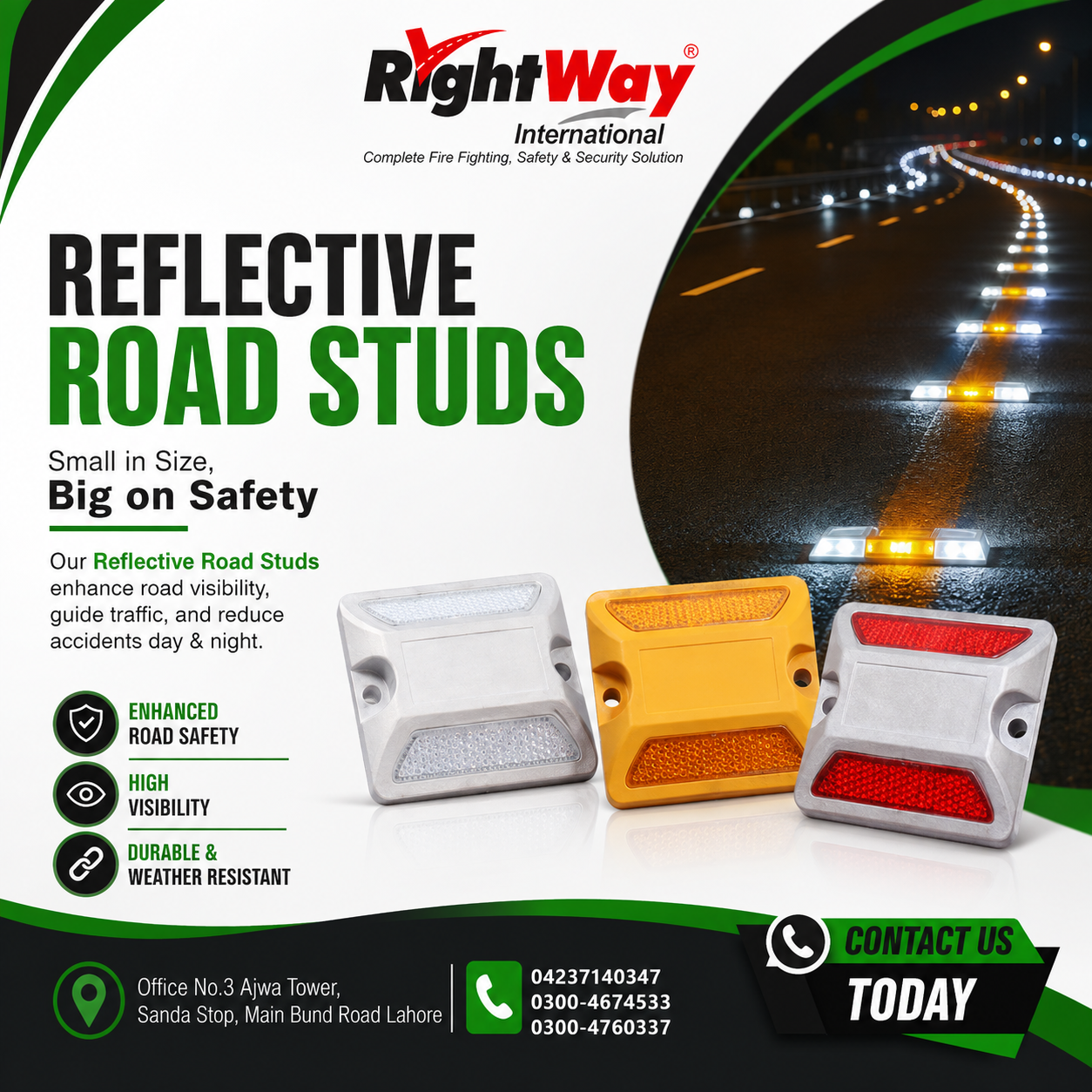
Reflective Road Studs are essential road-safety devices that help drivers identify road boundaries, lane markings, curves, traffic islands, and other important roadway features. These compact markers use reflective lenses, prisms, or LED technology to improve visibility, especially at night and during low-visibility conditions.
Moreover, road authorities and contractors commonly instal road studs on highways, motorways, urban roads, bridges, tunnels, intersections, roundabouts, industrial roads, parking areas, and construction zones. As a result, these products provide drivers with continuous visual guidance while they travel.
Furthermore, modern road studs come in different materials, shapes, colors, mounting configurations, and technologies. Therefore, municipalities, highway contractors, construction companies, traffic-management teams, industrial facilities, and infrastructure developers can choose products according to traffic conditions, pavement type, climate, road design, and applicable standards.
What Are Reflective Road Studs?
Reflective Road Studs are small roadway markers that provide additional visual guidance to drivers. Manufacturers typically equip them with reflective elements that return vehicle-headlight illumination toward approaching drivers.
Some modern models also use LEDs and internal power systems to provide active illumination.
Depending on the application, road studs can include:
- Surface-mounted road studs
- Recessed road studs
- Embedded road studs
- Raised road studs
- LED road studs
- Solar-powered road studs
- One-way reflective studs
- Two-way reflective studs
- Multi-directional road studs
Road authorities can install them along:
- Lane boundaries
- Road edges
- Centerlines
- Highway lanes
- Motorways
- Curves
- Bridges
- Tunnels
- Roundabouts
- Traffic islands
- Pedestrian crossings
- Parking areas
- Industrial roads
- Construction zones
Therefore, reflective road studs can complement conventional road markings and traffic signs.
Why Are Reflective Road Studs Important?
Road markings can become difficult to see at night, especially when rain, fog, dust, glare, or poor lighting affects visibility. However, reflective road studs can provide additional visual reference points along the pavement.
For example, vehicle headlights illuminate the reflective elements as a driver approaches. The studs then return the light toward the driver. Consequently, the driver can identify the road alignment more easily.
Reflective road studs can therefore:
- Improve nighttime visibility
- Highlight lane boundaries
- Identify road edges
- Guide drivers through curves
- Improve roadway delineation
- Support safer lane positioning
- Highlight traffic islands
- Improve visual guidance during poor weather
- Complement road markings
- Reduce uncertainty on poorly illuminated roads
Moreover, road authorities should use reflective studs as part of a broader road-safety system that may include signs, markings, barriers, delineator posts, lighting, and traffic-control devices.
How Do Reflective Road Studs Work?
Reflective road studs use optical technology to make road features more visible.
Step 1: A Vehicle Approaches
First, a vehicle travels along the road during nighttime or low-visibility conditions.
Step 2: Headlights Illuminate the Stud
Next, the vehicle headlights shine toward the road surface and illuminate the reflective lens.
Step 3: The Reflective Element Returns the Light
The optical element reflects the incoming light toward the driver’s viewing direction.
Step 4: The Driver Sees the Stud
As a result, the driver sees a series of bright reflective points along the roadway.
Step 5: The Driver Follows the Road Alignment
Finally, the visible sequence helps the driver identify lane boundaries, road edges, curves, traffic islands, and other roadway features.
In addition, LED road studs can provide their own illumination. Therefore, they can offer active visibility instead of relying entirely on vehicle headlights.
Main Types of Reflective Road Studs
Different roads require different types of reflective road studs. Therefore, buyers should select the product according to the traffic environment and installation requirements.
1. Plastic Reflective Road Studs
Plastic reflective road studs use durable engineering plastics to create a lightweight roadway marker.
They can provide:
- Lightweight construction
- Good reflective visibility
- Corrosion resistance
- Easy handling
- Cost-effective installation
Therefore, they can suit selected roads, parking facilities, private roads, and other applications with appropriate traffic conditions.
2. Aluminum Reflective Road Studs
Aluminum road studs use strong metal housings with reflective optical elements.
They can provide:
- Strong construction
- Good durability
- Corrosion resistance
- Reliable roadway visibility
- Suitable performance for demanding applications
Consequently, aluminum road studs can suit roads that experience significant traffic and environmental exposure.
3. Ceramic Reflective Road Studs
Ceramic road studs provide a durable option for applications that require resistance to wear and environmental conditions.
Moreover, their robust construction can support long-term roadway delineation when the product matches the project requirements.
4. Glass Road Studs
Glass road studs use optical glass elements to reflect vehicle headlights.
They can provide strong optical performance and a relatively low-profile installation. Therefore, road authorities may consider them for specific roadway applications.
5. Solar Reflective Road Studs
Solar road studs combine reflective or LED technology with solar power.
During the day, an integrated solar panel charges the internal battery. At night, the battery supplies energy to the LED light source.
As a result, solar road studs can provide active nighttime illumination without conventional electrical wiring.
6. LED Road Studs
LED road studs use light-emitting diodes to produce active illumination.
Depending on the design, they can receive power from:
- Solar panels
- Rechargeable batteries
- External electrical systems
Furthermore, LED technology can provide high visibility and fast illumination.
7. Recessed Road Studs
Recessed road studs sit inside prepared openings in the pavement.
Because they have a lower profile, they can reduce direct exposure to vehicle tires. Therefore, suitable recessed models can work well in demanding traffic environments.
8. Raised Road Studs
Raised road studs sit above the pavement surface and provide a visible reflective point.
They commonly support lane and road-edge delineation where their design suits the traffic environment.
9. One-Way Reflective Road Studs
One-way road studs direct their reflective performance primarily toward one approach.
Therefore, they can help identify specific traffic directions or roadway boundaries.
10. Two-Way Reflective Road Studs
Two-way road studs contain reflective elements facing opposite directions.
As a result, they can provide visibility to drivers approaching from both directions.
11. Multi-Directional Road Studs
Multi-directional road studs provide reflective visibility from several approach directions.
Consequently, they can work well around intersections, traffic islands, roundabouts, and complex roadway layouts.
12. Temporary Road Studs
Temporary road studs can support temporary traffic arrangements during construction, maintenance, lane changes, and road diversions.
Therefore, contractors can use them where traffic patterns change for a limited period.
Reflective Road Stud Colors
Manufacturers produce road studs in several colors according to different roadway applications.
Common colors include:
- White
- Yellow
- Red
- Amber
- Green
However, road authorities should select colors according to local traffic regulations, project specifications, and applicable road-marking standards.
The meaning of each color can vary between jurisdictions. Therefore, buyers should confirm the required color before installation.
Key Components of Reflective Road Studs
A reflective road stud can contain several important components.
Reflective Lens
The reflective lens provides the optical surface that returns vehicle-headlight illumination toward approaching drivers.
Housing
The housing protects the internal optical or electronic components.
Manufacturers may use:
- Aluminum
- Plastic
- Polycarbonate
- Ceramic
- Other engineered materials
LED Module
LED road studs contain one or more LEDs that provide active illumination.
Solar Panel
Solar-powered models use photovoltaic panels to convert sunlight into electrical energy.
Rechargeable Battery
The battery stores solar energy during daylight and powers the LED system after dark.
Mounting Base
The base connects the road stud securely to the pavement.
Protective Cover
A protective cover shields the reflective or electronic components from environmental exposure and physical damage.
Benefits of Reflective Road Studs
Reflective road studs offer several important road-safety and traffic-management benefits.
- Improve nighttime road visibility
- Highlight lane boundaries
- Identify road edges
- Guide drivers around curves
- Support lane discipline
- Improve roadway delineation
- Increase driver awareness
- Highlight traffic islands
- Provide additional guidance during poor visibility
- Complement conventional road markings
- Improve visibility on dark roads
- Identify changes in roadway alignment
- Support highway safety
- Improve visibility around bends
- Provide continuous visual reference points
- Support traffic-management systems
Furthermore, road studs can strengthen the overall visibility of road markings when authorities use them as part of an integrated road-safety system.
Reflective Road Studs for Highways and Motorways
Highways and motorways require clear lane guidance because drivers often travel at high speeds.
Therefore, road authorities can use reflective road studs to identify:
- Lane boundaries
- Road edges
- Central reservations
- Curves
- Exit areas
- Entry ramps
- Merging lanes
- Diverging lanes
However, project designers should consider traffic loading, pavement type, road geometry, environmental conditions, visibility requirements, and applicable standards before selecting a product.
Reflective Road Studs for Curves and Bends
Curved road sections can become challenging to follow at night, particularly when street lighting is limited.
Therefore, road authorities can install a sequence of reflective road studs along curves to show the direction of the roadway.
They can be particularly useful around:
- Sharp curves
- Highway bends
- Mountain roads
- Bridge approaches
- Junction curves
- Roundabouts
- Interchange ramps
As a result, drivers can receive a clearer visual indication of the road’s direction.
Reflective Road Studs for Road Edges
Road-edge visibility plays an important role in nighttime driving.
When authorities install reflective road studs along suitable road edges, the studs can help drivers identify the boundary between the usable pavement and the roadside.
This application can benefit:
- Rural roads
- Highways
- Motorways
- Poorly illuminated roads
- Mountain roads
- Bridges
- Long road sections
Consequently, road-edge studs can provide an additional visual reference when conventional lighting is limited.
Reflective Road Studs for Lane Marking
Road authorities can install reflective road studs alongside suitable lane markings to strengthen nighttime visibility.
They can help drivers identify:
- Lane divisions
- Centerlines
- Shoulder boundaries
- Turning lanes
- Merge lanes
- Exit lanes
Moreover, combining road studs with high-quality reflective road markings can create a more complete visual guidance system.
Reflective Road Studs for Roundabouts
Roundabouts contain multiple traffic movements and curved driving paths.
Therefore, reflective road studs can help identify:
- Roundabout approaches
- Central islands
- Traffic islands
- Lane boundaries
- Curved sections
As a result, drivers can follow the intended roadway alignment more easily at night.
Reflective Road Studs for Bridges
Bridges often contain narrow lanes, barriers, curves, and limited roadside space.
Therefore, road authorities can use reflective studs to identify:
- Bridge edges
- Lane boundaries
- Approach sections
- Curves
- Traffic separation areas
Furthermore, buyers should select products that can withstand the environmental conditions of exposed bridge locations.
Reflective Road Studs for Tunnels
Tunnels provide limited natural light, so drivers need clear roadway guidance.
Reflective road studs can help identify:
- Tunnel lanes
- Road edges
- Curves
- Emergency areas
- Lane boundaries
In addition, active LED road studs can provide additional illumination where the tunnel design requires enhanced visibility.
Reflective Road Studs for Pedestrian Areas
Road authorities can use suitable reflective studs around selected pedestrian and traffic-management areas.
Applications can include:
- Pedestrian crossings
- Traffic islands
- School zones
- Shared road areas
- Parking facilities
- Pedestrian approaches
However, designers should carefully position road studs so they do not create unnecessary hazards for pedestrians, cyclists, or other road users.
Reflective Road Studs for Construction Zones
Construction projects often change normal traffic patterns.
Therefore, contractors can use suitable temporary road studs to identify:
- Temporary lanes
- Road edges
- Traffic channels
- Curves
- Diversions
- Construction boundaries
Moreover, contractors should select temporary traffic-management products according to project duration, traffic volume, pavement conditions, and applicable safety requirements.
Reflective Road Studs for Industrial Areas
Factories, warehouses, logistics centers, ports, and industrial facilities often operate vehicles during both daytime and nighttime.
Therefore, facility operators can use reflective road studs around:
- Loading zones
- Truck routes
- Factory entrances
- Warehouse roads
- Parking areas
- Security gates
- Internal intersections
As a result, road studs can improve nighttime visibility and help organize internal vehicle movement.
Important Features of High-Quality Reflective Road Studs
When selecting reflective road studs, buyers should evaluate several technical features.
High Reflectivity
The reflective element should provide strong and consistent visibility when vehicle headlights illuminate it.
Strong Housing
The housing should provide suitable protection for the reflective or electronic components.
Impact Resistance
The road stud should withstand the traffic and environmental stresses associated with its intended application.
Weather Resistance
Outdoor road studs should handle exposure to:
- Rain
- Dust
- Heat
- Humidity
- UV radiation
- Wind
- Temperature changes
Water Resistance
Suitable construction can help protect internal components against moisture and water penetration.
Slip Resistance
The surface design should suit the intended roadway application without creating unnecessary risks for road users.
Long Service Life
Durable materials can reduce replacement frequency and maintenance requirements.
Clear Optical Performance
The reflective surface should maintain consistent visibility throughout its expected service life.
Easy Installation
The product should match the selected installation method and pavement type.
How to Choose the Right Reflective Road Studs
Selecting the right product requires careful consideration of the roadway and traffic environment.
1. Identify the Application
First, determine whether you need road studs for:
- Highways
- Motorways
- Urban roads
- Rural roads
- Curves
- Bridges
- Tunnels
- Roundabouts
- Construction zones
- Industrial roads
- Parking areas
2. Determine Traffic Loading
Next, evaluate the volume and type of traffic using the roadway.
For example, roads with frequent heavy-truck traffic may require stronger road-stud designs than lightly trafficked private roads.
3. Select the Appropriate Material
Then, compare plastic, aluminum, ceramic, glass, and other materials according to the project’s durability requirements.
4. Choose Reflective or LED Technology
Traditional reflective studs rely mainly on vehicle headlights. In contrast, LED road studs provide active illumination.
Therefore, select the technology according to the required visibility and available power source.
5. Consider the Mounting Method
Determine whether the project requires:
- Surface-mounted studs
- Recessed studs
- Embedded studs
- Temporary studs
6. Evaluate Visibility Requirements
Consider:
- Vehicle speed
- Road width
- Nighttime conditions
- Weather
- Headlight visibility
- Road geometry
- Existing street lighting
7. Consider Environmental Conditions
Evaluate exposure to:
- Extreme heat
- Rain
- Dust
- Humidity
- UV radiation
- Temperature changes
- Heavy traffic
8. Check Pavement Compatibility
Make sure the selected road stud works with the existing pavement and installation method.
9. Check Applicable Standards
Before purchasing, verify the relevant road-safety standards, project specifications, certifications, and local road-authority requirements.
10. Consider Maintenance Requirements
Finally, select products that allow practical inspection, cleaning, replacement, and maintenance.
Reflective Road Stud Installation
Correct installation plays an important role in road-stud performance.
Step 1: Assess the Road
First, inspect the pavement, lane markings, road layout, traffic flow, and intended application.
Step 2: Mark Installation Locations
Next, mark the required installation points according to the approved road design and applicable specifications.
Step 3: Prepare the Surface
Clean the pavement and remove dust, oil, moisture, and loose material.
Step 4: Prepare the Mounting Area
For recessed or embedded products, prepare the required opening according to the manufacturer’s instructions.
Step 5: Apply the Fixing System
Apply the approved adhesive, resin, mechanical fixing, or other installation method.
Step 6: Position the Road Stud
Place the stud in the correct position, direction, and alignment.
Step 7: Allow Proper Setting
If the installation uses adhesive or resin, allow the material to cure according to the manufacturer’s instructions and environmental conditions.
Step 8: Inspect the Installation
Finally, check the alignment, stability, visibility, and surface condition before normal traffic resumes.
Reflective Road Stud Maintenance
Regular maintenance helps road studs maintain their intended performance.
Inspect road studs for:
- Broken lenses
- Damaged housings
- Missing studs
- Loose installations
- Reduced reflectivity
- Surface contamination
- Cracks
- Water damage
- LED failure
- Solar-panel damage
- Battery problems
- Incorrect alignment
Furthermore, maintenance teams should remove dirt, mud, oil, and other contaminants whenever they reduce reflective visibility.
In addition, teams should replace damaged or missing studs according to the relevant maintenance procedures.
Reflective Road Studs and LED Technology
LED technology has expanded the capabilities of modern road-stud systems.
Traditional reflective studs depend mainly on vehicle headlights. However, LED road studs can produce their own illumination through integrated LEDs.
Depending on the design, the system can use solar energy, batteries, or external electrical power.
LED road studs can provide:
- Active nighttime illumination
- High visibility
- Low energy consumption
- Fast illumination
- Long operating life
- Reduced wiring requirements for solar systems
Therefore, LED technology can provide an effective option for locations that require enhanced nighttime visibility.
Solar Reflective Road Studs
Solar road studs combine roadway delineation with solar-powered LED illumination.
During daylight hours, the solar panel converts sunlight into electrical energy and charges the internal battery. At night, the stored energy powers the LEDs.
Consequently, solar road studs can provide:
- Independent solar power
- Active nighttime illumination
- Low operating energy requirements
- No conventional electrical wiring in many installations
- Easy deployment in selected locations
- Reduced dependence on grid electricity
For this reason, solar road studs can work well on remote roads, rural routes, curves, traffic islands, and other locations with limited electrical infrastructure.
Reflective Road Studs vs Road Marking Paint
Road marking paint creates continuous lines on the pavement, whereas reflective road studs provide individual reflective or illuminated reference points.
| Feature | Reflective Road Studs | Road Marking Paint |
|---|---|---|
| Main Function | Visual road delineation | Continuous road marking |
| Night Visibility | High when properly reflective | Depends on marking reflectivity |
| Physical Profile | Raised or recessed | Generally flush with pavement |
| Active LED Options | Available | Generally unavailable |
| Lane Guidance | Yes | Yes |
| Curve Guidance | Yes | Yes |
| Maintenance | Inspection and replacement | Repainting or remarking |
| Best Use | Additional visual guidance | Continuous lane and road markings |
Therefore, road studs and road markings often work best together.
Reflective Road Studs vs Road Safety Delineator Posts
Reflective road studs sit on or inside the pavement, while delineator posts stand vertically beside the road.
Road studs provide low-level roadway guidance. In contrast, delineator posts provide a higher and more distant visual reference.
Therefore, road authorities can use both products together to create stronger roadway delineation.
Reflective Road Studs vs Traffic Cones
Traffic cones primarily support temporary traffic control, work-zone management, hazard marking, and lane separation.
On the other hand, reflective road studs generally provide permanent or semi-permanent roadway delineation.
However, contractors can use both products together during construction and temporary traffic-management projects.
Reflective Road Studs in Pakistan
In Pakistan, reflective road studs play an important role in highway safety, motorway safety, urban road management, rural road visibility, and traffic delineation.
Authorities and contractors can use them on:
- Highways
- Motorways
- Urban roads
- Rural roads
- Intersections
- Curves
- Bridges
- Traffic islands
- Construction zones
- Industrial roads
- Parking areas
When selecting reflective road studs in Pakistan, buyers should consider reflective performance, material, durability, traffic loading, pavement compatibility, installation method, weather resistance, UV resistance, visibility, maintenance requirements, and applicable road-safety standards.
Furthermore, municipalities, highway authorities, road contractors, construction companies, infrastructure developers, industrial organizations, and private facility owners should select products according to the specific requirements of each project.
Best Practices for Reflective Road Studs
For reliable roadway guidance, road authorities and contractors should follow these practices:
- Use appropriately designed road studs
- Select products according to traffic loading
- Maintain consistent installation
- Follow approved spacing requirements
- Keep reflective surfaces clean
- Inspect studs regularly
- Replace damaged or missing studs
- Check alignment
- Inspect mounting integrity
- Monitor reflective performance
- Consider pavement compatibility
- Use suitable installation materials
- Follow manufacturer recommendations
- Follow applicable road-safety standards
- Combine road studs with appropriate road markings
- Review road-stud placement when roadway layouts change
Moreover, project teams should treat reflective road studs as one component of a complete road-safety strategy rather than as a standalone safety solution.
Frequently Asked Questions
What are reflective road studs used for?
Reflective road studs help improve nighttime visibility, identify lane boundaries, highlight road edges, guide drivers through curves, and provide additional roadway delineation.
How do reflective road studs work?
Traditional reflective road studs return vehicle-headlight illumination toward approaching drivers through reflective lenses or optical elements. Meanwhile, LED road studs can provide active illumination through integrated light sources.
What are the common types of reflective road studs?
Common types include plastic, aluminum, ceramic, glass, recessed, raised, one-way, two-way, multi-directional, LED, solar-powered, and temporary road studs.
Are reflective road studs useful at night?
Yes. Reflective road studs can provide important visual guidance during nighttime and low-visibility conditions.
What are solar road studs?
Solar road studs use solar panels to charge internal batteries during daylight. At night, the stored energy powers integrated LEDs.
Where are reflective road studs commonly installed?
Road authorities commonly install them on highways, motorways, urban roads, rural roads, curves, bridges, tunnels, roundabouts, traffic islands, construction zones, industrial roads, and parking areas.
Are reflective road studs suitable for highways?
Yes. However, the selected product should meet the required durability, visibility, traffic-loading, installation, and project specifications.
What materials are used to manufacture reflective road studs?
Manufacturers commonly use aluminum, plastic, ceramic, glass, polycarbonate, and other engineered materials.
What colors are available for reflective road studs?
Common colors include white, yellow, red, amber, and green. However, the permitted use and meaning of each color depend on local traffic regulations and road-authority requirements.
How long do reflective road studs last?
Their service life depends on material, traffic loading, installation quality, environmental exposure, pavement conditions, maintenance, and product design.
Can reflective road studs be installed on asphalt?
Yes. Many road studs work with asphalt surfaces. However, buyers should confirm pavement compatibility and installation requirements before installation.
Can reflective road studs be installed on concrete?
Yes. Many products can work with concrete when installers use the correct fixing method and follow the manufacturer’s specifications.
What should be checked before buying reflective road studs?
Buyers should evaluate reflectivity, material, durability, traffic loading, size, visibility, mounting method, pavement compatibility, weather resistance, UV resistance, installation requirements, certifications, and applicable road-safety standards.
Are LED road studs better than traditional reflective studs?
Both technologies have different advantages. Traditional reflective studs rely mainly on vehicle headlights, while LED road studs provide active illumination. Therefore, the best choice depends on the roadway, visibility requirements, power availability, budget, and project specifications.
Can reflective road studs be used in construction zones?
Yes. Suitable temporary or permanent road studs can provide additional visual guidance around temporary lanes, diversions, curves, and construction areas.
Where can I buy reflective road studs in Pakistan?
Buyers can source reflective road studs from road-safety equipment suppliers, traffic-management companies, highway-safety product suppliers, specialized manufacturers, and infrastructure-solution providers. Before purchasing, buyers should verify product specifications, quality, compatibility, warranty, and applicable standards.
What Are Traffic Signal Lights?
Traffic movement becomes increasingly difficult when multiple vehicles approach an intersection from different directions.
Without proper traffic control, vehicles may enter the intersection simultaneously, increasing the possibility of collisions, congestion, and confusion.
Traffic signal lights provide a simple and recognizable method of controlling these movements.
For example, when the red light is displayed, vehicles approaching from that direction are instructed to stop. When the green light appears, vehicles may proceed when the route is clear.
Similarly, the yellow or amber indication provides a transition between movement and stopping.
Consequently, properly designed traffic signal systems can:
- Control vehicle movement
- Organize intersections
- Reduce traffic conflicts
- Improve pedestrian safety
- Manage traffic flow
- Reduce confusion
- Provide clear visual instructions
- Support safer road crossings
- Improve intersection efficiency
- Assist traffic authorities
Moreover, traffic signals are most effective when combined with appropriate road markings, traffic signs, pedestrian facilities, street lighting, speed management, and enforcement. Read More