




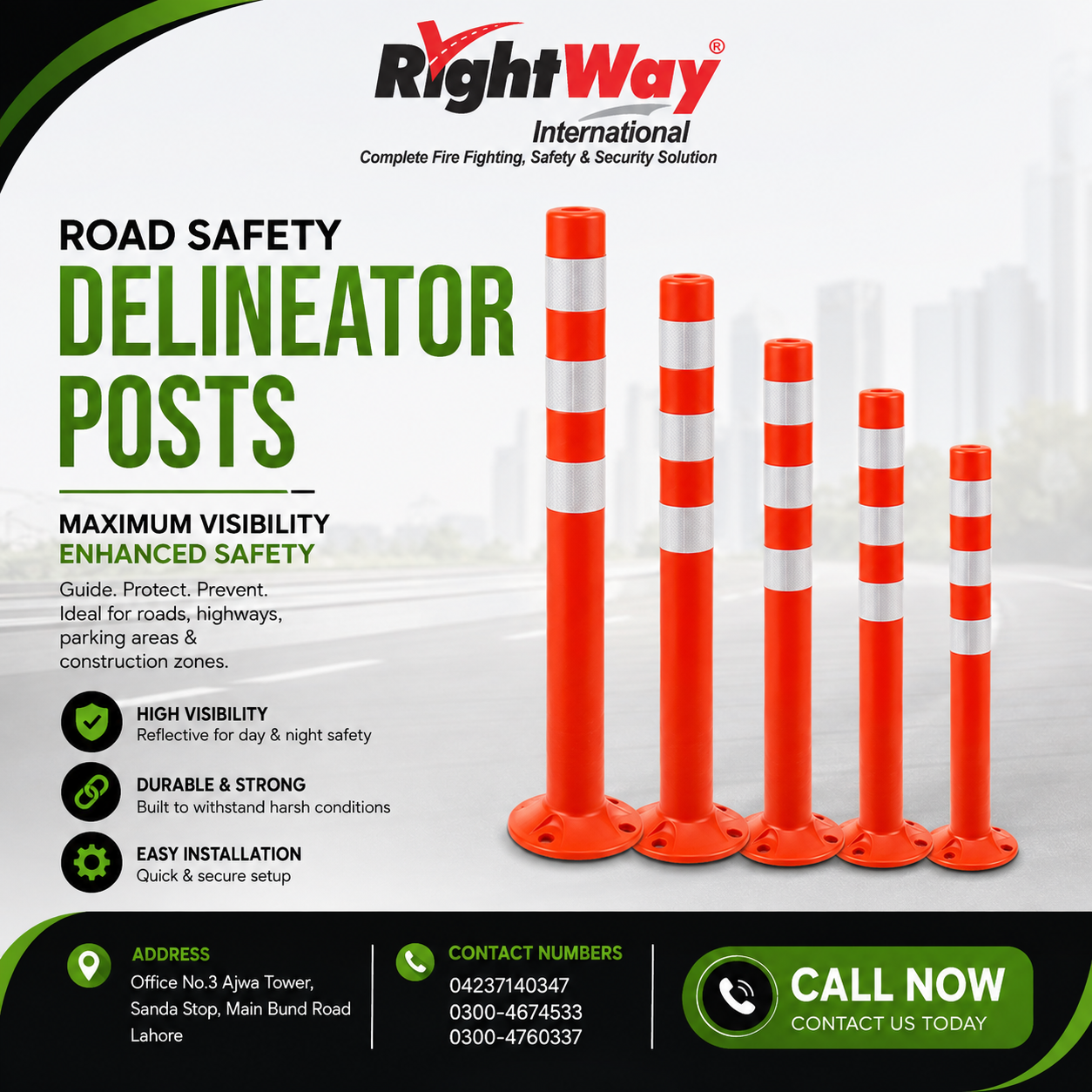
Road Safety Reflective Delineator Posts are important roadside safety devices designed to improve visibility, guide drivers, identify road edges, and support safer traffic movement. These posts typically use durable bodies with reflective elements that become highly visible when illuminated by vehicle headlights.
Moreover, reflective delineator posts help drivers recognize road boundaries, curves, medians, traffic islands, construction areas, and potential hazards. Therefore, road authorities, highway contractors, construction companies, municipalities, parking facilities, and traffic-management teams commonly use them in different road and industrial environments.
Furthermore, modern delineator posts are available in different heights, colors, materials, shapes, reflective configurations, and mounting designs. As a result, organizations can select a suitable product according to road conditions, traffic volume, weather exposure, visibility requirements, and applicable safety standards.
What Are Road Safety Reflective Delineator Posts?
Road Safety Reflective Delineator Posts are vertical roadside markers that help guide drivers by clearly indicating the position and direction of a roadway.
These posts usually feature a highly visible body combined with reflective strips, reflectors, or reflective panels. When vehicle headlights illuminate the reflective elements at night, they return light toward approaching drivers.
Consequently, drivers can identify the edge of the road, curves, traffic channels, and other important areas more easily.
Common delineator post colors include:
- White
- Red
- Yellow
- Orange
- Black and white
- Red and white
- Yellow and black
Depending on the design, posts may include:
- Reflective strips
- Reflective panels
- Reflective bands
- Integrated reflectors
- Flexible bases
- Mounting holes
- Ground anchors
- Reinforced sections
- High-visibility bodies
Road safety reflective delineator posts are commonly used for:
- Highways
- Motorways
- Rural roads
- Urban roads
- Road curves
- Traffic islands
- Medians
- Roundabouts
- Construction zones
- Roadwork areas
- Parking facilities
- Bridges
- Tunnels
- Industrial roads
- Warehouses
- Private roads
- Temporary traffic management
Why Are Reflective Delineator Posts Important?
Drivers need clear visual information to understand where the road begins and ends. This becomes particularly important at night, during bad weather, and in areas with poor lighting.
Reflective delineator posts provide a clear visual reference along the roadside. Therefore, they can help drivers maintain better awareness of road alignment and boundaries.
For example, a driver approaching a sharp curve at night may use reflective delineator posts to recognize the direction of the road.
Similarly, posts positioned along a highway can help drivers identify the road edge and maintain their lane position.
Moreover, delineator posts can help highlight:
- Road edges
- Curves
- Intersections
- Traffic islands
- Medians
- Bridge approaches
- Construction zones
- Hazardous roadside areas
As a result, these simple roadside devices can support safer and more organized traffic movement.
How Do Road Safety Reflective Delineator Posts Work?
Reflective delineator posts combine physical positioning with reflective visibility.
Step 1: The Post Creates a Visible Roadside Marker
First, the bright-colored post provides a clear visual reference during daylight.
Step 2: Reflective Elements Respond to Headlights
Next, vehicle headlights illuminate the reflective strips or panels.
Step 3: Reflected Light Reaches the Driver
The reflective material returns light toward the approaching vehicle. Consequently, the driver can identify the post from a greater distance than a non-reflective marker.
Step 4: Multiple Posts Create a Roadside Guide
Finally, a series of properly positioned posts creates a visual line that helps drivers understand the direction and boundaries of the roadway.
Therefore, correct spacing and placement are important for effective delineation.
Types of Road Safety Reflective Delineator Posts
Different road environments require different delineator designs. Therefore, manufacturers provide several types.
1. Standard Reflective Delineator Posts
Standard delineator posts provide a straightforward solution for marking road edges and guiding traffic.
They commonly feature a durable body with reflective strips or panels.
Therefore, they can suit highways, rural roads, urban roads, and other suitable applications.
2. Flexible Delineator Posts
Flexible delineator posts can bend or deflect when vehicles or equipment contact them.
As a result, they can reduce the likelihood of permanent damage during minor impacts.
Moreover, their flexible construction can make them suitable for temporary traffic management, parking areas, construction zones, and urban applications.
3. Heavy-Duty Delineator Posts
Heavy-duty posts use stronger materials and construction for demanding environments.
Therefore, they can suit highways, industrial roads, construction areas, and locations with frequent vehicle movement.
4. Reflective Traffic Delineator Posts
Reflective traffic delineator posts use high-visibility reflective elements to guide vehicles.
They are commonly used along road edges, traffic islands, curves, and other areas requiring clear visual guidance.
5. Temporary Delineator Posts
Temporary delineator posts help organize traffic during road construction, maintenance, repairs, and temporary lane changes.
Consequently, contractors can reposition them when the work zone changes.
6. Permanent Delineator Posts
Permanent delineator posts provide long-term roadside guidance.
They typically use durable materials that can withstand outdoor exposure and regular environmental conditions.
7. Solar-Reflective or Enhanced Visibility Delineator Posts
Some advanced traffic-management systems combine reflective materials with additional visibility features.
For example, certain designs may incorporate warning lights or other visibility technologies.
However, organizations should select these systems according to project requirements.
8. Flexible Rubber Delineator Posts
Rubber or elastomer-based posts provide flexibility and impact resistance.
Therefore, they can be useful in parking areas, traffic channels, industrial compounds, and temporary traffic-control applications.
9. Plastic Delineator Posts
Plastic delineator posts offer a lightweight and practical solution.
Moreover, high-quality plastic posts can provide resistance to weather conditions, corrosion, and moisture.
10. Custom Reflective Delineator Posts
Some manufacturers can provide custom sizes, colors, reflective patterns, branding, or mounting configurations.
However, customization should not compromise the required visibility or applicable safety specifications.
Common Applications of Road Safety Reflective Delineator Posts
Reflective delineator posts support many road, transportation, construction, and industrial applications.
Highways and Motorways
High-speed roads require clear roadside guidance, particularly at night.
Therefore, reflective delineator posts can help identify:
- Road edges
- Curves
- Medians
- Interchanges
- Exit areas
- Hazardous sections
As a result, drivers can maintain better awareness of the roadway layout.
Rural Roads
Rural roads may have limited street lighting and fewer roadside visual references.
Consequently, reflective delineator posts can provide useful nighttime guidance.
They can help identify road edges, curves, bridge approaches, and other important locations.
Road Curves
Sharp curves can become difficult to recognize at night.
Therefore, properly positioned reflective delineator posts can create a visual path that helps drivers follow the road direction.
Traffic Islands
Traffic islands can create obstacles for drivers who are unfamiliar with an area.
Reflective posts can make these islands more noticeable during both daytime and nighttime conditions.
Road Medians
Delineator posts can help identify the boundaries of road medians and separate traffic flows.
Roundabouts
Roundabouts require clear visual guidance because traffic moves around a central island.
Therefore, reflective delineator posts can help make traffic islands and road boundaries easier to recognize.
Construction Zones
Construction areas often contain temporary lane changes, barriers, machinery, and uneven road surfaces.
Consequently, reflective delineator posts can help define temporary traffic routes and work-zone boundaries.
Parking Facilities
Parking areas can use flexible or fixed delineator posts to guide vehicle movement and identify restricted areas.
Moreover, reflective elements can improve visibility during nighttime parking operations.
Industrial Facilities
Factories, warehouses, logistics centers, and industrial compounds often have internal vehicle routes.
Therefore, reflective delineator posts can help separate traffic lanes, pedestrian areas, loading zones, and restricted sections.
Key Features of High-Quality Reflective Delineator Posts
When selecting delineator posts, buyers should consider several important features.
High-Visibility Body
A bright-colored body provides strong daytime contrast against the surrounding environment.
Therefore, high-visibility colors such as white, orange, yellow, or fluorescent shades can improve daytime recognition.
Reflective Strips or Panels
Reflective elements provide nighttime visibility when headlights illuminate the post.
Moreover, reflective panels should remain securely attached and maintain their performance during the intended service life.
Durable Material
Quality delineator posts use materials suitable for outdoor exposure and the intended application.
Common materials include:
- HDPE
- PVC
- Rubber
- Polyurethane
- Flexible polymers
- Other durable plastics
Flexible Construction
Flexible designs can bend during minor impacts and return toward their original position.
As a result, they can provide practical performance in areas with frequent vehicle contact.
UV Resistance
Outdoor posts remain exposed to sunlight for long periods.
Therefore, UV-resistant materials can help reduce fading and material deterioration.
Weather Resistance
Roadside posts may face rain, heat, dust, humidity, and temperature changes.
Consequently, outdoor-grade materials should provide appropriate environmental resistance.
Strong Base
A stable base helps keep the post correctly positioned.
Depending on the application, bases may use:
- Bolts
- Anchors
- Ground spikes
- Weighted bases
- Permanent mounting systems
Impact Resistance
Delineator posts should have suitable impact resistance for their intended application.
However, the required level of impact resistance depends on the location and applicable standards.
Benefits of Road Safety Reflective Delineator Posts
Reflective delineator posts offer several practical benefits:
- Improve roadside visibility
- Help identify road edges
- Support nighttime driving
- Highlight curves
- Improve traffic guidance
- Mark traffic islands
- Support construction-zone management
- Improve visibility during poor weather
- Provide daytime visual guidance
- Provide nighttime reflective visibility
- Help identify hazardous areas
- Support highway safety
- Improve parking-area organization
- Help guide industrial traffic
- Provide lightweight roadside marking
- Require minimal maintenance
- Offer different installation options
- Suit temporary and permanent applications
Furthermore, delineator posts work best as part of a complete road-safety system that includes signs, road markings, barriers, lighting, traffic cones, warning devices, and appropriate traffic-management procedures.
Reflective Delineator Posts for Daytime and Nighttime Visibility
Visibility requirements change according to lighting and weather conditions.
During daylight, the bright body color helps drivers identify the post.
However, nighttime visibility depends heavily on reflective elements and available light sources.
When vehicle headlights illuminate the reflective panel, the material returns light toward the approaching driver. As a result, the delineator becomes easier to identify in darkness.
Therefore, organizations should select posts with suitable reflective performance for their operating environment.
How to Choose the Right Reflective Delineator Posts
Choosing the correct delineator post requires careful consideration of the installation environment.
1. Assess the Road Environment
First, determine where the posts will operate.
For example, highways, rural roads, construction zones, parking areas, and industrial facilities have different requirements.
2. Consider Permanent or Temporary Use
Next, determine whether the installation will remain in place permanently or move frequently.
Temporary applications may benefit from lightweight or portable designs.
3. Evaluate Visibility Requirements
Consider both daytime and nighttime visibility.
Therefore, select a post with an appropriate body color and reflective configuration.
4. Check Reflective Coverage
Evaluate the size and position of reflective strips or panels.
Moreover, ensure that the reflective elements provide visibility from the directions that matter for the application.
5. Consider Impact Conditions
If vehicles may contact the posts, flexible or impact-resistant designs may provide a more practical solution.
6. Consider Weather Conditions
For outdoor applications, evaluate exposure to:
- Sunlight
- Rain
- Heat
- Humidity
- Dust
- Cold temperatures
- Temperature changes
7. Check Mounting Method
Choose a suitable mounting system based on the surface and installation requirements.
8. Consider Material Quality
Select materials that provide appropriate durability, flexibility, UV resistance, and weather resistance.
9. Check Applicable Standards
Before purchasing, verify the relevant road-safety standard, project specification, certification, and intended application.
10. Consider Maintenance Requirements
Finally, select posts that allow easy inspection, cleaning, repair, or replacement when required.
Best Practices for Using Reflective Delineator Posts
Proper installation and maintenance help maintain effective visibility.
- Install posts at appropriate locations
- Follow applicable spacing requirements
- Keep reflective panels visible
- Avoid covering reflective elements
- Use suitable mounting systems
- Inspect posts regularly
- Clean dirty reflective surfaces
- Replace damaged reflective panels
- Replace severely faded posts
- Check mounting points
- Inspect flexible posts after impacts
- Maintain clear visibility around the posts
- Follow manufacturer recommendations
- Follow applicable road-safety requirements
Furthermore, road authorities and site managers should inspect delineator posts regularly, particularly after severe weather, road construction, or vehicle impacts.
Reflective Delineator Post Installation
Correct installation helps ensure that posts remain visible and stable.
Step 1: Select the Installation Location
First, identify the road edge, curve, traffic island, barrier, or hazard that requires visual guidance.
Step 2: Determine the Appropriate Spacing
Next, follow the applicable road-design requirements or project specifications for spacing.
Step 3: Prepare the Mounting Area
Prepare the ground or surface according to the selected mounting system.
Step 4: Install the Post
Secure the post using the appropriate anchor, base, spike, bolt, or mounting system.
Step 5: Check Alignment
Make sure the post remains upright and correctly positioned.
Step 6: Inspect Visibility
Finally, confirm that drivers can clearly see the reflective elements from the intended approach direction.
Reflective Delineator Post Maintenance
Regular inspection helps maintain long-term performance.
Inspect posts for:
- Cracks
- Bending
- Broken sections
- Faded colors
- Damaged reflective strips
- Peeling reflective material
- Loose bases
- Broken mounting hardware
- Dirt accumulation
- Chemical contamination
- UV deterioration
Moreover, clean reflective elements according to the manufacturer’s recommendations.
Avoid abrasive cleaning materials that may scratch or damage the reflective surface.
If a post becomes severely damaged or loses its required visibility, replace it promptly.
Reflective Delineator Posts for Highways
Highways require clear visual guidance because vehicles travel at relatively high speeds.
Therefore, reflective delineator posts can help drivers recognize:
- Road edges
- Curves
- Medians
- Interchanges
- Bridge approaches
- Hazardous sections
In addition, consistent positioning can create a continuous visual guide along the roadway.
Reflective Delineator Posts for Road Construction
Road construction projects often change traffic routes and lane configurations.
Therefore, contractors can use reflective delineator posts to identify:
- Temporary lanes
- Work zones
- Road edges
- Traffic channels
- Construction barriers
- Restricted areas
- Equipment zones
As a result, these posts can support clearer traffic organization during roadwork.
Reflective Delineator Posts for Parking Areas
Parking facilities can use delineator posts to organize vehicle movement and identify restricted areas.
For example, flexible reflective posts can help separate:
- Driving lanes
- Pedestrian areas
- Parking spaces
- Loading zones
- Restricted sections
Moreover, reflective elements improve visibility when parking facilities operate at night.
Reflective Delineator Posts for Industrial Facilities
Industrial facilities often have forklifts, trucks, loading vehicles, pedestrians, and machinery operating in shared areas.
Therefore, reflective delineator posts can help identify internal traffic routes and restricted zones.
They can be used around:
- Warehouses
- Factories
- Loading docks
- Logistics centers
- Industrial compounds
- Vehicle entrances
- Parking areas
However, delineator posts should complement proper traffic management, pedestrian separation, signage, and operator training.
Reflective Delineator Posts in Pakistan
In Pakistan, road safety reflective delineator posts can support highways, motorways, rural roads, urban roads, construction projects, industrial facilities, parking areas, logistics centers, and traffic-management operations.
When selecting road safety reflective delineator posts in Pakistan, buyers should consider material quality, post height, flexibility, reflective performance, body color, base design, mounting method, weather resistance, UV resistance, impact resistance, durability, intended application, and applicable safety standards.
Furthermore, organizations should select posts according to the specific road conditions and traffic-management requirements of each project.
Road Safety Reflective Delineator Posts vs Traffic Cones
Although both products help guide traffic, they serve different purposes.
| Feature | Reflective Delineator Posts | Traffic Cones |
|---|---|---|
| Main Function | Roadside and traffic delineation | Temporary traffic control |
| Shape | Vertical post | Conical |
| Reflective Elements | Usually Yes | Usually Reflective Bands |
| Flexibility | Available in flexible designs | Generally Flexible |
| Long-Term Use | Suitable for permanent and temporary applications | Mostly Temporary |
| Road Edge Guidance | Highly Suitable | Limited |
| Construction Zones | Suitable | Highly Suitable |
| Parking Areas | Suitable | Suitable |
| Highway Delineation | Highly Suitable | Limited |
Therefore, organizations should select the product according to the traffic-management requirement.
Road Safety Reflective Delineator Posts vs Bollards
Reflective delineator posts primarily guide and visually mark traffic routes. On the other hand, bollards often provide physical separation or access control.
Therefore, the two products can complement each other, but they should not automatically replace one another.
Technical Specifications
| Specification | Typical Details |
| Product Type | Road Safety Reflective Delineator Post |
| Primary Function | Roadside Delineation and Traffic Guidance |
| Common Materials | HDPE, PVC, Rubber, Polyurethane, Flexible Polymers |
| Common Colors | White, Orange, Yellow, Red, Black and White |
| Reflective Elements | Reflective Strips, Panels, Bands, or Reflectors |
| Design | Standard, Flexible, Heavy-Duty, Temporary, Permanent |
| Mounting | Base, Anchor, Spike, Bolt, Weighted Base |
| Visibility | Daytime and Nighttime |
| Weather Resistance | Available in Outdoor-Grade Designs |
| UV Resistance | Available in UV-Resistant Designs |
| Impact Resistance | Depends on Product Design |
| Applications | Highways, Roads, Construction, Parking, Industrial Areas |
| Additional Features | Flexible Body, Reinforced Base, High-Visibility Markings |
| Main Benefit | Improved Roadside Visibility and Traffic Guidance |
Frequently Asked Questions
What are road safety reflective delineator posts used for?
Road safety reflective delineator posts help identify road edges, curves, traffic islands, medians, construction zones, and other areas that require clear visual guidance.
How do reflective delineator posts work?
They combine a visible body with reflective strips, panels, or reflectors. When vehicle headlights illuminate these reflective elements, they return light toward approaching drivers.
Are reflective delineator posts suitable for highways?
Yes. Suitable highway-grade delineator posts can provide roadside guidance and improve nighttime visibility.
Can delineator posts be used on road curves?
Yes. Properly positioned reflective delineator posts can help drivers recognize the direction of road curves, especially at night.
Are flexible delineator posts better than rigid posts?
Neither design is automatically better. Flexible posts can provide advantages in areas where minor impacts are likely, while rigid or heavy-duty posts may suit applications requiring greater structural stability.
Therefore, users should select the design according to the specific environment.
Can reflective delineator posts be used in construction zones?
Yes. Contractors commonly use suitable delineator posts to organize temporary traffic routes, work zones, barriers, and restricted areas.
What materials are used to manufacture delineator posts?
Manufacturers commonly use HDPE, PVC, rubber, polyurethane, and other durable polymers. The best material depends on the application and required performance.
Are reflective delineator posts suitable for nighttime use?
Yes. Their reflective strips or panels can return vehicle-headlight illumination toward approaching drivers, making the posts easier to see at night.
How long do reflective delineator posts last?
Service life depends on material quality, UV exposure, weather, traffic conditions, impacts, installation, and maintenance. Replace posts when they become severely damaged, unstable, excessively faded, or no longer provide the required visibility.
How should reflective delineator posts be maintained?
Inspect posts regularly for cracks, damage, fading, loose bases, damaged reflective material, dirt, and other deterioration. In addition, clean reflective elements according to the manufacturer’s instructions.
Where can I buy road safety reflective delineator posts in Pakistan?
Buyers can source reflective delineator posts from road-safety equipment suppliers, traffic-management companies, industrial-safety suppliers, and specialized manufacturers.
Road Safety Reflective Tape
What Is Road Safety Reflective Tape?
Road Safety Reflective Tape is a high-visibility material that reflects incoming light toward its source. In most cases, the tape contains a reflective layer and an adhesive backing that allows users to attach it to suitable surfaces.
When headlights illuminate the tape, its reflective elements return light toward the approaching vehicle. Consequently, drivers can identify marked vehicles, barriers, machinery, and other objects more easily.
Common reflective tape colors include:
- Red
- White
- Yellow
- Fluorescent yellow
- Orange
- Amber
- Red and white
- Yellow and black
In addition, manufacturers offer reflective tape in rolls, strips, sheets, segmented patterns, chevrons, and custom-cut formats.