




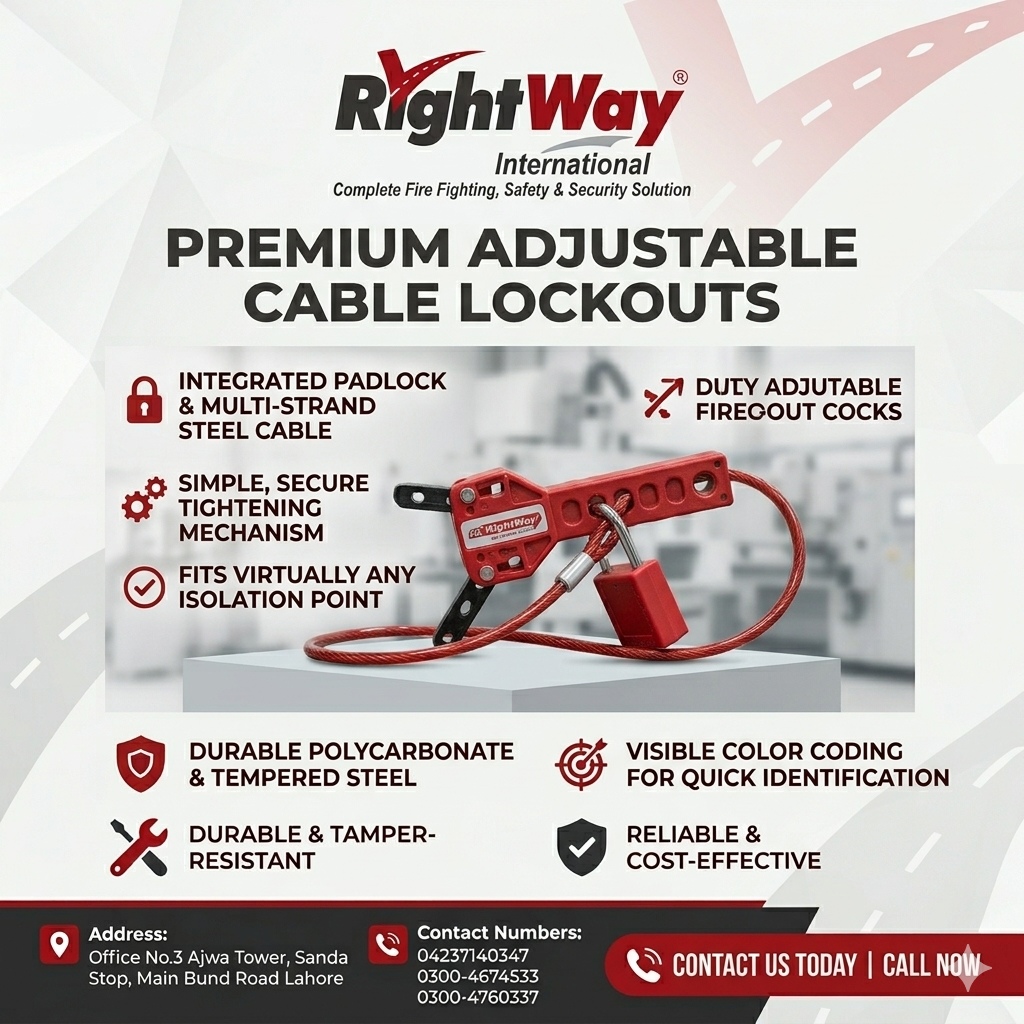
Adjustable Cable Lockout devices are essential Lockout/Tagout (LOTO) safety solutions used to isolate hazardous energy sources during industrial maintenance, repair, servicing, and inspection procedures. Safety professionals widely use adjustable cable lockouts because they can secure multiple energy isolation points simultaneously, making them highly versatile for complex industrial systems.
These lockout devices help organizations improve workplace safety, support Occupational Safety and Health Administration (OSHA) compliance, and prevent accidental equipment startup during servicing operations. Furthermore, OSHA’s Lockout/Tagout Standard (29 CFR 1910.147) requires employers to implement effective hazardous energy control procedures to protect workers from unexpected machine energization.
Because industrial equipment often includes multiple valves, switches, breakers, and disconnect points, adjustable cable lockouts provide a flexible and reliable solution for comprehensive energy isolation.
What Is an Adjustable Cable Lockout?
An Adjustable Cable Lockout is a flexible lockout/tagout device that uses a durable cable combined with a locking mechanism to isolate hazardous energy sources. The cable can wrap around multiple disconnect points, valve handles, circuit breakers, or machinery controls before being secured with safety padlocks.
Unlike standard lockout hasps or fixed lockout devices, adjustable cable lockouts can adapt to various shapes, sizes, and applications, making them ideal for complex lockout situations.
The device commonly secures:
- Electrical disconnect switches
- Circuit breakers
- Gate valves
- Ball valves
- Multiple energy isolation points
- Hydraulic controls
- Pneumatic systems
- Industrial machinery
- Conveyor systems
- Mechanical shutoff devices
Once installed, authorized employees apply personal safety padlocks to the cable lockout device. As a result, machinery and equipment remain safely isolated until every worker removes their individual lock.
Most adjustable cable lockouts support:
- Multiple safety padlocks
- Group lockout procedures
- OSHA-compliant LOTO programs
- Hazardous energy isolation
- Electrical and mechanical lockout applications
- Multi-point lockout systems
Because each worker maintains personal control over their lock, adjustable cable lockouts significantly reduce workplace injury risks during maintenance operations.
Common Applications of Adjustable Cable Lockout
Industries use adjustable cable lockouts for various hazardous energy control procedures, including:
- Industrial machinery maintenance
- Electrical panel servicing
- Multi-valve isolation
- Conveyor system shutdowns
- Group lockout procedures
- Hydraulic equipment repairs
- Pneumatic system maintenance
- Chemical processing shutdowns
- Oil and gas facility servicing
- Power plant maintenance
- Manufacturing equipment lockout
- HVAC servicing operations
- Water treatment facility maintenance
- Mining equipment shutdowns
- Construction site safety procedures
How Adjustable Cable Lockouts Work
Adjustable cable lockouts provide a highly effective and flexible safety solution for complex lockout/tagout applications.
Step 1: Equipment Shutdown
Authorized personnel turn off machinery or equipment according to standard operating procedures.
Step 2: Hazardous Energy Isolation
Workers isolate all energy sources using disconnect switches, valves, or shutoff controls.
Step 3: Cable Installation
The adjustable cable is routed through the isolation points or wrapped around control devices.
Step 4: Locking Mechanism Secured
The cable is tightened and secured using the lockout device body.
Step 5: Personal Padlock Application
Each authorized employee applies their individual safety padlock.
Step 6: Maintenance Work Begins
The equipment remains safely locked out while servicing or repairs are performed.
Step 7: Lock Removal and Equipment Restart
After maintenance is complete, each worker removes their personal lock. Once all locks are removed, authorized personnel safely restart the equipment.
Types of Adjustable Cable Lockouts
Different industrial environments require different adjustable cable lockout designs.
1. Standard Adjustable Cable Lockout
These are commonly used for general industrial lockout applications.
Features:
- Durable steel or thermoplastic body
- Flexible steel cable
- Multiple padlock capacity
- Compact industrial design
2. Insulated Adjustable Cable Lockout
Manufacturers design insulated cable lockouts for electrical safety applications.
Benefits:
- Non-conductive materials
- Electrical shock protection
- Suitable for electrical maintenance work
- Improved worker safety
3. Nylon-Coated Cable Lockout
These models feature protective nylon-coated cables for enhanced durability.
Applications:
- Corrosive environments
- Outdoor facilities
- Chemical plants
- Marine applications
4. Heavy-Duty Cable Lockout
Heavy-duty models support larger industrial isolation points.
Advantages:
- Extra-strength cable construction
- Longer cable lengths
- Suitable for large machinery
- Multi-point lockout capability
5. Compact Cable Lockout Devices
Compact versions are ideal for portable maintenance kits.
Common Uses:
- Contractor lockout kits
- Mobile maintenance teams
- Confined industrial spaces
Safety Lockout Scissors
Lockout Scissors, also called a Safety Lockout Hasp or Scissor Lockout Hasp, is a metal locking device designed to accommodate multiple padlocks on a single isolation point.
The device works by passing through an energy isolation point such as:
- Electrical disconnect switches
- Circuit breakers
- Valve handles
- Machine shutoff points
- Pneumatic isolation systems
- Hydraulic controls
Technical Specifications
| Specification | Details |
|---|---|
| Material | Steel, Nylon, Thermoplastic |
| Cable Material | Stainless Steel, Nylon-Coated Steel |
| Cable Length | 4 ft to 15 ft |
| Padlock Capacity | 4 to 8 Padlocks |
| Color | Red, Yellow, Blue, Custom Colors |
| Application | Electrical, Mechanical, Valve Lockout |
| Temperature Resistance | Industrial Grade |
| Compliance | OSHA 1910.147, ANSI Z244.1 |
Key Features and Advantages of Adjustable Cable Lockout
Flexible Energy Isolation
Adjustable cables secure irregular or multiple isolation points efficiently.
Multi-Point Lockout Capability
One cable lockout device can isolate several hazardous energy sources simultaneously.
OSHA Compliance Support
Adjustable cable lockouts help facilities meet OSHA lockout/tagout safety requirements.
Improved Workplace Safety
Equipment remains isolated until all workers remove their safety locks.
Durable Industrial Construction
Heavy-duty materials withstand harsh industrial environments.
Corrosion Resistance
Protective cable coatings improve longevity in corrosive conditions.
Portable and Lightweight
Compact designs simplify transportation and storage.
Versatile Applications
Suitable for electrical, pneumatic, hydraulic, and mechanical systems.
Enhanced Group Lockout Procedures
Supports coordinated maintenance activities involving multiple employees.
How to Select the Right Adjustable Cable Lockout
Choosing the correct adjustable cable lockout improves hazardous energy control efficiency.
1. Determine Cable Length
Select a cable length suitable for the isolation points being secured.
2. Evaluate Environmental Conditions
Use corrosion-resistant or insulated models for harsh industrial environments.
3. Consider Electrical Safety Requirements
Choose non-conductive lockout devices for electrical maintenance operations.
4. Verify Padlock Capacity
Ensure the device supports the required number of worker padlocks.
5. Confirm OSHA Compliance
Always use OSHA-compliant lockout/tagout equipment.
6. Assess Cable Strength
Heavy-duty industrial systems may require stronger cable materials.
Best Practices for Adjustable Cable Lockout Safety
- Train employees on proper lockout/tagout procedures.
- Use only approved safety padlocks and lockout devices.
- Inspect cable lockouts regularly for wear or damage.
- Never bypass lockout procedures.
- Ensure every worker applies a personal lock.
- Replace damaged cables immediately.
- Store lockout devices in organized lockout stations.
- Follow facility-specific hazardous energy control procedures.
Industries That Commonly Use Adjustable Cable Lockouts
Manufacturing Plants
Factories use adjustable cable lockouts during machinery servicing and production shutdowns.
Oil and Gas Industry
Facilities isolate valves, pumps, and pipelines safely during maintenance procedures.
Chemical Processing Facilities
Workers control hazardous energy during chemical system servicing.
Power Generation Plants
Technicians secure turbines, generators, and electrical systems during maintenance.
Water Treatment Facilities
Operators safely isolate pumps and control valves during repair operations.
Mining Industry
Mining companies secure conveyor systems and heavy equipment during servicing.
Construction and Engineering
Portable cable lockout systems improve temporary worksite safety.
HVAC and Mechanical Services
Maintenance teams isolate electrical and mechanical systems during repairs.
Importance of OSHA Compliance for Adjustable Cable Lockouts
OSHA’s Lockout/Tagout Standard (29 CFR 1910.147) requires employers to protect workers from hazardous energy during maintenance and servicing activities.
Proper use of adjustable cable lockouts helps organizations:
- Reduce workplace injuries
- Improve maintenance safety
- Prevent accidental machine startup
- Support OSHA inspections
- Improve employee safety awareness
- Standardize hazardous energy control procedures
- Minimize operational downtime
Failure to implement effective lockout/tagout systems can result in severe injuries, fatalities, OSHA penalties, and costly equipment damage.
Difference Between Adjustable Cable Lockout and Standard Lockout Devices
| Feature | Adjustable Cable Lockout | Standard Lockout Device |
|---|---|---|
| Flexibility | Highly Flexible | Limited |
| Applications | Multi-point lockout | Single-point lockout |
| Cable System | Adjustable cable | Fixed locking design |
| Versatility | Multiple equipment types | Specific applications |
| Group Lockout | Excellent support | Moderate support |
| Portability | Lightweight and compact | Varies |
Frequently Asked Questions (FAQs)
What is an adjustable cable lockout used for?
Adjustable cable lockouts isolate hazardous energy sources during industrial maintenance and servicing operations.
Can adjustable cable lockouts secure multiple isolation points?
Yes. Adjustable cable lockouts are specifically designed for multi-point lockout applications.
Are adjustable cable lockouts OSHA compliant?
Yes. Most industrial adjustable cable lockouts support OSHA-compliant lockout/tagout procedures.
Can cable lockouts be used for electrical systems?
Yes. Insulated adjustable cable lockouts are ideal for electrical maintenance applications.
What materials are adjustable cable lockouts made from?
Manufacturers commonly use thermoplastic bodies, stainless steel cables, nylon-coated steel cables, and insulated materials.
How many padlocks can adjustable cable lockouts hold?
Most models support between 4 and 8 safety padlocks depending on the design.
Adjustable Cable Lockout devices are critical Lockout/Tagout safety solutions that improve hazardous energy control, support OSHA compliance, and protect workers during industrial maintenance procedures. Their flexible cable design allows workers to isolate multiple energy points simultaneously, making them ideal for complex industrial systems.
Whether used in manufacturing facilities, oil refineries, chemical plants, power stations, mining operations, or construction sites, adjustable cable lockouts remain an essential component of modern industrial safety programs and hazardous energy control systems.